All eyes were tears
To hear soothsayers the better
All ears issue from
A shady place on the syllogism
Channels divide
Attention span from
Disinformation
Shock and awe from say
On the sets of consent.
*
"Fuck the people"
He wrote
The cogito is also
Something to be seized
They're vanished into
The capillary
Functioning of power
Multiplicity's
A fancy hung
On the nail of spectacle.
Wednesday, October 11, 2006


Tuesday, October 10, 2006
For Broodthaers

My books are written by molds
This cast is called the mind
A kind of afterglow
The sun blows out and
Dust ushers in
Blind motes of unmoving
My molds are so written
My moles around the sea.
Monday, October 09, 2006
Sunday, October 08, 2006
Myung Mi Kim's *River Antes* (Review)
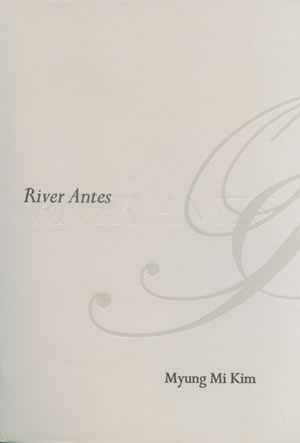
I have long wanted to address the work of Myung Mi Kim, whom I have been reading with delight and devoted interest for over a decade now. Her most recent work with Michael Cross' B-flo based Atticus / Finch Press provides me with an opportunity, albeit brief....
When a section from *River Antes* appeared in Cross Cultural Poetics a couple years ago, what struck me immediately about Kim's new work was not a syntactical or lyrical innovation-- a significant change in the language or content of the work per se-- but the unprecedented and abundant use of two punctuating marks: the double slash ("//"), as well as a mark I'm not sure the proper name of, but which appears as a kind of partition or staff: "|".
As early as Kim's book, *Under Flag*, and throughout her more recent books, *Dura* and *Commons*, the poet has struggled to express language as a time-inhering and shaping material. The ways she has successfully achieved this are quite various, if not innumerable. For starters, Kim expresses durational meaning through a singular use of the space of the page where the reader finds ample tabs and spacings between words: the poet also does so through grammars which stress the palpability of word tenses, and deictical words (words indicative of time, place, and subject); by using inchoate words, phonemes and morphemes, and illegibility to enact states of language both of acquisition (learning to speak a language) and the post-semantic; and in her extensive use of notebooks, where Kim continualy accretes materials for her composition process.
Although Kim has employed punctuating marks before in unconventional and often diacritical ways, I am interested in how significantly punctuation marks seem to factor in *River Antes* and shape the book's meaning. While I am sure that the "|" and double "|" marks delay a reading process-- that is, delay the eye as it reads and processes--I wonder if there is not a deeper import at stake in the use of the marks. Do they mark, for instance, an ontological rupture--difference, trauma? Are they marks of dis-*aster*--the disconstellating of stars, and thus fate and time? I take this to be a possible meaning of the mark in the following from *RA*:
[conjugate]
A dependent's call
A dependent cries out
A || marvel perceive
Two pages later, the mark sounds a very different sense to me as it seems to perform another kind of lapse: the time-lapse of a cinematic or photographic process as it reveals a social-biological one--the consumption of corn-on-the-cob:
corn | corncob
Kim's scoring is especially meaningful as corn is transformed suddenly into its waste product (corncob) through the phantom objectivity* of the jump-cutting mark. Elsewhere the marks "|" and "||" seem to act as partitions cleaving highly discrete, anti-grammatical word sequences. Are these partitioning marks in fact mirrors?

The mark acts here as a kind of visual and aural rest, if not also the transferential surface of an abandoned dialectics--"spar wanton drear dear forbid" obscuring "hold facing simple adore one"; and "rights tie wallow heaving cause" not having a reflection at all (thereby nothing to be (mis-)identified by unless by absentee itself?).
In *RA* I am also struck by how Kim's concern for duration *qua* articulation (articulation of economic, racial and gender-based oppressions; articulation of "natural" and cultural forces; articulation of the interpollated and language-bearing self undergoing world) is given possibly its most creative book form to date. Through the poet's collaboration with her publisher, Michael Cross, the two have arrived at a form that not only treats Kim's hard-earned words elegantly (as all of her books to date have done), but that may possibly further the poet's project in book form.
Such an innovation becomes most clear in the pages of *RA* that fold out to three separate pages. In these fold-out "triptychs" there is a terrific sense of simultaneity as one scans all three "panels" at once, taking in the diversity of Kim's exquisite word scores and shapes. Among these pages are a variety of forms: on four of the pages the type is centered; on four others discrete words with spaces between them are divided by the mark "||" [as in the above]. On a page I find particularly stunning, Kim has arranged words that have been made partially illegible through photo-copy. In the center panel of my favorite of the five fold-outs the mark "|" and slash marks cascade down the page interrupted by periods and limited spacing, as if the punctuation marks from the book had conspired to form a Concrete poem. In this condensation of markings Kim provides a playful reminder of her ongoing preoccupation as a poet: to relate language itself as a time-based, and thus socially informed, process.
*"phantom objectivity" is a term used by Georg Lukacs to indicate a circumstance in which producer and produced are no longer related in a process, that are, therefore, abstract in their reification.
Wars I have not seen (Piece)
On my screen of kills
I can't remember
The precision bombs of September
Or was it January
1991 when
Global hegemonic strategy
Swept reality
Bricks turned to glimmering coins
While mushrooms metonymically
Displaced the body count
Repressing a distant present
Of slaughter
I can't remember
The precision bombs of September
Or was it January
1991 when
Global hegemonic strategy
Swept reality
Bricks turned to glimmering coins
While mushrooms metonymically
Displaced the body count
Repressing a distant present
Of slaughter
To Themiscyra
"Penthesilea: Son of the Neriad!
You will not follow me to Themiscyra?
You will not follow me to that fair temple
That rises tall among the oaks?
Come here, I haven't told you everything..."*
What marble
Eyes cry
True tears
For stone
Heart's mind
Whips legions
From lips
Their tears
For you
Unsubstitutable
Will we meet
At my temple
Or yours
Penthesilea
Resurrected
In bed
Your hand
Was my thigh
Heart's eye
Evens the score.
Come here
You haven't
Told me
Everything come
Here to
Themiscyra you
Haven't told
Me everything
My precious
Friend I
Haven't told
You everything
To Themiscyra
We go
My precious
Friend I
Haven't told
You everything
I haven't
Told you
Everything for
My temple
For my
Temple for
The sake
Of all
Homelands
I haven't
Told you
Of our
Legions slaying
Identity
My precious
Friend another
Temple rises
Even taller.
*from Kleist's *Penthesilea*, trans. Joel Agee.
You will not follow me to Themiscyra?
You will not follow me to that fair temple
That rises tall among the oaks?
Come here, I haven't told you everything..."*
What marble
Eyes cry
True tears
For stone
Heart's mind
Whips legions
From lips
Their tears
For you
Unsubstitutable
Will we meet
At my temple
Or yours
Penthesilea
Resurrected
In bed
Your hand
Was my thigh
Heart's eye
Evens the score.
Come here
You haven't
Told me
Everything come
Here to
Themiscyra you
Haven't told
Me everything
My precious
Friend I
Haven't told
You everything
To Themiscyra
We go
My precious
Friend I
Haven't told
You everything
I haven't
Told you
Everything for
My temple
For my
Temple for
The sake
Of all
Homelands
I haven't
Told you
Of our
Legions slaying
Identity
My precious
Friend another
Temple rises
Even taller.
*from Kleist's *Penthesilea*, trans. Joel Agee.
Monday, October 02, 2006
Peace On A presents E. Tracy Grinnell & Andrew Levy
Peace On A
presents
E. Tracy Grinnell & Andrew Levy
Saturday, September 30th 2006 8PM sharp
hosted by Thom Donovan at:
166 Avenue A, Apartment #2
New York, NY 10009
about the readers:
E. Tracy Grinnell is the author of the chapbook Harmonics (Melodeon Poetry Systems, 2000), Music or Forgetting (O Books 2001), Of the Frame (Duration Press ebook, 2004), Some Clear Souvenir (O Books, 2006), and Quadriga, a collaborative work with Paul Foster Johnson (g o n g chapbooks, 2006). She lives in New York and edits Litmus Press and the journal Aufgabe.
Andrew Levy teaches in the English Department at QCC-CUNY, serving as Faculty Advisor for the student newspaper, Communiqué. He is the author of ten books of poetry, including Ashoka (Zasterle Books), Paper Head Last Lyrics (Roof Books), Curve 2 (Potes & Poets Press), Values Chauffeur You (O Books), and Democracy Assemblages (Innerer Klang). New titles are forthcoming from Factory School, and Innerer Klang. His newest manuscript is Don't Forget to Breathe. He is editor, with Roberto Harrison, of the poetry journal Crayon.
about the series:
Peace On A is an events series devoted to emergent work by writers, artists, and performers.
“Make peace not love.”--Amos Oz
*
Intros:
“how real or imagined it was real”: E. Tracy Grinnell
In its persistent movement between “clip” and “example,” E. Tracy Grinnell's *Some Clear Souvenir* enacts actuality as it is composed doubly by memory and perception in discrete historical self-experience. Language is a cinematic rack focus whereby the poem alternates between objects in the foreground and the back, memory and immediate data of consciousness, percept and essence. A forming blank* resides between two focal points: perceiving one’s self in the mirror (as one holds up a camera to take a snapshot?) and recognizing the reproduced photogram in the mirror’s frame—the news clipping which wrests a particular instance in space-time. Present perception struggles to cognize concomitantly the photogram affixed in the mirror (and thus also the mirror as exterior frame for perception) and a self involved in a consciousness of its perceptions. The poet/reader inhabits less a pre-subjective “mirror stage” than the point where virtuality and actuality haunt one another in clairvoyance (i.e., clear seeing):
“of four hands or disembodied
motivation that is external
to motion so that one haunts
or is haunted by the actual world”(10)
In Grinnell’s work the quest of a poetics is ultimately the question of actuality’s forms. I am reminded of George Oppen’s late-work—that poet of the “small words”—where space opens both in the poem’s horizon (at the level of line, and between words and phrases within individual lines) and the poem’s vertical axis (between lines and pages) to present thinking as it occurs in language. I am also reminded of poets as diverse as Larry Eigner, Madeline Gins, Robert Grenier, Jessica Grim, Lyn Hejinian, Leslie Scalapino, and Hannah Weiner—who have managed to push poetic technique to the point of a practical and lived phenomenology. A marriage of quotidian revealing and ontological rigor.
To get to the chiasmus of world and self through the shared third-party Experience, sensation turns not inside-out but upon the indiscernible points where one touches the world and both feels themself touching and being touched, acting and knowing itself in action:
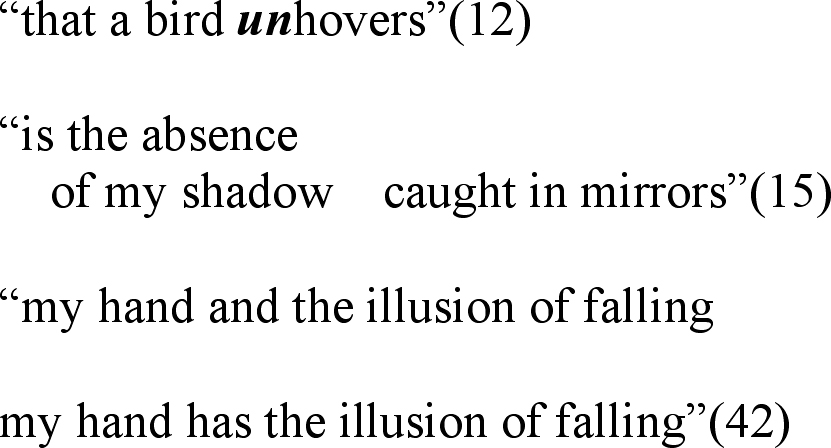 Poetry approaches the limits of interiority where subject and object, interior and exterior, here and there are constituted in the intense lapses of prepositions, conjunctions, articles and other relating words towards the abstract injunctions of grammatical becoming: “newsprint grey / of everything / changes everything”(47). Thought-sensation is formed where the writer touches and is touched, where words risk tautological coevalness. By the play of more and less formal elemental intentions appearing to unfold and unfolding to disappear, Grinnell maintains the mobility of perceptions, sensations, ideas, and memory shards where one might otherwise “see” prehensively, foreclosing the open. Beyond theory *per se* and literary mannerism are lived words the located remnants of actualities, desires, potentia. Where experience touches experience “these locations are history”(65). When words evidence lived duration “rupture is / rapture”(8).
*”forming blank” is a term invented by Madeline Gins and Arakawa.
*
“No ideas but in effects”*: Andrew Levy
“Out of all the stream of human life
And action
Implicated
Scattered
Intensified
Sovereign”(51)
If Andrew Levy’s newest manuscript, *Don’t Forget to Breathe*, seems a clear continuation of the poet’s work—which for the last 15 years has yielded some of the most rigorous poems of “language effects” and tactical (dis)informing—the manuscript also seems a crisis point for Levy’s poetics. I have no doubt that this crisis stems from 6 years of the Bush administration, which has—as Donald Rumsfeld’s infamously mystifying addresses have gone to show—developed an effective poetics of rhetorical abstraction towards the end of Noble Lying: the rule of the hep (if not wise) through calculated dissimulation, disinformation, and distraction.
Reading Eliot Weinberger’s 2005 *What Happened Here*—a must-read chronicle of the W years—one encounters one of the most baldly stated and chilling statements of the Bush doctrine of Noble Lying: "An unnamed ‘senior advisor’ to Bush recently told the journalist Ron Suskind that people like Suskind were members of ‘what we call the reality-based community’: those who ‘believe that solutions emerge from [the] judicious study of discernible reality.’ However, he explained, ‘That’s not the way the world really works anymore. We’re an empire now, and when we act, we create our own reality… we’ll act again, creating other new realities, which you can study too, and that’s how things will sort out. We’re history’s actors, and you, all of you, will be left to just study what we do.’”
Against the actors of “history” so-called and of empire for real, Levy accretes remixes of subject position, address, information, affect, and fact to effect thought and action among his community: reality-based readers, writers, artists, students, family and friends who would work to alter the course of history by halting the current political, social and economic travesties of the United States. To do the voices, in Levy’s case, means butting a multiplicity of voices truthful and false, imagined and real, reasonable and justifiably hysterical against one another in order to reopen the question of how the real is arranged and inscribed. As apocalypse is of the hour in a global cultural imagination, and hope a scarce commodity, I can think of no more responsible way to be conducting one’s self as an artist at this point in history. To intend a new ordering for reflection; to attend a language as much of tactical abjection (proto-Flarf) as felt necessity is not to further suspend reality—to give in to the fantastic, sentimental and anti-intellectual as too much recent writing and art has done—so much as to hoist by their own petards those who would abuse it to gain and maintain power.
*quoted from *Paper Head Last Lyrics*
*
Don’t Forget to Breathe
There is always the danger
The facts will fall and part
Repeat what cannot be altered
Infinite and misunderstood
If I were the pronunciation of my name
The miseries of human life, tension of nothing
The softening of its existence, of yours
Arrested through mute consonants
Omniscient flood distributing a cultivated
Fragrance able to be fairly complementary
Or vernacular or made less arbitrary
In this undefinable sweetness
It says to me – it is you who incorporate
Domestications committed atrocities
Doctrines of isolation, the perfect boring
Controls of irresistible onslaught and slaughter
Betray continuity and visions of speckled fish
Calm and judicious views that housed
All of nature qua cultural whims given and
Completed – it is you who’s dead
The perfect boring salutary onslaught
Tension of consonants uncultured but cluttered
Complementary arbitration
Continuity housed it is you
The miseries softened flood it is you
Who misunderstood it is you
In this indefinable mumbo jumbo
This yodeling humor
This tasty loyalty?
This secret and secreted polis?
This innocent yet compelling
Permanence
--Andrew Levy
Sunday, October 01, 2006
this new physics of power
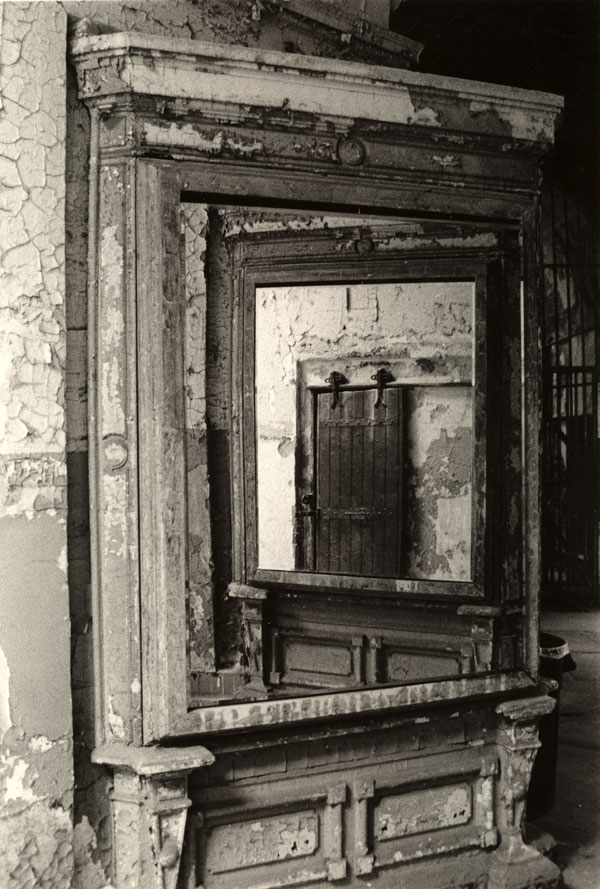
The Panopticon's solution to this problem is that the productive increase of power can be assured only if, on the one hand, it can be exercised continuously in the very foundations of society, in the subtlest possible way, and if, on the other hand, it functions outside these sudden, violent, discontinuous forms that are bound up with the exercise of sovereignty. The body of the king, with its strange material and physical presence, with the force that he himself deploys or transmits to some few others, is at the opposite extreme of this new physics of power represented by panopticism; the domain of panopticism is, on the contrary, that whole lower region, that region of irregular bodies, with their details, their multiple movements, their heterogeneous forces, their spatial relations; what are required are mechanisms that analyse distributions, gaps, series, combinations, and which use instruments that render visible, record, differentiate and compare: a physics of a relational and multiple power, which has its maximum intensity not in the person of the king, but in the bodies that can be individualized by these relations.
--Michel Foucault
Thursday, September 28, 2006
Wednesday, September 27, 2006
Piece
Is
Partisans, reality makers, History with a capital "Is"
In the eyes of song the present goes on
*
Struggling Models
An Equally Familiar
Disinhibitor Thing
*
Harm
What you lose what you gain what contacts you abstract what hems you in
What you gain what contacts abstract you what hems you lose
What contacts you hem in you lose what you gain
What abstracts you what hems
*
In
-SENSATE
-STATE
-NATE
*
My Piece
Kills sonorously relationally
Kills realistically nominally
Kills dialectically fundamentally
Transitively empirical
Just for the fun of it
*
Odyssey
The wager knows the bow of suitors
When become must suffer six strings
*
An innovation
An innocent autotelic protozone
*
Truth Effects
All the things overheard that will never be said
Ear whispering to ear of the beheaded
Dead presidents a mere curfuffle in the grand schematic
We all go down in trains we build against the sky
There is no sky here just say
*
Decide
The sun goes down
In your eyes the night
Rises in the throat
*
Arrive
My native piece
Blind to our
Plate-glass-nation
Floats by
A kind of lapse
Which one
Always moving
Segues home
Sudden-ing
*
Night Saving
There is your
Body like my eyes
Alive because they doubt
There is your distant crying
There is an oblivion
To speak of when we begin
Lobbed into the dark
Like a stone that never
Makes a sound
*
This Magic Moment
Two bodies lean
one against the other
one's plunder
the other's utterly
absconded from the enjoyment
of its earthly bounty.
One's surety the other's
harm
one's guarded
the other's a martyr
of global multiplicity
fair game for the shady.
Partisans, reality makers, History with a capital "Is"
In the eyes of song the present goes on
*
Struggling Models
An Equally Familiar
Disinhibitor Thing
*
Harm
What you lose what you gain what contacts you abstract what hems you in
What you gain what contacts abstract you what hems you lose
What contacts you hem in you lose what you gain
What abstracts you what hems
*
In
-SENSATE
-STATE
-NATE
*
My Piece
Kills sonorously relationally
Kills realistically nominally
Kills dialectically fundamentally
Transitively empirical
Just for the fun of it
*
Odyssey
The wager knows the bow of suitors
When become must suffer six strings
*
An innovation
An innocent autotelic protozone
*
Truth Effects
All the things overheard that will never be said
Ear whispering to ear of the beheaded
Dead presidents a mere curfuffle in the grand schematic
We all go down in trains we build against the sky
There is no sky here just say
*
Decide
The sun goes down
In your eyes the night
Rises in the throat
*
Arrive
My native piece
Blind to our
Plate-glass-nation
Floats by
A kind of lapse
Which one
Always moving
Segues home
Sudden-ing
*
Night Saving
There is your
Body like my eyes
Alive because they doubt
There is your distant crying
There is an oblivion
To speak of when we begin
Lobbed into the dark
Like a stone that never
Makes a sound
*
This Magic Moment
Two bodies lean
one against the other
one's plunder
the other's utterly
absconded from the enjoyment
of its earthly bounty.
One's surety the other's
harm
one's guarded
the other's a martyr
of global multiplicity
fair game for the shady.
Sunday, September 24, 2006
Last Word
Joshua Clover's last words are still ringing after his reading with Sarah Manguso earlier tonight:
"The poets were all reading Machiavelli when they should have been reading Clausewitz."
"The poets were all reading Machiavelli when they should have been reading Clausewitz."
False Generations (Revision)*
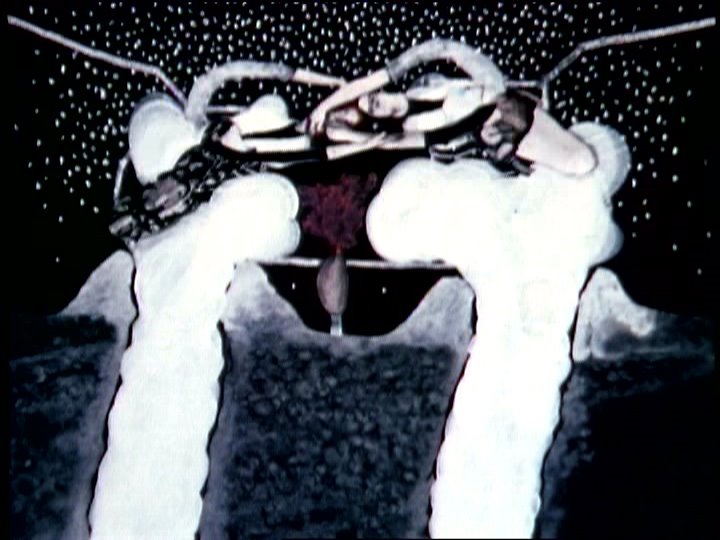
2. False Generations in David Lynch’s The Grandmother
In David Lynch’s third shorter film, *The Grandmother*, seeds give birth to human beings who behave as dogs in accelerated and non-linear generations. Is *The Grandmother*, then, not a film concerning rhizomatic deterritorialization? A nomadology of seedlings? “The wisdom of the plants: even when they have roots, there is always an outside where they form a rhizome with something else – with the wind, an animal, human beings.… Follow the plants: you start by delimiting a first line consisting of circles of convergence around successive singularities; then you see whether inside that line new circles of convergence establish themselves with new points located outside the limits and in other directions. (*A Thousand Plateaus*, 11)” Perhaps. But then the cinematic universe Lynch establishes in *The Grandmother* seems “archetypal,” preformalist or Occasionalist more than anything else. Lynch often says of his first film, *Six Men Getting Sick (Six Times)*, that he came to it in an attempt to make his paintings "move"; that is, to animate them. What is animation but a limit of cinema as false generation of movement (Bergson), or as an atomization of time per frame? False time, false movement, false generation.
*The Grandmother* is the second of two films that move from the painterly animation of Lynch’s first towards an original blend of diegetic “movement images” (Deleuze) with extra-diegetic and animation techniques. In the film, seed growth belies an inorganicism of the falsely generated, non-linear and preformalist. We can oppose the false generations of Lynch’s films to the non-organicism of Deleuze’s “crystal images,” where such images are generated by the bifurcating movements of actual images reflected in the uncanny opacities of their virtual counterparts: “This is unequal exchange, or the point of indiscernibility, the mutual image. The crystal always lives at the limit, it is itself the ‘vanishing limit between the immediate past which is already no longer and the immediate future which is not yet . . . mobile mirror which endlessly reflects perception in recollection’. What we see in the crystal is therefore a dividing in two that the crystal itself causes to turn on itself, that it prevents from reaching completion, because it is perpetual self-distinguishing, a distinction in the process of being produced; which always resumes the distinct terms in itself, in order to constantly relaunch them.”(*Cinema 2*, 81-82) These “powers of the false” of crystallic-virtualism—a virtualism which rests on Bergson’s crucial distinction between the dyadic terms real/possible and actual/virtual—we should distinguish from a preformalist organicism underlying that of Zoroastrian-Islamic aesthetics. Where crystallic-virtuality presupposes Bergson’s method of philosophical “intuition”—to locate form tendentially in irreducible temporal movements (or Durations)—preformalism assumes organicity as a consequence of the realization of preexisting potential forms (“templates” or clichés). Here, realized forms are the “copies” of possible forms as in Plato; however, per the magic of Surrealist exquisite corpse collage and primitive montage, ages and spaces (not to mention generations) may also meet in highly fortuitous assemblage. Counterposing the irony of Gertrude Stein’s statement from her lecture on “Portraits and Repetition”--“the only thing God can not do is to make a two year old mule in a minute”--such a view of creation assumes (following Jalal Toufic’s own Atomistic view of cinema in his essay, “Before thy Gaze Returns to Thee”) that Being is non-continuous, renewed during each “subsequent" instance: “Out of the clash of any two images, but even more clearly of any one image, do not arise, as in Eisenstein, many concepts (even if, as in Einsenstein, beneath them all be the concept of the dialectic itself or of class struggle), but a *dhikr* (invocation, remembrance) of the one necessary Being, who is beyond concepts; or the notion of the absolute dependence of the myriad entities. The jump cut, 'the sound of one hand [or image] clapping,' is a silent *dhikr*. Forgetfulness of God is a molar illusion, since creatures, not having their substance in themselves, are always returning to that which alone has subsistence, God. (*Forthcoming*, 121)”
In an early animation sequence from *The Grandmother*, the grandson ascends from his sprout-bed in order to abscond from his belligerent father. Analogously, throughout the film, the grandson negotiates what appear to be the three stories of a house: a bottom floor in which the grandson’s demonical, canine parents sit around a kitchen table and taunt him; a second floor where the grandson's bedroom is, and where he is periodically punished for wetting his bed; and a third in which he “grows” his grandmother, and he and the grandmother subsequently visit with one another. In ascending and descending the stairs of Lynch’s set, the grandson presents a typical movement from Angelosophy—the higher floors indicating subtler and thus more perfected degrees of Being, the lower the more demonical-animalistic. The shock of Lynch’s false generations is finally heightened by a passionate kiss shared by grandmother and grandson, as well as by a high-pitched whistling sound emitted from the grandmother’s throat, reminiscent of the sirens from *Six Men Getting Sick (Six Times*), and premonitory of Lynch’s first feature-length film, *Eraserhead*, in whose soundtrack many have claimed to hear super- and sub-audible pitches. Are the effects we know Lynch to have produced with fellow sound designer, Alan R. Splet, during the making of *Eraserhead* not evidence of a paradisical subtlety available through rigorous experiment in film soundtrack?
The problems of generation and temporality endemic to *The Grandmother* look forward to later Lynch films, and especially his most recent ones—*Lost Highway*, *Mulholland Drive*, and *Rabbits*—in which one encounters countless conundrums of narrative temporality. How, for instance, the protagonists of *Lost Highway* and *Mulholland Drive* are bifurcated by identities indicative of multiple temporal universes; likewise, how the characters of *Rabbits* occupy the same space/set however speak distantly, as though from different points in time, the lines of a mock situation comedy. That they are rabbits—those uncannily prolific creatures—who become the ostensible subject of one of Lynch’s most recent films, adds a comic dimension to his ongoing problem of generations ahistorical and “false”.
*a previous version of this text may be found among the March 2006 postings of this blog.
Saturday, September 23, 2006


Sunday, September 17, 2006
Praises Thunders Kills
Fire waits where fury was with looped ears and a mind full of lack
Motives come from positive position but guarded walls aren't fullproof
Until they could also move sensing a way towards our interpolations
Pressing on in cruel techniques memory complains about persisting mind
For every music never seen fire awaits every fact never sung we aligned
Falsely and do not see the brute exhibit for the lack of what is done
Where number does not bind hold me in this echo ironic as a scribe goes
During backward glances brave bright sand holds shape of attention most
Cameras that come and the sincerely undead beloved as they project
A reproaching flicker so hear your exterior heroics where eye's not I yet
Refugees escape harm to be harmed these corrupt words scattered to lyric
Forgetfulness regulated by a mutual blood of project of action and wrist
Onwards piecemeal go with the words as this is written and severed
By the eventual twist which is not innocence indeed no since nor sense
But justly ulterior suffered as the horizon of an awaited thought
What the aphorist makes instead not having forgotten to be dead
Like a magic lantern among the particulars of thought throwing out
Soundtracks of surrounding bifurcations the tears of shadows fell
Of project of action and rest forgetfulness regulated by an insular course
These words of corruption scatter lyrical refuge save it praises from it kills
So hear your outer heroics an approaching flicker where I’s not eye yet
As they come cameras and the sincerely undead as they project beloved
Brave bright sand holds shape of attention most during backward glances
In this echo iconic as a strobe goes where number does not bind merely show
We aligned falsely and do not see the brute exhibit for all evaluations worth
In this gas and despair we can thrive by dying for now our time to cry no
Being immortal organs for hearing noontide a way towards every fact never sung
Calling out the broad conditions of this leave from fronts I hear
That child whose image insists where they put the cut the will is power put
Promising no one some lines in your judgment book so we are time so far.
Saturday, September 16, 2006
Firstness*
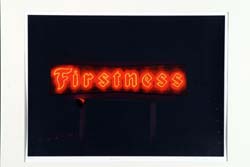
"The typical ideas of firstness are qualities of feeling, or mere appearances. The scarlet of your royal liveries, the quality itself, independently of its being perceived or remembered, is an example, by which I do not mean that you are to imagine that you do not perceive or remember it, but that you are to drop out of account that which may be attached to it in perceiving or in remembering, but which does not belong to the quality. For example, when you remember it, your idea is said to be dim and when it is before your eyes, it is vivid. But dimness or vividness do not belong to your idea of the quality. They might no doubt, if considered simply as a feeling; but when you think of vividness you do not consider it from that point of view. You think of it as a degree of disturbance of your consciousness. The quality of red is not thought of as belonging to you, or as attached to liveries. It is simply a peculiar positive possibility regardless of anything else. If you ask a mineralogist what hardness is, he will say that it is what one predicates of a body that one cannot scratch with a knife. But a simple person will think of hardness as a simple positive possibility the realization of which causes a body to be like a flint. That idea of hardness is an idea of Firstness. The unanalyzed total impression made by any manifold not thought of as actual fact, but simply as a quality, as simple positive possibility of appearance, is an idea of Firstness. Notice the naïveté of Firstness. [---] The idea of the present instant, which, whether it exists or not, is naturally thought as a point of time in which no thought can take place or any detail be separated, is an idea of Firstness." (A Letter to Lady Welby, CP 8.329, 1904)
*from Commens' Dictionary of Peirce's terms: http://www.helsinki.fi/science/commens/dictionary.html
Sunday, September 10, 2006
Words hinge
Words hinge
we are those
hinges
this is a grammar
of continuity
no.
Help yourself
to the spaces
between things
the breathing
between each breath
being for you.
we are those
hinges
this is a grammar
of continuity
no.
Help yourself
to the spaces
between things
the breathing
between each breath
being for you.
These Firstnesses
Which lushness is a correspondence an analogy of flowering
Your fingers positioned so in my memory of fingers
Or of these firstnesses before relation I remain hushed
Your body analogous bowing to our seconds flitting verities
Content to commence distance in blood so sequential
Because to be is to cause to cause shall see
This kiss with a difference our thighs lie
Uncovered towards a nearer blood
The city rises above us again twilight blue
In the sprinkle because to be is to cause
To cause shall see our delightful springing
Content to commence distance in blood so sequential
Your body analogous bowing to our seconds flitting verities
Of these firstnesses before relation I remain hushed or
Your fingers positioned so in my memory of fingers
Which lushness is a correspondence an analogy of flowering
Your fingers positioned so in my memory of fingers
Or of these firstnesses before relation I remain hushed
Your body analogous bowing to our seconds flitting verities
Content to commence distance in blood so sequential
Because to be is to cause to cause shall see
This kiss with a difference our thighs lie
Uncovered towards a nearer blood
The city rises above us again twilight blue
In the sprinkle because to be is to cause
To cause shall see our delightful springing
Content to commence distance in blood so sequential
Your body analogous bowing to our seconds flitting verities
Of these firstnesses before relation I remain hushed or
Your fingers positioned so in my memory of fingers
Which lushness is a correspondence an analogy of flowering
Eigenstates*
Summer pervades the lantern all quiet
Sirens around feet as I walk range
In grounds company effect & distance
Circumference of light long ago
Bigger than this difference of hearing I'm given to
How we are parts of speech to account for it
The yard its grammar disappearing here
In aspects different patch of way
*composed summer 2004 after the Larry Eigner Picnic, Blfo. Photo credit, Peter Manson: http://www.petermanson.com/eigner.htm.
Subscribe to:
Posts (Atom)