Friday, February 03, 2006

Devotion II & III*


Devotion II.


To know
if you can know

the flat portraiture
rectangle necessary

irrevocable memoir
of when we were not separable


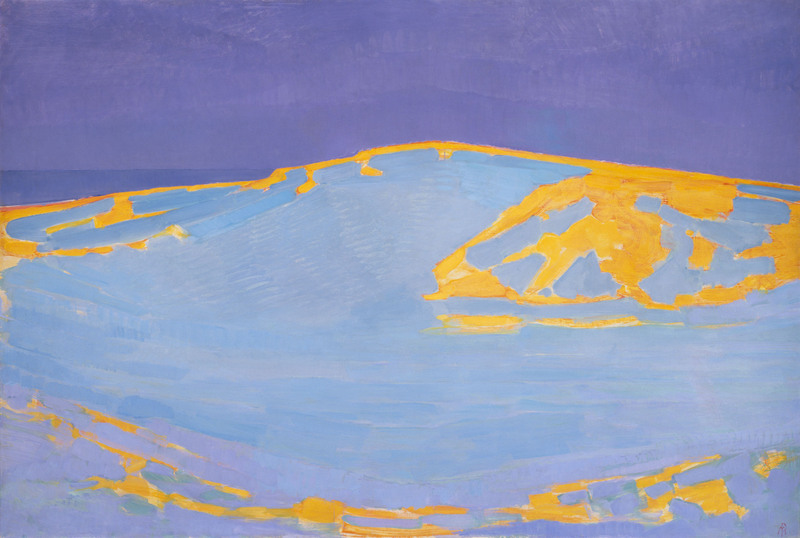
Windmills stalk flat flat flat flat

all wind blown at wind push weather

push all mill wind through color the wash

the reeds of a plain and

flat the wind pushed through them


Towering in its gesture
their simple relay
like machines do

The wind conveyed
by points that flutter
drawn by wash


Flat cross assymetric make aerial

make conveyance make
courses through winds graves

flat cross
the mark from an aerial
my sole blank bird

be flat vanished arrow
by cursor pushing which way


What more endemic but wind?

weeds
reeds weeds reeds
weeds reeds
weeds

blank of a cross
pure reed simple move

smooth cloth
smooth cloth
cloth smoothed


What the child looks at while it has vision
of having a flower before its mind

and the flower
the flower holding her
face and breast

mute the start.
The child gazing beyond
the colors of the flower

vibration and eyes deep


If we were young child and
the face young and honest

depersonalized upon
a fold of your hand
clasping
some object

the brushstrokes would show this


With flesh contact

canvas gaze at

a slight bend over which we call landscape

not flatness, not merely time

to the horizon

world
where it begins and ends


Slight bud and bend swell
and blood obsess

alabaster, spirits
equation for making weather
sound as weather does

expansion through it and without
to a cold stretch of green gray land

the cheek to show me my own soft watch


Devotion III.
Ghost Riding


Being beside
others days humans

separate the flesh mass

thunder being beside
suddenly this fence


Sand
an impossible
waterway line

instinct
move for
phenomenal tuft

indiscriminate
a point to
a distance ahead

a distance ahead
a way


On the backs points and
desert tongue

reel from sweet music
memory of orgy

artillery in a distance
without history

madness
without joyful test


Test of truth
league of wish
for infinity
site of flight

savagery
from the photograph of work

there the ink

the screen my thought of it
while it is spilling

would be dark


We cried in games
bad air pact
bird in sub-state (substrates)
places where none march straight

we beat the graves
and covered earth with sound
of the real like a dark stone
between two dark stones


Pray for me too...

from nothing but distance
is each night born

where a mile is not a mile
where a sun’s not a sun

capitalize this refusal


Not the kids
the wrap-around dead

pushed up by car
to ladder

to him


Pushed up put guns
down words
hostage to light

dear deer above
scrape the dust

(more often the place we return to)

... small machines
deer redeemed from context

caption:
to none aimed in fog


Near enough to nearly touch
their fingers, their lapels

women and men in black
sign and small world
preposition is our silence


The eye in the cat’s body

flashes

the face
an animal’s intention

if sickness were grace


Where vision is removed the human

Where vision is replaced our thoughts tend

*composed Fall / Winter '02

"fire is not clay thus not only each" (coda)

in grace the center that is
is grace the center of our soon-to-be
innocence in grace the center that is

in grace grace the center that is is grace
the center of our soon-to-be
fire is not clay thus not only each

grace is the center
center of infinity or zero not being
only one not only itself alone with the earth
the center that is

is grace the center of our soon-to-be
fire the movement that neither amounts
to one we are either zero or infinite

in a concave scene concave our being
concave our being in a concave scene
fire is not clay thus not only each
the center of our soon-to-be innocence

Wednesday, February 01, 2006

Ozu*


1.
It is her face lit by that light
Contemplative light
Contemplative mask
Of a face
Lit by that light
That beats like a drum
Dwindling in his heart

It is her
Face lit by that light
Capable of being
Covered
Being covered
By hands
Being covered by light
Covering conclusive tears

That beats like a drum
Dwindling


2.
Augment the mask, mask of
Her face
The lighting design
Augments time

The camera which stays
All trains
As they pass
Not quite upon these lines

Augment the white, of shirts
On a line
For all time, for all
Designs

Show time finally
The covered face of
Her tears
Smoke cuts away.


3.
Lit by that light
Bright light direct light
That beats like a drum
Dwindling in his heart

This is the time for this
Incense whisking
Frames away –
Fragile shades

This, the time for this
Who knows no time
When you leave,
Incense whisking

Little boats away
Down stream,
Attenuating
Rates per frame

That know no schedule -
Light which covers
The covered face
No heart can dwindle.

*composed Summer '05

Tuesday, January 31, 2006

"in a marionette or in a God"

“But, as the intersections of two lines, from the one side of a point, after passing through the infinite, returns suddenly to the other side; or, the image of a concave mirror after moving into the infinite appears suddenly again, near or before us; so, when Knowledge has gone, so to speak, through the infinite, Grace returns again, appearing at the same time, most purely, in the structure of a body which has either no knowledge, or an infinite knowledge, to wit: in a marionette or in a God.”
--Kleist

I Love Poets (review)


1. Richard Tuttle is an artist’s artist. 2. Richard Tuttle is a poet's artist. 3. Richard Tuttle is an artist's poet. 4. Richard Tuttle is a poet's poet.... There is a need for logical confusion of the terms of naming. Yet, beyond any confusion, the poets and artists who read for Tuttle this past Thursday, January 26th at The Whitney attest to the affinity and company the artist shares with poets. And mainly to the force of Tuttle’s most unforceful and gracious practice.

What struck me especially during the event, I Love Poets, was a certain trend in the reading selections. These selections may be said, whether they were written directly in collaboration with Tuttle (as in the case of works by Charles Bernstein, Barbara Guest and Mei-mei Berssenbrugge) or not, to be works enacting a vital ontology *after* and (perhaps more accurately) *with* Tuttle’s own works. Charles Bernstein probably highlighted this phenomena best as he (half-)joked that the works he was to read were not ekphrastic, not poems *to* or *for* paintings, so much as texts reciting what the work of art might say if it could only speak. The work then is what it says by showing. What it does or enacts *with* its viewer.

This “withness” of poetry, its adjacency to and participation with the being of the work of art, I felt particularly in the readings by Jonathan Skinner (reading for Anne-Marie Albiach Keith Waldrop’s elegant translation of a recent longer poem forthcoming from Post-Apollo Press), Leslie Scalapino, Larry Fagin, Berssenbrugge, Bernstein, and Tuttle himself reading from a collaboration with Guest. And such withness may be necessary in the face of Tuttle’s body of work, a body which consitstently em-bodies the subtleties of essentials made sensible, and makes apparent a grace of discrete and multiplicitous materials “hanging together,” suspended seemingly in a force-field by gracefulness alone. So it is likely in a Kleistian gracefulness where the artist, at a point zeroed or made infinitely light, finds mobile center.

However different their responses, each reader presented a means of expressing in poetic language the certain forces of Tuttle’s work as the responsive forces of grace. Skinner did so by way of his well-measured French which, despite his apology to the contrary, to my ears successfully sounded the immense silences and resonance of Albiach’s spacious pages, and Scalapino by her signature forays into the temporalities of meditational interiority. Fagin, especially through a pairing of poems he had composed for the occasion, "Loosey" and "Lacey," conveyed many of the revelatory qualities of Tuttle’s installed works by concise word-choice, and by pivotting radiantly upon prepositions, articles and pronouns. Bernstein’s poem in thirteen parts, “In Parts,” (from a collaboration with Tuttle called *Reading Red*) continued where Bernstein seems to leave off in his “thought opera” for Walter Benjamin, *Shadowtime*, activating the promise of the work of art to confuse the sensible and the emotional, and to extend emotions into thoughts in a present of aesthethic encounter -- what Bernstein may call in "In Parts" "the middle of the middle". In Bernstein's selection I could also not help but overhear the refrains of *Shadowtime*’s final libretto where the poet incants “now time” invoking thinking itself as an instantaneous and emergent making, the productions of attendence beyond comprehensibility or assimilation. Mei-mei Bersenbrugge’s text, *Hiddenness* (also in collaboration with Tuttle), presented a measured meditation seemingly about her daily contacts with the artist’s person and work, the notion of *hiddenness* taking on a “psychic” (if not also biological) air of the possibility of sharing interior and exterior "lives" - what William James in his late-philosophical works called the problem of two minds knowing the same thing. The notion of hiddenness also recalled to me my own encounters with Tuttle’s work wherein many of his objects appear on the brink of an occultation, with one foot in “this” world, in actualities, and one in another – in a world presupposing a need for perceptual exegesis. Finally, Tuttle’s own reading of his collaboration with Guest, *Durer in the Window*, proved himself a thoughtful and deliberate reader of poetry as he gave Guest’s words their well-deserved space and measure. Demonstrating unequivocally his *love* for poets.

2 after Alexander Sokurov*


Whispering Pages / Spiritual Voices


The weightless will.

We laugh, we all
fall down.

Twisting
to rest
in senseless sleep.


*

The fallen faces.
I will pretend. They will fall
To water a reflection
Of water at least.


*

And that they could
fall

in reverse it is a matter

of how we find our way around

the pogramed city

convinced we
are still dreaming.


*

There is a sense
of magnitude in boots.

Boots made Infinite in
hovering.

The dead do not
intend anything,
do they?


*

While birds, seemingly matted, cross the screen, the screen, as though flip pages.

While birds, birds too heavy to be real birds, play at gravity.

A Russian novel per frame.


2.
Black cataracts
the sun
goes down in my eyes

*

Dear Afghanistan,

we see
with sepia the past
as though the same war
wasn’t always
being fought
under the same
desert sun.

Dear Russia,

a soldier sleeps
on sunless days
dreaming the milky
black of both pictures,

everything changes
because the eye persists.


*

The dust / in their eyes
profile / of a mountain / side
flat, incisive / sublime
arriving / in slow-motion
whatever “real / time” is.

*

Like icons these soldiers
the clouds which move
as they move
not above them

but as synchronous
surfaces,
angels twisted
in earthbound sleep.

*

The world,
the green
world is a tableaux

vivante or a Turner

where the clouds
break

the sun still won’t appear.

We hover above the cameras of this earth.

*composed October, '05.

Monday, January 30, 2006

For Richard Tuttle

"It is not in the premise that reality
Is a solid. It may be a shade that traverses
A dust, a force that traverses a shade."
-Wallace Stevens

As you say - no thing
should be thought
at first
not this first
line - the line
or words
but don’t you mean
first thought
best thought
or do you
that emotions extend
into thoughts with force

Like efforts

The efforts – of consciousness
as you say no thing – leads
thought back – to the way it was
not the second
line or thereafter –
what we call marks and
not lines – which could also mean
the signs
of language – that language
is now - and not was
or will be
don’t you think
lines thicken with thought
intensified by our shadowy
attendence –
our silence before them –
like causes unforced

Like effects

The effects of shadows as they cross
shadows or now – as you say
no thing – no single
shade
or gesture – no
matter how immaterial -
matter hangs together
leads thought
back to its first
movement – not any
other here
and now as what we call
attending – not thoughts
per se
as thought grasps ideas –
intends instead
of extending – as attendance
makes a shade
for the ears and the sun sets over
our speculations
and crosses
the mind – signs that we
are taking place – the edge
of an edge
or a wire without
a frame -
the centers of the world
of perfect force and
the unforced

Consequently grace

False Generations: Lynch’s *The Grandmother* (Notes / Discursus)


For falsehood, falsehoods of generation, and corruption, the perfect inorganic (Nietzsche), the imperfect organic, who rise from colors, the colors of the false, who rise bed-ridden, false seed relation, of generation and false corruption, the non- corrupt, the renewed innocent...

Men then bear their own fathers… But it is not so simple as Kierkegaard would make out, in all of his paradox and contradiction -- his standstills; since Kierkegaard’s generations still rest on an Aristotilean genealogy, on “family trees” and re-productive “organicisms”. Men then bear their fathers, but they only resurrect themselves once (as Deleuze’s points out in *Logic of Sense)*; Kierkegaard is prey to Abrahamism as an (onto)logical paradox of heredity and generation. That one bears their own father, but also that one sacrifices the created to continue living.

There is something peculiar, something "out-of-joint," about David Lynch’s animated seed beds throughout his early shorter film, *The Grandmother*, from which "human beings" behaving as dogs apparently sprout: that trees typically give birth in linear, bifurcating generations (the “family tree”), but do so non-linerally (and thus falsely?) in Lynch’s third short film. Is *The Grandmother* then not a film concerning rhizomatic generations? A nomadology of seedlings? “The wisdom of the plants: even when they have roots, there is always an outside where they form a rhizome with something else – with the wind, an animal, human beings. … Follow the plants: you start by delimiting a first line consisting of circles of convergence around successive singularities; then you see whether inside that line new circles of convergence establish themselves, with new points located outside the limits and in other directions.(*A Thousand Plateaus*, 11)”

Perhaps. But then Lynch’s world in *The Grandmother* seems archetypal, “preformalist,” and atomistic more than anything else. Lynch says of his first film that he came about it in an attempt to make his paintings "move," that is to animate them. What is animation but a truer limit of cinema as false generation of movement (Bergson), or as an atomization of time by frame rate? False time, false motion, false generation. *The Grandmother* is the second of two films that move from the pure animation of his first, *Six Men Getting Sick (Six Times)*, towards a complex (however much intuited and post-"psychadelic") blend of diegetic elements with extra-diagetic and animation techniques.

The fact of tree / seed growth belies an inorganicism or organicism of the falsely generated, non-linear and preformalist. And we can oppose the false generations (the immaculate conceptions?) of Lynch’s films to the inorganicism of the “crystal images” of *Cinema 2*, by which images are generated in a duality constitutive of the "falseness" of actuality in relation to the "phantasmic" opacities of the virtual. This "falseness" of crystallic-virtualism – a virtualism which rests on Bergson’s crucial distinction between the dyadic terms *real* / *possible* and *actual* / *virtual* – we should distinguish from preformalist (in-)organism. Where crystallic-virtuality presupposes Bergson’s method of “philosophical intuition” – creative evolutions within tendential forms - preformalism assumes organicity as a consequence of the realization of existing potential forms. That is, realized organisms are the copies of possible forms. Such a view of creation may assume, following Jalal Toufic’s own atomistic view of cinema in his essay, “Before thy Gaze Returns to Thee,” that creation is non-continuous or *renewed* during each "subsequent" instance.

Non-continuous creations, like Lynch’s “seed,” know no continuous generationality. Rather, a seed remains a “person” in potentia until planted in the ground and watered; therefore, the generations between seeds remain horizontal, discrete, and non-chronological / non-linear. However a vertical dimension does assert itself in the set and animation segments of *The Grandmother*: initially, in order to abscond from his belligerent "father," the "grandson" / boy acsends upwards from his sprout-bed; also, throughout the film, the "grandson" / boy negotiates what appear three stories of a house: a bottom floor in which his demonic-animalistic parents sit around a kitchen table performing common household activities; a second floor, where the grandson's bedroom is and where periodically he is punished for wetting his bed with a Day-Glo orange substance; and a third in which he “grows” “the” / his grandmother, and he and the grandmother subsequently visit with one another.

In ascending and descending the stairs of Lynch’s set, the "grandson" / boy presents a primordial movement from Imamology / Angelology, the stairs presenting degrees of being: the higher being the subtlest / least sensual and thus more perfect, the lower the most sensual, and therefore most demonic-animalistic… The shock of Lynch’s false generationalities is heightened by a kiss shared by grandmother and grandson, as well as by a high-pitched whistling sound produced by the grandmother reminiscent of the sirens from Lynch’s first film, *Six Men Getting Sick (Six Times)*, and premonitory of his first feature-length film, *Eraserhead*, in whose soundtrack many have claimed to hear super- or sub-audible (paradisical? imaginal?) pitches.

That animated / extra-diegetic film techniques redouble *The Grandmother*’s contents (seed conception of a / "the" grandmother by her / "the" grandson) may finally provide a key to later Lynch films, especially his most recent ones (*Lost Highway*, *Mulholland Drive*, and *Rabbits*) in which one encounters countless conundrums of narrative temporality… How, for instance, the protagonists of both *Lost Highway* and *Mulholland* are bifurcated by identities indicative of multiple temporal universes (and Toufic seems to get to this idea through his concept of *radical closure*); likewise how the "rabbits" of *Rabbits* occupy the same “space” / set however speak “distantly” (as though from different points in time) the lines of a mock (and most Beckett-like) situation comedy. That they are rabbits, those uncannily prolific creatures, who constitute the ostensible subject of one of Lynch’s most recent films, points to the ongoing problematic of generationality in his work. Generations uncanny, false, “unnatural”.

Sunday, January 22, 2006

The Devouring and the Convivial (For a Radical Interiority)

We can distinguish two kinds of interiorizing: the Devouring and the Convivial. The former is characteristic of the solitary ego regarding the world as alien and external. Its approach to the world is confrontational and defensive. This ego imagines that its imagination of what constitutes the literal is the one and only truth. It is monolithic in style because the Other is threatening and must be denied autonomy. The characteristic approach to the Other is objective Understanding – whether dogmatically nonrational (religion) or dogmatically rational (science). In either case the goal is to know, because what I know is no longer Other, it is part of Me. This drive to know, to dominate and deny the autonomy of the Other, to Devour the world, is insatiable. And this for two reasons: it is based on Fear and so can never rest; and, all this devouring gives no sustenance because there is no sympatheia, no connection to the source of nourishment, no possibility of feeding the soul from the soul of the world. The devouring ego drains everything it touches, and, closed in upon itself, it never empties, holding desperately onto its own waste, trying hopelessly to eat the universe. Its mode of growth is, of course, inflation.

But there is another kind of interiorizing, and it is this to which Corbin points. A turn to the imaginal need not be experienced as a retreat inward, into the interior, to what belongs to me. Psyche is not private. But neither is it “public” in the sense of impersonal, objective, soulless. Psyche is communal. But true community transcends any boundaries between the inner and the outer, the public and the private. Community only exists among persons, and persons can only be perceived, perhaps they can only exist when the walls dividing the inner from the outer begin to crumble. Only when we begin to hear the voices inside can we begin to listen to the voices outside. Then the boundary between what is mine and inside, and what is Other and outside grows ambiguous and unclear. We find ourselves immersed in the convivium, in community. We meet the Other as Other, in fear and respect. This experience is open, embodied, and mysterious…
--from Tom Cheetham's *Green Man, Earth Angel*

Saturday, January 21, 2006

A Question Concerning Video Games


On the question posed
to me: what do
poetry and video games
share in common...
should I answer:
information? Words,
language forms, as first
informed, the rest,
as Zukofsky notes in his
"A - 12," risk:
"A poetics is informed
and informs -- / Just
informs perhaps --
the rest a risk." What is
the "rest" of "risk"
after informing?
Is it the "recklessness"
(a risk?) of the musician
Zukosfky also speaks of
in Bottom? The master
mastered by music
in virtuosic playing?
To "master"
form form masters you.
We are in-formed,
we are mastered. This is
where "the work,"
the value
of the work comes from.
The work's vitality,
perhaps, also.
To inform: for there
to be "basic" / simple
forms / "structures"
for creation; tendencies of
composition, generation.
"A - 12" is a poem
of generations in touch
or informed of
Stein's own "makings of":
"Or: remember,
G.S. begins / "Making of
Americans" / With
a quote / From Nicomachus'
father -- / With patient
father and Angry son -- /
That she said, 'How can
you know / More than
you do know / And we
are still in the shadow /
Of explanation.'"
From this form, this
in-forming, a lot can happen.
This informing as ultimately
rhythmic, a rhythm
of material, (in)formable
material. A kind of
"tendency" or
"culture" about the poem.
WITHOUT CODE. One
assumes after our
current parlance information
is a code. But what
informs is not
merely binary data; but
the data of what Bergson
may have called
"the intuitive":
the immanence of
composition itself, poetic
or otherwise. Information
makes a form
in which to dwell; it is
this form in which
to dwell and to
extend forms in time.
Being at home - being
"rest"-less - informing in
"rest"-lessness - "reckless-
ness" - "recklessness" re-turning
to basic information -
a kind of "home" or
more familiar (however
alter-able) dwelling:
the real question may then be
how and when
does risk occur?

Thinking Cures


The act of thinking became identical with suffering, and suffering with thinking. From this fact, Nietzsche posited the coincidence of thought with suffering, and asked what a thought would be that was deprived of suffering. Thinking suffering, reflecting on past suffering -- as *the impossibility of thinking* -- then came to be experienced by Nietzsche as the highest joy. But does thought really have the power to *actualize itself* without itself suffering, without reconstituting its own suffering? Does thought itself suffer from its own ability to actualize itself? What then is doing the suffering or enjoying? The brain? Can the cerbral organ enjoy the suffereing of the body of which it is a function? Can the body rejoice in the suffereing of its supreme organ?
-- Pierre Klossowski

Beuys --------------------- Nietzsche
Sickness ------------------ Health
Alchemy ----------------- Physics / Biology
Cross --------------------- Circle

Homepathy = contagion = swallowing a little poison goes a long way = migrain = talking cure = drawing cure = thinking cure = impulsive contagions = a semiotics = contagion as information

Or:

STOP FEELING TEACH
A DEAD HARE
TO STOP FEELING AND
PLAY DEAD

Dying to live / Gnostic Holographies


--To Matthew Ronay after Beuys's Codex

What we mean to write and what
We mean

To draw what
We mean by having

Insides and having
Other insides

(The inside
Of inside) is somehow

A matter of sex it is
Somehow

A matter of death.
Or Eros otherwise

A lag
Time of perception

A perceptive
Dark an occultation

Of the eyes
Of the hand

Drawing the eyes
As they don’t see

Fever balloons and
Madness blisters.

They trace
A therapy

A constant therapy
To heal

By writing words
As one might

Draw them
The pressure of this

A pressure
Not unlike

Death bearing
Down

Bearing
Down on an inside.

You will reconstruct
What organs you will

Reconstruct
By drawing

Organs without
Community bereft

Impermeable collective.
Bereft in slipping

The interminable
Slipping

Of affects
From body

To transmutable
Body

Your multiple
Bodies are

A distraction
Instances

Of time themselves
The floating

Organs of a draughtsman.
The sovereign holography

Feverish topology
Of pain and what is

Not quite pain
Not actually

Your organs
Your organs no longer

With outsides
For or

In themselves.
As one must always be

Alert to heal
As trauma

Has no end
Nor beginning

Except in
These occultations

Ex-orcisms /
In-orcisms

Dying in your codex
To live.

Friday, January 20, 2006

Wake Games (Every Name in History)


-- for Catherine Sullivan

"Questioner: Where are you going now?
Reply: Stealing the goats from Hell.
Questioner: Swear that you are.
Reply: I swear that I am."

Convince ourselves
We are not dead
That we are pretending
To be dead
We are
Dead children we are
Dead we play
Dead to be alive
We play dead
To be alive again

Pretend impulses
To act
On impulse
Or
Not act
Re-action
Makes all
The difference
“Swear that you are”
“I swear that I am”

The actor makes
The world wearing
Both masks
Noontide
Of that obscurer
Crystal
That dark night
The burden
Of mirrors
To scratch their tains

A mirror of sorts
The backside
To act
Is a mirror of sorts
For the world to be two
Split in two
And to take you with me
Into “the fire
of our future”
The actor is
An abyss of repetition

The actor played
By impulse
By not acting
On these words
Our words
Are masks
We are masks too
Growing
Out of crystal
Parousia of
Our history

Our impulses
Are the memory
Of time itself
Crosses of
Night over
Night
“where the sun don’t
ever shine”
Crises of mid-
Night
Over the shoulder in
Backward
Motions of the mind

Orpheus-like
Or Eurydice
Or Rachael
Orphans wake to
Mimetic withdrawals
Percept of this
Emotion to act
Out the names
Is to become them

Sovereign emotion
This will take time
The names of events
In time my angel
Of repetition night
Indifferent from light
When one has acted
When one
Has yet to act

To create the world again
The fire of this theater
The bombs
Of this theater the
Threatening gas
To create
This world again
Incendiary an angel says yes
Children play dead

As history falsens
Angels say yes
Say no to say yes
As history falsened
Radiant apparition (Docetic)
Split in this mirror
Inward dwelt and informed
Disassociated by fragments
The fragments of fragments
For the Whole

Split in this mirror
This is the present face and
The present wrist
This is the present split
The repeated gestures of song
Presupposing what the
Actor will say
An hysteric mood
Of their gestures

Empty of foci
To form the dark
Perceptive dark
Of that fork and her water
Speechless speeches
Perceptive emptying
Of mimesis withdrawing
The foci of first words
First gestures
Made for all time
The trade an imminent
Trade in persona

Beyond extension
Beyond any particular
Extensity
Of the hand
Any comprehending
A gesture
The backward
Motion of the hand
As the hand reflects itself
Discontinuously
A continuous motion
Of all time
To be or not to be
To be felt
Singing oneself to sleep
To pose this problem first

Of first-ness this-ness
And parody
Of the hand
The hand
Twisting in parousia
Paradise of history
Your traumas are
For all time
All time trying
To be born again
Pretending to all identities
No one.

Monday, January 09, 2006

Becoming or Understanding

"As rational metaphysics teaches that man becomes all things by understanding them, imginative metaphysics shows that man becomes all things by not understanding them, for when... he does not understand he... becomes them by transforming himself into them."
--Vico
Quoted from Tom Cheetham's *Green Man, Earth Angel*

An End to Nostalgia*


Mirrors are
For hiding in

The light too
Of incubations

Towering
Interiority of our

Mirrors our
Mirrors make

Curves
In the large

Universe this is
Remarkable

They make
Images

An obsession
With image-

Making
Images too

Are to hide
In

A sympathy
Of radiant

Coincidents
Images

They make
Images of

The creator
Occulted not yet

At sympathy
With itself

Nostalgic in this
Sense

A sense for
The creator itself

Absconded
To heal itself

By its created
The passion

And ruin
Of this hearth

This fire for
Coming

Inside inside
What

Dwelling
Will reveal

To Shamim Momim, upon touring Rob Fischer's *Living Will*.

Sunday, January 08, 2006

"This ethic of resurrection..."


This ethic of resurrection, to which we have already referred (as an ethic of struggle against a retard, against a being-surpassed) shows us each adept supporting the responsibility of the whole Temple of the Imamate. By virtue of this responsibility the adept does not merely live *in* a fragment of measurable and measured time. He is himself the total Time of his own measure, and that is why the entire combat constituting the essence of cyclical Time is carried on in the cycle of his own life. Since this Time is a retard, the gap between the fall and the reconquest of angelic rank is the Time of the combat for the Angel. This expression (which results from our situation and reverses the famous image of "the combat *with* the Angel") is to be understood in a twofold sense. It is a combat *for* the person of the Angel of mankind (the third Angel who has become tenth), for the Angel does not carry on alone the combat which is to lead to the final reabsorbtion of Iblis-Ahriman, whose form reappears throughout the cycles of Occultation. But, since they have assumed his repentance and his nostalgia, his fellows, made in his image, become responsible in their own person for the combat that they wage *for him*. It is their own Iblis that they must hurl into the abyss, and in doing so they wage battle for the Angel who is in them *in potentia*. To reflect in oneself the Temple of the eternal Imamate is to anticipate the consummation of the aeon; it is here "to become aeon," to produce in oneself the mutation of cyclical or measured Time, and for each adept this consists in assuming in his person an increasing exemplification of the Angel's being. This implies that what occurs in and by the person of each adept also affects the being of the Angel who is their archetype and who finds exemplification in them.(49)
--from Henry Corbin's *Cyclical Time and Ismaili Gnosis*

Friday, January 06, 2006

Soon-to-be / Hiding Your Present From You*


No center trapped no
Ageless words the center
Of our soon-to-be
Innocent fire
Fingers flick string
To air happening again no
Center trapped the fire
Of our soon-to-be
Our
Soon-to-be
Words fire fingers
Flick our words
Light reflect
Soon-to-be an innocent world
No present hides
A thing of mesh

No present hides in truth
No center trapped no
Words immortals trapped
The string
Fire fingers
Flick heart breath to
Bow
Our soon-to-be will
No past negates

A thing of mesh a
Thing soon-to-be
The lights the fire flares-up
The string song bird return to the fire
To transvalue a thing
This moving
Force against the bow
Stretch
Stretch this present yet

Spire the reverb the
Verb ticking as wood spies
A light changing somewhere
Inside the song
Somewhere hidden
A thing of mesh
Some violent present almost
A violin box
Almost a tick
Against the bow wood

Some fire soon-to-be next
To these gifts somewhere
In song where is it
And which somewhere in the
Song hidden spirit
Of his child-like violence
Distortion
The way to the verb
Tapping his passage

Somewhere in song a delay
Of the thing thin mantle
Mesh hiding your present
Blow distorting
This passage to when and
Some drums
And some
Drums pass as cloud
He therefore claims them
As movements

Or stillness to still the
Bow song space throughout time
Wait for the voice
To get there to get
Where
The song unsettles waves washing
These words
Suddenly the
Closeness of clouds
Soon-to-be

Suddenly the closeness of
Listening soon-to-be
The soon-
to-be words
Sing the
Soon-to-be things of air
Break your phrasing
The charms of
Your frame waves
Washing the strings
Who is still moving suddenly

Cut voice from air unformed
Unformed mover in the
Soon-to-be words
The soon-to-be names of things this
Bow
This bow against
Our sudden lips
The unprecedented
And present light
Nothing will hide

Unformed mover who can’t
Give up this place
The center
A bow
Cut clouds clouds cut what a gas
To find place looking
Down
Looking down at
The center
The center
Of our soon-to-be
Innocent fire
The present of
His violence child-like

Eager gifts
And patient ones to find where you will
See where it is and where
You won’t know where it is
The coming drums of
Your voice
Your sudden voice
Of stillness

Looking down where you
Won’t know where it is
Your purloined lips the lips of song
Somewhere in song
Something in
The light the soon-to-be
Stillness
A voice moves

Finds fills and moves
In circles soon-to-be
Fire of what we weren’t and what we are
The soon-to-be breath transvalued
Without resemblance this
Speed
This stillness of gas

A gas to cut the strings
To cut the quiet names
The mind mind of this
Play or suffering mind
Suffering
The delayed waves
And playing upon the eyes

What the fingers can throw
Thought rain luck talk
Through
This part to enclose
A cloud and to free
A frozen wave
To think these were once my words
Lucky cloud leave it alone
I’m watching
Out of my ears

California here I come
Distorting what the fingers
Can throw
Rain talk
Talk against the bow
To be a gift to be
A soon-to-be gift
Treating the strings

Frozen wave of these
Strings moving frozen words
Of this mind
Here come the drums
The strings drums talk the coming words
Out of soon-to-be cloud

Coming home coming through
The little words of song string bow
Drums echo
Echo for the present
Of this next home coming
Returning through
The simple words

The coming air of this
Inside the
Inside outside
Little words of song still
Happily
Happily inside
The coming of this inside
Soon-to-be
This
Outside inside
Happy and
Still weather as it moves in place
Weather
The song times

Tapping happily
Tapping
Claiming the clouds clouds hide
An innocence
Child-like violence
Of their soon-to-be light
Light through the
Clouds the end of this
Claims
A soon-to-be
Voice lifting-off
Our last night together

Somewhere in the song
Tapping
Happily
Clouds hide
Claiming the coming air of this
Inside you’re coming back
O your coming back
Inside

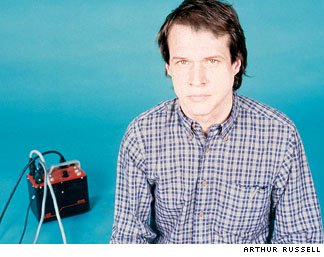
composed winter '04-05 for Arthur Russell.

Compensations for Not Knowing (a Proposal)*

Compensations for Not Knowing: a series of performances for video or elsewhere

Materials: books / texts I and other performers “know” to varying degrees, about which we will
speak and write extemporaneously, converse and interact with.

Intending: “Amateur” epistemology? / exegesis evolved to an imagined telos, producing excess in
absences the compensatory describes.

What won’t the compensatory hold?
Producing system’s inversion
Is it medieval to pursue this beautiful purposelessness amidst violence (when people are dying)
To unite the soul and the body
The mirror of entropy is an insanely deliberate imagining of information and know-how
The number of angels, the number of aeons
A conceit for ambient not knowing, gestures of psychotic insisting

How to proceed?
Will you proceed by questions?
By outright lies?

What is the difference between lying and the imagination in this case? Falsifying? What will be
your relationship to these texts?

Speech and logos seem at issue, what presentation is. The mind self-organizing in relationship to
objects, material. For that matter -- another mind. The “mystery” of what occurs when minds
involve each other as the mystery of why something exists instead of nothing.

Where to begin? By reading a line of text, a word? By reading marked passages or passages at
random and commenting on them? By bringing different things (words) to a collision? Chance
encounter as interpretive strategy.

Who is my addressee? Who is the real addressee, if not an “art” audience? Should the addressee not
be the mind itself? As in prayer / meditation. Non-religious “praying,” prayer in place of
knowing. Is prayer compensatory?

Prayer augmenting what we can not know, and only insist.

As the monologue in a voice addressing the other as an other, the doubled voice of one entity.
“no” thyself. “not” know. now thyself. I is two or more others talking to itself in the same
voice. The interior becoming exterior, creating place for the exterior inside itself, furthest
inside. A limit of inside.

To “perform” this presentation is then no performance. But the presentation of withdrawing to no
longer be one. Confronted by a shared object, or a mind also trying not to be one: by soliloquy,
imaginative seizure (clairvoyance), storying, song, breath. By the vicissitudes of listening.

This profound listening in the interior, the radical interior; or an equally profound listening in
the face of an other’s words.

Which may be the interlocuted Same.

To inter-locute: as in two or more entities involved in circuits, among circuits.

Is the voice a circuit?

*to Eliza Newman-Saul

Thursday, January 05, 2006

Bresson's Saints (Notes)


Bresson's characters are ideas, if not modernized archetypes; there is not psychological identification with them, as in action driven plots, but certain ideational-emotional investment (as in great metaphysical theater: Shakespeare, Stein, Beckett, Foreman).

The interior lives of Bresson's characters are exteriorized making for a purer interiority, an interiority of surface, and in this way they are both like animals and saints: animals incapable of a knowable interior life; saints praying towards an interior limit which produces the outward appearance of grace -- demonstrations of graceful demeanor and speech, perfect emotion.

As in Stein's saints, the saintly (including her saintly words) should move as little as possible (the words of serial?), grace being a quickness in calm (Badiou's dancer after Nietzsche who is fast because they conceive the world slowly, deliberately). In constant prayer (their lives of prayer) the saint is a dancer making grace visible by a rigorous interior life. This depth of ontological interior is not of psychological perception, but rather a depersonalized depth of shared voice / mind in prayer (immediate or direct reflection).

Someone once told me that Chris Marker had written one typically taciturn sentence addressing Bresson's work: the gist of the remark, as I remember it, that a single frame of any of Bresson's films contained more significance than the majority of films taken in their entirety. I take this as a comment on the perfection of Bresson's craft as an artist, but also as addressing the saintliness of Bresson's films. For the significance or saintliness of each frame derives not only from an economy of dialogue and action made possible by careful editing and cinematography, but also an economy of character. In using models and non-professional actors Bresson probably did so to capture the interior limits of the saintly by its inverse: the radical emptiness and pure objecthood of the non-actor / model completely directed, or chosen by the director for their appearance and disposition to certain movements and expressions.

Prayers Not Yet


I. “Everything is moving me up”

Is not yet an angel
Is an angel
Not yet
To forget what time isn’t
What musn’t
Be again
Fatefully our immanence
Our innocence
The tents
Of neutral voice into which

On our soft watch
We intuit
What gravity won’t heed
Nor heal
On our soft watch
We invisibly see
Those miles of forced wildness
What grace
Gravity won’t
Be heir to
What storming what hearing
And promised voice

Not of their imperial knack
We seek in trembling lack
Stock branches a trembling
Night for the voice an ear
To accompany a voiding air
Eye breeze and not snow no longer
Trembling branches as such

This time of year to continue with
Our name not yet an angel-name-event
In situ redemptions frozen into
Face retreated from glory grace

Not saved again to
The power two
To the one two
Effulgent percept
Fragrant cinematics
And invisibles

The guilt of our innocence
Guilt of our excess guilt
Of our individuation guilt
Of our ignorance to the power of two
Misidentified in a penitent pose

Pose adepts not this dance again
Exegesis Corbin not yet to clock Descartes’s Plato
To move the motion
Pictures up
To move infinite
Only poetry finds an
Angel again to move in perfect motion
Name not yet an image

Not yet an event supplicant in dance
This infinite dance to not continue
Without woe
Invisibly to continue
In this infinitely not contingent must
Is a surpassed world
Your pretended body

Is the voice trembling
In the dark is not
The voice is not anyone’s
Voice
In particular
Is no body
Obscuring a punctured
And punctual light
It is to suddenly be
Here

II. For the Cycles

Where space begins suddenly
In time and presupposes our love
For the worlds (the world) what image will you
Make
Will one make
So neutral to think
The voice
A delay shapes

Delayed shapes suddenly here
And not here
Not yet to shore
The body up
Not the erotic
Mind you occult
By drinking up ink
A scholastic problem of love

Delaying future shapes
Of a certain bow
Of an angel struggling
In potentia with
A certain bow
Circular to sing

The inside before his breath is done
Before light light falsely
Catches up

A retard
To light
Catches up
To words
An allegory of their fall

And not a fall
Serials
From light evening light

Night / Light
Not a fall

As light so literal
An angel in actuality
Kept by its words

III. The Presentable, for Nancy Spero

So withdrawn
Were
Their words as
Screaming
As such this
Time of year (every time
Of year
Everywhere
And for the general)
For the particular
Spero
Pictures of
Copters are
For the destroying
For
The destroyed
Women paint
Stone-like
Inscriptions
Art must exist
To produce knowledge.

We speak soliloquies
Our prayers
And apostrophes
Of the one
For the two
The one and one
Not making
Merely two (Creeley)
Not equal
In numericity
Our daily voices
Our images
Of the voice nations are
Hallucinated
(his Later numbers).

Nancy Spero
For what
We see and
Don’t see
The blood for
The trees
The dark
Of lovers for what
We see to not see
The dark
Of bodies
In pain
Ruptures from
Existence
Torturously must be
Presented

IV.

To move for all
In perfect motion culture
Of our fall
And our repeated
Resurrections, who
Will forgive
The fallen-risen
Who shelter ink and image

Those who flock
Those who kill
Of the one for
The two
The two
Of forgetting
Those who flock
Those who will
The graphics of a cloud
Loving only the difference

A different delay
Her body
Of letters and
Her body of substance
Circling the onus
Of time
Her material
Body the retard
Of perfect naming

Delayed
And suddenly
Shudder shiver
For the one (the One)
Of value
Eternal are the
Names
Of flux in this
Dance, perfect
Image of our regard

Is to partake
Of images
Letters
Of which
To partake
Not-yet
Of the body
Of the soul hiding

V. Coda (Prayer Wheel)

Devoid delaying
Lacrimose injunction
Imageless motion
More than branch
Voicelessly