Wednesday, February 06, 2013

What won’t we alienate so as to once again possess it (talk)


The following talk was given for the event Windows/Mirrors, a series of "non lectures" at Kunsthalle Galapagos in DUMBO. It was hosted by Adam Fitzgerald, who provided participants with the following prompt:

"Unless the mirror becomes a window, we will never see into the world, even ourselves. Unless the window becomes a mirror, we will never see into our seeing. The world of our parents was a TV world, an imagination that offered a window onto the 'world' that was manufactured, conventionalized with little scope. The world of our generation is increasingly a mirror world, where the Internet hedges us into promoting and narrowing the view of our own self-image. How do we balance window and mirror, can they become synonymous, and what is the danger if they do/don't?"

___________

What won’t we alienate so as to once again possess it
some notes on reflexivity, poetry, and social media

For the past year and ½ I have worked a fulltime plus job that requires that I am not online nearly as much as I had been in previous years when I was a part-time cataloguer and adjunct professor. Withdrawing to a large extent from Facebook, and in turn from many correspondences that I would have once had via email (forget about slow formats like letter writing) has resulted in a certain kind of melancholy, the decathexis from a feeling of participation and mutual exchange that I felt with others, and most intensely with certain poetry and art communities around the occupations of 2011 and ‘12. This participation no doubt had its superficialities, its codes of conduct and manner (liking or not liking something; commenting or not commenting; friending, ignoring, blocking; endlessly inviting). Yet these basic elements of Facebook seem vatic now; which is to say, they often pave the way for more substantial exchanges. Not just the sharing of information (links) or opinion (comments) but discourse via comment streams, tagging, reblogging. While I remain completely suspicious of the corporate platform, whose structures and propriety guidelines make themselves up as we consent, I am also convinced that endless groups have squatted in the medium, reappropriating its various potentia, the agency taken by its users despite hypervigilant managers and programmers.

Facebook was and is some kind of big party, a party had while the world is laid waste to in every possible way. Facebook has also prompted the decapturing of particular affects and content within a period of the accelerated accumulation and circulation of semiocapital. As a form of life, or that which extends and disperses life forms, it escapes. And here I am paraphrasing Fred Moten quoting Michel Foucault in an interview published at the end of his book B Jenkins. I also know I am echoing one of my favorite books of poetry to come out in the era of Web 2.0: Dana Ward’s This Can’t Be Life. Can’t we read This Can’t Be Life as one extended hashtag or shout-out? Shouldn’t it be read as a brilliant mining of pre- and post-social media networks, where emailing, texting, and Facebooking constitute drafting processes. Where they give way to a virtuosic performance that resists “authenticity” while maintaining and putting forth emergent forms of intimacy, a range of affects that may only be possible through participation in an environment conditioned by Web 2.0. Perhaps we can’t help but read any recent book (of poems) in relation to Web 2.0. Yet many of Dana’s works extend New York (School) Poetry and New Narrative writing into an era in which the dream of these movements for aesthetic-communal reflexivity seem fully realized, in fact in often vexing ways. Could Dodie Bellamy’s Cunt-Ups be written now via Facebook? Could Robert Gluck’s Margery Kempe? I wonder.

There’s an ambivalence in the title This Can’t Be Life that’s difficult to pinpoint, an ambivalence presaged by Jay Z’s song “Big Pimpin’,” which Dana lifts his title from only to lovingly place it back in its proper context via epigraph on the first page of the book. 

This Can’t Be Life:

As in: This can’t really be happening. This can’t be my life.
Or: What the fuck won’t we alienate?
Or, better yet: What won’t we alienate so as to once again possess it as experience. Reflection, recognition, interpellation.
(Jay Z and Dana are both Hegelians.)

Life so-called appears in the places we least expect to find it; that is its infinite charm. A fugitive bios is the radical kernel of cultural production, whose dark matter is both rejected and captured by commodity fetishism. Life escapes in spite of the totally administered environment of Web 2.0, that which now embodies networked capital.

As a way of addressing Adam’s Windows/Mirrors dichotomy, I want to extend some propositions about the tagging function of Facebook and hashtagging in Twitter, a medium I am less familiar with. The problem, or if you prefer poetics, of tagging goes back to Frank O’Hara and continues through New York poetries, in which we frequently encounter the use of proper names and their abbreviations, where the abbreviation seems less to protect the innocent than to circulate an open secret. Maybe in some cases it is actually a deflection of possible gossip; or a display of humility (Creeley?).

The name in O’Hara functions like a tag inasmuch as it constitutes an affective node—a point of singularity or intensity riven in what Susan Howe calls a “universal flux.” In O’Hara case, it is not just a form of possession to name (which is to say, Adamic); it is simultaneously a gesture of affection and a wager of association circumscribing real or imagined power. The (deterritorializing) power of the band, the pack, the non-familial group, for instance. The (reterritorializing) power of the coterie, the clique, the immediate circle. Branding (or proto-branding) lurks in O’Hara’s use of the name. It is a key aspect of the proper name qua tag’s doubleness. That it constitutes both a form of social capital and expresses a kind of agapeistic relation. Homosocial (if not sexual) as in Michel de Montaigne’s essay “On Friendship,” highly regarded by both Bruce Boone and Gluck. In which the hope for a liberatory recognition of identity is always bound up with commodity culture; the types and constructs this culture produces; the forms of appropriation it elicits, in fact has always been begging for. (Cf. Gluck’s talk at New Langton Arts Center in 1983 for a wonderful unpacking of these ideas with regards to narrative tactics and what he calls “caricature”; cf. also Rob Fitterman’s introduction to Rob the Plagiarism, where he addresses consumerism and identity formation).

Last spring I saw this ambivalence of the proper name qua tag in action, at a reading given by Joseph Bradshaw for the series I organize with Dottie Lasky at Pete’s Candy Store. Joseph read for the first time a poem I’ve since heard him read a few times, “Of Being Numerous.” The title alerts you that something unusual is going on. That the poem he is going to read is some kind of metatext, a poem about a poem. And not just any poem. The poem of George Oppen’s poethical canon.

The poem starts and seems like it will never stop; there is an anaphoric insistence that drives its lines. Its half-tongue-in-cheek litany echoes Oppen’s title, taking it too literally. The litany of proper names is mostly comprised of the names of contemporary poets, but also brand names. At a certain point, listening to it, I was fascinated. Not just to hear these names of people I knew in close succession, but to in some way anticipate my own name, which eventually was read in tandem with an image of Cori Copp holding an iPhone. The intelligence and singularity of this poem issues from the way that Joseph is playing with the narcissistic investments we form through and with Facebook, a medium I know Joseph to have actively avoided all these years. The Mathussian numerousness of Oppen’s original poem is complicated by Joseph’s tactical deployment of the proper name in a tagging function that foregrounds the flattening of proper name and brand name by social media culture. Playing with the distance between self and image, name and social capital, it fucks with our reflection to the point where that distance is abolished. Attaining The Real (in Zizekian parlance). Reckoning with the capture of our capacity to enjoy without a feeling of complicity in a larger matrix of governmental and economic forces.

There is another poem that would be interesting to look at in this context. Anne Boyer’s “The Day Steve Jobs Died, “which I was able to publish last year in a feature devoted to “Poetry During OWS” in Rethinking Marxism. The poem, one might say, is a remapping of O’Hara’s “The Day Lady Died,” in which we find the poet moving from site to site, commodity to commodity, ‘friend’ to ‘friend’ throughout his daily life, blissfully unaware of the death of the famous blues singer. In Anne’s brilliant rendering of this poem, proper names are preceded by hashtags. And where we must imagine the 2nd Avenue of O’Hara’s day in “The Day Lady Died,” in “The Day Steve Jobs Died” we imagine the mass arrest of 700 demonstrators on the Brooklyn Bridge via Livestream.  If O’Hara’s original poem lyricizes an everyday (physical, urban) network of proper names traversed by the names of commodities/brands, if it revels in the egotistical sublime of Personism, Anne reexamines the function of the name in O’Hara’s original poem through the windows offered by contemporary social media, where individuals united in their resistance against finance capital struggle to remain in touch and share vital information virtually. Anne’s poem is satirical. But it also reflects the liberatory recognitions and information sharing that social media makes possible, a potential that should not eclipse important spatial practices but which we have learned through the occupations and other recent civilian uprisings can feedback and inform a new mapping of social-civic space. 

Wednesday, January 30, 2013

Ben Kinmont Bookseller (essay)


"In the text Towards a Definition of Project Art one can possibly locate where Kinmont’s aesthetic-ethical concerns line-up specifically with contemporary critical discourse about the social practices of art. Pablo Helguera proposes in his lecture/book, Education for Socially Engaged Art, that one of the central questions for the socially engaged artist is whether (and why) they should venture into the complex disciplines of education, anthropology, and social service. In Kinmont’s work, art can model the kinds of practices and behaviors that one would otherwise want from a larger sociopolitical and economic sphere. Art can also present a kind of micro-politics—a space where aesthetic decisions can undergird and affirm political or social ones."

Click here to download PDF 

Thursday, January 17, 2013

After Hito Steyerl

Enjoying life again
Like there were no such thing as autonomy
Wearing these protest breasts
Hoping their naked forms will open
To some other shade of gray
Or owl of Minerva our affects embody
Outside any sense of control
So what we capture briefly is our not being captured
Dressed up like the book
Of that theory we practice
By dressing up like the book
Being beaten and kettled as such
Some form of night the cops can't touch
I am thinking about taking a break
From life
But life doesn't let you take a break
I think I am enjoying life
Then autonomy interrupts
My sense of identification
With the things I have enjoyed

Intense Autobiography (syllabus)


Visual Poetics
Intense Autobiography
Thom Donovan
wildhorsesoffire [at] gmail [dot] com


I want to write the vector of self, the intense autobiography that is also a philosophy of the body.
--Bhanu Kapil

Course description

In this course we will look at various forms of autobiographical writing in the 20th and 21st centuries. I am qualifying this series of texts as “intense” in order to distinguish them from more traditional forms of autobiographical writing, where one typically encounters the writer struggling to give a narrative account of the life they have led, moral conflicts they have faced, and to accurately portray the history of their “person” or “self” within a larger society. The modes of confession found in much Greek and Christian writing offer precedents for these more traditional forms of autobiography. In much of the writing we will look at, notions of person/self are replaced by an exploration of the human being as it is conditioned by modern disciplines (medicine, biology, statistics). They also produce an examination of “life” (bios) through a registration of collective experience as it is mediated by economic, legal, and political struggle. Intensity may imply that life is a series of thresholds through which one passes—“phase states,” to use a term from contemporary physics—whence identity remains in a more or less constant state of flux, contingent on organic transformation. It may also imply conditions of movement, desire, and metabolic change within an interpersonal field. Much of the writing, as you will see, explores aesthetic forms as an extension of experiences that challenge our ability to represent them (because they are horrific, subtle, traumatic, or withdrawn from our capacity to perceive them). They also explore how notions of  “person” or “self” are fabricated through aesthetic experience.

Required texts

Numerous texts will be made available to you via PDFs and urls.

The following are the textbooks you must purchase or borrow for this class. I recommend you purchase books online via Bookfinder or Small Press Distribution. You may also feel free to use the public library and the library at SVA.

Primo Levi’s Survival in Auschwitz (Bookfinder)
Bhanu Kapil’s Incubation: a Space for Monsters (SPD; Bookfinder)
William Burroughs’ The Soft Machine (Bookfinder or library)
CA Conrad’s A Beautiful Marsupial Afternoon (Bookfinder)
David Wojnarowicz’s Close to the Knives (Bookfinder or library)
Bruce Boone’s A Century of Clouds (Bookfinder or SPD)
Robert Gluck’s Margery Kempe (Bookfinder)
Ronaldo Wilson’s Poem of the Black Object (SPD) 

Schedule

January 10

Introductions.
Franz Kafka’s The Metamorphosis, in class recitation.

Homework:
PDFs of Michel Foucault texts, “Right of Death and Power Over Life” and “On the Genealogy of Ethics: Overview of Work in Progress” (from The Foucault Reader)

Further reading:

Recommended exercise:
Produce a reflection on one of the following quotations, from Foucault’s “Right of Death and Power Over Life” and “On the Genealogy of Ethics: Overview of Work in Progress”

“For millennia, man remained what he was for Aristotle: a living animal with the additional capacity for a political existence. Modern man is an animal whose politics places his existence as a living being into question.” (pg. 265)

“I would like to say exactly the contrary: we should not have to refer the creative activity of somebody to the kind of relation he has to himself, but should relate the kind of relation one has to oneself to a creative activity.” (pg. 351)

17

Foucault’s “Right of Death and Power Over Life” and “On the Genealogy of Ethics: Overview of Work in Progress”

Homework:
Primo Levi’s Survival in Auschwitz

Further reading:
Giorgio Agamben’s Remnants of Auschwitz
Georges Perec’s “W”: The Memory of Childhood
Robert Antelme’s The Human Race

24
Primo Levi’s Survival in Auschwitz

Homework:
Bhanu Kapil’s Incubation: a Space for Monsters with excerpts from Jalal Toufic’s Vampires [2nd Edition] (PDF)

Further reading:
Bhanu Kapil’s Humanimal
Gilles Deleuze’s and Felix Guattari’s “Becoming-Intense, Becoming-Animal” section from A Thousand Plateaus

31

Bhanu Kapil’s Incubation: a Space for Monsters
Skype “visit” with Kapil (7:30-8:45)

Homework:
William Burroughs’ The Soft Machine

February 7

William Burroughs’ The Soft Machine

Homework:
Hannah Weiner’s The Fast (PDF) and excerpts from Clairvoyant Journals manuscript

Further reading:
Bernadette Mayer’s Studying Hunger and Studying Hunger Journals
Carolee Schneemann’s Imaging Her Erotics
Hannah Weiner’s Open House
Vito Acconci’s Language to Cover a Page
Vito Acconci’s and Bernadette Mayer’s 0 to Nine magazine

14

Hannah Weiner’s The Fast and Clairvoyant Journals

Homework:
CA Conrad’s A Beautiful Marsupial Afternoon

Further reading:
Charles Bernstein’s “Experiments” at the Electronic Poetry Center.

21

CA Conrad’s A Beautiful Marsupial Afternoon

Homework: David Wojnarowicz’s Close to the Knives and excerpt from Kevin Killian’s Argento Series (PDF)

Further reading:
Gregg Bordowitz’s The AIDS Crisis is Ridiculous and General Idea Imagevirus
Deborah B Gould’s Moving Politics: Emotion and ACT-UP’s Fight Against AIDS
Douglas Crimp’s AIDS: Cultural Analysis/Cultural Activism

28 midterms due

David Wojnarowicz’s Close to the Knives and excerpt from Kevin Killian’s Argento Series (PDF)

Homework: Robert Gluck’s “Long Note on New Narrative” and Dodie Bellamy’s “Low Culture” essays from Biting the Error (PDF) with Bellamy’s Cunt-Ups (PDF)

Further reading:
Biting the Error: Writers Explore Narrative (ed. Burger, Gluck, Roy, Scott)
Dodie Bellamy’s The Letters of Mina Harker
Kathy Acker’s My Mother: Demonology

March 7

Robert Gluck’s “Long Note on New Narrative” and Dodie Bellamy’s “Low Culture” essays from Biting the Error (PDF) with Bellamy’s Cunt-Ups (PDF)

Homework:
Bruce Boone’s A Century of Clouds and Frank O’Hara’s “Having a Coke with You”

            Further reading:
            Bruce Boone's My Walk With Bob 
            Dana Ward's This Can't Be Life
            Michel de Montaigne's "On Friendship"
            Tyrone Williams' Pink Tie

21

Bruce Boone’s A Century of Clouds and Frank O’Hara’s “Having a Coke with You”

Homework:
Amber Di Pietra’s and Denise Leto’s Waveform (PDF), excerpts from Jordan Scott’s Blert (PDF), and excerpts from Beauty is a Verb: the New Poetry of Disability (PDF)

Further reading:
Somatic Engagement (ed. Petra Kuppers)
Tobin Siebers’ Disability Theory
Michael Davidson’s Concerto for the Left Hand
The Collected Writings of Larry Eigner, Volumes 1-4
Eleni Stecopoulos’ Armies of Compassion
Robert Kocik’s Overcoming Fitness
David Buuck at Small Press Traffic

28
Amber Di Pietra’s and Denise Leto’s Wavelength (PDF), excerpts from Jordan Scott’s Blert (PDF), and excerpts from Beauty is a Verb: the New Poetry of Disability (PDF)

Homework:
Robert Gluck’s Margery Kempe

Further reading:
Bhanu Kapil’s The Vertical Integration of Strangers
Brandon Brown’s The Poems of Gaius Valerius Catullus
Douglas Huebler’s Secrets

April 4 Visit from Brandon Brown

Robert Gluck’s Margery Kempe

Homework:
Ronaldo Wilson’s Poem of the Black Object

Further reading:
Frederick Douglass’ Narrative of the Life of Frederick Douglass, an American Slave
Karl Marx's Economic and Philosophical Manuscripts
Fred Moten’s In the Break and Hughson’s Tavern
Adrienne Piper’s OUT OF ORDER, OUT OF SIGHT: Selected Writings in Meta-Art and Art Criticism 1967–1992, volumes 1 and 2

11 final work due

Ronaldo Wilson’s Poem of the Black Object

Presentation of final work 

2012 Disinhibitions

via Michael Cross

It's the Political Economy, Stupid (essay)


order here

Interviews at The Conversant

The following are links to two interviews at The Conversant, the first with Andy Fitch, the second with Matvei Yankelevich, regarding his book Alpha Donuts and my book, The Hole.


AF: After everything we’ve discussed about The Hole’s constructivist, cybernetic, participatory nature, I feel we haven’t given an adequate account of the lyric sections. I find it interesting, given what you’ve said, that you capitalize each line, that you provide neat and tidy quatrains, that you’ll outline something like a sentence structure then close serialized sections with definitive periods. What draws you to this orderly local architecture? How has the significance of these lyric passages changed once placed amid the book’s broader discontinuities? How would you describe the lyric’s enduring status amid post-Language poetics or contemporary poetics? Here I can quote some lines if that helps: “What voice of lyric what / Voices would resist the doing / Should syntax still be a sacrifice / Like cutting off one’s limbs / While still alive isn’t that / How Mallarmé put it of Rimbaud’s / Becoming an arms trader?”
TD: The term “lyric” seems inadequate. I tend to use it as a place holder. But often people will use this term as a foil—a negative way to define a retrograde poetics, an outmoded contrast to emergent constellations of writing. To me this all becomes quite problematic. I maintain a more or less daily practice of writing poems that look lineated, that often deploy quatrains, that retain formal characteristics people associate with poetry. I value staying faithful to this practice, to its rhythmic possibilities, to certain compositional principles. But in terms of the dynamic you’ve drawn, between localized lyric details and globalized experimental structures, I’ll sense how a literary form inflected with lyric potential can become much more interesting when you direct it someplace else, when you juxtapose more discursive elements, when you rethink design features. For example, I have a manuscript I’ve worked on for some time, with about 160 pages of mostly lineated poems. But I’ll wonder what it would mean to distribute this manuscript, collect responses to it, then remove the poems, or make new projects out of those responses. What if those withdrawn poems just served as the vehicle for inviting something else? Still I remain committed to poets working through prosodies based on constraint and procedure. One book I love that just came out (tragically, because published posthumously) is Stacy Doris’ Fledge. Its intense prosody works through some of Celan’s grammar. Much still can happen within inherited and imposed forms.


At Small Press Traffic with Sara Larsen and Suzanne Stein, September 2012


Video shot and edited by Stephen Novotny
Reading organized by Michael Cross

5 Questions for Contemporary Practice with Suzanne Lacy (@ Art 21)


The practice of listening is so foundational to public practice that it’s almost a cliché. What we don’t talk about is how listening is, in fact, learning. That’s why I got into this kind of artwork. When I work on projects I listen carefully for both the learning as well as the images that form between us. I test the images out in conversation and eventually the shape of the work emerges. In the process, friendships form and I begin to see issues from both personal and political perspectives. If you work in the territory of oppression, you cannot avoid being radicalized by people’s experiences.

Friday, November 02, 2012

"A riot is the language of the unheard" at Cooper Union (Video)

Homage to Etel Adnan (Anthology)


at SPD

Does the Document Promise? (@ Academy of American Poets)


I would like the tense of the promise to be the tense of the poem I am dedicating to you, just as soon as I've written it

“Talking about my generation” (@ The New Museum)


“Talking about my generation”: Jill Johnston and the Critic as Subject

Movement Research in Residence

Cover Image: 
Elaine Summers, Ouverture, 2012. Photo: Sarah Holcman
Critical Correspondence is an online publication by Movement Research. For this program, Critical Correspondence coeditors Aaron Mattocks and Marissa Perel honor the celebrated writer and critic Jill Johnston, whose experimental and personal voice communicated the culture of the interdisciplinary 1960s art scene. In light of Johnston’s innovative contributions to the form, this conversation considers contemporary criticism and the writer as subject. Speakers include David Velasco (editor of artforum.com) and Claudia La Rocco (founder of theperformanceclub.org). The event culminates as Movement Research artists perform readings of reviews on dance and performance.
Readers:
Thom Donovan
Ariel Goldberg
Cassie Petersen
Christine Shan Shan Hou

Sunday, September 30, 2012

"A Riot is the Language of the Unheard" (at Cooper Union)

I will participating in this event with many other fine folks next weekend. It is part of a larger exhibit currently up at Cooper Union, Ruptures: Forms of Public Address.

Monday, September 17, 2012

Occupy/Poetry

"When Zuccotti Park was still occupied something that impressed me were the various tents that provided medical and emotional aid to occupiers. This is something that we too often disassociate from struggle: mutual aid. And it is also the reason for struggle, maybe its primary reason: to become a society of mutual aid. Poetry provides not just a Kantian critical distance from events and subjects, as I notice certain poets arguing for; but it binds and is immediate to intersubjective formations that undergird collective social action."

The latest Boog City features talks from a panel I was on with Tyrone Williams this past August, regarding poetry, activism, and Occupy Wall Street, edited by Brenda Iijima and David A. Kirschenbaum

5 Questions for Contemporary Practice with Doug Ashford


"The forms in my working process these days are chosen for both their factual reportage and their imagistic drift. I want to know what motivates the figures depicted, if they imagine in unknown relations; figures that are beautiful because they respond to emergency, moving as if empathy has taken them into a momentum that overcomes catastrophe. Although sometimes hard to see, political disaster creates events of extraordinary love because it makes the enduring of life imaginable beyond dark practical economies of getting and selling."

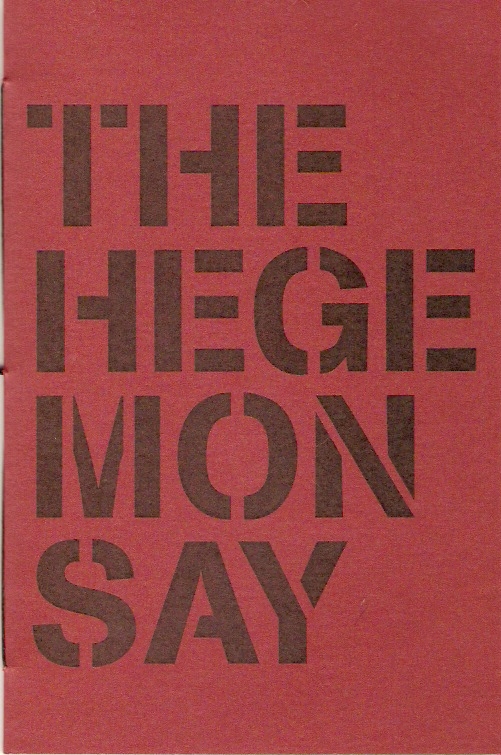
The Hegemon Say (Chapbook)


Check out this chapbook, hot-off Michael Cross's COMPLINE press in Oakland, CA.


Designed after Theresa Hak Kyung Cha's Pomegranate Offering (1975), it features a single poem dedicated to Cha.