Saturday, March 11, 2006

Thomas Hirschhorn's "Superficial Engagement" (Review: Part II)


2. Devoted Materialism: beginning in the form of a letter to Fanzine/Casey McKinney

“How with this rage can beauty hold a plea…”
--Shakespeare

“One must make a friend of horror.”
--Chris Marker quoting Marlon Brando quoting Joseph Conrad

“Mythical violence is bloody power over mere life for its own sake, divine violence pure power over all life for the sake of the living. The first demands sacrifice, the second accepts it.”
--Walter Benjamin

I have been thinking a lot about the problem of submitting a journalistic account or account otherwise of Thomas Hirschhorn’s recent show at Barbara Gladstone gallery in Chelsea, *Superficial Engagement* (2006). What I admire about Fanzine is the extent to which it presents itself conversationally, and to this extent communicates things worth knowing in fresh and accessible ways. Yet there is something that has not allowed me to be so conversational or journalistically inclined (and that has in fact made me dread my critical freedom) in the face of Hirschhorn’s recent showing. Why have I dreaded so? Is it because *SE* brings to a head the deepest ambivalences I have felt about the US response to 9/11 and subsequent events: ambivalences which situate the artist between the exigencies of political effectiveness and the necessities of transcendence -- our recourses to devotion, to the divine? Our resources.

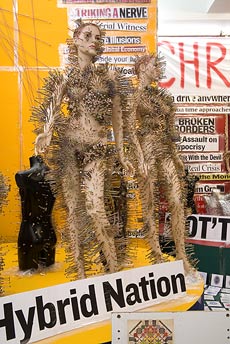
The thing about *SE* – and why I feel it to be one of the artist’s most important works to date, and perhaps a significant marking point for art in general – is that it aligns itself with two aesthetic tendencies, and in doing so goes beyond these tendencies producing a third. The first of these tendencies is abstraction: the highly rational, beautiful, and “rested”-Classical. This tendency is embodied by a host of devotional reference points: Emma Kunz’s theosophical drawings, images from works of “color musicians,” as well as kitschy reproductions of 80’s “spiral art” and other post-psychedelic craft forms. Precariously, in a clash of culturally sanctioned forms (however marginalized, or outside) and mass-products, such references appeal to a power of the beautiful to calm, rest and inhere to it spiritual power – a metaphysical potential “to heal” Hirschhorn himself sites as one of the objectives of his latest work. The second tendency, a tendency arguably inverse of the first, presents through the most direct means violent actualities -- a severed head, or a barely recognizable human body standing in a pool of blood; and in so doing burdens the viewer’s gaze with overwhelming images and signs of manifest violence. This phenomena Jean-Francois Lyotard may likely call the ”presentation of the unpresentable,” and his contemporary, Emmanuel Levinas, an instantiation of the “there is” – the anarchic night of creation itself -- commesurable with ethical repsonsibility.

Considering the ethics of this second tendency – to present directly beyond ponderability, or comprehension: where to pre-hend, or grasp in advance of feeling, would be to violate the responsibility of voiding one’s gaze, witnessing beyond witness or looking awry -- it is crucial the extent to which many of Hirschhorn’s Afghani and Iraqui figures are dis-figured, that is, lacking faces as portals of commandment and absolute obligation; instead, what may remain of obligation is a transcendental lack-in-excess, the excessive (non-)presences of photographed corpses striking-out a merely human economy of legal-moral retribution. Not only in the images of mutilation, but in the sheer volume of blown-up headlines embodying a thick fog of media-warfare, the viewer is caught in the throes of a type of negative transcendence: a failure to transcend, to sublate or synthesize, a series of messages in excess of what they would say -- noisy in their contradiction, often tragically pleasant in their paratactical sense-making. Between sublimation and a transcendent negativity, “Chromatic Fire” and “Concrete Shock” (the names of two of Hirschhorn’s three rooms at Gladstone), between spiritualist “Abstraction” and immaneticist “Constructivism,” there is an ambivalence which may constitute a third tendency: to choose both tendencies, and in so choosing to put them into utmost tension with each other. An oscillation pattern we may write to infinity: to heal to overwhelm to not heal…

*

If there is any problem I have with claiming Hirschhorn for “critical theory,” as many critics have done productively and which much of the contemporary art world resists for its own reasons, it is that he is a devotional artist, an artist devoted to divine presence through a highly unique, and recent, form of materialism. This devoted materialism – a materialism as much after Mondrian, Malevitch and other Abstractionists as it is the philosophers Hannah Arendt, George Bataille, Gilles Deleuze, and Baruch Spinoza – would maintain the radical freedom of the artist as a noble actor within collective cultural struggle (“The decision to be an artist is the decision to be free. Freedom is the condition of responsibility”), while simultaneously realizing the suspension of this very freedom in the depersonalization of Abstraction for itself.

By a chiasmus of these two positions: radical agency and transcendental depersonalization, I wonder if we can not locate a radical position towards violence, one that has been opened up by the recent publications of Giorgio Agamben, in which the philosopher discusses what he calls “states of exception”. Particularly relevant to Hirschhorn’s recent work is Agamben’s reading of the debates between Carl Schmitt and Walter Benjamin concerning the “state of exception” in Germany during the first World War. If, as Agamben shows after Benjamin, states of exception are exceptions that historically ground the rule of democratic and totalitarian states alike then one should look elsewhere, in states beyond states of exception, to recover that which remains beyond the rule of both natural and cultural law: beyond “bare life” (Agamben) and “mere life” (Benjamin): the reduction of bodies to biological states of subsistence in the suspension of legal conventions grounded by constitutional law and international agreements regarding human rights.

For Benjamin, this state beyond states of exception is achieved by two means: by passional acts constitutive of “pure means,” or means no longer directed towards a juridical or moral result -- unpurposeful as such; and in “divine violence” that is “law-destroying,” that in its anarchism interrupts law as a source of juridical retribution and as the fulfillment of mythical fates. “This very task of destruction poses again, in the last resort, the question of a pure immediate violence that might be able to call a halt to mythical violence. Just as in all spheres God opposes myth, mythical violence is confronted by the divine. And the latter constitutes its antithesis in all respects. If mythical violence is lawmaking, divine violence is law-destroying; if the former sets boundaries, the latter boundlessly destroys them; if mythical violence brings at once guilt and retribution, divine power only expiates; if the former threatens, the latter strikes; if the former is bloody, the latter is lethal without spilling blood.”(Benjamin, “Critique of Violence”)

The punches *SE* packs I believe to be ones “lethal without spilling blood” insofar as they put its audience face-to-face with divinity as presented by creative force and aesthetic determination. If these creative forces bear-out their effects directly in the printouts and Xeroxes of mutilated bodies and the confusion of headlines ripped from the contexts of various Western media sources, these forces may have a symbolic effect through their correspondence of contemporary mannequins and African sculptures both riddled with nails. While the first force puts the audience in the presence of the “unpresentable” (Lyotard) and the “there is” (Levinas), the second, symbolic one indicates a post-mythical function of art itself: to substitute a creative violence of works of art for a violence of territorialization and retributive warfare. This later violence, the violence of true Holy War beyond “fundamentalism” and cynical “secularism” alike, of divinity beyond mythos, is that which may trump the reduction of bodies to “mere life” and “bare life” the stakes of which we see playing out currently in Guantanamo and elsewhere. It is the violence, lastly, of sacrificial expiations, a pure immediate violence Benjamin’s contemporary, Georges Bataille, recognized as the very opposite of warfare itself in its glorious wages, its infinite use and malicious possessiveness: “In deadly battles, in massacres and pillages, it has meaning akin to that of festivals, in that the enemy is not treated as a thing. But war is not limited to these explosive forces and, within these very limits, it is not a slow action as sacrifice is, conducted with a view to a return to lost intimacy. It is a disorderly eruption whose external direction robs the warrior of the intimacy he attains. And if it is true that warfare tends in its own way to dissolve the individual through a negative wagering of the value of his own life, it cannot help but enhance his value in the course of time by making the surviving individual the beneficiary of the wager.”(Bataille, Theory of Religion) Against the wages of Iraq and elsewhere and the ravaging of the United States and its allies, Thomas Hirschhorn has waged his own battle: a battle that should not result in loss of "mere life," and that if it has anything to gain, may gain “sovereign violence” (Benjamin) once again through the sacrifices of profaned creation.

Thursday, March 09, 2006

Punishment Park (States of Exception)


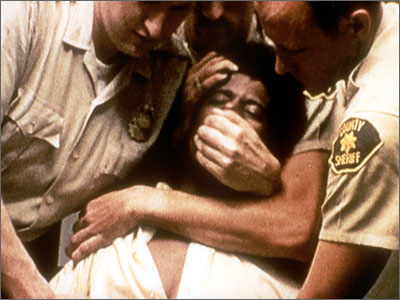
On recently watching Peter Watkins' '71 film, *Punishment Park*, a post-Vietnam documentary-style account of the (fictional) partisan hearings and punishments of late 60's "radicals," I thought of obvious parallels to the current geo-political situation (Patriot Act, Abu Grahib, Guantanamo...) and the debate between Carl Schmitt/Walter Benjamin concerning "states of exception" recently taken up again by Giorgio Agamben and others. Here are some notes I took weeks ago, with the film in mind as a teaching companion to Agamben's short, but seminal book:

Degrees of Exception:
1. Suspension of constitution.
2. Suspension of legal processes founded by constitution.
3. The suspension of laws founding the police as force of law, the law enacted thru punishment.

Thru these three completely related degrees of exception, the prisoners of Watkins' *Punishment Park* are reduced to what Agamben calls "bare life": a state of "natural law" before, after or in the suspension of laws "human". However there is a psychological cunundrum in Punishment, a canundrum we must accept in order to embrace the reality of its diegesis. And this is that the characters *unanimously* choose the park – thus opening themselves to be punished to any end without a constitution or other legal grounds for their punishment. For this viewer, watching the characters choose their punishment (as opposed to not choosing at all, and thereby going to jail) was not unlike watching when in horror films the characters decide to split into groups, or go out on a limb only to meet the monster, ghost, badguy, etc. In choosing punishment park, Watkins' characters affirm both the lawlessness and total juridical-social power of their judges. The only resistances that remain for them: reasonable dialogue (with completely unreasonable parties); to sustain a rhetoric of the courtroom (without legal precedent or established procedure); hysterical outburst, name-calling, childish self-objectification (something Jean Baudrillard, coincidentally, advocates for political struggles in an age of "simulation"); consent to the labyrinthine (however non-Kafkan, insofar as an unpredicatble purposefulfulness remains) law of the oppressor (who should only modify the rules of the game as the game is played) and an accompanying hope for freedom thru this means (to reach the appointed flag if they survive heat/cold of desert, dehydration, natural perils, personal disability); to kill, revolt, act psychotically; to appeal, by whatever of these means, to the camera -- the camera of the film being also the diegetic camera of a BBC television team making a documentary about punishment park: curiously, Watkins’ camera team remains "objective" until the final moments of the film, when a voice I assume to be the filmmaker’s addresses the police and national guardsmen, chastising them for their treatment of the prisoners; and this moment of witness pointing to an extra-legal and moral authority beyond the situation of the characters (the Brits? the rest of world outside U.S.) seems one of the few hopeful throughout the film...

I am particularly interested in the decisions the characters make in this film, and Watkins' creation of a hyperbolic situation both of (in)justice (on the part of the tribunal/police) and false agency (on the part of the prisoners). One that, insofar as it frustrates, brings out contradictions of/in "the law" and the way society functions thru a series of ideologies (the partisan tribunal representing these ideological strongholds)... Yet it is disappointing in its either/or-ness, its binarity. Where thought is not at a level of dialogue, or rhetoric, but in the inability for speech to succeed in the face of a certain despairing situation of the law, and in which hope would seem to lie only outside that situation -- not in the "state of exception" (where law reigns absolutely) nor in the social contract (dialectically substantiated by the exceptional state), but elsewhere -- in an eschaton, in revolutionary violences very much like the ones Watkins' characters are ostensibly being prosecuted for. It is this vicious circle which ultimately frustrates, and its resemblance to our current situation, where everything the characters do -- act reasonably, act out, appeal to an extra-legal situation -- only seem to result in the continuation of a self-fulfilling program of radical misjustice. It leaves me wondering, with Agamben, where a force beyond the law, beyond the state of exception, remains active. What Benjamin himself called tragically "the current messianic elements" and "the straight gate of the Messiah".

The Fate of Number

for Alain Badiou

BEACUSE THE SOUL AND BODY
OF THE IMAGINATION
ARE BEYOND ECONOMY
LEGALITY AS MEANS
MORALITY AS ENDS
SO MUCH DO THEY LOVE
THEIR MEANS WITHOUT QUALIFICATION
THEREFORE PASIONATELY

*

So the mind
must make
one
and can't make one.

So we must
love
each other
and love the abstract.

So this is a notion
of what subjects are
together, intersubjective
ground of love.

So there must always be
love for the mind.

So the mind is
what we love,
powers of mind.

So the eyes are the first sign
we see
of the mind, the eyes
and their cancellations,
their voiding.

So there are words.

There is perhaps a one that is not one.
The mind is such a one.
The mind as imaginal, a soul as such.
That thing most capable of love, these things.
The heart, the mind, the breath.
The heart's hallucination.
It's subtlest images, in the mind.
Of the mind...

*

A LIMIT INSCRIBED IN PLATO
(A PLATONISM WITHOUT GUARANTEE)

Why can't one one be one one be?
Why can't one one and one one be two?
Why can't one and one and one be one?
One and one, perhaps only one?

There is no numericity
in the outside again,
none inside.

Just the movement of the all
and each.

Multiplicity
destroying number
in order that it may be saved...

Intuiting Beuys (Project)


To produce intuitions (a purer knowing?) from meditations on individual drawings from Madrid Codices (1974). Through a form of repetition not unlike that Leonardo uses to begin in inchoates towards discovering forms, or Beuys uses after Leonardo at the level both of word and drawing.

Here I am most interested in the conveyance of energy as graphic mark, whether letter or drawing -- or sound as Beuys recognizes it to also make marks in air, to leave acoustical traces... If there were such thing as an ontological acoustical trace, Beuys wld definitely leave it thru his drawings...

Beuys' drawings seem not just figuratively, but literally of tracings. As tho the holographies, the holographic tracings, of different bodies, objects, schemes, words. A holography or typology of energy patterns. Marks constituted by different energies overlaying each other -- interpenetrating, intussucepting. Coeval and yet heterogenous, as such.

Others Letters: Ryan Chowdhury...

3/8/06 on Jim Behrle, Rhys Chatham @ Tonic, the Grand Ducal family of Luxembourg, and Iraq

"Thanks for the link. Phunny
stuph. Chatham
was great fun--warm
& fuzzy
guitar minimalism,
pulsing down
that mass-
tonal highway. Rock
musicians
as members
of the high school minimalist band.
A piece called
"Out of Tune Guitars",
for,
guess what,
6-7 hastily detuned guitars.
Fuck--
I'm checking a
society column, what's the
current slang for "ennui"?
& how come the
British, Swedish & Belgian
royal families have official web sites,
but not the
Grand Ducal family of Luxembourg?
What are they hiding?
Where are they hiding?
Did you know
Prince Harry (3rd in line
for British throne)
might go
to Iraq to fight?
What if he got
abducted & had his head lopped off on
videotape-- 1789 comes
to England,
about bloody time.
Speaking of which, do
you think
I could get a Fullbright
if I applied to study in Iraq? One idea is
I could just go
there &
retype Kipling's
"White Man's Burden,"
except heavily redacted. [...]"*

*my lineations

"The mind gives an order..."

"Why does this strange phenomenon occur? What causes it? O Lord in your mercy give me light to see, for it may be that the answers to my question lies in the secret punishment of man and in the penitence which casts a deep shadow on the sons of Adam. Why does this strange phenomena occur? What causes it? The mind gives an order to the body and is at once obeyed, but when it gives an order to itself, is resisted. The mind commands the hand to move and is so readily obeyed that the order can scarcely be distinguished from its execution. Yet the mind is mind and the hand is part of the body. But when the mind commands the mind to make an act of will, these two are one and the same and yet the order is not obeyed. Why does this happen? What is the cause of it? The mind orders itself to make an act of will, and it would not give this order unless it willed to do so; yet it does not carry out its own command. But it does not fully will to do this thing and therefore its orders are not fully given. It gives the order only in so far as it wills, and in so far as it does not will the order is not carried out. For the will commands that an act of will should be made, and it gives this command to itself, not to some other will. The reason, then, why the command is not obeyed is that it is not given with the full will. For if the will were full, it would not command itself to be full, since it would be so already. It is therefore no strange phenomenon partly to will to do something and partly to will not to do it. It is a disease of the mind, which does not wholly rise to the heights where it is lifted by the truth, because it is weighed down by habit. So there are two wills in us, because neither by itself is the whole will, and each possesses what the other lacks."

-- from Augustine's Confessions
Book XIII.
Chapter 9

Tuesday, March 07, 2006

3 Sketches for Sharits / "How with this rage can beauty hold a plea?"*


1.
A Total Sense of Sense (END WAR)

In soliloquy
For color
We are doubled

Triply for speech
What we would say
Saying

Of the colors in soliloquy
Or of a piece
The pieces

What pieces
Were you holding
So quick and not quick

The calm
Velocities of colors
Kunz cunnilingus awash

A total sense of sense
In this
Your utter plastics utterly not

For war
The stillness
Of those flickers ripped

From the colored
Ideations
Remaining arrest

What is dreamt of the colors
In soliloquy
Or of a piece

For speech
What we should say
Saying

2.
Mandala (for two or more voices)

Devoid delaying
Lacrimose injunction
Imageless motion
More than branch
Voicelessly Devoid
delaying Lacrimose
injunction Imageless
motion More than
branch Voicelessly…

3.

A blue word a red one a green
So go these tone rows
The blues

A blue word
A yellow an orange
If dreams were only dreams, their due warmth,

We hath not seen
We have dreamt bottomlessly
The sounds swelling, their due warmth their vigils

Call light to light
Separate dark from demonic dark
Paraclete

Go down
To these tones of red in a row
Pinkish-red of sex dreaming again

Of rest in this war, this human war
And the cosmic,
Dream the bottomless subject

& beyond.
If one could only rest
History would be purchased

And memory protected
By forgetfulness,
Art would once again be…

“It can be understood that the now
is the permanent point of origin
for the ecstasies of time.”

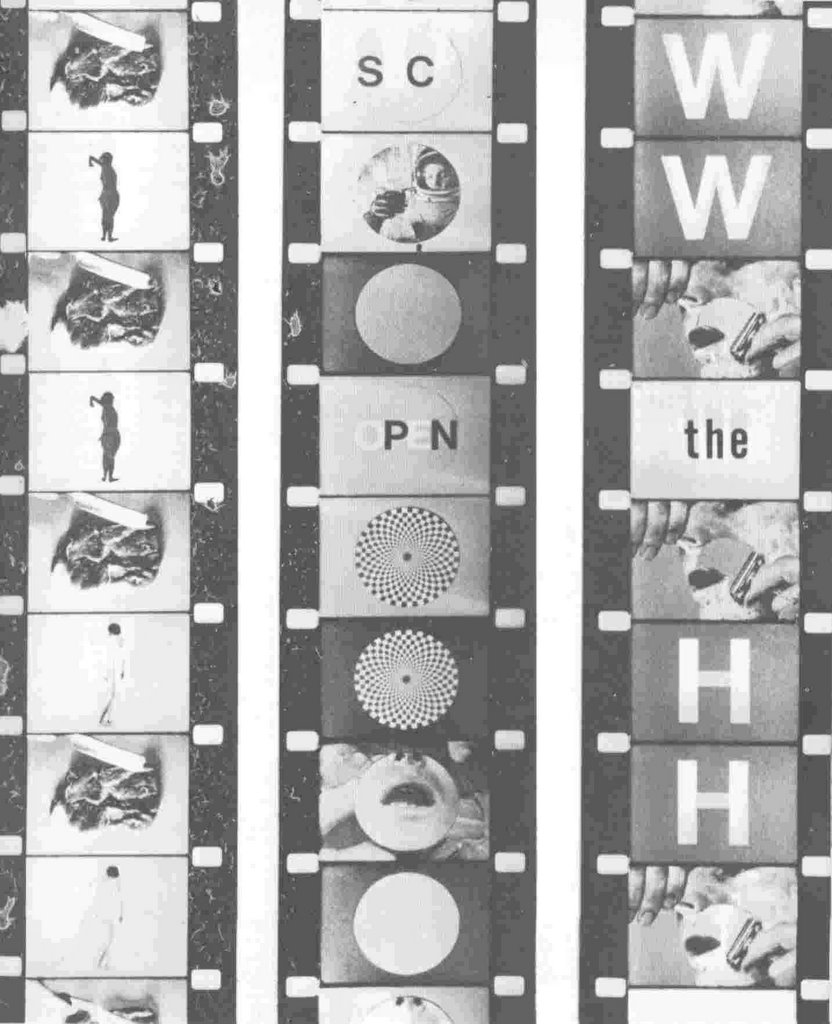
*Next Monday, March 13th I will be reading at the 11th Street Bar (on E. 11th btwn Avenues A & B) with Forrest Gander and Karen Garthe as part of the Reading Between A and B series, curated by Jonathan Thirkield. "3 Sketches" are three lineated drafts or "sketches" towards a longer work for Paul Sharits, who in 1966 made his seminal film-"mandala" ostensibly to "end war": *Piece Mandala/End War*. Alongside a politics of direct action and address, the dissemination of knowledge and a ruthless critique of the atrocities in Iraq and elsewhere by the hands of the United States and aligned international forces, I wonder if "peace" should not also still be sounded after a tradition that enfolds any number of poets and artists, not the least of which include: Sharits, Jackson Mac Low, Pauline Oliveros, Gertrude Stein, Agnes Martin, Piet Mondrian, John Taggart, Olivier Messiaen, Terry Riley, Steve Reich....

Between the need for participatory intervention and ecstatic overdetermination in the mediatized face of violent malice "how with this rage can beauty hold a plea"?

Into Bride: Inventing a Resurrectional Cinema (Paper)


If I had the time here, I would like to provide a taxonomy of Maya Deren’s cinema – a cinema that for many of us who make and care for post-cinematic media may be said to be the mother of us all. Something that has seemed curious to me for a while now is that Deren’s work is not addressed by Gilles Deleuze’s *Cinema* books, those hieroglyphs the philosopher himself describes as “an attempt at the classification of images and signs.” The closest Deleuze may come to addressing Deren, arguably, is in his analyses of Beckett’s *Film*, in which Buster Keaton finds himself in an objective cinematic space that one might call Derenesque. Then again, we may also begin to imagine what Deleuze may have had to say about Deren when he discusses those inverse geniuses of the Hollywood musical: Kelly and Astaire.

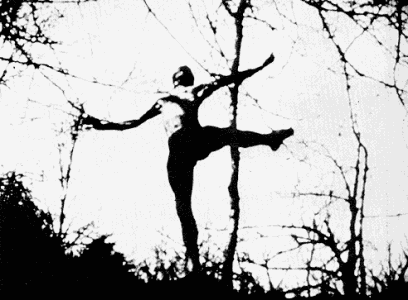
This extraordinary exclusion (or occlusion) is surprising to the extent that Deren – as a critic, poet, and filmmaker – like Deleuze, privileged cinematic images *as* ideas and not merely as the expressions of a psychological content or data. Among the image-ideas Deren presents through her works, the most insistent of these seem the images of movements, movements eventually extensive with dance and ecstatic psychoses. This concern for movement – for movement *of* and *in* cinematic space – originates in Deren’s first mature work, a work the filmmaker herself describes as an “emotional complex”: her ’43 collaboration with Alexander Hammid, *Meshes of the Afternoon*.

One of the ostensible concerns of this symposium is for “gendered spatiality”. For the remainder of this presentation, I would like to briefly consider how space is gendered in Deren’s *Meshes of the Afternoon*, and how Deren’s film exceeds problems of gender as problems all too often of the merely identificatory and human.

--Meshes may very literally be said to be gendered insofar as the three figures we see in the film (excluding Deren’s shadow, which picks a flower off the road in the opening shot; and her multiple body doubles) are Deren herself, Hammid, and a cloaked figure who wears a mirror on its face or, as is more likely the case, with a mirror *for* a face. Beyond this enigmatic and foreboding third figure we are, then, dealing with a binary relation: man/woman, and man/woman specifically in erotic encounter.

--It does not become clear that this is an erotic encounter until we see the couple ascend a staircase to a bedroom where the two lie down on a bed, and where the man caresses the woman, and the woman responds, amorously at first, however eventually by drawing a knife murderously from under her pillow. What occurs after this is interesting: upon the drawing of the knife we see a photogramme of Hammid, his medium close-up double exposed with a shot of a mirror the knife appears to shatter. Cut to the mirror-shards falling into a tide, sticking to the sand, and finally a subjective shot from the man's perspective of the woman dead on a chair with the mirror shards covering her body and scattered around her feet.

How can we read what I can not help but read as a suicide?

In Artaud’s seminal work on Van Gogh he speaks of the artist ‘suicided by society’: that is, put into a situation where her own vitalities, forces, and desires are turned against her by the reactive forces of her society. The result of this inward turning we may consider a specific category of suicide itself, if not suicide’s essence, and the very opposite or inverse of Spinozan conativity -- that is, the costriving of beings towards production, reasonable discource, and joy.

Elsewhere, in terms of the situation of women “suicide bombers” or "Martyrs" (as they are called by their communities) I have wondered if the elusive “emotion complex” of Deren’s Meshes embodies what I will call, for lack of a better term, suicidal becoming or emergence in reverse.

--Thru Nietzsche’s Zarathustra we get the dice throw as an ethics of decision and consequence, where the thrower wills what she is and, perhaps more importantly, what she does, for all time, that is, for eternity. However this eternity is not Plato’s eternity of transcendental archetypes, but what Deleuze recognizes as the “disjunctive synthesis” of instances constitutive of Universal Becoming as Cosmic Duration.

--Like Nietzche, through his notion of “creative evolution,” Henri Bergson (one of the few philosophers to whom Deren refers in her published writings) imagines a similar eternity whereby life forms continually become actualized – invented or anewed -- within a duration both universal and heterogeneous.

Deren’s Meshes deals radically with gender insofar as it imagines radically the situation of a woman suicided. This woman I actually believe the filmmaker to repetedly resurrect thru the subsequent movements of her films, and most clearly in *Ritual in Transfigured Time*, where Deren presents the transformation of what she calls “widow into bride.” Is the widow of Transfigure not the widow of herself, the woman who dies, suicided in Meshes, and who remains at the close of Meshes to be resurrected: by movement, by dance, by spirit-possession, and, mainly, by cinematic space itself?

Meshes (and all of Deren’s films for that matter) finally present a beyond of gender as Deren posits that beyond in creative difference, and this is insofar as she imagines the suicide of her protagonist (and a possible being-suicided) as the very inverse of genetic coming-to-be. Deren herself expresses this wonderfully in a 1955 letter to James Card: “As the girl with the knife rises there is a close-up of her foot as she begins striding. The first step is in the sand (with suggestion of sea behind), the second stride (cut in) is in grass, third is on pavement, and the fourth is on the rug, and then the camera cuts up to her head with the hand with the knife descending towards the sleeping girl. What I meant when I planned that four stride sequence was that you have to come a long way – from the beginning of time – to kill yourself, like the first life emerging from the primeval waters.”

*Presented at "The Inventing Space of Cinema," curated by Caroline Koebel, March 1st 2006 @ SUNY-Buffalo.

The Movement of Movement


--for Maya Deren


The mother
Of us all
Mother
Is movement
1st movement
1st as dance
Is naked
The naked
Form of movement
A space where things
Can no longer be put
Simply put, is time

Transfigured
For the body the
Body arrested
Transfigured
To rest
In the edit
Cut
Cut to dance on film
Is something different
Inventive
To edit this
To fall or ascend

Or grace
Some affirmation the mother
Of us all
Born in that movement
1st movement of movement
The empty body
The body
Before the body
The body after the body
Was the body
Lightened, ever lightened
By air and light.

Sunday, February 26, 2006

Thomas Hirschhorn’s “Superficial Engagement” (Review: Part 1)


Art is higher than reality, and has no direct relation to reality. Between the physical sphere and the ethereal sphere there is a frontier where our senses stop functioning. Nevertheless, the ether penetrates the physical sphere and acts upon it. Thus the spiritual penetrates the real. But for our senses these are two different things—the spiritual and the material. To approach the spiritual in art, one will make as little use as possible of reality, because reality is opposed to the spiritual. Thus the use of elementary forms is logically accounted for. These forms being abstract, we find ourselves in the presence of an abstract art.
--Piet Mondrian, from Art and Reality

To go deeply into something, I first must begin with the surface. The truth of things, its own logic, is reflected on the surface.
--Thomas Hirschhorn, from the press release for Superficial Engagement

1. As of flatness: a devotion
Return to Matt Ronay’s comment at PS1 this past December: that death is our lasting sexuality after Iraq and 9/11. Is trauma then totally interiorized, left, as we are, to the horrors of the imaginary inside and without, to an inwardly imagination converting terror to terror, and terror also to love (cruel or otherwise)? Loving only the mutilations of the Universal, the whole “human war,” our slogan may be a prophetic one of the imagination’s call: “to heal or to war.” A mystical slogan no doubt, however one not finally against beautiful rationalizations or the affections of reason.

If, as Hirschhorn says in the Gladstone press release for Superficial Engagement (hereafter: SE), the only way to go “deeper” (to assume truth as depth) is to spend more time with “surfaces” – to seek truth in the horizontality of a total surface which becomes, given time and attention, a depth in truthfulness (a truth of the false or simulacral: the truth that horizontality, too, can bear witness) we are in the thick of the thick (the thick of a thickness intensified in spreading). “We” (those of us who attended Thomas Hirschhorn’s recent show) remain in the throes of a directness, an immediacy perhaps: direct actions, direct communications, a "too-much" of presentation; the directness of Punk/D.I.Y. ethos, of Constructivist “anti-aestheticism,” and of war’s total, mediatized face – for all to see (or miss in seeing the all). To pixellate (post-Video and long past transcendentalist Abstraction, Mondrian, etc.) is also to flatten. Pursuing this truth in flatness, the grainy truth; the truth of photographic circles of confusion or low res. internet printouts and Xeroxes set into more or (decidedly) less global circulation.

As of flatness looms Mondrian and other Modernists for Hirschhorn. Benjamin Buchloh recognizes in the artist the inheritance of an attempt to posit the art object in its formal purity (and thus “reality”) in order to transcend the particular subject both as author (artist) and receptionist (viewer): to de-identify through Abstraction towards Theosophical-utopian resorts (Mondrian of course holding dear his copies of Madame Blavatsky and Rudolf Steiner; Hirschhorn Mondrian and other Modernists, including, most recently, the “healer” and draughtsman, Emma Kunz, and “color-musician,” Richard Land). But there is another flatness (or a complementary one) that the artist cannot help but negotiate. A “flatness,” “frontality,” “iconicity” of the art object directly presenting, if not communicating, a series of signs as facts, a telepathy or psycho-kinesis of facts if you will… --this art which refuses to aestheticize its political effectiveness (and is hence typically Modernist in its negativity), and when it does forsake this effectiveness does so towards a critique or deconstruction of aesthetic categories and "tastes".

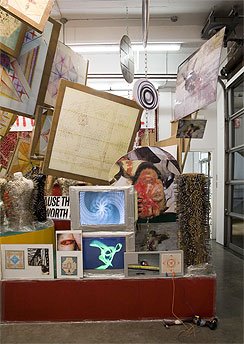
What could be more directly communicating of revolting signs than a severed head, or a barely recognizable human body standing in a pool of blood; what more than a host of texts lifted from various prominent (and not so prominent) media sources… hanging together, a sublime mess, through Hirschhorn’s signature materials: packaging and other common household tapes, nails, screws, cardboard boxes – a detritus of loose and timely material adhering? And this directness (for lack of a better term), a directness so apparently lacking from mainstream political discourse (or art for that matter) is affective, which is to say an emotional thing striking at the heart of the gallery goer, the goer moralizing (and yet in perfect ambivalence about the purpose of art as an instrument of “Moralism” or “sublimation”) before the propinquities and adjacencies of the artist’s “mess”. A mess determinate, yet irresolvable, if to resolve is to terminate any means of productive emotional and critical response, an engagement anything but superficial.

Such an affectivity, that Hirschhorn has produced an affective environment beyond mere “installation,” may account for the fact that everyone has a reaction to his work (whatever which way they are moved). I have certainly found this to be the case in other reviews and in conversations with friends and total strangers about Hirschhorn, including many whose first encounter with the artist’s work was his most recent showing.

The artist is, then, neither a mirror to reflect the world in which she lives, nor a hammer with which to smash said mirror, so much as the bearer of common and extraordinary problems (common problems, then again, often being the most extraordinary) of culture at its most extreme points of pressure, and of the ambivalences these plays of pressure produce irresolvable beyond their presentation. Which is to say, Hirschhorn is valuable to me insofar as his work produces an irreducibility of imponderables. And that these imponderables demand response at the limit where thoughts become feeling (affect) and feeling thought (in between them remaining, perhaps, a profound emptiness; the space in which thought as feeling actively occurs, is born out). As much as ever (and after the 80’s hegemony of critical theory, whereby theory could only stand to frustrate or, worse yet, moralize aesthetic actions) we need the arduous messes of artists such as Hirschhorn.

Tuesday, February 21, 2006

After Waves*


to Aaron Miller
after Gary Hill and Paul Sharits

Children repeat
This wave after me
This image is something
That changes waves
A grainy voice
Should glisten
On this sea

Turns of phrase

The image is something
That changes shape
The image
Something that
Shapes change
A voice
Seen should
Listen to me

Turning grain after grain

Repeat this wave
Repeat after me the
Image is something
Heard distantly
Here is why
We have some stake in color

Heterodyne ~ turn these waves off

Flick them on turning
Phrase after
Phrase
Images should be
Heard
And not seen
Not on these dark waves

These waves turning on and on

Children repeat
To make a change
There is
No reversing
These waves
Only enacting world

These phrases turning like waves

They tune to
Our dreams hetero-
dyne
That a boat was too
Small on that
Sea
That
A phrase was too small
For its frame

From this distance turning grain after grain

As the waves turn off and
Off
Repeat this wave
This word after waves
Heterodyne
A voice is something that
Distorts words
Making them occur

Repeat this image a grainy voice flicks

Children repeat this effect after me

*composed Winter-Spring '05

"a total sense of sense" (the Senseless)


"Seeing, at last, your mind as it must be at times in unendurable anguish, a series of events leading to that sense of self as burden, artaud making art of it, misery, saw your minding of such in my own horror, shocked, shaking my head a crazy catalogue of images, classical symbols, cartoons of grief -- but it is not always so and it is that lack of it which has to stand for joy in the absence of blessings -- and there are, in rare instances, blessings and you are often there at those places and I have a total sense of sense and you are absolutely cream, having to step on plastic flowers, my mind bursting, blossoming -- someday I will tell you my dreams when it is quiet and I am more willing to let the tragic have its due warmth -- that comes later; now I am content that my dreams were dreams."
--Paul Sharits, 1966

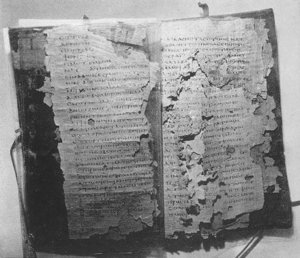
The Thunder : Perfect Mind*


Take me
[understanding] from grief
and take me
to yourselves from understanding
[and] grief.
And take me
to yourselves from places
that are ugly and in ruin,
and rob from those
which are good even though in ugliness.
Out of shame, take me
to yourselves shamelessly;
and out of shamelessness
and shame, upbraid my members
in yourselves.
And come forward to me,
you who know me
and you who
know my members,
and
establish the great ones among the small
first creatures.
Come forward to childhood,
and do not despise it
because it is small and it is little.
And do not turn away
greatness in some parts from the
smallnesses,
for
the smallnesses are known
from the greatnesses.

*from *The Nag Hammadi Library*, trans. George W. MacRae, ed. Douglas M. Parrott (my lineation)...

Monday, February 20, 2006

Innocence (a proposition)*


for Robert Creeley

“… but blinds as it blinds
itself through
what it illuminates.”
-- Jean Francois Lyotard

Some times I know
What it is
To be exposed

What I am to be
This dark singing
Under a lamp.

It is not
To do anything
Not what

We would want
To do, as in
Any impulse

But by necessity
To feel everything
Outside inside

The “dark singing
under a lamp"—
as are such burdens.

I know it is to be
Born out by that
Total regard

Of what it is to be
Seeing also
In a light’s edges.

Song,
Of necessity turning
Cast us back

So to think
The lines
Themselves.

*composed Winter-Spring '05

Wednesday, February 15, 2006

Bouquat On* (Review)


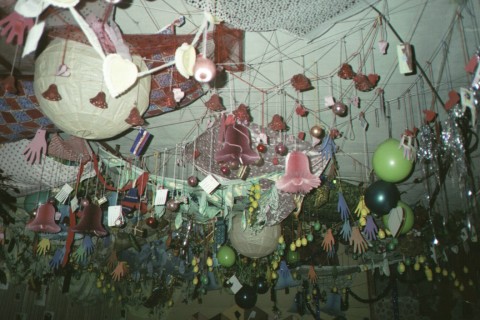
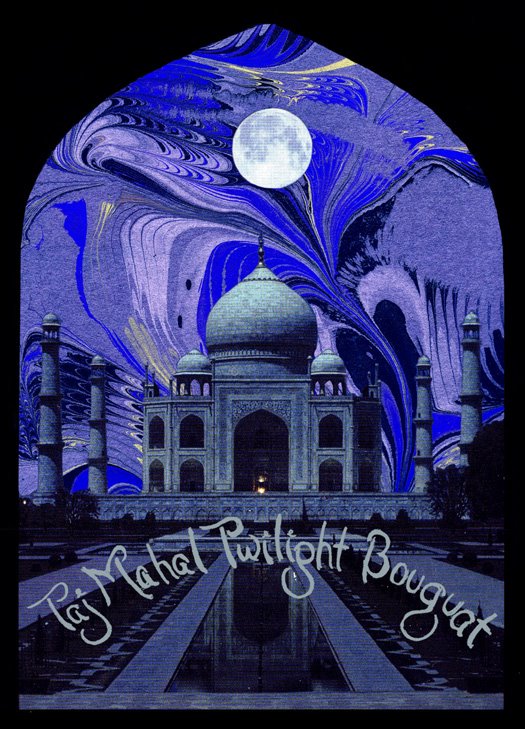
For the past seven years, Abby Walton (along with collaborators Beth Houfek, Sarah Saltzman and others) has been throwing a Valentine's party (qua gallery-sized "installation"/qua all night dance-off) she calls a "bouquat." Says Walton, the bouquat originates in parties her parents and their friends used to throw around Valentine's day in Columbus, Ohio. In the past the bouquat has had the (often twin) themes of: swans (Swanny Boquat), bears/berries (Beary Bear Boquat), weather/fast food (Windy's Taco Tornado), mandables and chocolate (Cocoa Clap). This year's bouquat is called Taj Mahal Twilight, and features (who can guess?) the motifs Taj Mahal and stars.

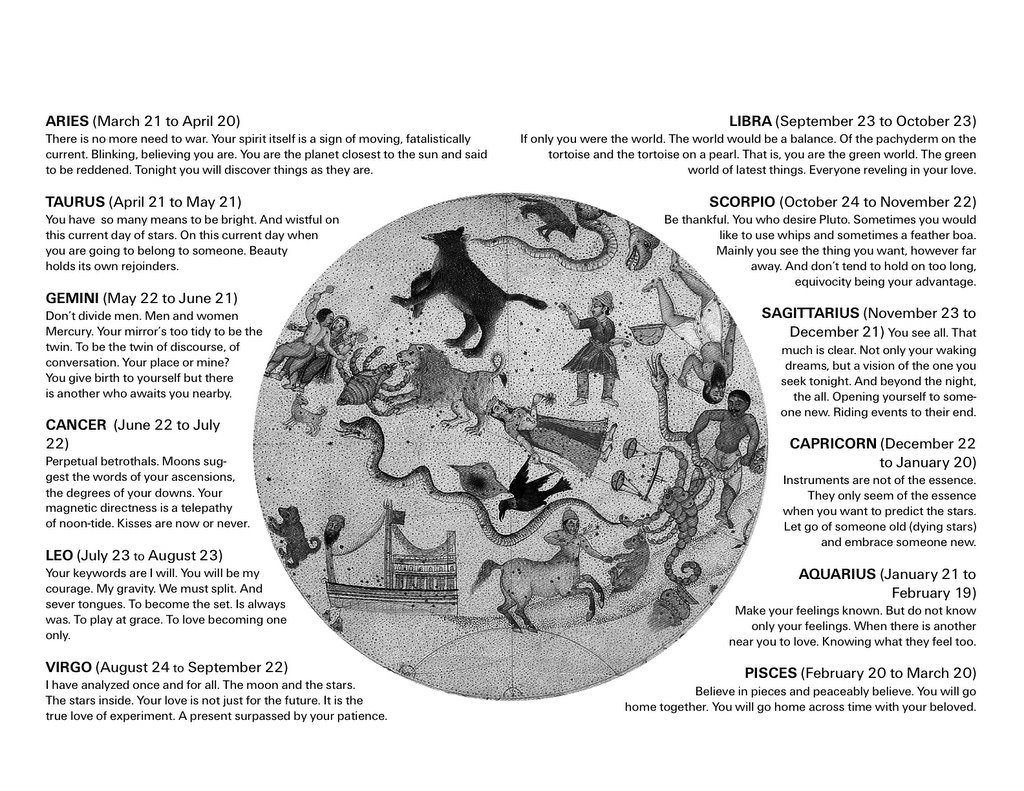
In addition to making elaborate wall and ceiling hangings, wallpaper, baked goods, kissing booths, and playing dance music (generally Hip-Hop and more recently Reggaeton) each year Walton and her collaborators also provide party favors after their theme. This year's favor is a collaboration between myself and Walton, a horoscope which I post below.

Combining folk-"craftiness" with art school "knowing" the bouquat (like much of Walton's work) is an original negotiation of recent gallery-sized installations/environments (of Whitney Biennial or Chelsea galleries) and the more traditional design sensibilities of the party thrower. What makes a difference in this later category is the sheer amount of work and attention to detail the artist gives to the bouquat, an event for which she prepares the entire year round, and for which she is helped by many hands (gathering materials, printing, baking, hanging).

Among other projects Walton is currently at work on, you may also check her ongoing self-portaiture (she has taken a Polaroid of herself nearly every day for the past 5 years), and her "Ponathons," a sewing circle where instead of sewing the participants make miniature pom-poms from a variety of yarrns and other materials. Walton is also the maker of any number of limited edition books, including our collaboration Tears Are These Veils (Wild Horses of Fire, 2004).
ARIES - March 21 to April 20.
There is no more need to war. Your spirit itself is a sign of moving, fatalistically current. Blinking, believing you are. You are the planet closest to the sun and said to be reddened. Tonight you will discover things as they are.

TAURUS - between April 21 to May 21.
You have so many means to be bright. And wistful on this current day of stars. On this current day when you are going to belong to someone. Beauty holds its own rejoinders.

GEMINI - May 22 to June 21 Mercury.
Don’t divide men. Men and women Mercury. Your mirror’s too tidy to be the twin. To be the twin of discourse, of conversation. Your place or mine? You give birth to yourself but there is another who awaits you nearby.

CANCER - between June 22 to July 22.
Perpetual betrothals. Moons suggest the words of your ascensions, the degrees of your downs. Your magnetic directness is a telepathy of noon-tide. Kisses are now or never.

LEO - July 23 to August 23. Their keywords are I will, Sun.
Your keywords are I will. You will be my courage. My gravity. We must split. And sever tongues. To become the set. Is always was. To play at grace. To love becoming one only.

VIRGO - between August 24 to September 22.
I have analyzed once and for all. The moon and the stars. The stars inside. Your love is not just for the future. It is the true love of experiment. A present surpassed by your patience.

LIBRA - September 23 to October 23.
If only you were the world. The world would be a balance. Of the pachyderm on the tortoise and the tortoise on a pearl. That is, you are the green world. The green world of latest things. Everyone reveling in your love.

SCORPIO - October 24 to November 22.
Be thankful. You who desire Pluto. Sometimes you would like to use whips and sometimes a feather boa. Mainly you see the thing you want, however far away. And don’t tend to hold on too long, equivocity being your advantage.

SAGITTARIUS - November 23 to December 21
You see all. That much is clear. Not only your waking dreams, but a vision of the one you seek tonight. And beyond the night, the all. Opening yourself to someone new.
Riding events to their end.

CAPRICORN - December 22 to January 20
Instruments are not of the essence. They only seem of the essence when you want to predict the stars. Let go of someone old (dying stars) and embrace someone new.

AQUARIUS - January 21 to February 19.
Make your feelings known. But do not know only your feelings. When there is another near you to love. Knowing what they feel too.

PISCES - February 20 to March 20.
Believe in pieces and peaceably believe. You will go home together. You will go home across time with your beloved.

No Idem Mother*


Rotate come track the camera around
Come walk the camera around him with child
Come track the camera walk around him an innocent one
An innocent one will pray come track that prayer
Come track that prayer prayer until time ends
Come track until she extends time her life in prayer
Her life in prayer come track her prayer extend the life of mother
Extend her hand vision mother camera pace around these loving two
Light as air he picks up the child her kiss and his embrace as light as air

Effortless to pray for the dead to pray for the dead the dead will come again clocks clocks must pick up where they left off

Where they left off come pace the camera around that lightest prayer for mother

For mother wish this night this night away until day until daylight shines through these windows come track those weeds the wind down


Come walk with the camera camera around around one room one room for the two her kiss as light

Effortless extend her hand as vision this will be a day the body stays stays on earth this will be a day the eyes await

Awaken as in the days of old camera pace in one room in one in one room with the two in one room with the two two candles by the window will show no way through darkness tonight keep pacing keep pace until today the light through the two windows

Two go down go down together together in prayer pacing around the light a kiss the lightest kiss the light on the wall in the room pacing the room of two their light

Spring or fall light one can not tell summer light wind down by the reeds the two one can not tell weather moves over the dunes to find them pacing effortlessly

Effortless as the sea the wind in the reeds the two the two is she dead or are we mother born by prayer by the two two windows filling the room with light the mourners


Rising effortless as the wind from the sea lifting rising to make their tears commence prayer is a habit and a movement make it happen make mother rise again

Make mother the camera here and pacing walk pacing walk around this room room of two in prayer eyes with tears two eyes with tears two windows

Come track until she extends her death in life clocks stop clocks stop until she renders her death in life a kiss
the kiss of one born the kiss the kiss of one dead rising effortlessly as the wind from the sea with tears in her eyes cheeks cheeks and teeth

A new mother not an imitation a new mother a new mother who renders this death in life her tears to be renewed as in the days of old

Her tears our tears for time for time to be renewed the fleeting of of this death in life how light shines on the walls from the windows the reeds how they gather perceptible wind


How tears gather how the mourners gather tears lifting so effortlessly so light to render this kiss this kiss is life rendering death

Pray how the body comes and pray how the wind comes by these tears obey the body the wind in the reeds this camera pace the two pace the two in a circle in a circle the center of the world that has no circumference multiple centers for the eyes this death in life how the body comes how her life alights wind

Light thoughts light think light the child the child thinks light prays her kiss so light this shot around so effortless a central event this camera track circle pace a light the child’s kiss

Labor on the waves a play of light dies it renders life dead and living play on the waves the way reeds tend

We tend toward wind camera pace renewal of the eyes light in the eyes this death in life she breaths again she gasps she kisses no imitation

No mother in resemblance go down the two to reed beds go down the two to win this innocence child pray kiss child pray

*composed Winter-Spring, '05.

For Your Son When He Can Read*


to Alasdair Schlesinger

Pick a time and pluck
The printer thinks in ink
The eyes see mimicry
And pursue it
To their blankest song

These pulses are of the eyes

To blink endlessly
Blink
Among anything your
Body can know
By loving the world
Which you seek

This feeling which is first

Walk amply
In this time
Of letters cleaving thoughts
A body of your
Speaking
Simple whips of talk

Of this prairie green
A myth of this greenness

Initially this spectrum
The mouth is its
Own motor
The body becomes
The world in words
Going a million miles

Green preceding waves
Green conceiving

Attend seriously to
Attention
Errant in its emergence
Flick eyes sing
The mind that is
The body flashing
In a time it leaves

These letters playing their love

Graphically this integer
This year, this
Tear
In time
That is your birth
Against any drudgery

Overtures that overturn all

Attend to attention
Attend
A time of marks, of
Lines again
Your grace is not an
Artillery
Nor a crick of clocks

These pulses are of the ears

*composed February, 2005 for the occasion of Alasdair Schlesinger's birth.

Monday, February 13, 2006

Mazing Vids (Review)


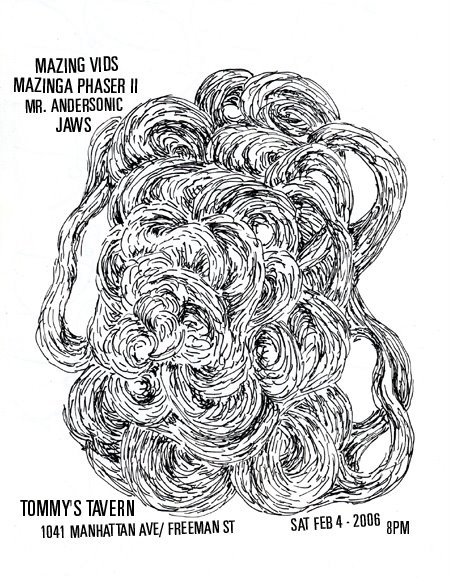
The Saturday before last, February 4th, I had the pleasure of seeing one of NYC's most over-looked and under-published bands in action at Tommy's Tavern in Greenpoint. Mazing Vids are two members, Ryan Byzantine (of Tallboys and Soft on Cuba fame) and Ryan Sovereign (AKA "Redux," of the esteemed Lasereye Stingray and also of the defunkt Soft on Cuba). Their typical configuration has the duo trading off instruments (Yamaha synth. and Fender Jazzmaster) while an 808 drums on. Both players lyricize and (dare I say it!) sing however it is Byzantine who really holds forth, talking psychotically and/or hysterically chanting in a style redolent of any number of post-punk ranters, and particularly channeling (thru years of practiced transmutation) Mark E. Smith (that original of literary histrionics).

Despite their generic company among emergent and established "noise" afficianados, Vids have a particular pop knack, the knack of bands as disparate as Cabaret Voltaire (the early drum-machine based stuff especially), The Clean (and Flying Nun Recs. in general), Desperate Bicycles, Theoretical Girls and others of stripped-down/total-intensity post-punk/electro expertise. What accounts for this knack (among other things) is the entrancing insistence of Sovereign's guitar "lines" whereby the guitarist repeats one riff (or note) thruout an entire song against the grain of the 808 and Chowdhury's lyric weavings. Of the later, the genius of Byzantine's lyrics lie in the artist's singular ability to elaborate within songs as short as two (or so) minutes a veritable set of formal and expressive clarity. As if to break the spell of his (self-induced) siren's song, Byzantine will often take random swipes at the Yamaha or Fender before concluding a song. And it would seem it takes such a gesture for him to return from the mental distances, the distances of psychotic attention, his lyrical performances clearly demand.

Given the duration, intensity and pedigree of the Vids who have played-out with some of the most formidable "art-rock" musicians of their generation (Black Dice, Yeah Yeah Yeahs, and Gang Gang Dance to name but three) I can't help but wonder why they haven't had an EP yet, let alone a full-length. But this is something for the labels (if not historians of NYC "rock") to sort out.

A Fantasy of Description* (Paper)


Propositions and discursus towards an Amateur Angelology

“To come into this world, as we said a moment ago, can have no significance other than to convert its metaphoric reality … into its true Reality …. Our author makes it clear that there can be beings who, although they have in appearance come into this world, since they are there, have in fact never come into it. Inversely – and here the analysis becomes most striking – there are men whom we can visibly discern to have left this world. They are dead, they are no longer there. We say: “They have departed.” No, actually they have never left this world and they will never leave it. For to leave this world it does not suffice to die. One can die and remain in it forever. One must be living to leave it. Or rather, to be living is just this. Can we distinguish in the winter, as Nasir-e Khosraw says, between a living tree and a dead tree? Both, it is true, are materially there. But in one the sap flows secretly. In the other the sap does not flow, because its roots are dead. When the spring comes – that is, the Imam of Resurrection—only the first will be covered with flowers and savorous fruits at his call. It is no indulgence in a mere literary reminiscence if the image of the Iranian philosopher suggests the thought of Balzac: “Resurrection is accomplished by the wind of heaven that sweeps the worlds. The Angel carried by the wind does not say: Arise ye dead! He says: Let the living arise!”(58)”
—from Henry Corbin’s *Ismaili Gnosis and Cyclical Time* (1964)

I. Five Propositions Towards an Angelological View of Materialism Written During a Period of Decisive Withdrawal

Prop. 1. That the world appears materially, but is ungrounded in its apprehended “materialism”.

Prop 2. That there is likely no “material” or “immaterial,” only the hidden (which is to say, occulted) and apparent (or revealed).

Prop 3. That the individual itself (both turned towards and beyond “the each” and “the all,” and being “alone with the alone”) makes the hidden appear as truth.

Prop 4. That in this making the hidden appear the individual achieves exteriority through a radical form of inwardness, what we may call a radical interiority.

Prop 5. That this process is ever fleeting, however utterly dis-continuous and e-ruptive.

II. Discontinuous Creation or A Platonism Without Guarantee

What would a site of discontinuous creation be?

How does such a site complicate “site-specificity” as a term indicating a literalized and anti-metaphorical materialism?

Is the recent turn away from “site-specificity” (if such a turn has in fact taken place) the turn away from an Incarnationalist discourse towards a Docetic view – where the Incarnationist-dogamatist cynically believes that God could be destroyed as matter in the form of the incarnated Christ, and the Docetic-heretic that the incarnation was only the appearance of one, that is, a phantasmic materialization, becoming ghost, or virtual corpse -- the “insight” specificity of each whose eyes beheld the prophet. This “insight” specificity, the assertion of a radical individuation of revelatory and ecstatic vision the gifts of which are bestowed by a Theosophical-Pentecostal Holy Spirit and an Oriental-Islamic Angel Gabriel, hinges primarily upon the verse from the Koran (4 : 156): “They slew him not nor crucified, but it appeared so unto them, and lo! those who disagree concerning it are in doubt thereof; they have no knowledge thereof save pursuit of a conjecture. They slew him not for certain”; yet also on the verse from the apocryphal Acts of Peter: “I saw him in such a form as I was able to take him in.”

Following the opposition Incarnationist / Docetic, is the turn from a “site-specificity” to an “insight” specificity a cultural shift towards understanding “site” as virtual, labyrinthine, non-continuous, apparent, and constitutive of multiple universes, worlds, aeons or degrees (the archaic gnostic divisions of the universe)?

How can the museum / gallery or, for that matter, post-Smithsonian dialectic of “site” / “non-site” become a site of non-relation after this cultural shift? How a site of radical inwardness? Of the responsibilities, if not the imperatives, the necessities, of the super-sensible, the subtle-invisible, and the eternal battle for an imaginal realm? What French Orientalist and scholar of Islamic Theosophy, Henry Corbin, calls, “the battle for the angel”. That is, the battle for the form of one’s possible soul, the soul *in potentia*: an angelic form the event of which is metamorphosis and resurrection of the self, and the world as it extends into invisiblity.

Where, in other words, does “site” become “insight”? And how can works of art and the spaces which ostensibly circumscribe them, turn us from sense to non-sense in productive encounter? Where and when does “site” turn inward to become outward again? The inside inside… The outside inside inside… Being "alone with the alone" to encounter the world.

III. Anti-Historical Materialism and Post-Cinematic Insight

Proposition 6. Historicity is not creative alone, if it is creative at all…

Yet site specificity assumes the case of a series of facts related in sequential duration by cultural or natural forces. History, like evolution, is then continuously created.

But can the non-sense of an imaginal shift throw sense back upon the mind radically, the mind in turn back upon itself. Beyond psychosis per se, halluciogenetics, dream or trance states, hypnosis. Beyond empirical or psychological shifts. . . .

The view of creation I would like to oppose to the continuous one is one eruptive and re-creative, atomistic, occasional. It is one most recently intuited and demonstrated by post-cinematic media. Lebanese artist and writer Jalal Toufic, shows this view of creation as it is demonstrated by cinema in his article, “Middle Eastern Films *Before Thy Gaze Returns to Thee*—in Less than 1/24 of a Second”. His primary examples are taken from the cinema of Armenian-Georgian filmmaker, Sergei Paradjanov.

Thru the jump cuts of Paradjanov’s cinema, the cinematic gaze returns to the viewer before the viewer has had the perception that in an instance between percepts the entire world has been made anew, renewed in a void of non-being. Yet, as Toufic shows, it is entirely in these moments of non-perceptibility that one’s prayers for the world become necessary, a commemoration of the divine as it erupts in the discrete intervals of the world’s creation:

“Out of the clash of any two images, but even more clearly of any one image, do not arise, as in Eisenstein, many concepts (even if, as in Einsenstein, beneath them all be the concept of the dialectic itself or of class struggle), but a *dhikr* (invocation, remembrance) of the one necessary Being, who is beyond concepts; or the notion of the absolute dependence of the myriad entities. The jump cut, 'the sound of one hand [or image] clapping,' is a silent *dhikr*. Forgetfulness of God is a molar illusion, since creatures, not having their substance in themselves, are always returning to that which alone has subsistence, God. If one is enjoined not to forget God for an instant, it is that that is the maximum that one can possibly forget Him, since at the end of the instant one reverts to Him, thus remembering Him. From the standpoint of perpetual creation, we are not forgetful of God, but of our return to, of our non-forgetfulness of, God. As in Buddhism, where though we are in *Samsara*, occluded, we have Buddha nature and Buddha face; in Islam, we are, through this renewed resumption into/return to Being/*al-Haqq*, involved in a perpetual *dhikr*. The explicit *dhikr* in the form of the repetitive invocation and remembrance of the name of the one necessary Reality has an echo in an implicit *dhikr* in the form of the recurrent resolution back of the non-subsisting entity to Reality. The disciple must have meditated enough this atomism and the *dhikr* it implies that however much he reiterates the name of God during a *dhikr* ceremony, he does not go into trance, since trance would be a sign of an obliviousness to the former *dhikr*.”(*Forthcoming*, 2001)

Against Gertrude Stein’s admonition from her 1934 lecture in America, “Portraits and Repetition”: “the only thing God can not do is to make a two year old mule in a minute” – Stein, that writer of “continuous present” and “stanzas in meditation” – everything is possible in Paradjanov’s cinematic universe so long as it can be established by a cut (or, more recently, by CGI). So it is perhaps in inverse relation that Paradjanov/Toufic and Stein compose the world serially, Stein becoming ‘I not any longer when [she] sees’ (that is, non-identical in the act of writing as envisioning), Paradjanov/Toufic expressing God (or remembering not to forget Him as it were) where there is no longer an identical subject “I,” the subject becoming disidentified by the recurrent occasions of divine commemoration.

Following Toufic’s highly original body of work, insofar as post-cinematic media is non-linearally generated, serialist, and emanationist (created and creative of light) it may do us best to locate a phenomenology of insight specificity in a poetics of cinematic and post-cinematic metaphorization.

IV. The Preservation of the Imaginal or Non-Sensical Imaginary as an Approach to Being Opposed to a "Literal"-"Allegorical" Imagination (or How to Make a Radical Interiority)

The special view of “materialism” I have only begun to point to and articulate in this presentation is one derived from Gnostical trends since the 1st century (Common Era), and both subtlized and intensified by the confluent discourses of Sufism, Neo-Platonist Theophany, and Persian Gnosis between the 10th and 12th centuries, yet it is a view that may be useful, if not salvational, for our present. What now is at stake in angelological insight and how does it bear on aesthethic production and reception?

Perhaps a better question may be why does a mystical or Gnostical understanding of the material world still matter?

If gnosticisms (literally: special ways of seeking knowledge) and mysticisms have continually been persecuted since their beginnings in Hellenic-Alexandrian culture (5th century B.C.) it is probably because they present a radical relationship between the individual and the divine. This relationship, for lack of better terms, may be called immediate and Pneumatic insofar as the individual, beyond the authorities of a Church or dogmatic hermeneutics or law, discovers the divine for herself through visions, revelations and ecstatic intuitions, that is, through a special imaginative ability. The angel of Islamic, Ismailian gnosis, for one particular example, is not the angel of a multiplicity or a community of beings, but a singularity equivalent only to the soul of the individual who seeks to know that soul as a name, event or symbol within a cyclical and recurrent eternity: an eternity of not one resurrection but countless, of not one degree of being but many: an eternity that the contemporary French philosopher, Gilles Deleuze, after Nietzsche’s Persian influenced notion of Eternal Return may recognize as a “disjunctive [ontological] synthesis,” and his colleague, Alain Badiou, “the truth of the event”. The struggle for this singular angel within eternity becomes a collective struggle, a struggle of all beings for the resurrection of the world, through a going within – into the imagination, into the mind, into a dialogue with divinity – that turns each individual towards God and in so turning turns God toward itself, face-to-face with the reality of its creation. In being so turned, “alone with the alone” as the 11th century Theophanist Ibn Arabi calls it, one turns outward towards the entirety of beings which should not be said to be of an actual world, but an imagined one which determines the “apparent” or “material” one so-called. Surpassing any contemporary view of the individual as an ego cruelly isolated by her interiorization, capitivated by the reifications of late-Capitalist Postmodernity, such a notion of interiority may be said to be radical in the way its puts the singular and multiple into ethical relation. The movement of this ethics, an ethics that may be termed that of a radical interiority or an interiority surpassing interiority towards exterior, is one that begins in the imagination coeval with the nervous system (the heart) however irreducible to the senses per se, compelled, as it were, by a non-sense of subtler organs…

If I could finally put forward an equation for a gnostical materialism of the radically interior it may look something like this: from the heart the imaginal, from the imaginal the interior, from the interior to the interior’s limit, from this limit to dialogue of the divine, from the dialogue of the divine to one’s angel (soul-event or true name), from the angel to a community of beings, from the community of beings a return to the heart… Universal Love being preserved by this need to imagine, to turn towards, to be face-to-face, to defer a conclusive understanding of the mysteries one most needs to know.

V. For the Cycles

“It is their own Iblis [darkness, demon] that they must hurl into the abyss, and in doing so they wage battle for the Angel who is in them in potentia. To reflect in oneself the Temple of the eternal Imamate is to anticipate the consummation of the aeon; it is here "to become aeon," to produce in oneself the mutation of cyclical or measured Time, and for each adept this consists in assuming in his person an increasing exemplification of the Angel's being. This implies that what occurs in and by the person of each adept also affects the being of the Angel who is their archetype and who finds exemplification in them.”
--ibid, Corbin

Where space begins suddenly
In time and presupposes our love
For the worlds (the world) what image will you
Make
Will one make
So neutral to think
The voice
A delay shapes

Delayed shapes suddenly here
And not here
Not yet to shore
The body up
Not the erotic
Mind you occult
By drinking up ink
A scholastic problem

Of love delaying future shapes
Of a certain bow
Of an angel struggling
In potentia with
A certain bow
Circular to sing

The inside before his breath is done
Before light light falsely
Catches up

A retard
To light
Catches up
To words
An allegory of their fall

And not a fall
Serials
From light evening light

Night / Light
Not a fall

As light so literal
An angel in actuality
Kept by its words.

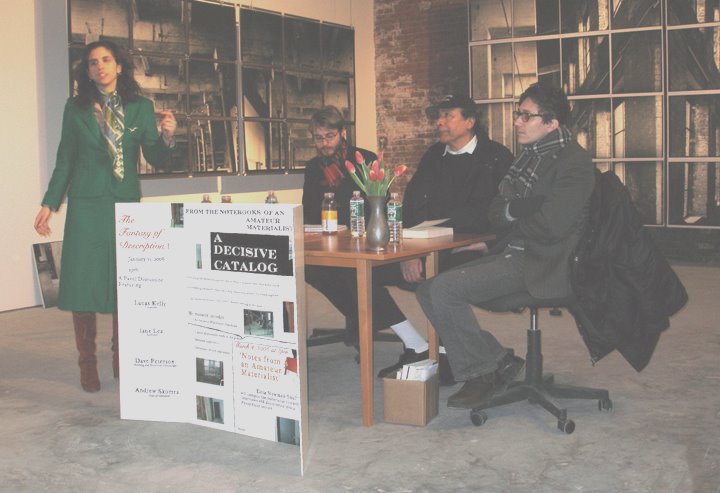
*"A Fantasy of Description" was delivered as a paper at Smack Mellon gallery (Brooklyn) Feb. 11th, 2006 as part of the second of two panels (Fantasy of Description I & II) organized by Eliza Newman-Saul for her project "From the Notebook of an Amateur Materialist" currently on exhibit at the gallery. Newman-Saul's talk, "From the Notebook of an Amateur Materialist" will take place March 4th at the close of the larger exhibition, Site 92. Other panelists have included Matvei Yankelevitch (Ugly Duckling Press), Professor Raphael Ortiz (Rutgers University Art Dept.), Jane Lea (Columbia University Graduate School of Architecture) and Andrew Skomra (The Center for Psychoanlaysis and Culture, SUNY-Buffalo).

Friday, February 10, 2006

Knowing Not Knowing (Alone With the Alone)*


to Eliza Newman-Saul

The ‘interlocuted Same’ is a voice of ‘inner discourse’ (consider Lacan on Judge Schreber) of which we all perhaps partake, a voice interlocuting, circulating or circuiting in Generality. …Or the voice of God talking to Itself (Toufic); the ‘middle’ or ‘neutral’ voice of literary ontology (Blanchot).

Re: your “caring” or “uncaring” in an event of exchange or “communication” between “people”… I’m not sure that what I wish to address through our project is communication per se – whether something is “boring” or “of interest,” “private” / “solipsistic” or “inclusive” / invitational / dialogic. I want to attain the moments everyone should / does care about because it concerns no one in particular – a deepest interior shared in exteriority, a non-numerical thirdness of all entities / “parties”.

It is a genuine withdrawal beyond “performance” -- not experienced because experienced by no one -- that is a call to listen or to silence rendering interest / boredom out-of-the-question (expression or silence as “pure” interest: interest that stays interest?).

So perhaps it shouldn’t matter whether our video has a soundtrack or not: soundtrack should be silent, should evoke a silence, and that silence should be expressive / interesting in this sense and not merely non-invasive (avoiding interference with image-track). It is this silence that is not contingent on “actual” sounds.

Yet all this seems something different from my original proposition and your response. The thing I want to return to is “knowing,” compensations for “knowing” and “not knowing” (should we not also have to compensate for knowing if we should have to for not?).

As a precedent for our collaboration, what comes most readily to mind are David Antin’s transitional works between ‘meditation’ and ‘talk’ in which he and his wife proceed by a series of tape recorded ‘exercises’ by which they defer a unity of narrative intention and conclusive interpretation through conversation (and all that conversation entails in terms of interruption, distraction and circular modes of attending).

Only we may start less determinately and without so much “ironic flair”. To experiment with the consequences of beginning somewhere (anywhere?) in a series of texts, and to relate these texts interpretively to produce knowledge (however elliptical or circular) about them. In compensation for not knowing them we may perhaps come to know something else. A know how of ourselves, of poetics, of thinking itself opening beyond both the drudgery of textual authorities and the interiorities of private fancies and fantasies not nearly interior enough (not so interior that they produce an exteriority in which the different becomes equatable, if not Univocal). An ethics of commons.

*composed Jan '06 to Eliza Newman-Saul towards a series of collaboratve video performances w/ the artist. "Knowing Not Knowing" is a follow up to the post on this blog, "Compensations for not Knowing".