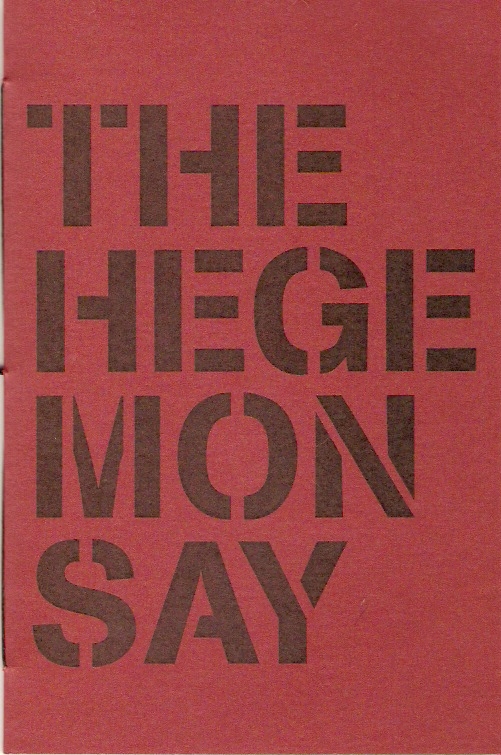
I am thrilled to have work in Robert Dewhurst's brilliantly edited Satellite Telephone vol. 3, which includes work by BRUCE BOONE, JOSHUA BECKMAN, MARIE BUCK, TODD COLBY, CACONRAD, TANYA LARKIN, HEDI EL KHOLTI, ISH KLEIN, CHRIS KRAUS, NICOLE MAURO, SHARON MESMER, REBEKAH RUTKOFF, and ROD SMITH, and art by TRACEY EMIN.
Friday, March 19, 2010
Satellite Telephone vol. 3
I am thrilled to have work in Robert Dewhurst's brilliantly edited Satellite Telephone vol. 3, which includes work by BRUCE BOONE, JOSHUA BECKMAN, MARIE BUCK, TODD COLBY, CACONRAD, TANYA LARKIN, HEDI EL KHOLTI, ISH KLEIN, CHRIS KRAUS, NICOLE MAURO, SHARON MESMER, REBEKAH RUTKOFF, and ROD SMITH, and art by TRACEY EMIN.


Monday, March 15, 2010
Interview with Guy Ben-Ner in BOMB

This past winter I was fortunate enough to be able to interview one of my favorite contemporary visual artists, Guy Ben-Ner.
You can read part of the interview here and the rest in print.
Thom Donovan: I watched Second Nature and If Only… tonight. I am thinking about the significance of their many literary allusions: Waiting for Godot, Aesop’s Fables, The Little Prince, Around the World in Eighty Days, The Divine Comedy, King Lear, Don Quioxte, and many other classic works of Western European literature. How does literature influence your work and how do you come to use source texts?
Guy Ben-Ner: In my earlier movies, literature functioned more like a construction upon which I could mount my own material. The grand narratives I am interested in have a peculiar trait: they pretend to be inherited rather than acquired. Most people think they know Moby-Dick without ever really reading the book. When I first read Robinson Crusoe, I already felt I was revisiting it. Everybody knows what the Oedipus complex is, though I doubt many people actually read Freud on it. These narratives are so well integrated into our culture—they actually form this culture—that it feels like you get them from looking at milk cartons and Corn Flakes boxes. In the same way, IKEA showrooms look familiar; you feel like you’re back home, although it never was anyone’s home. I think grand narratives are exactly what you can never revisit—you were never with them, and yet they never really left you. It might seem simple to bring grand narratives down into one’s kitchen, but the relationship is complicated. The “fiction” and my “reality” had to enter into conversation—in Wild Boy, for example, my son really does utter his first English word on-screen, just as the wild boy does. He gets his first haircut and you see him barely managing to dress alone for the first time. It’s both reality and fiction. The fictive element was structured as a “play within a play,” (the obvious example would be the play staged in Hamlet) and that fiction serves as a motor to generate real events in the actual life of the participants. None of the “readymade” material I use comes from the desire to pay homage to this or that artist/writer. I’m using source material as a survival kit, as building blocks; I don’t know any other way. I hope this doesn’t come off as some kind of intellectual game—it isn’t. The “knowledge” I use, those quotations, are a stick to help me walk. I would limp otherwise.
Wednesday, March 10, 2010
All the Whiskey in Heaven official NYC launch!!!
 All the Whiskey in Heaven: Selected Poems of Charles Bernstein launch
Sunday March 28, 2010, 6:30pm
Zinc Bar
82 W. 3rd St, New York, NY
Poets & friends read from All the Whiskey in Heaven
Thom Donovan
Peter Gizzi
Kenneth Goldsmith
Erica Hunt
Dorothea Lasky
Tan Lin
Elizabeth Willis
& Charles Bernstein
hosted by Dorothea Lasky
more information on the book at
http://epc.buffalo.edu/authors/bernstein/books/all-the-whiskey/
read a review of the book in Time Out New York here: http://newyork.timeout.com/articles/books/83616/charles-bernstein-all-the-whiskey-in-heaven-book-review
Facebook event page: http://www.facebook.com/profile.php?ref=profile&id=31844#!/event.php?eid=353717594665&ref=mf
Monday, March 08, 2010

On Jane Sprague's The Port of Los Angeles (@ Harriet)

here
In the first part of Sprague’s book she tells a story. She sings herself, “Citizen Jane,” in conveyance (her family’s move from Upstate New York to Southern California), and in doing so speaks both of personal loss—a loss of feeling rooted in a place—and about conveyances far exceeding herself—“ourselves perfectly pitched at the edge of globalism.” (23) Global or international economic exchange is represented by the ports of which Sprague also sings (“container / as the staple / vessel of modernity” [28]). The ports encompass a local ecology of dockworkers and natural phenomena, drug and sexual trafficking, goods transported via shipping containers and other modes of transport. They are also the backdrop for the United States’ over-consumption; its consumption of world products and commodities at the expense of others within an international community—their labor power, their health/wealth, the security of their families and communities. “ownership or loss / and ‘no bordered sense of that’ / I do not know how we were to be (we) unbordered.” (32) Irresponsible consumption and waste as a result of exception.
Sunday, March 07, 2010
"I am testing..."
I am testing a series of propositions about friendship and
Community which may or may not last in time
Or produce the results I would have wanted or intended
I am testing them against the tried ephemera of political action
And reflection on this action called theory
Even while it may be occurring
No dream encompasses this contradiction
Between what we dream and how we wake up
And an effective mode of action within a particular
Set of forces or relations
Thus the feeling one is doing nothing
While one is in fact doing everything
One must act very specifically
While maintaining the possibility of everything.
Community which may or may not last in time
Or produce the results I would have wanted or intended
I am testing them against the tried ephemera of political action
And reflection on this action called theory
Even while it may be occurring
No dream encompasses this contradiction
Between what we dream and how we wake up
And an effective mode of action within a particular
Set of forces or relations
Thus the feeling one is doing nothing
While one is in fact doing everything
One must act very specifically
While maintaining the possibility of everything.
For Robert
My friend when you go away
Into a medical emergency
An emergency of how living
Is practiced I miss you
I feel I am missing out
On my own life the consequences
Of which a building never
Materializing would make it true
Because the building is never
Built it remains a proposal
Or plan about how prosody
Lifts the body outside itself
How ekstasis cures
Your books remain to be written
Because the possible
Doesn’t end with words.
Into a medical emergency
An emergency of how living
Is practiced I miss you
I feel I am missing out
On my own life the consequences
Of which a building never
Materializing would make it true
Because the building is never
Built it remains a proposal
Or plan about how prosody
Lifts the body outside itself
How ekstasis cures
Your books remain to be written
Because the possible
Doesn’t end with words.
The Archivist
Because you wanted the world to hear
What you heard
Ears are all we are sometimes
A moment of music on them
And not all this drudgery
That is work and that is
A politics of work
The details not the mirage
Of seeing that’s what the archivist sees
Like we were sometimes just eyes
No longer I when we see
Stein said that
Because the world is mindful
Of identity you were taping it
All the time even the noise even the blanks
Before they organized our memories
What was even searchable
As memory
How any of it could impress us
This is where music comes in
Structuring the thing otherwise
All that time with the tape on
Just in case there was music.
What you heard
Ears are all we are sometimes
A moment of music on them
And not all this drudgery
That is work and that is
A politics of work
The details not the mirage
Of seeing that’s what the archivist sees
Like we were sometimes just eyes
No longer I when we see
Stein said that
Because the world is mindful
Of identity you were taping it
All the time even the noise even the blanks
Before they organized our memories
What was even searchable
As memory
How any of it could impress us
This is where music comes in
Structuring the thing otherwise
All that time with the tape on
Just in case there was music.
Thursday, March 04, 2010
Some words for Dave...
 Here are some words I read for Dave Nolan's funeral on behalf of the 92nd St. Y this Wednesday afternoon at St. Mark's Church. The service for Dave was sublime. I am still reeling from all of the lives he touched, the immensity of his circles...
Dave Nolan was both a friend and my colleague at the 92nd St Y on the Upper East Side. We worked there together for what would have been four years this spring. Dave was a loved person at the Y. Loved for his friendliness and collegiality, and for his unique fashion sense (I will never forget the signature cowboy hat coupled with business attire and Hippie accessories). I would look forward to having a conversation with Dave usually at my desk about archival issues related to our jobs, but also about Downtown poetry and music, and the social histories surrounding St. Mark’s Church and The Bowery Poetry Club.
Dave and I worked on a project together at the Y to digitize the Unterberg Poetry Center’s collection of audio recordings from the center’s ongoing literary events series. Through Dave’s example as an archivist I learned a lot about archivism both as a profession and an art. Not only did Dave teach me to think about what the job of the archivist is and how properly to perform it, but also about archivism as an ethical relationship to cultural materials. Without the care and dedication of rare people like Dave we wouldn’t have archives, and therefore would lose our relationship to the past, to history, and to possible futures. As a result of Dave’s efforts, many hundreds of the Y’s programs are preserved for posterity. Likewise, Dave was instrumental in creating an infrastructure for further preservation projects across the Y’s many departments and programs.
To take on many of the archival projects that Dave undertook, made him that much more rare a person. This past New Years day right here at St. Mark’s Church Dave recorded yet another poetry marathon for the Poetry Project. This is a work of love. To attend local poetry, to attend poetry culture as a marsh for more visible cultural expressions and forms, to attend poetic language as a glue which binds us all. Dave served poetry and poets through his work at the Y, but also through his work at Poets House, Bowery Poetry Club, and The Poetry Project. Poetry will miss him and so especially will I.
World Remaking in Kathy Westwater's Park (@ Brooklyn Rail)

here
While there were many memorable moments about Westwater’s highly episodic work, two particular moments of the performance struck me as particularly evental. The first occurred when dancers Rebecca Brooks and Ursula Eagly rolled out a large sheet of Mylar over the studio floor and proceeded to walk on the Mylar in shoes fashioned from wood logs. Gradually and in synch, Brooks and Eagly walked towards each other, turning at the center of the sheet to face the audience. They then walked towards the audience until they were nearly at the front row. As Dan Hurlin rightly pointed out at the beginning of the post-showing Q&A, the ritualistic walk was “mythic,” conjuring simultaneously both dryads (tree nymphs) and some kind of evolved humanoid creature of the future. Crouching before the audience, the dancers transformed themselves into something at the limits of the human. Their slow movements and pronounced breathing patterns struck me as otherworldly and strange.
Rachel Levitsky's Neighbor (@ Harriet)

here
Something which attracts me to Levitsky’s book are the narrative qualities of the writing. How a sense of scene or episode is always erupting into philosophical/theological speculation and lyrical play. From the start of the book, there is an almost scholastic quality about Levitsky’s thinking, whereof she contemplates the “levels” in her head. Also from the start of the book, there is the sense that the voices of the book do not just belong to a singular person, but represent the person subjected in specific ways. That there is someone that calls itself “I” in Levitsky’s book is crucial. And that this “I” is self-conscious of itself in relation to neighbor(s) enables Levitsky to establish a continuous meditation on ethics, geopolitics, and sexual encounter/desire. The “I” of Levitsky’s book disjunctively narrates her (and our) own interpellation by local, national, and global functions of power. Neighbor as Other, but also as interstice of public/private, exterior/interior, becomes the site where person and subject cleave.
Tuesday, March 02, 2010
David Nolan 1962-2010 (via Poetry Project @ St. Mark's)
It is with great sadness that we share the news of the passing of our longtime friend David Nolan. David suffered a heart attack last Thursday, February 25th. The funeral will be held this Wednesday, March 3, here at St. Mark’s Church. The service will run from 4pm to 5:30pm. A reception will follow in the Parish Hall from 5:30pm to 7pm.
Many of you know David through the countless volunteer hours he spent at Project events helping us with sound and guiding us through technical knots. He spent all of New Year’s Day, this year and last, along with David Vogen, making sure each performer everything they needed for their performance, and making sure the Project always got the highest quality recording. It was clear that he got a lot of joy from the work that he did for us as well as so many other organizations he was connected with. He loved being here and we loved him and will miss him dearly. Look for an extended obituary in the Fall issue of the Newsletter. Our deepest condolences go out to David’s family and friends. His family asks that in lieu of flowers donations be made in David’s name to one of the community and arts organizations that he worked with during his life.
East Village Community School – 610 E. 12th St., Rm 205, NY, NY 10009 Attn: Mary Talbot
Poets House – 10 River Terrace, NY, NY 10282 Attn: Jane Preston
Theater for the New City – 155 1st Ave. NY, NY 10003 ATTN: Crystal Field
WBAI – 120 Wall St.10th Fl. NY, NY 10005 ATTN: Morning Dew
The Poetry Project – 131 E. 10th St. 10003 ATTN: Stacy Szymaszek
Many of you know David through the countless volunteer hours he spent at Project events helping us with sound and guiding us through technical knots. He spent all of New Year’s Day, this year and last, along with David Vogen, making sure each performer everything they needed for their performance, and making sure the Project always got the highest quality recording. It was clear that he got a lot of joy from the work that he did for us as well as so many other organizations he was connected with. He loved being here and we loved him and will miss him dearly. Look for an extended obituary in the Fall issue of the Newsletter. Our deepest condolences go out to David’s family and friends. His family asks that in lieu of flowers donations be made in David’s name to one of the community and arts organizations that he worked with during his life.
East Village Community School – 610 E. 12th St., Rm 205, NY, NY 10009 Attn: Mary Talbot
Poets House – 10 River Terrace, NY, NY 10282 Attn: Jane Preston
Theater for the New City – 155 1st Ave. NY, NY 10003 ATTN: Crystal Field
WBAI – 120 Wall St.10th Fl. NY, NY 10005 ATTN: Morning Dew
The Poetry Project – 131 E. 10th St. 10003 ATTN: Stacy Szymaszek
Friday, February 26, 2010
Commoning
--for Steve Collis
Spilled in the language's veins
A militant regard
When will it be
A tool for something other
Than exchange watching us fuck
Them up in the dance with
Forces again
The city shine with it
Little estates make a little
Shit out of me
You are everything
To me dear abstractions fleeting
View of the thing from the thing
In itself trees move with us
Our disappearance
We disappear the world thus
Appears flashes with
Thoughts spreading in these leaves
Bifurcating futures
Like elements huckleberrying
Like language sometimes
Squats in us.
Spilled in the language's veins
A militant regard
When will it be
A tool for something other
Than exchange watching us fuck
Them up in the dance with
Forces again
The city shine with it
Little estates make a little
Shit out of me
You are everything
To me dear abstractions fleeting
View of the thing from the thing
In itself trees move with us
Our disappearance
We disappear the world thus
Appears flashes with
Thoughts spreading in these leaves
Bifurcating futures
Like elements huckleberrying
Like language sometimes
Squats in us.
Thursday, February 25, 2010
Three Proposals (@ Harriet)
here
“Not let this story dry” (aka “The Dolors of Glenn Beck” or “Instant Tears”), will take up a proposition from Baruch Spinoza’s Ethics: “The more an affect is known to us, then, the more it is in our power, and the less the Mind is acted on by it.” I would like to re-present Beck as a series of affects in order that the Mind (consciousness, cognition) may become less reactive, more prepared for action and reflection. Participants in the performance will be provided with a few basic instructions: the first, to watch Beck videos on YouTube and to memorize three or more of his gestures; the second, to select footage of Beck’s speech and gestures at their most pathetic/histrionic; the third, to practice these gestures and speeches together and separately (as if to separate language-track and image-track) until they feel like the gestures/speech become more of less involuntary, something they can perform without having to think about them, that their muscle memories have assimilated.
“Not let this story dry” (aka “The Dolors of Glenn Beck” or “Instant Tears”), will take up a proposition from Baruch Spinoza’s Ethics: “The more an affect is known to us, then, the more it is in our power, and the less the Mind is acted on by it.” I would like to re-present Beck as a series of affects in order that the Mind (consciousness, cognition) may become less reactive, more prepared for action and reflection. Participants in the performance will be provided with a few basic instructions: the first, to watch Beck videos on YouTube and to memorize three or more of his gestures; the second, to select footage of Beck’s speech and gestures at their most pathetic/histrionic; the third, to practice these gestures and speeches together and separately (as if to separate language-track and image-track) until they feel like the gestures/speech become more of less involuntary, something they can perform without having to think about them, that their muscle memories have assimilated.
Tuesday, February 23, 2010
Others Letters: Dana Ward (@ Harriet)

here
"So much to say, but one thing I’m curious as to yr thinking is the sort of standardized sense of how poetry becomes public. I’ve noticed, both in listening to your reading the other morning, & then in reading some of your notes at Harriet, perhaps in some of the comment fields there, that you talk about the absence of a standard trade edition of your work, or have a sense of its belatedness/potential, depending. Very interested in you talking about how Wild Horses of Fire performed some of that work in advance of/in tandem with the absence of, a more normative mode of tech. bringing it into the world–the perfect bound book. What’s your sense of the latter’s import outside of its obvious practical use–having a physical object to put into the hands of others. Do you think/write at the scale of ‘the poetry book’ as it stands as currently administered thing 80-150 pages? As someone in a place similar to you–a lot of poetry with no real physical center of gravity–wondering what your desires are to this end? I have a nagging sense of dissatisfaction, centered primarily around the fact that the work I make rarely wants to open out over the course of 60 pgs. Shorter interrelated quasi-serial works, more like constellations really, seem for me to be the way correspondence/ togetherness exerts its magnetisms between poems. Then there’s really from there but a ’stack dump’ of shorter books into this form. Vexing! Always this beautiful problem of how to be public, my favorite problem."
--Dana Ward
Park
--after Kathy Westwater and Jennifer Scappettone
I want to make a park with you
Make a campfire in the park
Like Mylar crinkles like light is durable
The light that unmakes us
I want to make a fort where
Melody was and our voices were
Where our voices became a
Collective cry in the lost air
And yet uplifted and yet
Somehow spoken
To me not in heaven yet
Not into its hands
Nor enclosed the voices we do
The fences we tend to also a kind
Of unmaking
Bodies full of pain remake
The world because they are not just
A language never were they full
Of grace the toxins structuring us.
I want to make a park with you
Make a campfire in the park
Like Mylar crinkles like light is durable
The light that unmakes us
I want to make a fort where
Melody was and our voices were
Where our voices became a
Collective cry in the lost air
And yet uplifted and yet
Somehow spoken
To me not in heaven yet
Not into its hands
Nor enclosed the voices we do
The fences we tend to also a kind
Of unmaking
Bodies full of pain remake
The world because they are not just
A language never were they full
Of grace the toxins structuring us.
Thursday, February 11, 2010
Wednesday, February 10, 2010
Teaching Etel Adnan's The Arab Apocalypse (@ Harriet)

here
"Opposing the volcanic with the solar, Adnan evokes the power of the immanent as a power outshining the light of the sun. This power will produce a kind of interruption—an apocalypse—of the human that may lead to a night of “peace and knowledge” (a wish the book closes with). The volcanic moon will be brought down to earth—its cratered surface (only recently territorialzied by US astronauts at the time Adnan is composing her book) a mirror of the earth’s own volcanic surfaces—and through this inversion (both a geological one and a mystical one) an apocalyptic solar night will remember those of the Civil War. An impossible remembrance. The remembrance of occlusion, of occult discourse. A remembrance of the body which experiences the pain of the cosmos–the ears becoming little suns, the eyes becoming little suns. What Jalal Toufic calls “undeath”; undeath as a condition of possibility for remembrance, and for bearing witness to human and non-human (cosmic, terrestrial) cruelty. Jalal Toufic in his talk last week at St. Mark’s Poetry Project told me that to deserve the event (the event which is the disaster of the Lebanese Civil War and other all-too-human disasters) requires that one have collaborators. Evoking terrestrial forces–calling them “I,” saying “I” brings them forth–both Césaire and Adnan make the earth their collaborator, their texts/persons solar anuses (little suns shooting out of every orifice)."
Tuesday, February 09, 2010
ON Contemporary Practice vol. 2 Bay Area Launch

ON Contemporary Practice vol. 2 launches tomorrow at Moe's Books in Berkeley, CA.
Here's my write up about the event and vol. 2 at Harriet.
Subscribe to:
Posts (Atom)