Wednesday, July 18, 2018

Christmas 2015


My daughter (I can finally say that!), my daughter what is Christmas to a Jew? And what is New Years when we/you were just born.

The NICU is no place for loving you, there are never enough nurses for this world.

Like music, the world is measured by your breath, an alarm is all we fear.

You paw at my chest like an animal, because you are an animal.

You search/seek out sustenance when all I can provide is song and warmth.

I sweat with the different instruments pressed to our skin.

While your mother is somewhere else, I am your mother for this instant, and song is your mother.

The tones coming out of me are all we can know since infancy is everything, it is everything we do.

Little blank of my measure, little rupture, hiccup to erupt, read the world in milk.


Friday, January 12, 2018

Second Reflection, Second Innocence: Linguistic-affect and Anti-debt Prefigurement in Corina Kennedy’s Tender for All (Essay)


The new Afterimage double issue features an essay I wrote about Corina Kennedy's "Tender for All," an exhibit which appeared at PC4 gallery in Yonkers in the fall of 2016. The following is from the essay:

As Thomas Gokey remarks in conversation with [Chris] Kraus in the pamphlet Lost Properties, “Debt is such an immaterial thing, but I feel it in my body. I feel the stress of it, I feel the weight of it.” By laboriously scoring the language of debt—both in its Canadian and United States contexts, and in English and French, and English and Spanish respectively—Kennedy registers debt as an immaterial force weighing upon our consciences, organizing the subject through ressentiment—Frederick Nietzsche’s term for ways of remembering that prevent action, creativity, and conatus. Related to this effort is a sustained attempt to capture debt’s mood or tone. Encountering the language of debt writ large, albeit in hushed shouts, Kennedy reestablishes a distance necessary for experiencing certain uses of language as endemic to our emergence as subjects within the debt economy[.]


Wednesday, January 10, 2018

On Renee Gladman's Prose Architectures (review)

The following is from a review of Renee Gladman's Prose Architectures written for Hyperallergic:

Gladman imagines writing in English (would the experience be different in an iconographic or hieroglyphic language?) as a form of drawing, a sequence of lines. She recalls Gertrude Stein’s preoccupation with the “continuous present” of composition, and her frustration with repeatedly “beginning,” a quality she associated with the 19th Century Novel and which she attempted to transcend with her word portraits. Through the cube, a form that is both Platonic and ultra-Modern, Gladman begins to think about sentences and, eventually, paragraphs architecturally. “Were you building the present?”, she asks, closing this section of Calamities with the statement: “For a while, I hadn’t actually been writing but doing a transcription that fell in the deep space between drawing and landscape.” What links writing and drawing (in English) is their sequentiality — one word or line leads to another — as well as their essentially architectural character. Crossing over from writing to drawing, as Gladman does in Prose Architectures, therefore seems no crossing at all.


Tuesday, December 12, 2017

unbag Issue 2: End


unbag Issue 2: End is now available for pre-orders! This issue features critical essays, literary works, visual art, and web-specific projects that begin with the notion of “end.”
Featuring projects from: Morehshin AllahyariDevin Kenny and Justin AllenAmerican ArtistThea BallardDaniel CerrejonFayen d'EvieJesse Darling, Benjamin Davis, Thom DonovanShawné Michaelain HollowayBaseera KhanWill Lee, Ishmael Marika, Precious OkoyomonAshwin RavikumarJoe RileyJonty Tiplady, Calvin Warren, and Intersectional Lexicon Against Xenophobia, Racism, Sexism, Ableism, Homophobia, and Transphobia, Etc.
First 50 pre-orders receive a limited edition risograph print by Paul John, Too Woke to Live, Too Dumb to Die.

Friday, December 01, 2017

Being Gone To Be Here

Sell snowballs and plunge outside
Be the noise you want to see
No authority just you and me
Making common shadow

Recovered from visibility
From this body when a hood would do
You go to them flashing
Fleeing authority through hair, fleeing form

When black and blue would do
Where hoops are insanely tall
And everything can be remade
The world is never the world
Being gone to be here

Friday, November 17, 2017

Reading at Segue Series 4/15/2017

Here is an audio recording of a reading I gave from "Ressentiment," the second part of my ongoing anti-memoir, Left Melancholy, at Segue last April.

https://www.mixcloud.com/SegueReadingSeries/thom-donovan-for-segue-reading-series-041517/

Thursday, November 16, 2017

MEATYARD, MY NEIGHBOR for Pre-order at Apport Editions

https://apporteditions.wordpress.com/books/


Originally intended as the beginning of a collaboration with another writer, Meatyard, My Neighbor was composed when I first arrived in Manhattan in the fall of 2005, and has been edited and worked over many different times in the past decade, often as part of unpublished poetry manuscripts. During that time I was steeped in the work of the Lebanese writer and artist Jalal Toufic and his many theoretical and aesthetic reference points that I shared an interest in, including the Kentuckian photographer, Ralph Eugene Meatyard. Meatyard’s work appealed to me since it seemed to use photography as a means of visualizing the metaphysical, therefore making the ‘otherworldly’ available through an ensemble of “aesthetic facts” (Toufic’s phrase). Like other poems I was writing during this time, it also became a way of mediating—albeit obliquely—ongoing geo/political crises, such as the USAmerican wars in the Middle East, and widespread racism against Arab subjects. Much of the poem is ekphrastic—a relationship anyone can see who is familiar with Meatyard’s photographs—but with something else in the mix both highly speculative and oddly New York Schoolish (see Hannah Weiner’s The Magritte Poems, for instance) in excess of the verbal description of works of visual art (ekphrasis). Like other poems I was writing in the mid-2000s, it also embodied a melancholy attempt to understand my encounters with the world as a Bardo or state of transmigration. Since the poem has been in a transmigratory state itself for quite some time now, I’m relieved that it has finally found rest in print. –Thom Donovan, 11/2017

Tuesday, November 07, 2017

An Online Compendium & Accompaniment


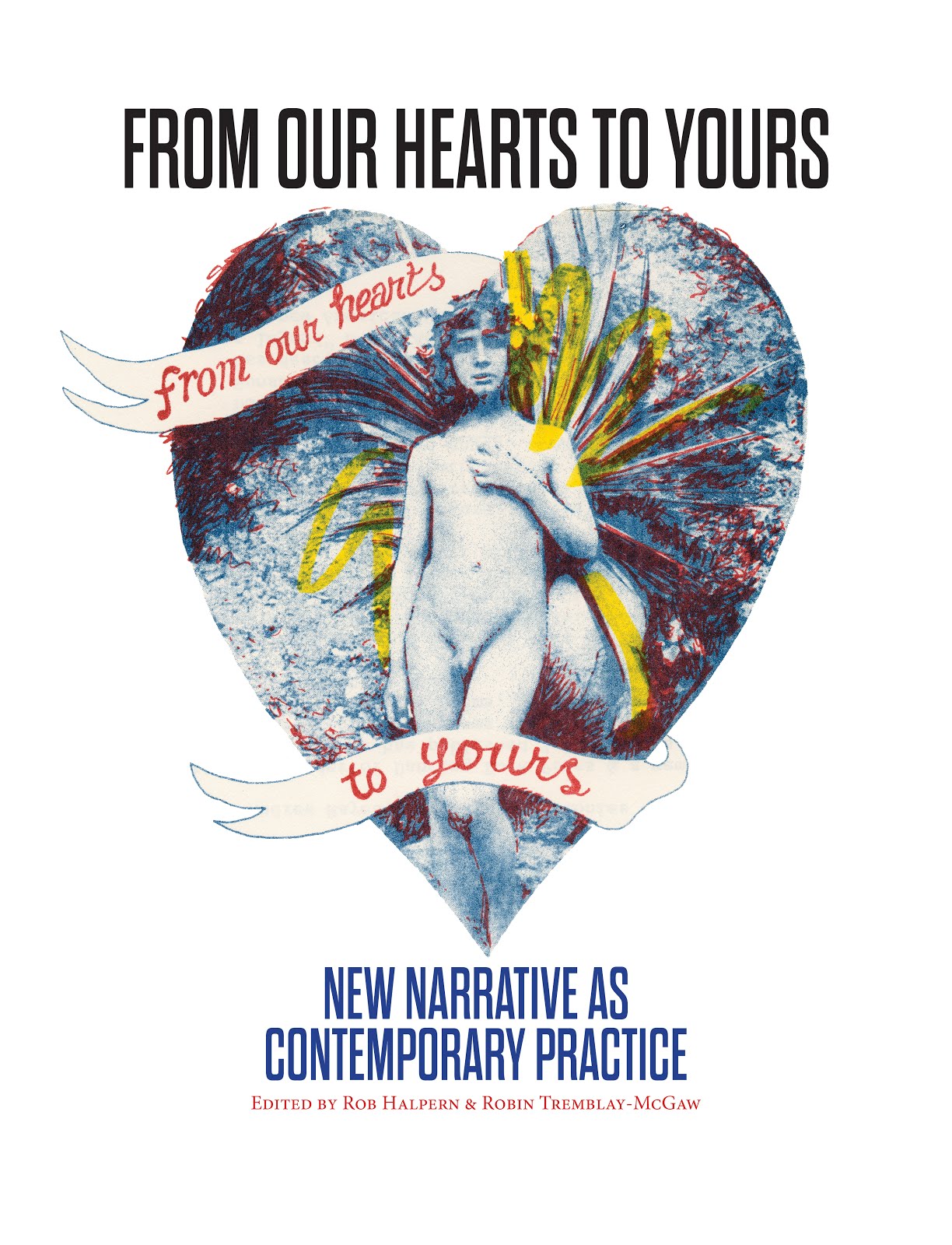
ON Contemporary Practice is proud to announce An Online Compendium and Accompaniment, edited by Rob Halpern and Robin Tremblay-McGaw. Intended as an appendix to From OurHearts to Yours: New Narrative as Contemporary Practice, an anthology of critical essays regarding New Narrative writing practices and literary community, the editors write: “In the process of editing From Our Hearts to Yours: New Narrative as Contemporary Practice, we realized that the book’s appearance in the world could also be the occasion for making available a set of archival documents and fugitive texts intimately related to our approach to New Narrative. These materials will serve ongoing scholarly and critical inquiries, while also enhancing any reader’s engagement with the book. In addition, we solicited three interviews with New Narrative writers, and these interviews are housed here exclusively. We also prepared an exhaustive Index of Keywords and Concepts to accompany the book as a finding aid in addition to the Index of Proper Names and Places included in the book itself (and even on its own, this second index offers its own pleasures as a poetic form!).”
Featured contents include: the introduction to From Our Hearts to Yours, “A Generosity of Response,” composed by Halpern and Tremblay-McGaw; transcripts of the 1981 Left Write Conference, edited by Steve Abbott; archival documents related to the Left Write conference; Soup 2 The New Narrative Issue (also edited by Abbott); exclusive interviews conducted by Jocelyn Saidenberg with Bruce Boone, Robert Dewhurst with Dodie Bellamy, and Miranda Mellis with Kevin Killian; the opening section to “Scandalous Narratives,” from Earl Jackson’s seminal 1995 scholarly study of New Narrative writers, Strategies of Deviance: Studies in Gay Male Representation; a Bibliography of Works Cited in From Our Hearts to Yours; and an Index of Key Words and Concepts from the anthology. 

Tuesday, October 24, 2017

Friendship

Capital doesn’t really want us to be friends

Neither does whiteness

Friendship under racial capital is a structure or system of debt

Facebook is its IMF/World Bank

I wanted to give you everything but capital wouldn’t let me

Whiteness wouldn’t let me

Only to have everything taken away anyway

How many children’s books have been written about friendship and how many really instruct children how to be friends?

When will having a coke with you just be having a coke with you?

When will capital die? 

When whiteness? When debt? When coke?


Sunday, September 24, 2017

This is not a poem for J.A.

I need my space
The t-shirt with stars says
While the malls burn all around
The barricades being built
Until they are one with violence
The night comes it is all
They have left after
The world has ended again
This is not a poem
For John Ashbery who
Killed the subject quietly
With the kitsch of elites
We would imitate until
Our actual voices fade
Or the spaces a public didn’t make
Are finally recognized.