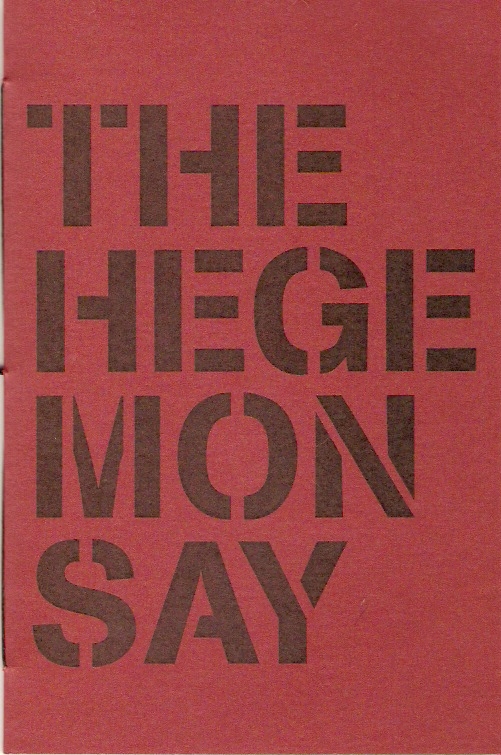
As we gather together in solidarity to express a feeling of mass injustice, we must not lose sight of what brought us together. We write so that all people who feel wronged by the corporate forces of the world can know that we are your allies.
As one people, united, we acknowledge the reality: that the future of the human race requires the cooperation of its members; that our system must protect our rights, and upon corruption of that system, it is up to the individuals to protect their own rights, and those of their neighbors; that a democratic government derives its just power from the people, but corporations do not seek consent to extract wealth from the people and the Earth; and that no true democracy is attainable when the process is determined by economic power. We come to you at a time when corporations, which place profit over people, self-interest over justice, and oppression over equality, run our governments. We have peaceably assembled here, as is our right, to let these facts be known.
They have taken our houses through an illegal foreclosure process, despite not having the original mortgage.
They have taken bailouts from taxpayers with impunity, and continue to give Executives exorbitant bonuses.
They have perpetuated inequality and discrimination in the workplace based on age, the color of one’s skin, sex, gender identity and sexual orientation.
They have poisoned the food supply through negligence, and undermined the farming system through monopolization.
They have profited off of the torture, confinement, and cruel treatment of countless nonhuman animals, and actively hide these practices.
They have continuously sought to strip employees of the right to negotiate for better pay and safer working conditions.
They have held students hostage with tens of thousands of dollars of debt on education, which is itself a human right.
They have consistently outsourced labor and used that outsourcing as leverage to cut workers’ healthcare and pay.
They have influenced the courts to achieve the same rights as people, with none of the culpability or responsibility.
They have spent millions of dollars on legal teams that look for ways to get them out of contracts in regards to health insurance.
They have sold our privacy as a commodity.
They have used the military and police force to prevent freedom of the press.
They have deliberately declined to recall faulty products endangering lives in pursuit of profit.
They determine economic policy, despite the catastrophic failures their policies have produced and continue to produce.
They have donated large sums of money to politicians supposed to be regulating them.
They continue to block alternate forms of energy to keep us dependent on oil.
They continue to block generic forms of medicine that could save people’s lives in order to protect investments that have already turned a substantive profit.
They have purposely covered up oil spills, accidents, faulty bookkeeping, and inactive ingredients in pursuit of profit.
They purposefully keep people misinformed and fearful through their control of the media.
They have accepted private contracts to murder prisoners even when presented with serious doubts about their guilt.
They have perpetuated colonialism at home and abroad.
They have participated in the torture and murder of innocent civilians overseas.
They continue to create weapons of mass destruction in order to receive government contracts.*
To the people of the world,
We, the New York City General Assembly occupying Wall Street in Liberty Square, urge you to assert your power.
Exercise your right to peaceably assemble; occupy public space; create a process to address the problems we face, and generate solutions accessible to everyone.
To all communities that take action and form groups in the spirit of direct democracy, we offer support, documentation, and all of the resources at our disposal.
Join us and make your voices heard!
*These grievances are not all-inclusive.
*Drafted and published originally by the New York City General Assembly.
Monday, October 03, 2011


Sunday, October 02, 2011
Three for Austerity
Peopleless I didn't want
Of anything but freedom ripped
From life after austerity policed
Full employment Whitman
Never predicated this synthesis
Yet for a different kind
Of totality do we spray
The will within population
Saying what won't be defended
Because natural rights aren't given
We risk losing the whole periphery
To be in this sea writing
*
Hedges grow like deficits
Inflation does more work breed
What you see but do not know
What you are doing and know too well
Concrete like money, like the air is heard
Abstract like a surface and
A surface just beneath
The visor called finance
Visualize a difference
These markets make on the skin
Visualize the end of the world
Then stop it since these
Distributions form a name
*
I know these waves don't shelter me
No shelter was their song
They gave to me American
A kind of islander in a divine
Wind, its exceptional breath
When we take our last whole worlds collapse
Whole markets collapse proletarianizing
What we touch, even ourselves,
Immune to this gift no longer.
--composed August, 2011
Of anything but freedom ripped
From life after austerity policed
Full employment Whitman
Never predicated this synthesis
Yet for a different kind
Of totality do we spray
The will within population
Saying what won't be defended
Because natural rights aren't given
We risk losing the whole periphery
To be in this sea writing
*
Hedges grow like deficits
Inflation does more work breed
What you see but do not know
What you are doing and know too well
Concrete like money, like the air is heard
Abstract like a surface and
A surface just beneath
The visor called finance
Visualize a difference
These markets make on the skin
Visualize the end of the world
Then stop it since these
Distributions form a name
*
I know these waves don't shelter me
No shelter was their song
They gave to me American
A kind of islander in a divine
Wind, its exceptional breath
When we take our last whole worlds collapse
Whole markets collapse proletarianizing
What we touch, even ourselves,
Immune to this gift no longer.
--composed August, 2011
Poetry@Occupy Wall Street
An update, for all who would like to organize a reading, or otherwise get involved:
Update: The protests were large and electric yesterday. We stand with all those arrested against their right of free speech and public assembly. If you were arrested, please contact Occupy Wall Street's Legal Sub-Committee through the National Lawyers Guild at 212-679-6018 ASAP. The National Lawyers Guild is a progessive alternative to the Bar. Secondly, a message from the Culture and Arts Sub-Committee to us: "We believe we are at the brink of a new art movement, a new school of thought. To catalyze that, we are creating collectives inside our Arts and Culture to advance our movement and society aesthetically, towards a new paradigm. We have already a collective on performance art, one is music, and hopefully you will join us with poetry." We have been asked by the Culture and Arts Sub-Committee to hold Poetry Assembly every Friday night. This is a leaderless event and we're looking for new organizers, facilitators, and promoters for every Poetry Assembly. If you are interested in facilitating a democratic assembly, please go on our event page at FridayNightPoetryAssembly@OccupyWallStreet and send a message to the event organizer. Finally, we have been asked to be more present on-site. We would like to be present daily at the library, including a representative/sign to let people know about poetry and the arts at Occupy Wall Street. We also need representatives of our group to attend Culture and Arts committee meetings. Can you let us know if you can help?
Update: The protests were large and electric yesterday. We stand with all those arrested against their right of free speech and public assembly. If you were arrested, please contact Occupy Wall Street's Legal Sub-Committee through the National Lawyers Guild at 212-679-6018 ASAP. The National Lawyers Guild is a progessive alternative to the Bar. Secondly, a message from the Culture and Arts Sub-Committee to us: "We believe we are at the brink of a new art movement, a new school of thought. To catalyze that, we are creating collectives inside our Arts and Culture to advance our movement and society aesthetically, towards a new paradigm. We have already a collective on performance art, one is music, and hopefully you will join us with poetry." We have been asked by the Culture and Arts Sub-Committee to hold Poetry Assembly every Friday night. This is a leaderless event and we're looking for new organizers, facilitators, and promoters for every Poetry Assembly. If you are interested in facilitating a democratic assembly, please go on our event page at FridayNightPoetryAssembly@OccupyWallStreet and send a message to the event organizer. Finally, we have been asked to be more present on-site. We would like to be present daily at the library, including a representative/sign to let people know about poetry and the arts at Occupy Wall Street. We also need representatives of our group to attend Culture and Arts committee meetings. Can you let us know if you can help?


Wednesday, September 28, 2011
For the Occupiers
After the polis
Before the police
The problem is that
This is a feeling,
That feeling undergirds
Any organization
Or collective action
My friend Robbie
Tells me
Chris Kraus says
That all utopian
Social movements
Matter because
Their wager is
For time and time
Can't fail
I really
Believe that
But bodies can
Be hurt, bodies can
Easily disappear
All it takes is
Some pepper spray
Or a fist misapplied
What the opposite
Of Habeas Corpus
Is dissolves with
Your hair on my face,
Your legs around
Me without demands
Agreed upon in
Advance
The problem is to
Make us an us
Without making us
An us, to keep
These pronouns
At arm's length,
Touching proper names
Like the singular becomes
Multiple
No people was ever
Separable, no dialogue
From what it intends,
The abuse of the abused
Must end, the undead
Move through these
Lines thinking the
Necropolis, thinking
The polis after it was
Not one of them
In their proper place,
Like I or you wasn't
The remnant,
Sublime kernel of
Wanting to be a citizen
Here is a list of all the things
I did while revolution was fomenting
Or while we watched something
Happen in the distance
Of Facebook
Now's your chance.
Before the police
The problem is that
This is a feeling,
That feeling undergirds
Any organization
Or collective action
My friend Robbie
Tells me
Chris Kraus says
That all utopian
Social movements
Matter because
Their wager is
For time and time
Can't fail
I really
Believe that
But bodies can
Be hurt, bodies can
Easily disappear
All it takes is
Some pepper spray
Or a fist misapplied
What the opposite
Of Habeas Corpus
Is dissolves with
Your hair on my face,
Your legs around
Me without demands
Agreed upon in
Advance
The problem is to
Make us an us
Without making us
An us, to keep
These pronouns
At arm's length,
Touching proper names
Like the singular becomes
Multiple
No people was ever
Separable, no dialogue
From what it intends,
The abuse of the abused
Must end, the undead
Move through these
Lines thinking the
Necropolis, thinking
The polis after it was
Not one of them
In their proper place,
Like I or you wasn't
The remnant,
Sublime kernel of
Wanting to be a citizen
Here is a list of all the things
I did while revolution was fomenting
Or while we watched something
Happen in the distance
Of Facebook
Now's your chance.
PoetryReading@OccupyWallStreet
via Travis Holloway, come one come all and read a poem:
"On Friday night at 9 p.m., we'll hold the first general Poetry Reading at Occupy Wall Street. We're asking poets to come down and read a poem as a prelude to the march on Saturday. In accordance with the movement that is now called Occupy Wall Street, the reading will take the form of a direct democratic assembly. As we discussed tonight at the Culture and Arts Committee meeting, we wish to have no headliners or special privileges but rather presume the equality of each poet's voice and try to listen to one another. We ask that each poet try to keep their poems under 3 minutes at the least. And we hope that poets will select poems that they feel are relevant to the hopes and demands of the people here. See you Friday night. We're looking forward to it. *Please note that PA systems and alcohol are banned from the park, but megaphones will be available. In other words, this is no ordinary poetry reading."
"On Friday night at 9 p.m., we'll hold the first general Poetry Reading at Occupy Wall Street. We're asking poets to come down and read a poem as a prelude to the march on Saturday. In accordance with the movement that is now called Occupy Wall Street, the reading will take the form of a direct democratic assembly. As we discussed tonight at the Culture and Arts Committee meeting, we wish to have no headliners or special privileges but rather presume the equality of each poet's voice and try to listen to one another. We ask that each poet try to keep their poems under 3 minutes at the least. And we hope that poets will select poems that they feel are relevant to the hopes and demands of the people here. See you Friday night. We're looking forward to it. *Please note that PA systems and alcohol are banned from the park, but megaphones will be available. In other words, this is no ordinary poetry reading."
Wednesday, September 21, 2011
Bhanu Kapil's Schizophrene
 Schizophrene, by Bhanu Kapil and published by Nightboat, just hit the streets. Below is a little blurb I did for the back cover. Bhanu is amazing if you didn't already know it. Check-out all her books, and especially this one!
 Bhanu Kapil’s Schizophrene cleaves the human-animal, organic-inorganic, virtual-actual, immigrant-native where “‘Reverse migration....’ is psychotic” and "‘Nobody is [emigrant].’" Wrested from states of abandonment and undeath, language flickers somewhere just beyond the sensory. This is autobiography (life writing) in enthusiastic, map-defying movement, “…a flux where the body always is.” In Schizophrene, and all of Kapil's writing for that matter, sumptuousness moves through a restless presence of mind.
Monday, September 19, 2011
The Hole: a Meta-Discourse (in P-Queue vol. 8)
 A version of the talk I gave in Bflo last February about The Hole is in the new P-Queue, which also features work by David Buuck, CA Conrad, Brad Flis, Lewis E. Freedman, Lawrence Giffin, Josef Kaplan, Ish Klein, Jena Osman, Chris Sylvester, Andrew Topel, Divya Victor, Anna Vitale, and David Wolach. Thanks to Joey Yearous-Algozin and Holly Melgard for their excellent work as the journal's new editors.
Monday, September 12, 2011
False Flags
What is loss what we didn’t
Even know yet was in
Those others also a part
Of ourselves unknowable
I am withdrawing
Every image of the event
Now, what is left being
The remnant, hard kernel
Of how they’ve maintained
Consent, the citizen being
A fiction and the people being
A fiction, nations don’t exist
Really just this proximity,
To disaster borders determine
Who gets to feel this sense
Of tragedy, whose death matters
What comes back comes
The fuck back clutching
At a lack every image
Still tries to fill, a hole where
The truth got clipped
In the attempt to list
The names of the dead
What else is lost, displaced
By an intention to make visible,
Unaccountable though it may
Always return to the place it was
The motion of this
Withdrawal without caption,
Or negative space or silence
Surrounding it being
What is left, calls me back
From a sense of process to you
History in those arms the
Opposite of immunized would be
Secret name of God or
A negation we’ve always dreamed
Casualties of false flags
Full of grace and excepted
From witness, through peace
Do we dominate, through
The millions we’ve captioned.
Even know yet was in
Those others also a part
Of ourselves unknowable
I am withdrawing
Every image of the event
Now, what is left being
The remnant, hard kernel
Of how they’ve maintained
Consent, the citizen being
A fiction and the people being
A fiction, nations don’t exist
Really just this proximity,
To disaster borders determine
Who gets to feel this sense
Of tragedy, whose death matters
What comes back comes
The fuck back clutching
At a lack every image
Still tries to fill, a hole where
The truth got clipped
In the attempt to list
The names of the dead
What else is lost, displaced
By an intention to make visible,
Unaccountable though it may
Always return to the place it was
The motion of this
Withdrawal without caption,
Or negative space or silence
Surrounding it being
What is left, calls me back
From a sense of process to you
History in those arms the
Opposite of immunized would be
Secret name of God or
A negation we’ve always dreamed
Casualties of false flags
Full of grace and excepted
From witness, through peace
Do we dominate, through
The millions we’ve captioned.
Thursday, September 08, 2011
Taylor Brady's and Rob Halpern's "Sensitive Correspondence" (at Others Letters)
 The latest post at Others Letters features Taylor Brady's and Rob Halpern's "Sensitive Correspodnece" a selection of correspondence and essay regarding their book collaboration, Snow Sensitive Skin.
 "Sensitive Correspondence" offers insight into the process of the two collaborators as they reflect, via email, upon the particulars of their collaboration, with special attention to the role of time and duration in their writing, engagement with source materials, and to what Rob calls "patiency," a condition in which one becomes susceptive to the thought and affect of others, a mutual subject of prosody emerging through the work.
Sunday, September 04, 2011
Storeys End
 My friend/collaborator Sreshta Rit Premnath's solo show opens in Berlin this week, Storeys End, featuring a little essay I wrote for the catalogue. Here in an excerpt:
The exhibition Storeys End seems a culmination of Premnath's engagement with the Viennese philosopher, Ludwig Wittgenstein, who undoubtedly acts as a kind of muse for the artist. Like Wittgenstein, Premnath relishes philosophical, linguistic, and cultural aporia. In Storeys End, named after the address where Wittgenstein composed his posthumous text, On Certainty, and died shortly thereafter, the viewer is presented with a detective plot redolent with post-modernist obsessions.
Minimalism, Pop, and Conceptual Art offer Premnath an art historical language game, like so many of his generation who have returned to the "scene of the crime" of their parent and grandparent generations. But this game cum crime story also takes place between multiple media, which include photography, sculpture (the partial reconstruction of a kite designed by Wittgenstein in 1909), and painting.
Premnath's installation pushes against the limits of a particular universe of meaning, the work of art measuring the limits of a world-the personal and collective capability to understand in situ through a set of linguistic and visual propositions. By entering into the work, the viewer encounters the artifacts of the artist's research practice, which move seamlessly between philosophical speculation and humor. In the narrative tension of these objects, stories actually begin rather than end. Objects mark the mobile traces of our compulsion to make meaning faced with negation, absence, aporia, and gaps within signifying processes.
Friday, September 02, 2011
"The New Us" in BOMB 117

The latest BOMB features a ton of poets on artists, poets' writing, and poets in dialogue with art, including work by Erica Hunt, Corina Copp, Danny Snelson, Mónica de la Torre, Matvei Yankelevich, and Alan Gilbert. It also includes a suite of poems I wrote last fall, "The New Us."
The new us starts from a dish
Not socialism, continues to grow
Sans system, an attention
To this consumption system, a local
Kissing of totality what will be value
And what's the use, in poking
Our heads out, food sovereignties
Produce this singularity
The new us, the new good life
Well being as muse and health
As wealth all we are saying's
The all new thing, new expression
Being shares this sense, of turning
Around a land, or land fills
Me up with emergence, political
Like a dish, we cannot help,
Gathering around, or con/tem/plating.
Monday, August 29, 2011
Rights of Participation IV: Gym Tan and Laundry
--for Dottie
Life is repetition
(Gym tan and laundry)
Riding like a House beat
Over the heart, membrane of
That romantic organ,
Snooky plays dumb at another
Stupid job in another
City any shore
Of the multitude where people
Fuck, where people fuck
And cry their eyes out
The passions are in excess
To anything we mean
To discover there late
Late late in this twilight
Called credit, called brand name
Called ban, little houses
They live in and excursions
That everyone can believe,
Life is real but not recordable
This is what it means for it
To escape us.
Life is repetition
(Gym tan and laundry)
Riding like a House beat
Over the heart, membrane of
That romantic organ,
Snooky plays dumb at another
Stupid job in another
City any shore
Of the multitude where people
Fuck, where people fuck
And cry their eyes out
The passions are in excess
To anything we mean
To discover there late
Late late in this twilight
Called credit, called brand name
Called ban, little houses
They live in and excursions
That everyone can believe,
Life is real but not recordable
This is what it means for it
To escape us.
Sunday, August 28, 2011
5 Questions for Contemporary Practice with Gregory Sholette (@Art21)
 here!
here!
Sholette’s dirty messianic approach also comes across in his appropriation of dioramas, window and museum displays, and souvenirs. Playing upon our familiarity with these 19th century formats, Sholette moves fluidly between sentimentality and criticality, ironic abandon and the recognition that, as Walter Benjamin famously wrote (and Sholette quotes through a particular work of his citing the relationship between John D. Rockefeller’s founding of the New York MoMA and management of his public image after a mining disaster): “There is no document of civilization which is not at the same time a document of barbarism.” Moving within the flicker of “civilization” and “barbarism,” Sholette tells history slant, through the eyes of the losers, the unrecognized (and unrecognizeable), citing the places where anomalies and antagonisms crucial to history’s retelling “flash-up.”
Thursday, August 25, 2011
For Will Alexander
Combustible I's in our eros
In the ear of the cosmos
Imagine crimes against being
Imagine pure means
Telepathy upside the head
Occult dialect the imaginal
Blows horns in your head
Kissed into other worldings
Identity nowhere but skin
Other times send us back
To what we've never been
Into the catch of being prior
Apocalypse isn't the end
Of anything, just a deepening
Interruption, futurisms like
Infinite priors in the solar
Wind of your riffing, alchemy
Reasons with an unreasonable
World, relieving the calculable
Of its alibis, powered by
Untold combination, by
Etymology and neologism.
In the ear of the cosmos
Imagine crimes against being
Imagine pure means
Telepathy upside the head
Occult dialect the imaginal
Blows horns in your head
Kissed into other worldings
Identity nowhere but skin
Other times send us back
To what we've never been
Into the catch of being prior
Apocalypse isn't the end
Of anything, just a deepening
Interruption, futurisms like
Infinite priors in the solar
Wind of your riffing, alchemy
Reasons with an unreasonable
World, relieving the calculable
Of its alibis, powered by
Untold combination, by
Etymology and neologism.
Friday, August 12, 2011
CJ Martin's Cosmetic Practice (Q&A)

This past month I corresponded with San Marcos, TX-based poet, CJ Martin, whose book, Two Books, just came out as the first imprint on Michael Cross' new Compline press. What has always impressed me about Martin's work is its rare attention to words as built worlds, as well as its choreopoetic virtuosity (the fact that the poems never stop moving, that the mind (perception, mindfulness, cognition) dances constantly within his lines). In Martin's work one feels as though they are reading a totally new prosody, poetry in its firstness. Wanting to understand his process better, which relies heavily on note-taking and the sculpting of others' texts, I asked him to go into some detail about how the poems of Two Books were composed (posted below). To order his book, which I highly recommend, go to Compline's website.
Thom Donovan: Your description of procedures makes me want to press you to describe in more detail. I mean, is it like Google collage or more like David Antin's Meditations (or something completely different?). One “take” or heavily produced? Sculptural or improvisatory? I find your description of taking up Norma Cole’s vocabulary or wanting to repulse Whitman intriguing, the word "repulse" reminding me of the cardiac in Zukofsky and Duncan, how the line is ever this physical thing determined by encounter.
CJ Martin: In a poem called "Face Essay" that I've been returning to after a couple of years, there are a couple of lines that might be useful here. Neither's mine. The first is Norma C's, actually: "interface / interfaith"----& the other's from a church billboard somewhere near Bryan, TX: "America needs a faith lift." In part, why the term cosmetic appeals to me is that its critical edge highlights the profanity, the complete trashiness, of getting visible---the fucking faith lift is brilliant (as pun) but just completely terrifying (as principle)---dear lord, suck out the fat of my faith, lift it up & stitch me back! Suck out the nation fat (deport it, suppress it), iron any wrinkles & make me look young again. The proximity b/w faith & face is kind of astounding in its obviousness, but as anything more than proximity, I'm not entirely convinced. That interface would necessarily be interfaith is kind of a given after a certain point, but as program it's so UN ('In your faith!', might be more like it, in terms of an encounter in the world).
So, the cosmetic as practice: all surface. Not contra depth, but as against the notion that surfaces have no depth, no gravity ("wall paper"). Against the notion that the work of a poem would be to arrive at unmediated depth, and against, in particular, the benchmarks of that effort (namely the sentence, the topic, the thought). Critical of a disdain for surfaces that gets aired, say, in places like Oppen's "The Mind's Own Place," given that the preferred program's a drag, too (we've known masculinity's a drag for awhile now, but too many poets seem still not to have recognized their participation as 'put on'). Cosmetics has abstraction (of language material, from meaning) as its plastic edge, attempts to recuperate abstraction as fundamentally political.
Cosmetic reading (which is cosmetic writing) is surface reading, reading as appendage, as drawn on (rather than as responsive, engaging). The procedure involves cloud-computing a vocabulary by
1. locating a surface (a page, a spread, an arrangement of multiple spreads of same number across multiple books, a digitized text, audio,
etc.) then
2. determining/arriving at a constraint. Early on, in the first of the Two Books, this was more annotative/straightforward collage—culling notes on reading, shaping & reshaping them, restrictive, but basically as organic as constraint could be for me at the time. Beginning w/the Worship poem (2nd book), a version of the mesostic was used to collect text: I'd write 'across' a surface by doing a line reading of a page & locating the first occurrence of each letter in a word/phrase I'd chosen, then collecting the first word containing the first letter in the first line, the first word containing the 2nd letter in the second line, etc. With one caveat: the first two sections of the Worship poem were largely written while listening to some kind of audio, & the procedure allowed for borrowing from the air as from the surface. Courted the blurred line, even, as dissonance. Sometimes the faux mesostic was abandoned in favor of a vertical reading (i.e.--a quick theft of the left-hand margin of a page, usually heavily sculpted) or, when digital, a control F constraint (like, say, control F "worship" in a digital copy of the HD Book & collect words on either side of that word). My reading of Whitman was repulsed by this function (ie turned away from itself), using passages from Ngai's Ugly Feelings. Whenever a reading splayed across & out from a constraint, it was permitted the turn. The 1978 poem was a slightly different constraint, too: (almost) all vocabulary had to be suggested by Cindy Sherman's film stills from '78, w/ a conscious effort not to 'write' the photos (fails sometimes miserably, but only if you really know the images or have them in front of you). So, that poem's kind of an anti-descriptive, treating the photos as lexical & trying to pry apart some of their material. In Wardrobe there are other procedures, like for ex the 2nd to last section in that poem, which is a back-masking of Wordsworth's "Prelude."
All of which I'm telling you b/c you asked! (Sorry to ramble on.) It may be that these notes would have been helpful if they accompanied the poems, but really it's not as important to me that the concept works itself out in the practice, successfully, or that the poems are understood in that context. More & more I feel like I'm settling into being a very poem-y poet---preoccupied w/prosody to such an extent that engaging the practice itself is sufficient to make me think I've written a poem--the positioning of material, not often towards elaborating sense. I'm writing a poem now called "Rhyme Eats the Words" (a quote from Meschonnic), which maybe says it all.
Thursday, August 11, 2011
After Matt Mullican
We put our fingers in death’s mouth, up death’s ass
To know we are objects, to remain objective
This represents “that person,” a kind of fellowship
With the dead, mysticism is our business
Though weary with wonder, always the link
Between death and the photograph, because that
Person or thing is no longer present, mark time
Through banality, specimens pinned as
Though once lived, giving life to shade that pinning
Seems the potential for something to move
Anything that means something, no association is free
We pay for it with our lives, in dailyness the whole
World’s draft, memento mori, this recognition
That we are living in someone’s place ancient
As our sense of bad faith, ancient as any symbolism.
To know we are objects, to remain objective
This represents “that person,” a kind of fellowship
With the dead, mysticism is our business
Though weary with wonder, always the link
Between death and the photograph, because that
Person or thing is no longer present, mark time
Through banality, specimens pinned as
Though once lived, giving life to shade that pinning
Seems the potential for something to move
Anything that means something, no association is free
We pay for it with our lives, in dailyness the whole
World’s draft, memento mori, this recognition
That we are living in someone’s place ancient
As our sense of bad faith, ancient as any symbolism.
Monday, August 08, 2011
Arthur Echo Echo (@ Jacket2)

The ever close listening Eric Baus has a nice write-up about poetry after Arthur Russell at Jacket2, featuring audio of me and CA Conrad reading our collaboration, Arthur Echo, and Kevin Killian reading his amazing poem for Russell, "Is It All Over My Face?".
Thursday, August 04, 2011
Brady's and Halpern's Snow Sensitive Skin Reissued
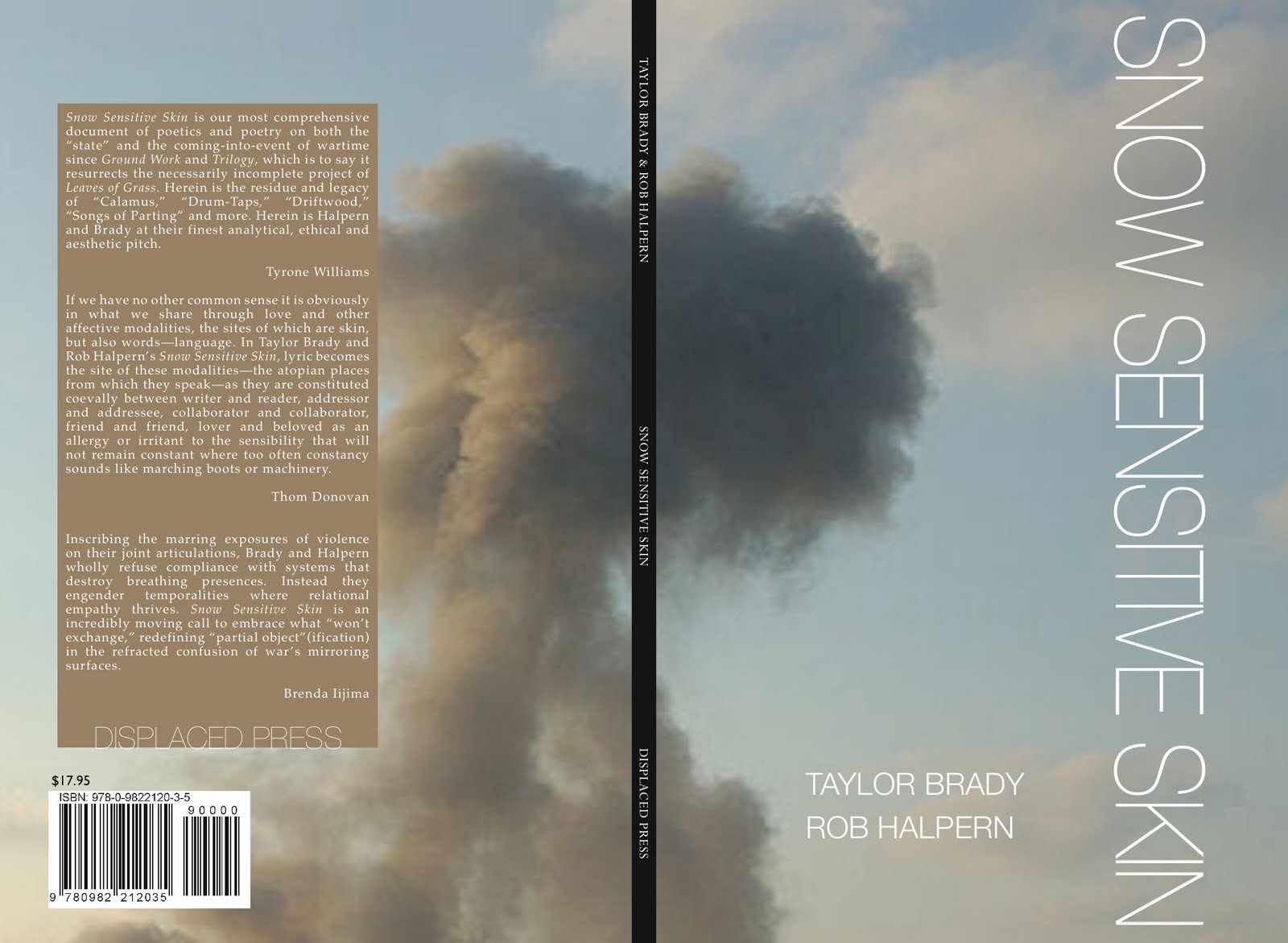
Taylor Brady and Rob Halpern's book length collaboration, originally published by Michael Cross's Atticus/Finch Press, has been reissued with Displaced Press. Below is a press release issued by Brian Whitner, the publisher of the press:
Dear Friends,
It is with great excitement that I write to announce the release of Taylor Brady and Rob Halpern’s Snow Sensitive Skin. This is an expanded edition of the original book published by Michael Cross’ Atticus/Finch and contains a new introduction by Michael, a selection of correspondence between Rob and Taylor during the writing of the project, and an extensive afterword by Taylor and Rob. The body in war-time; the time of war and of labor; “one vibration in both plane and flower”—Snow Sensitive Skin is one of the most moving and profound works ever produced out of a time of war and crisis, a must read.
…But don’t take our word for it:
“Snow Sensitive Skin is our most comprehensive document of poetics and poetry on both the 'state' and the coming-into-event of wartime since Ground Work and Trilogy, which is to say it resurrects the necessarily incomplete project of Leaves of Grass. Herein is the residue and legacy of Calamus, Drum-Taps, Driftwood, Songs of Parting and more. Herein is Halpern and Brady at their finest analytical, ethical and aesthetic pitch”—Tyrone Williams.
“If we have no other common sense it is obviously in what we share through love and other affective modalities, the sites of which are skin, but also words—language. In Taylor Brady and Rob Halpern’s Snow Sensitive Skin, lyric becomes the site of these modalities—the atopian places from which they speak—as they are constituted coevally between writer and reader, addressor and addressee, collaborator and collaborator, friend and friend, lover and beloved as an allergy or irritant to the sensibility that will not remain constant where too often constancy sounds like marching boots or machinery.”—Thom Donovan
“Inscribing the marring exposures of violence on their joint articulations, Brady and Halpern wholly refuse compliance with systems that destroy breathing presences. Instead they engender temporalities where relational empathy thrives. Snow Sensitive Skin is an incredibly moving call to embrace what “won’t exchange,” redefining “partial object”(ification) in the refracted confusion of war’s mirroring surfaces.”— Brenda Iijima
You can purchase Snow Sensitive Skin directly from SPD here: http://www.spdbooks.org/Producte/9780982212035/snow-sensitive-skin.aspx
As well, we would like to take this opportunity to extend a very special offer. For the very low price of $50USD (shipping included) Displaced will send you: Snow Sensitive Skin by Taylor Brady and Rob Halpern, Tout Va Bien by Suzanne Stein, hurdis addo by Samantha Giles, The Persians by Aeschylus by Brandon Brown, and The Hole by Thom Donovan. You can paypal us at iwaslike@hotmail.com. Your books will ship as one package (with some special surprises of course!) once all the titles are printed (mid-October-ish).
And as always, please feel free to join us on FB at
http://www.facebook.com/?ref=logo#!/pages/Displaced-Press/251206488224264
Please feel free to forward this message to your lists.
Very best,
Brian Whitener
Subscribe to:
Posts (Atom)