Sound blows the armor off
And love remains from fire
Or rather phonemics
Like they were making space up
As they went along phonemics
The place where the voice
Is playing me a prosody of disaster
The regret in this light
Too bright like bad faith
Discovers command—
Expropriated camp and blues,
A reappropriation you can feel, pours
This discovery over horns
And chicken scratch skronk
Of a voice circa 1979
Birth certificate of No Wave
Apotheosis of punk
Saturday, March 12, 2011


Friday, March 11, 2011
Dan Thomas-Glass on The Clipse's "Mr. Me Too"
The rap act that would turn out to have gotten the decade right was another regional product—Virginia Beach, Virginia’s The Clipse. Lauded and derided for their uncompromising “coke rap” approach, the duo’s lead single for their 2006 album Hell Hath No Fury was called “Mr. Me Too.” Whereas early Clipse videos (like “When the Last Time” and “Grindin’”) featured “local” spots like pizza parlors, bars, and projects, in the “Mr. Me Too” video the action is decidedly nowhere. Or, more precisely, it takes place in the sublimely blank world of capital circulation. The three major locations for the video are on the tarmac in front of a jet, in a blank white room, and, where else? Standing in front of $100 bills (see fig. 4). Like the Neptunes production that defines The Clipse sound, the video is vacant, full of empty spaces. The city is nowhere to be seen—the closest thing to it a stove sitting on the tarmac, a metonym for the cocaine that is itself just a metaphor for money. Elsewhere in the video women dance in front of different candy-colored screens like echoes of the iPod advertisements, circulating in the tumbler of image consumption in the age of digital music reproduction. In a different song on the album the chorus chants “Hello new world / here we come on our Twinkie Trains / with my man screaming ‘we’re on our way.’” Where we’re going isn’t the point, any more than where we’re from—what The Clipse understand, what is clear as day in the globalized present, is that the world is new, and movement is the only thing left resembling life.

Thursday, March 10, 2011
@ CAConrad's Jupiter88 (video)
 CAConrad made an episode of Jupiter88 with me this morning. Check it out, here!
Wednesday, March 09, 2011
An Archive of Eyes (@ Stretcher)
 Here's a link to a little poem I wrote after Fred Tomaselli's paintings, at the invitation of Stretcher.org. Part of a larger feature of writers on artists called See/Saw.
Tuesday, March 08, 2011
Others Letters :: Steven Farmer and Nathan Johnson
 Check-out the latest Others Letters, featuring poems and correspondence by Steven Farmer and Nathan Johnson, who via an anagram generator called "Anagramania" mediate a current semiotic terrain of NeoCon fascism in the US, with warm and exuberant interludes about baseball, friendship, and much else.
"Two friends, recently reconnected after over ten years apart, begin an online correspondence: one in California (Farmer), the other (Johnson, a Seattle native) in Budapest, Hungary. Shared interests lead to an ad-hoc collaborative writing project involving constraint-based texts on the subjects of baseball, expatriate-ism, and the recent rise of the Tea Party in the US."
from All I Want is to be in a Band, Man (V)
Is this the barely
Chiaroscuro of our moon-
like privacy breaking like
Our hearts privately
Into beams?
I want to be in a band,
A poetry band, this is for you
This wreckage Bruce and
Melissa, unlikely pair
Of you tonight
Anarchy of your
Alternative gathering spaces,
Aggressive affect and calm
The person starts again
From pure sound
Materiality of sound,
We are shock effects,
Hypnosis heard through
Orange command, holes we were
Sucked through
On our way to being,
Into another future, I want
To get this armor off
But rhetoric sticks
To substance
Like a permanent
War of subjects, where it wasn’t
Clear who or what was subject,
Just that sense ignited
Some sense of us.
Chiaroscuro of our moon-
like privacy breaking like
Our hearts privately
Into beams?
I want to be in a band,
A poetry band, this is for you
This wreckage Bruce and
Melissa, unlikely pair
Of you tonight
Anarchy of your
Alternative gathering spaces,
Aggressive affect and calm
The person starts again
From pure sound
Materiality of sound,
We are shock effects,
Hypnosis heard through
Orange command, holes we were
Sucked through
On our way to being,
Into another future, I want
To get this armor off
But rhetoric sticks
To substance
Like a permanent
War of subjects, where it wasn’t
Clear who or what was subject,
Just that sense ignited
Some sense of us.
Monday, March 07, 2011
from All I Want is to be in a Band, Man (IV)
I want to be in a band, man
Like Rimbaud wanted to be in a band
Or more likely wanted to be like all this stuff
The barricades were filled up with
During the Paris Commune, or so I imagine
After Kristin Ross’s The Emergence of Social Space
Which my friend Dana turned me onto,
All that we are the lived duration of our sociality is like
Those barricades made in such a way
That all of these meanings—the meaning of
Our work and life—seem temporary, mutable and arbitrary, yet full.
I want to be in a band
I want to be full like those barricades are full
I want my life to have meaning—or measure?—
Like those barricades have meaning and measure
The whole world thinking about how it is being made
That would be a politics to strive to create.
The whole world represented by its being made, through its being made.
Gives up art to be a worker.
Gives up art to be an (art) worker.
Gives up politics for life.
Because life becomes politics.
I want to be in band, not just a group, definitely not just any public.
Because, as Fred Moten says, there has never been a public
That wasn’t denied to most of us, most people.
The public is what has been historically defined
By its exclusion of certain people and not others.
What would be a public
That didn’t exclude us and others?
A band then? A really big band?
Like Rimbaud wanted to be in a band
Or more likely wanted to be like all this stuff
The barricades were filled up with
During the Paris Commune, or so I imagine
After Kristin Ross’s The Emergence of Social Space
Which my friend Dana turned me onto,
All that we are the lived duration of our sociality is like
Those barricades made in such a way
That all of these meanings—the meaning of
Our work and life—seem temporary, mutable and arbitrary, yet full.
I want to be in a band
I want to be full like those barricades are full
I want my life to have meaning—or measure?—
Like those barricades have meaning and measure
The whole world thinking about how it is being made
That would be a politics to strive to create.
The whole world represented by its being made, through its being made.
Gives up art to be a worker.
Gives up art to be an (art) worker.
Gives up politics for life.
Because life becomes politics.
I want to be in band, not just a group, definitely not just any public.
Because, as Fred Moten says, there has never been a public
That wasn’t denied to most of us, most people.
The public is what has been historically defined
By its exclusion of certain people and not others.
What would be a public
That didn’t exclude us and others?
A band then? A really big band?
Sunday, March 06, 2011
from All I Want is to be in a Band, Man (III)
But I want to be in a band, still
Some unresolved, unforeclosed sociality
(That singing is) (That being in a band is)
Going down like Rimbaud, say
To announce an end to which pronouns
To announce the organs unformed by work
That begin in our play—
To prove that these hands are made and unmade
By the music any one makes
Who is not just ‘me’ singing
Through the violence of that voice
Or a name we impose
On something when we feel
It is special, particular—like a band
Needs a name, like one feels they need to
Distribute this feeling for being in a band
Protean form of revolt, like a public
Not quite public yet, in an assembly of notes—
Like a ‘people’ forms a public—these notes.
Some unresolved, unforeclosed sociality
(That singing is) (That being in a band is)
Going down like Rimbaud, say
To announce an end to which pronouns
To announce the organs unformed by work
That begin in our play—
To prove that these hands are made and unmade
By the music any one makes
Who is not just ‘me’ singing
Through the violence of that voice
Or a name we impose
On something when we feel
It is special, particular—like a band
Needs a name, like one feels they need to
Distribute this feeling for being in a band
Protean form of revolt, like a public
Not quite public yet, in an assembly of notes—
Like a ‘people’ forms a public—these notes.
Saturday, March 05, 2011
from All I Want is to be in a Band, Man (II)
The DJ functions like love
To spread these petals difference
To see we don’t sing too sweetly
The stench of common sense
Wasted on your lips
Kissing me into which future
Like an ark of horns I
Haven’t heard
Because I can’t, I cant
With ears blown off
With an archive like
The tides are rising too
Into song and all those little islands they will
Only seem to rise to it, drowned
These waves like a wall of sound
This is the remix of a disaster hymn
I made when no one could hum immune
Or even probably hear me
To spread these petals difference
To see we don’t sing too sweetly
The stench of common sense
Wasted on your lips
Kissing me into which future
Like an ark of horns I
Haven’t heard
Because I can’t, I cant
With ears blown off
With an archive like
The tides are rising too
Into song and all those little islands they will
Only seem to rise to it, drowned
These waves like a wall of sound
This is the remix of a disaster hymn
I made when no one could hum immune
Or even probably hear me
Friday, March 04, 2011
from All I Want is to be in a Band, Man (I)
I just want to be in a band, man
And play anything ourselves out of here
Hear these tones like water stutters water
Like sunk ships suture the social or social
History was what we were immersed in
I hear your voice on the other side of disaster
What plays its way out of disaster
Just like it wanted to be, just like it wanted
To be in a band, convince us we are living
In a different future-past because the tones
The political economy of noise with its puncture
Of the present might wake/make a plinth
Through this struggle to be all-too-human
Come back from these feeling tones—
Assemblage, stutter, DJ function
And play anything ourselves out of here
Hear these tones like water stutters water
Like sunk ships suture the social or social
History was what we were immersed in
I hear your voice on the other side of disaster
What plays its way out of disaster
Just like it wanted to be, just like it wanted
To be in a band, convince us we are living
In a different future-past because the tones
The political economy of noise with its puncture
Of the present might wake/make a plinth
Through this struggle to be all-too-human
Come back from these feeling tones—
Assemblage, stutter, DJ function
Review of Xavier Le Roy's "Self Unfinished" (@ The Brooklyn Rail)
 Here is a link to a little review I wrote about Xavier Le Roy's recent performance of his Self Unfinished at MoMA:
Xavier Le Roy’s Self Unfinished, which I viewed in a packed audience at the Museum of Modern Art in early February, is among a series of works by Le Roy exploring the limits of what, recalling Baruch Spinoza, a “body can do.” Given Le Roy’s background in biology (he holds a Ph.D. in that field), one cannot help but think about the influence of the “hard sciences” on his choreography. This is especially true in Self Unfinished, where one encounters a body that evolves from a robotic state to a post-human one. This dramatic evolution attempts to imagine the choreographic body as radically “other”—destabilized by certain uses of costume, movements, blocking, and props.
Wednesday, March 02, 2011
Arthur Echo at Zebulon: reading with CAConrad

I will be reading with CAConrad from our collaboration, Arthur Echo, next Tuesday, March 8th at Zebulon Cafe in Williamsburg, Bklyn at 7PM. Many thanks to Roger Van Vorhees for organizing the reading.
Saturday, February 26, 2011
She's Lost Control Again
 Prepare to be disappointed. Mondo Bummer just put out a 'chapbook' of my poem, "She's Lost Control Again," in their super lo fi format (folding, one staple in the upper left-hand corner, stickers, 8 x 11 office paper). Thanks to Amy Berkowitz, publisher of Mondo Bummer, for asking me to contribute work. You can learn more about the press project, which features work by CAConrad, Brandon Brown, Kendra Grant Malone, Anna Vitale, and many others, here.
If above or below
These powers the boxes
Kept moving
If this was a game
We were making the rules
Up as we went along
As though within our
Own bodies without control
She's lost control again
We're just beginning
To manage her limbs
Like assemblage we shit
We perspire autonomy
When they tell us to
Only there is no me
And there is no you
There is no beginning
In other words to this
Process this continuous
Product producing our
Exception
Wednesday, February 23, 2011
You Are My Friend
--to Brenda Iijima
You are my friend, hi!
The bones know us and so do I
So I is just little eyes, little I's
In the belly my friend Brenda
One does have a naval
Animal-suffering-membrances are we
Extended into the sea and here (and hear)
Somewhere in the collective
Imaginary do I imagine you affected
Like every moment was a birthday
So our bones grow again
Resurrected two years at a time
I with a lower case i
I learned that today in my belly
My friend, Brenda, who we are?
Animal-suffering-membranes.
You are my friend, hi!
The bones know us and so do I
So I is just little eyes, little I's
In the belly my friend Brenda
One does have a naval
Animal-suffering-membrances are we
Extended into the sea and here (and hear)
Somewhere in the collective
Imaginary do I imagine you affected
Like every moment was a birthday
So our bones grow again
Resurrected two years at a time
I with a lower case i
I learned that today in my belly
My friend, Brenda, who we are?
Animal-suffering-membranes.
Tuesday, February 22, 2011
Somatics, Movement, and Writing
Here are some pics I took at the Somatics, Movement, and Writing symposium this past weekend in Ann Arbor. Praise and thanks to Petra Kuppers for inviting me to be a co-organizer for the symposium, and to all who participated. More reflections to follow!*


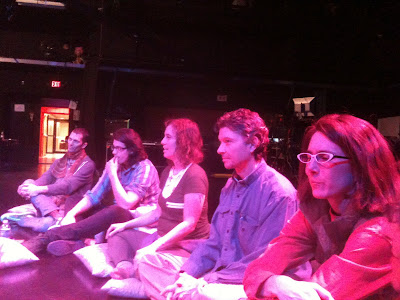


*last two pictures courtesy Neil Marcus


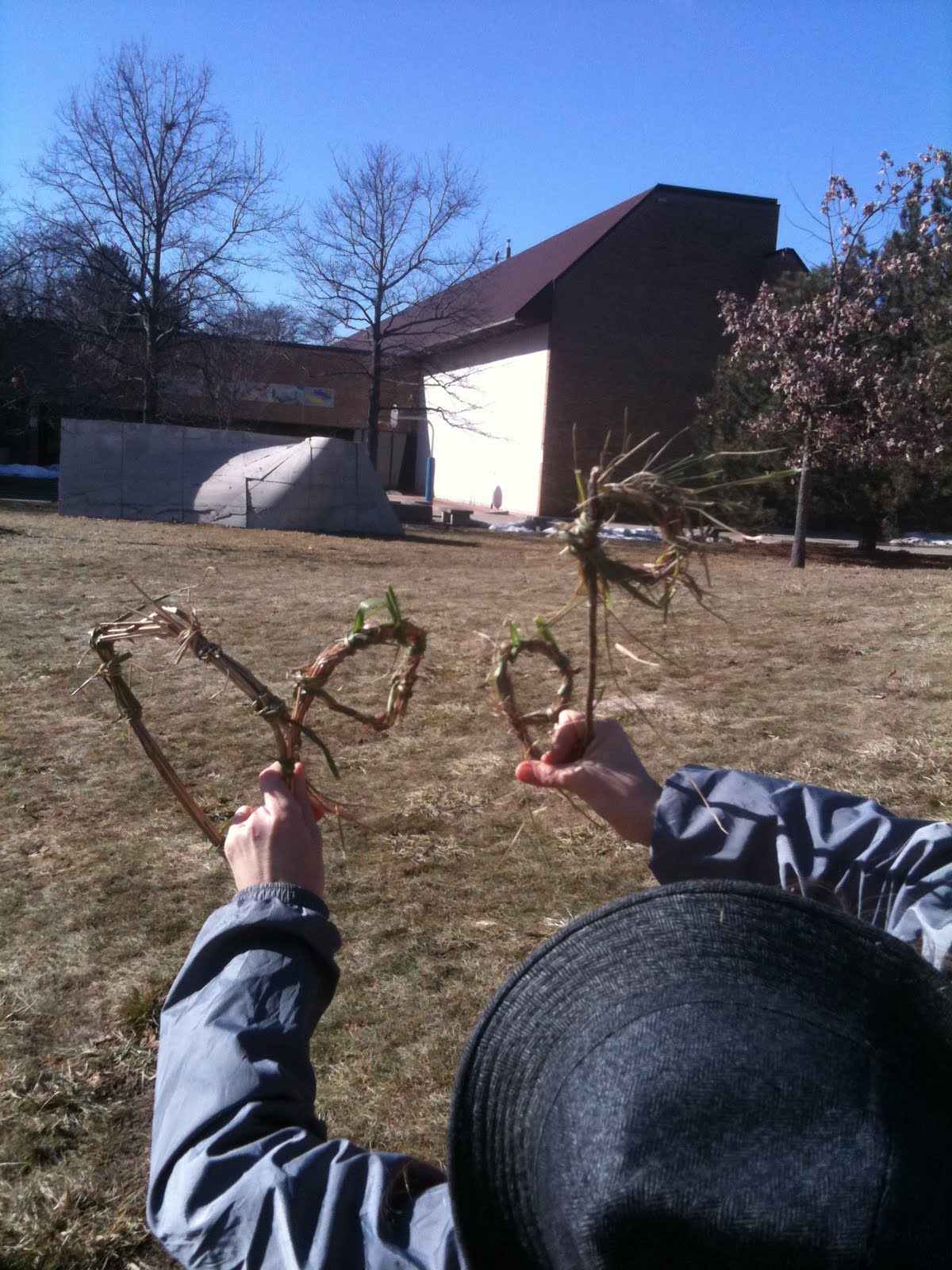


*last two pictures courtesy Neil Marcus
Monday, February 21, 2011
Virtuosity and the Survival of the Subject: on Catherine Sullivan (in Afterall)
Afterall 26 just came out, and features an essay I wrote on Catherine Sullivan, "Virtuosity and the Survival of the Subject: on Catherine Sullivan." Check it out in bookstores or here:
Catherine Sullivan’s work involves nothing less than the problematic of virtuosity. The virtuosic as it pertains to performance history (film and theatre), but also, to quote the Italian philosopher Paolo Virno, the virtuosity of ‘post-Fordist’ labour practices, practices which entail an ‘immaterial’, ‘living labour’ of the contemporary subject. Before I come to Sullivan’s oeuvre, however, let me dwell on Virno’s notion of virtuosity for a moment. To be a virtuoso, in the traditional sense, is to be able to perform a score in some extraordinary way. In Virno’s book A Grammar of the Multitude (2004), he poses the question: ‘If the entirety of post-Fordist labor is productive (of surplus-value) labour precisely because it functions in a political-virtuosic manner, then the question to ask is this: What is the script of their linguistic-communicative performances?’ What, in other words, constitutes the score which the contemporary labourer qua subject performs and how do the conditions of the contemporary labourer qua virtuoso – whose product is immaterial – differ from the conditions of labour which preceded them, those in which a visible ‘product’ or ‘object’ was produced? How, likewise, does one judge the value of ‘work’ when what is produced are affects or ideas, and when this production process relies on improvisation? Virno and his contemporaries, the Autonomists, provide a number of concepts which I believe can help us approach contemporary art practices, and particularly the practices of artists who make the connection between labour and performance explicit through their works. What might connect contemporary labour and live art are questions of virtuosic labour – contemporary live art being both reflective and critical of practices of virtuosity in the global work place.
Catherine Sullivan’s work involves nothing less than the problematic of virtuosity. The virtuosic as it pertains to performance history (film and theatre), but also, to quote the Italian philosopher Paolo Virno, the virtuosity of ‘post-Fordist’ labour practices, practices which entail an ‘immaterial’, ‘living labour’ of the contemporary subject. Before I come to Sullivan’s oeuvre, however, let me dwell on Virno’s notion of virtuosity for a moment. To be a virtuoso, in the traditional sense, is to be able to perform a score in some extraordinary way. In Virno’s book A Grammar of the Multitude (2004), he poses the question: ‘If the entirety of post-Fordist labor is productive (of surplus-value) labour precisely because it functions in a political-virtuosic manner, then the question to ask is this: What is the script of their linguistic-communicative performances?’ What, in other words, constitutes the score which the contemporary labourer qua subject performs and how do the conditions of the contemporary labourer qua virtuoso – whose product is immaterial – differ from the conditions of labour which preceded them, those in which a visible ‘product’ or ‘object’ was produced? How, likewise, does one judge the value of ‘work’ when what is produced are affects or ideas, and when this production process relies on improvisation? Virno and his contemporaries, the Autonomists, provide a number of concepts which I believe can help us approach contemporary art practices, and particularly the practices of artists who make the connection between labour and performance explicit through their works. What might connect contemporary labour and live art are questions of virtuosic labour – contemporary live art being both reflective and critical of practices of virtuosity in the global work place.
Thursday, February 17, 2011
5 Questions (for Contemporary Practice) with Amy Balkin (@ Art21)
 Check-out my feature with Amy Balkin at Art21 blog, with regards to her art of "counter-speculative spaces."
Some of my work deals with constructing “speculative counter-spaces” I’d like to see, such as a permanent global commons (in the project This is the Public Domain), or a clean-air park (Public Smog) in real space. I’m sure I’m not alone in wanting more equitable relations globally around access to and control of land, water, and air. But there’s also a range of issues raised by these kinds of projects, including questions of dilettantism when addressing issues of expropriation. It’s easy to think of current examples of brutal struggle over land, including land grabs, occupation, and forced expulsions, so what are the relative stakes?
But Walter Benjamin had this to say – ”One of the foremost tasks of art has always been the creation of a demand which could be fully satisfied only later” – and though he was speaking about future technological advancements that would allow for the production of new forms of art, I think it’s very helpful to consider, particularly in terms of the potential for positing counter-models in the context of aesthetic practice. And perhaps attempting to produce these spaces might move them further towards the realm of political possibility.
--Amy Balkin
Wednesday, February 16, 2011
For Xavier Le Roy

The body is an archive
Discourse is a skin
Porous to the things we are
Born also without air
The body is not just body
The soul a machine-like work
Administering worlds, saving face
Though nothing will be saved
The body is mainly condition
A grace in which the concept
Moves where a center was
Where hands become like shade
Trembling what they're doing did
This system "what a body can do"
Spirit becomes a spirit-hinge
Attaching what will have been
Like Duchamp's Étant Donnés
Picture the difference within
The social life of machines
And the skin of social life
Withdrawn where there wasn't
A line this harrows so this
Becomes the point instead
Life without center spread.
Tuesday, February 15, 2011
Meta-Discourse and the (Post-) Digital Book @ The Disinhibitor
Michael Cross posted a few paragraphs from the talk I gave in Bflo this past Friday, "Meta-Discourse and the (Post-) Digital Book (How The Hole Is Still Being Made)" at his blog, The Disinhibitor. Thanks to Margaret Konkol for organizing the talk, and for the great conversation and company of those in attendance!
How to instill the book with living presences that may bear witness to a set of social constellations and coordinates without doing harm to the participants/what has been offered through often unreflective and spontaneous forms of participation? How to resist this move as a gesture invested with cultural capital or as a move in a kind of art game while still being able to reflect critically upon it, or simply acknowledge its tendencies? The prefaces that I intend to include within The Hole, in this regard, reflect both the content of the would-be book, but also how the book is always a kind of performance within a discourse, and specifically as this performance is addressed to one’s peers, friends, and contemporaries (if only after the fact). How not to render lame (or dead) a process that one loves (or has loved) and wishes to further extend? How to circumvent the inevitable tendency for such ‘projects’ to become captured by staid forms of institutionalization, archivalism, or academic research; the negative forms of distribution and critical reception that pervade both commercial and academic culture (however much all of us work in relation to these cultural locations)?
How to instill the book with living presences that may bear witness to a set of social constellations and coordinates without doing harm to the participants/what has been offered through often unreflective and spontaneous forms of participation? How to resist this move as a gesture invested with cultural capital or as a move in a kind of art game while still being able to reflect critically upon it, or simply acknowledge its tendencies? The prefaces that I intend to include within The Hole, in this regard, reflect both the content of the would-be book, but also how the book is always a kind of performance within a discourse, and specifically as this performance is addressed to one’s peers, friends, and contemporaries (if only after the fact). How not to render lame (or dead) a process that one loves (or has loved) and wishes to further extend? How to circumvent the inevitable tendency for such ‘projects’ to become captured by staid forms of institutionalization, archivalism, or academic research; the negative forms of distribution and critical reception that pervade both commercial and academic culture (however much all of us work in relation to these cultural locations)?
Subscribe to:
Posts (Atom)