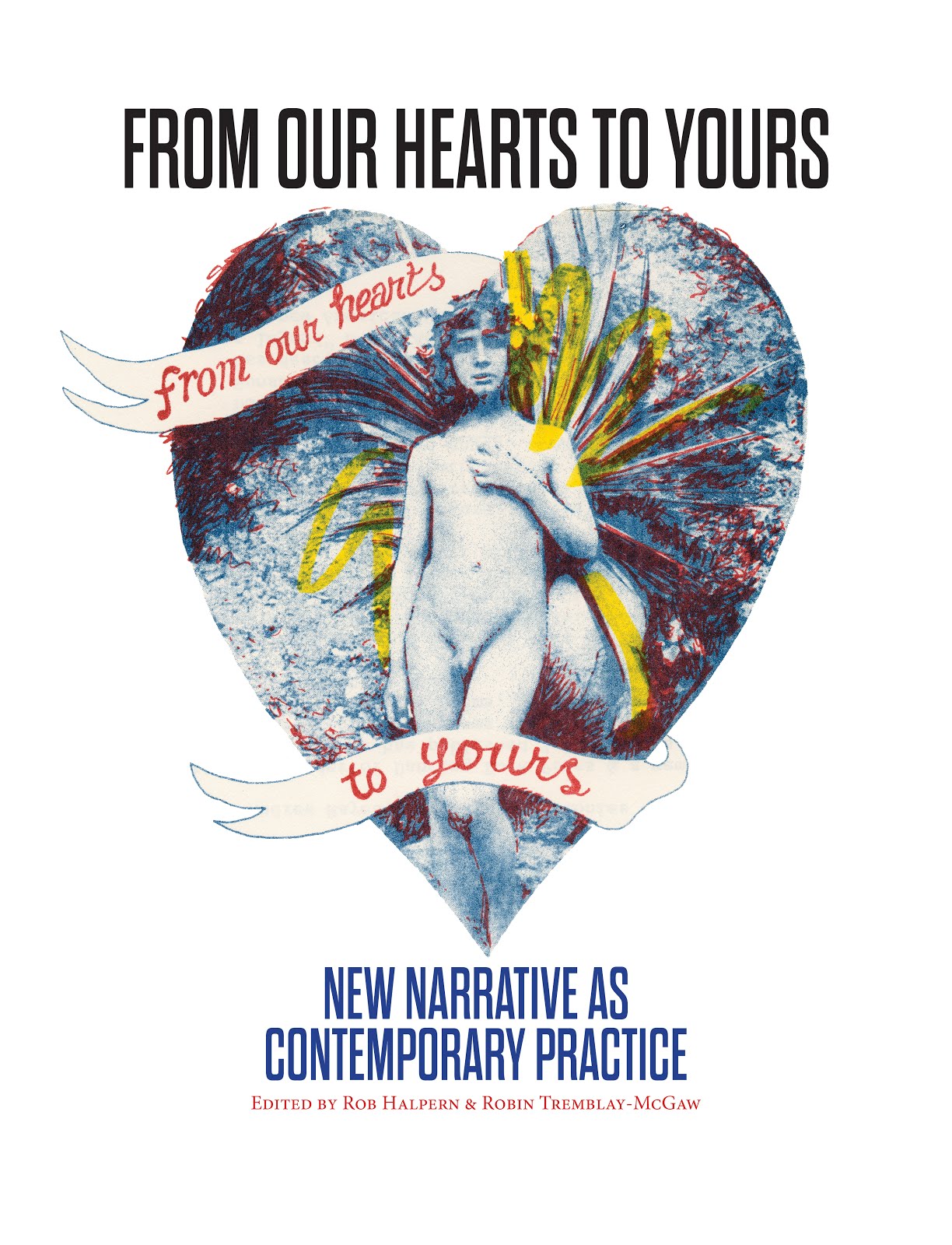
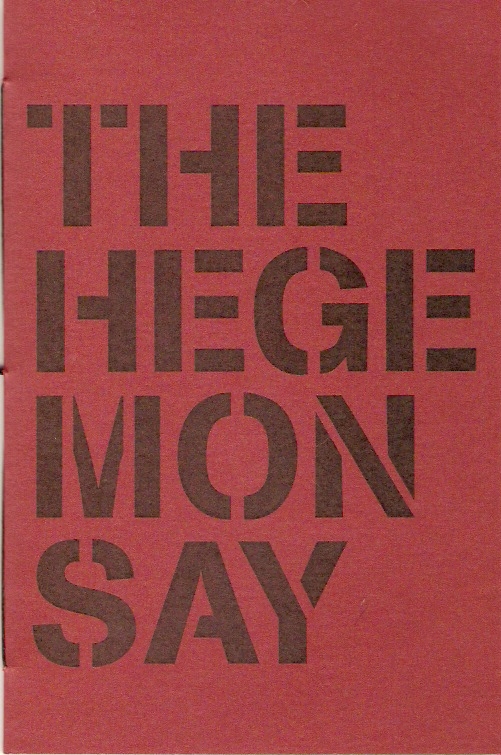
The creative exploration of these materials enacts a "weak messianic power" through which the world may be conceived differently. Perhaps one task of the artist/thinker is to make visible these powers of objects which should otherwise be perceived as corrupted by their commodity value, or by some prejudice about the sensibility and intelligence which produced them. To what extent is the future that we will want to have been (tense of the future anterior) a product of the senses (both a renewed sensibility and a coming to our senses)?
I have been thinking about how to reapproach cultural materials so that they may become active for something again. The return of "appropriation" in recent aesthetic practices seems to bring this problem to the foreground. Likewise, continued interest in archives, documentary practices, and attention to artifact through display and reenactment/live performance. These forms have pretty much defined art (and cultural production more broadly) in the aughts, so how may we think about these forms more specifically in terms of a dialogue about how art may determine, redirect, and reevaluate futures?
Friday, May 14, 2010


"Groundbreaking"
What makes something ‘public art’? Can language use alone adequately alter the frames through which we look at a site, or the ‘art’ there? Is there a way to see the urban environment that’s not mediated by money? What counts as an ‘intervention’? Can conceptualism alone achieve anything ‘real’ in a landscape such as this one? If I’m just watching some people ‘work’ how can I tell if it’s art? Are they doing art or making it, or neither? If the goal is to liberate private space for the commons, shouldn’t they also be taking over the cafe next door and giving away all the food? Are a couple of seemingly self-critical questions an adequate way to engage the various problems that such a project produce? Who is this action or art for? If not towards an artwork or product, then towards what?
--from BARGE’s “Groundbreaking"-Reflections, by David Buuck
--from BARGE’s “Groundbreaking"-Reflections, by David Buuck
Wednesday, May 05, 2010
Julie T. Ewald Reviews MAKE BELIEVE
@ Galatea Resurrects
The idea of the island creating a sort of sanctuary while imposing seclusion is confounded even further with the quotation Donovan uses to begin this piece: “An island / Has a public quality.” The quote comes from objectivist poet, George Oppen. This quote re-envisions the notion of the island that one gets from Ben-Ner’s film or from the content of Donovan’s poetics as it suggests that an island is not a place for sanctuary or separation, but a place that is open and accessible. This could also be a red herring, as the piece is dedicated to another poet, Gregg Biglieri, who is known for a masterful use of puns.
The idea of the island creating a sort of sanctuary while imposing seclusion is confounded even further with the quotation Donovan uses to begin this piece: “An island / Has a public quality.” The quote comes from objectivist poet, George Oppen. This quote re-envisions the notion of the island that one gets from Ben-Ner’s film or from the content of Donovan’s poetics as it suggests that an island is not a place for sanctuary or separation, but a place that is open and accessible. This could also be a red herring, as the piece is dedicated to another poet, Gregg Biglieri, who is known for a masterful use of puns.
Tuesday, May 04, 2010
Krist Gruijthuijsen
Could you expand a bit more upon this usage of existing languages, forms and images? In other words, could you explain what the term quotation means to you?
Adam Pendleton
I think it changes depending upon what you’re trying to achieve. Critically, I think the idea of quotation is a problematic track. As an idea, it opposes a necessary engagement with pertinent critical forms or discourses. I think in the realm of language, within certain linguistic vocabularies, appropriation is a very liberating idea, but quotation is a very limiting one. Within the sphere of art it’s the other way around, wherein quotation can feel more expansive as a position while appropriation is more limiting as an operating space. Any kind of definition that I do have is a functioning one. It is one that works itself out in my work. The making and the doing is its own definition. Quotation or appropriation is a way of confronting reality on its own terms.
--from Quote Number One. (Or how to thrive on linguistic prospects.)
Could you expand a bit more upon this usage of existing languages, forms and images? In other words, could you explain what the term quotation means to you?
Adam Pendleton
I think it changes depending upon what you’re trying to achieve. Critically, I think the idea of quotation is a problematic track. As an idea, it opposes a necessary engagement with pertinent critical forms or discourses. I think in the realm of language, within certain linguistic vocabularies, appropriation is a very liberating idea, but quotation is a very limiting one. Within the sphere of art it’s the other way around, wherein quotation can feel more expansive as a position while appropriation is more limiting as an operating space. Any kind of definition that I do have is a functioning one. It is one that works itself out in my work. The making and the doing is its own definition. Quotation or appropriation is a way of confronting reality on its own terms.
--from Quote Number One. (Or how to thrive on linguistic prospects.)
Mic Checks

"the ear is the only orifice that doesn't close"
--from Sharon Hayes' Parole
Your silence blows the
Ears off my head
So that what I'm hearing
And what isn't seen
Structures the rupture
What's left-over
From speaking privately
In a public place
Some ways to imagine
Not being them
Being sous rature
Or simply tongue-tied
If the tongue
Had eyes and they
Were here
If they
Looped like history
Like the history of
A scream
Or steam from that
Whistle not yet blowing
The voices absent in this present
In their presence coheres a statelessness
Without subject
Sentiment is the tenuous
We screaming again
Words one lip-synchs for their life (RuPaul)
Discourse schools a public void
In private just because
You put a mic
On me doesn't mean my voice
Will carry
Or anyone is out there listening
We are archivable which means
We can easily be forgotten
We are public which means
We are double/multiple/substitutional
Through no lack of repression
Do the words finally appear
However private we are however
Rich our interior life
[politics which pressures the inside out]
[politics will smoke us out]
[politics will drive us into the world]
[politics will drive us into the open]
Where any one may listen
To this resonance pattern
To these distances wherever you go
Voice a form of intimacy without control
Emotions before they formed and hardened
Into a public speech
Which summons us all these voices verbs
Recorded but not sufficiently heard
Stricken from the record it would seem
Before sound could appear
Thinner than the thing-in-itself
The magnetism of all lost futures
In the breaks silence sticks
Wakes the dead from trace
The living from paradise
Semblance sleeps in our ears
Across eras cross-phasing hatch
Private spaces in public
Tongue in my mouth in
Your mouth mic checks.
Check out David Wolach's generous response
to my piece about Nonsite Collective at the (former) Harriet blog:
http://davidwolach.blogspot.com/2010/05/nonsite-collective-on-harriet-blog.html
http://davidwolach.blogspot.com/2010/05/nonsite-collective-on-harriet-blog.html
Sunday, May 02, 2010
"Giant oil-services provider Halliburton may be a primary suspect in the investigation into the oil rig explosion that has devastated the Gulf Coast, the Wall Street Journal reports. Though the investigation into the explosion that sank the Deepwater Horizon site is still in its early stages, drilling experts agree that blame probably lies with flaws in the ‘cementing' process -- that is, plugging holes in the pipeline seal by pumping cement into it from the rig. Halliburton was in charge of cementing for Deepwater Horizon."
Saturday, May 01, 2010
Stop the World
Stop the world
It is dying too soon
We have not died
Enough into this
Life only ours if
We decide for
What others it is
For the form the
Fire will take all
Around us against
Every received
Idea and word.
It is dying too soon
We have not died
Enough into this
Life only ours if
We decide for
What others it is
For the form the
Fire will take all
Around us against
Every received
Idea and word.
Interview with Charles Bernstein part II (@ Harriet)

here
Recently I’ve started to see a number of my poems, early and later, as “bachelor machines” after Duchamp and Kafka’s “Penal Colony” – disciplinary structures (to get back to a point you made earlier): self-imploding, non-procreative systems. Or maybe I’d be better to say anti-bachelor machines. Recantorium, which is not in the book but recently appeared in Critical Inquiry and was excerpted in Harper’s, is the most extravagant of these. But it goes back a ways. I would say that “Asylum” (the first poem in the selected) is also an anti-bachelor machine. And at the same time – it’s apparent in Girly Man – I became interested in what I call radical legibility — a mode of explicit reiteration that makes it almost impossible to get lost, to drift; each line is like a rivet, so perhaps this is anticipated in “Sentences” in Parsing. Radical legibility doesn’t necessarily mean you’ll understand the poem, but you can’t not follow. “A Particular Thing” in Girly Man (included in the selected) is a good example (“A black man waiting at a bus stop / A white woman sitting on a stool / A Filipino eating a potato / A Mexican boy putting on shoes . . .”).
Friday, April 30, 2010
Nonsite Collective 3 Years In (@ Harriet)

here
Since the spring of 2007, Nonsite Collective has organized a number of events, all of which contribute to the collective’s purpose of establishing curricular resources. This series of events includes talks and presentations by CAConrad, Frank Sherlock, Jonathan Skinner, Amber DiPietra, Bhanu Kapil, Norma Cole, Miranda Mellis, Kyle Schlesinger, Dont Rhine (of Ultra-red sound collective), Tanya Hollis, Taylor Brady, Michael Cross, Emily Abendroth, Kevin Killian, Bruce Boone, Alphonso Lingis, Eleni Stecopoulos, Robert Kocik, Brandon Brown, David Buuck, Susan Greene, Chris Nagler and many others. For the collective, events are not discrete (”No event in isolation!,” as Halpern says), but articulate one another—extend and intensify existing conversations, problems, lines of research and concern. The non-isolation of Nonsite Collective events—mediated by curricular documents—I find a crucial aspect of the collective’s practice, and a necessary alternative to events dynamics as they occur in other institutional and non-institutional locations. The poetics of gathering, and of event, in this sense is about generating new modes of attention and of collective problem solving, conversation, and action within a duration. It is also about the perpetual movement of site and nonsite, as expressed by the draft proposal; that whereas sites present ‘real’ conditions of socio-political disparity, nonsites abstract and mediate these realities as art, science, writing (metaphor, representation). Through the movement from site to nonsite to site, a negative dialectics forms whereby what remains is social conflict, discrepancy, and difference rendered visible, manifest, and sensible.
The Hole notes cont'd: on William Pope.L (@ Harriet)

here
What I mean by having
Something is the fantasy
That having is possessing [and]*
That possessing is knowing
Therefore this sort of theorizing/[deodorizing]
Could only come from someone
Who believes in having things
As a political condition
Conversely, this theory
Could only come from someone
Who lacks something
As a political condition
Hole Theory engages lack
Across economic and cultural
And political boundaries
[Lack is where it’s AT]
Tuesday, April 27, 2010
Notes on The Hole (@ Harriet)

here
"So is the hole what remains after remediation or before it? I think it is what remains period as inequality, unassimalibility, radical loss..."
Friday, April 23, 2010
Interview With Charles Bernstein Part I (@ Harriet)

here
Thom Donovan: Making a selected is a time to be retrospective obviously. I was thinking of Zukofsky’s notion of a life-work, his Bottom weaving the strands of an organic whole. What emerges for you as the strands of the weave?
Charles Bernstein: I wanted to create a work that was refracted by changing forms, in changing parts (synchronic); the retrospective aspect gave me an additional diachronic scale to work with: works/themes/motifs changing over time, an old-time trope for sure. And one of the things that I’m interested in is seeing how far I can not follow that Zukofsky idea that everything is connected, to see to what degree everything is disconnected, or simply acknowledge that there is disconnection. I don’t think either is true or not true, by the way. Connection and disconnection, in the sense I mean here, are heuristic devices. When things seem to be disconnected on the surface that allows for other kinds of connections, elsewhere. So, in the end, I think that the relation of part to whole is unstable (or modular); still, shifting constellations emerge. … and that you discover what those constellations are not by trying to consciously make things that connect, but often by a poetics of aversion. In aversion we find unexpected connections (my own Emersonianism).
7CV Blurb
Here is the blurb I submitted for the Tan Lin 7CV EDIT event Wednesday night at UPenn:
Besides being a book framed by metadata--performing metadata as a dispersal of the book’s ‘substance’--7CV is a creative treatise anthropologizing current administered worlds. As such it exists where the utopian and the dystopian cleave, and where atopia (no place) posits The Open. What can (should?) be salvaged from the apparent judgment day of bar codes, pharmaceuticals, post-disco, Walmart-type 'superstores' and reality programs at the level of the concept and of material practices? 7CV makes us attend the most banal and transparent aspects of contemporary experience with renewed insight and interest. I’ll never view a Post-It note the same. Nor perhaps my experience of waiting at an airport during a flight delay.
Besides being a book framed by metadata--performing metadata as a dispersal of the book’s ‘substance’--7CV is a creative treatise anthropologizing current administered worlds. As such it exists where the utopian and the dystopian cleave, and where atopia (no place) posits The Open. What can (should?) be salvaged from the apparent judgment day of bar codes, pharmaceuticals, post-disco, Walmart-type 'superstores' and reality programs at the level of the concept and of material practices? 7CV makes us attend the most banal and transparent aspects of contemporary experience with renewed insight and interest. I’ll never view a Post-It note the same. Nor perhaps my experience of waiting at an airport during a flight delay.
Thursday, April 22, 2010
Project for an Archive of the Future Anterior (@ Apex Art)
Project for an Archive of the Future Anterior
by Sreshta Premnath & Thom Donovan
Featuring interviews with artists, scholars, scientists, writers, and theoreticians.
Saturday, May 22: 4-6 pm
APEX ART
291 Church Street, NYC, 10013
t. 212 431 5270
www.apexart.org
by Sreshta Premnath & Thom Donovan
Featuring interviews with artists, scholars, scientists, writers, and theoreticians.
Saturday, May 22: 4-6 pm
APEX ART
291 Church Street, NYC, 10013
t. 212 431 5270
www.apexart.org
Sunday, April 18, 2010
Project for an Archive of the Future Anterior (@ Harriet)

here
I could not imagine a more auspicious person to collaborate on this project with than Premnath, who is currently working on an installation which deals with the ways that monuments project symbolic values and retroactive cultural narratives. Visiting Premnath’s studio a few weeks ago in Sunset Park, Bklyn, upon entering the studio I immediately encountered a statue in the center of the room, covered by packaging materials bound in rope and standing on a wooden crate. Around the center of the room were propped mirrored sign boards upon which images of rope and newspaper photographs were silkscreened. In other incarnations of Premnath’s “monument,” the staue is surrounded by blank sign-boards, as though a particular political content were erased (vanished? forgotten?) or more likely yet-to-be-inscribed. In Premnath’s work, one always moves among multiple durations, historical contexts, and memory circuits, all of which potentialize the present through aesthetic-critical encounter.
Saturday, April 17, 2010
Poetics of Distribution, Metadata as Poesis: Tan Lin’s 7CV @ EDIT: Processing Network Publishing (@ Harriet)

here
"Tags: a poetics that foregrounds problems of data description/retrieval, Additionally, an impromptu workshop will be created (picture a nerdier version of Warhol's Factory), and Gordon Tapper, and the status of the book as an administered object., April 21 on the UPenn campus, as well as Lin's lively interview with Katherine Elaine Sanders at BOMB, blurbs, book arts, Danny Snelson, Danny Snelson has organized an evening to celebrate Tan Lin's recent book publication, Dual Language (Chinese/English) Edition, EDIT: Processing Network Publishing., etc.), graphic design, I include a lengthy excerpt from the interview below., I recommend checking out Lin's Tumblr site, In place of a book launch the event Wednesday seeks to enact and extend a poetics of distribution and/or metadata. Which is to say, In preparation for the event, information distribution, itself a kind of laboratory for a poetics of metadata, Kanban Board/Post-Its, Kristen Gallagher, library science, Lin has been conducting an extensive interview with Christopher W. Alexander, literary theory, lulu.com Appendix, media studies, micro lecture, PDF, Powerpoint, Q&A (xerox) and a film.", Selectric II interview, Seven Controlled Vocabularies and Obituary 2004. The Joy of Cooking [or SVC] through his event series, This coming Wednesday, Through the event, which will be published in its entirety on Wednesday. To give some sense of how Lin himself is thinking about 7CV in relation to the 'future of the book' (a problem which persists across poetics/poetr, which will extend the book through hand-made printed objects as well as digital ones. As the release for the event describes: "[...] the EDIT staff will accompany Tan Lin in the reauthoring and republ, wine/cheese reception"
If Not For This Ocean
And having found
The plane in chunks
Those track marks
Upon what dawn
Comfort us confront
The world with
The things that
Should have been
If not for this ocean
Between consequence
And actions what
Gives life to us
If not for this ocean
Between conscience
And what survives
The dead as wreckage
Revived by semblance.
The plane in chunks
Those track marks
Upon what dawn
Comfort us confront
The world with
The things that
Should have been
If not for this ocean
Between consequence
And actions what
Gives life to us
If not for this ocean
Between conscience
And what survives
The dead as wreckage
Revived by semblance.
Without Walls: Kyle Schlesinger Edits ABR
here
For my contribution to Schlesinger’s gallery, I chose to write on three small presses prominent thruout the aughts (Krupskaya, Factory School, and Palm Press), in terms of my sense of those presses’ "activism." Before my discussion of the presses themselves, I discuss at some length how I see small presses working in general via an activist function in relation to larger, ‘mainstream’ (i.e., hegemonic) cultural discourse. To what extent do the other bloggers here (or readers for that matter) see the press acting to effect socio-political transformation? Given the fate of off-line publishing, how does one view the future of small press activism on the web, and via print on demand and other electronic and psuedo-electronic media? What is the relation between printed matter and the expression of a particular socio-political content and/or idea? How can the book and/or printed matter give way to needed change?
For my contribution to Schlesinger’s gallery, I chose to write on three small presses prominent thruout the aughts (Krupskaya, Factory School, and Palm Press), in terms of my sense of those presses’ "activism." Before my discussion of the presses themselves, I discuss at some length how I see small presses working in general via an activist function in relation to larger, ‘mainstream’ (i.e., hegemonic) cultural discourse. To what extent do the other bloggers here (or readers for that matter) see the press acting to effect socio-political transformation? Given the fate of off-line publishing, how does one view the future of small press activism on the web, and via print on demand and other electronic and psuedo-electronic media? What is the relation between printed matter and the expression of a particular socio-political content and/or idea? How can the book and/or printed matter give way to needed change?
Thursday, April 15, 2010
For Us
Park rots, the possible hope
That it will bring us anything else
Things turn to metaphors
(easier to imagine)
Our ideas become materialized by time
The curation of the museum in contrast
To the neglect of the world
Yet traces social relation
Yet traces the products of culture
For the sake of any one
The good no one needed.
That it will bring us anything else
Things turn to metaphors
(easier to imagine)
Our ideas become materialized by time
The curation of the museum in contrast
To the neglect of the world
Yet traces social relation
Yet traces the products of culture
For the sake of any one
The good no one needed.
Subscribe to:
Posts (Atom)