Sunday, March 08, 2009

Conceptualism and Intervention: Some Notes after Rob Fitterman


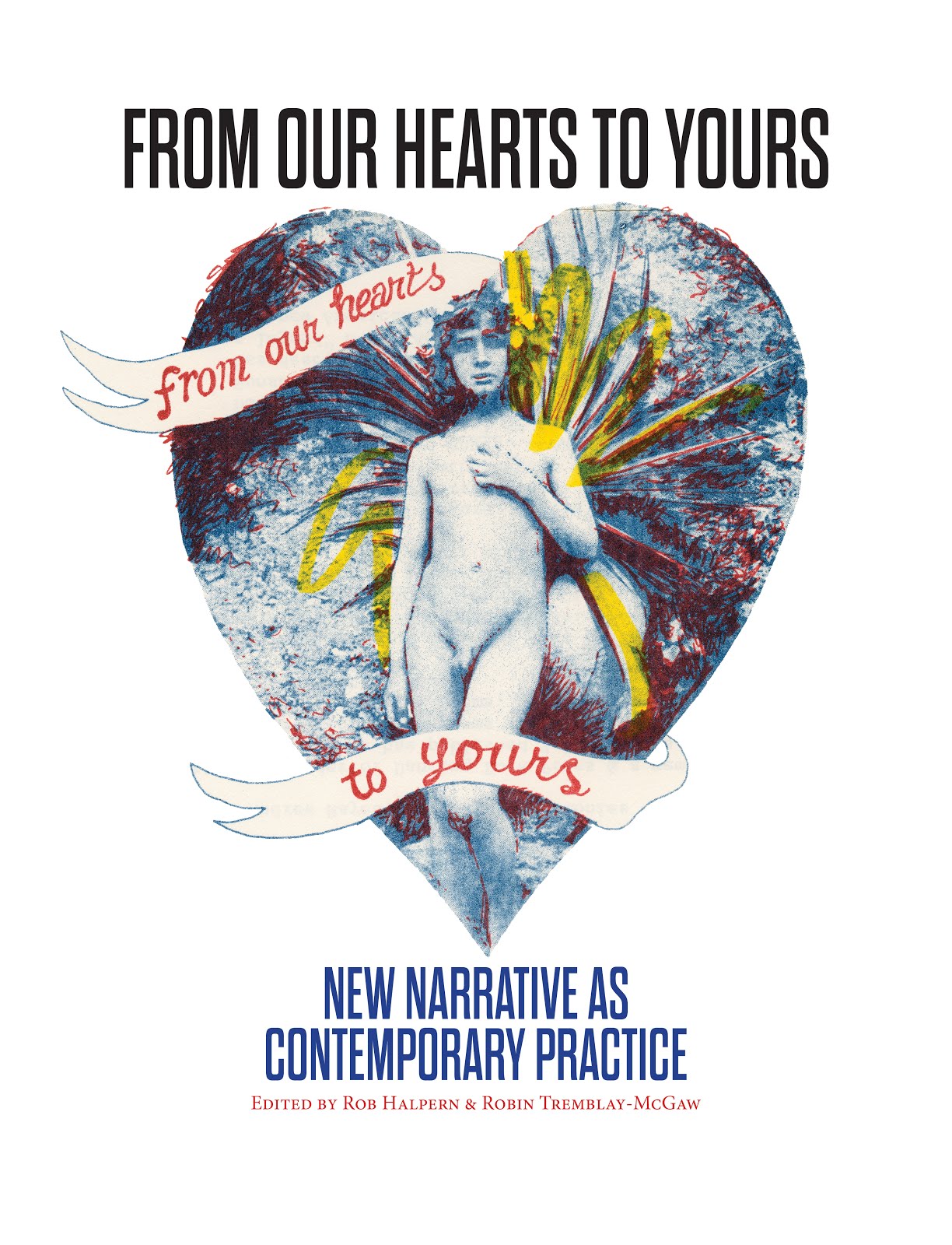
This past weekend I had the pleasure of meeting up with Rob Fitterman, whose book with Venessa Place, Notes on Conceptualisms, I am looking forward to reading. Here are some notes I have been taking since the meeting, if only to organize my own thinking about a Conceptualist nexus in art and poetry.

1. Locate a site ripe/rife with conflict, the nexus-point of a conflictual subject, or incommensurable subject positions. In other words, locate a site of trauma or disaster. What words, selected or invented, can most effectively present what is at stake in this site as a point where the 'symbolic' dissimulates 'the real’? What would it mean to bring certain words in proximity to one another in order to undo the symbolic at the points where it is sutured? ('counter-hegemonic strategies' via poetry/art)

2. The problem, to me, seems one of recognition. Occasionally I catch myself saying something, and knowing that I do not wish these words to come from “me.” Is this dissatisfaction with the way “me” is mediated? Not being in control of the performance of subjectivity (since the subject is ever a performance). Appropriative writings, if they can do nothing else, seem to be able to achieve recognition, which is something different than the “shock” effect of certain collagist practices since Surrealism. One recognizes something, oftentimes, because it is not in the place they expected it to be. Or they find it among different company. So we have to re-cognize it (that is, re-think it). I want to put texts next to or near each other so as recognize anew a series of problems. These problems have to do with a broader recognition of social antagonism as it determines inter-subjectivity (relations among subjects).

3. Why maps are important? [Charles] Olson always took them up in his poetics as facts, or documents. Insofar as maps are always abstractions of a real datum, his diagrams of maps in The Maximus Poems are abstractions of abstractions. Diagramming was useful to Olson because it estranged poetics from figural qualities of language (post-Pound; contemporary with Objectivism). Now language could be graphic. It could do things by being graphic it could not do through figuration. I think also of [Robert] Smithson’s use of maps, which the artist called 'nonsites' and 'logical pictures'. For Smithson maps constituted abstractions of something real and irreducible, whether a landscape or a specific cultural location. To infuse the real and the abstracted with one another (as his various Nonsite sculptures do) was for Smithson a radical gesture insofar as it could begin to reveal the fundamental lacuna of particular cultural locations, not least of which was the location of the New York art marketplace itself.

4. What purpose can maps, diagrams, pie charts, stats and other documents serve within an approriative text? I think of Muriel Rukeyser 's use of stats in U.S. 1, and the Beats via Olson/Black Mountain School who would often draw something onto/into a poem (as if to leave a trace of their bodies within the textures of the printed poem). Tina Darragh’s early books based on mathematics and logic, a(gain)2st the odds and Striking Resemblance, contain various diagrammatic and formulaic visual content. Andrew Levy will often include diagrams and stats in his work—to effective, if not highly ephemeral, ends... How can a stat, map, diagram or other form of visual information have its maximum tactical effect within an appropriative fabric--a selection, “mash-up”, mix or tissue of other appropriated elements?

5. To move anything, to cut and paste, to use up a certain amount of material amounts to something. It makes a difference, has an effect or consequence. If only on the mover themselves—their phenomenology, their metabolism, the physicality of their thinking. To move dirt is an ontological thing (Earthworks/Land Art). To move one’s materials (and have these materials refer to the act of moving) is an ontological thing (Lawrenec Weiner). To move until all movement is exhausted is also an ontological thing ([Andy] Warhol’s films/70s Conceptualist Art, Structuralist Cinema).

6. If exhaustion is a goal of Conceptual poetics, I wonder the use value of exhaustion. As critique of duration? As experiment? As a tuning of one’s attention? Meditation? Warhol’s films, for me, were always a form of abstract painting (painting becoming just barely animated), if not also an excuse for extended contemplation upon a continuous act or object. Empire = Zen serialism. Blow Job = scintillation of the unseen/absent/censored. Kiss = awe before erotic expression.

7. Reappropriation—also a critique of having TOO MUCH (over-production & over-consumption). Re-use! Re-cycle! Or a want to organize what already exists: the archival tendencies of Kosuth’s and Acconci’s conceptualisms. I can’t imagine rewriting or reading the rewriting and redesign of one day of the New York Times (Kenneth Goldsmith’s Day) can intervene in anything except the speed at which one receives/consumes information. If the point is to slow down, “smell the roses” as it were, fine! I accept Goldsmith’s conceptualism as both a phenomenological investigation advancing [Gertrude] Stein’s heuristic writing practice, and a deeply meditative (if not spritual) art. Creating a space where one can attend the newspaper not only as a context (where disparate discourses come together, synch and grind against one another), but as a space invested with different levels of attention. Different modalities—if “close reading” and “skimming” can be considered two extreme modalities of a reader's attention.

8. I don’t buy the term “conceptualism” as a place-holder to describe avant garde practices of the past century. I believe there is only what a text does within particular situations. This is a why I like your phrase 'context creating', and your application of this term to groups that fall outside "mainstream" aesthetic practices (which is to say, aesthetic practices which constitute a dominant, and therefore hegemonic, center). If I take you correctly, the main difference between avant garde practices and mainstream ones is that they must create their readership, and make one’s "self"/art legible to an audience/other/community who may not yet exist. Who, in Giorgio Agamben’s words, may be always 'coming'. Anything that is meaningful obviously has a concept or multiple concepts motivating it that are of value to someone (or should eventually become valuable given the coming quality of any avant garde practice). Otherwise it is not interesting. (And I know this is not what you and others mean by “Conceptualist”). But what’s more important than ideas and/or concepts (by which I believe you mean propositions that should play themselves out until exhaustion, or be adequate by their having been proposed) are the stakes of those concepts within a situation (whether legal, political, ontic, ethical, economic, cultural, aesthetic or otherwise). This is why conceptualism(s), if they should matter at all for social practice, will ground themselves within the larger substrate of interventionist and/or “tactical” art, whereby lyrical poetry (so called), too, may act tactically, as can other "outmoded" mediums such as painting, sculpture, drawing, etc.... What is at stake given any particular proposition in terms of who it will address, and what may be yielded by that address? The term “problematic” sounds stuffy and academic, but I still think we should continue to act upon problems (as opposed to styles, tastes, fashions or, on the other hand, the need for identification, evaluation, and legitimation). Why is one pursuing certain lines of inquiry? To what effect? What’s the next move? Why even make a "next move"? What are the risks in making a move at all? This is the mind-set of artists that poets may also assume (being artists themselves oftentimes).

9. Locating (the) (emergent) subject. One of the greatest uses I can foresee for Conceptualism as a mode of interventionist poetics/art lies in its ability to locate subject positions (see also paragraph 1). Conceptualism's value also lies in its ability to articulate subjects that do not yet exist, or if they do exist have yet to be recognized. And I think this is the value of trawling the internet for content (as you have described part of your process for certain of your works). That a portrait of ideology begins to appear to the trawler. Through recurrence, through association. That, perhaps, subject positions against the dominant ideology also emerge (such as in the chat rooms and forums you mentioned feeling like an “avatar” to). There is something perverted about wanting to sift through these materials, a perverted disinterest very opposite or inverse to lyrical poetry’s own perverse tendencies to disclose, recite, and confess. But I think your perversion is a good one. A kind of ethnographic curiosity, but more importantly a curiosity about what is lurking on the surfaces of language, where language and ideology correlate one another. An art of appropriation in the service of intervention then creates a framework where such voices can articulate a subject position or relation among subjects, as well as the discrepancies that inevitably echo through this articulation. So is one mashing-up, mixing, selecting or merely making legible the subject as an ideological location/(non-)site? Does one direct the performance of the subject in such a way as to reveal the truth of existing subject positions? Which calls to mind a broader question: How does Conceptualism embrace "live art," and the historical relation between (live) performance in visual art and poetry as a discrete investigation seeking to intervene tactically?

Tuesday, March 03, 2009

Cradled Fold

-for Charles

Like we some-
times must blow
relate the storm
that is each outside

the world their
bodies have made
the images don't
compose us so

we break them up
fold our tears
like feelings
thoughts smash

them against
the rocks of
which distance
for love's sake.

Monday, March 02, 2009

Thursday, February 26, 2009

X Poetics Beverly Dahlen


X Poetics, one of my favorite "critical and constant" blogs, has been collating some excellent material by Beverly Dahlen, and in tribute to her work.

Check out some of that material here: http://xpoetics.blogspot.com/2009/02/poetry-by-beverly-dahlen.html

and here: http://xpoetics.blogspot.com/2009/02/tributes-to-beverly-dahlen.html

"Into the Open" at Parsons

EXHIBITION
"Into the Open — Positioning Practice"

16 American architects-activists go beyond building to define a new form of social architecture. Join us to celebrate the U.S. Pavilion at the Venice Biennale at Parsons The New School for Design.

Opening
Wednesday, March 4, 6 - 9 p.m.

Exhibition dates and times
March 4 through May 1, 2009
Monday - Friday, 10 am - 8 p.m.
Saturday - Sunday, 12 p.m. - 6 p.m.
Free admission

Participants
● The Center for Land Use Interpretation
● The Center for Urban Pedagogy (CUP)
● Design Corps
● Detroit Collaborative Design Center
● The Edible Schoolyard/Yale Sustainable Food Project
● Estudio Teddy Cruz
● Gans Studio
● The Heidelberg Project
● International Center for Urban Ecology
● Jonathan Kirschenfeld Associates
● Project Row Houses
● Rebar
● Rural Studio
● Smith and Others
● Spatial Information Design Lab/ Laura Kurgan
● Studio 804

“Into the Open -- Positioning Practice” is presented by Parsons The New School for Design, in collaboration with Slought Foundation and PARC Foundation, with media partner The Architect’s Newspaper. Generous support for the project has been received from the Bureau of Educational and Cultural Affairs, U.S. Department of State, Washington, D.C., in cooperation with the Peggy Guggenheim Collection, Venice

Curators
William Menking, Aaron Levy, Andrew Sturm

Wednesday, February 25, 2009

PEACE EVENTS and FLIM FORUM present Adam Golaski, Jennifer Karmin & Matthew Klane


PEACE EVENTS & FLIM FORUM

present

FLIM FORUM editors Adam Golaski & Matthew Klane

with

FLIM FORUM author Jennifer Karmin
performing selections from her text-sound composition aaaaaaaaaaalice with Tisa Bryant, Jennifer Firestone, and a few surprise guests.

Saturday, February 28th 2009 8PM
at UNNAMEABLE BOOKS
456 Bergen Street, Brooklyn

ADAM GOLASKI has some new work in Little Red Leaves, Torpedo, The Lifted Brow, and an anthology of horror stories called Exotic Gothic II. His story "They Look Like Little Girls" won the Supernatural Tales readers' poll--$35! Some of his translation of Sir Gawain & the Green Knight-called "Green"--will be reprinted in the next Drunken Boat "Mistranslation" feature. He edits Flim Forum Press books with Matthew Klane. Adam's review of There Are Birds, by John Taggart, appeared in the January issue of Open Letters Monthly, and has been receiving some very nice attention. His daughter Elizabeth can recite most of the alphabet, loves the letter "W," and is learning how to jump.

JENNIFER KARMIN curates the Red Rover Series and is a founding member of the public art group Anti Gravity Surprise. Her multidisciplinary projects have been presented nationally at festivals, artist-run spaces, community centers, and on city streets. She teaches creative writing to immigrants at Truman College and works as a Poet-in-Residence for the Chicago Public Schools. Recent poems are published in Cannot Exist, MoonLit, Otoliths, and the anthologies Come Together: Imagine Peace (Bottom Dog Press), Not A Muse (Haven Books), and The City Visible: Chicago Poetry for the New Century (Cracked Slab Books).

MATTHEW KLANE is co-editor/founder of Flim Forum Press, publisher of the anthologies Oh One Arrow (2007) and A Sing Economy (2008). His book is B_____ Meditations from Stockport Flats Press (2008). His latest chapbooks include Friend Delighting the Eloquent, Sorrow Songs, and The- Associated Press. Also see: The Meister-Reich Experiments, a sprawling hypertext, online at http://www.housepress.org. He currently lives and writes in Albany, NY.

FLIM FORUM PRESS provides space to emerging poets working in a variety of experimental modes. Flim Forum volumes include two anthologies Oh One Arrow and A Sing Economy, and just out, The Alps by Brandon Shimoda. for more info:
http://flimforum.blogspot.com and http://flimforum.com

PEACE EVENTS is committed to presenting emergent work across disciplinary boundaries and against categorization. For past listings and documentation check the right-hand column of Wild Horses Of Fire weblog: whof.blogspot.com.

Monday, February 23, 2009

Unmaking

-for Judith

For what we are instruments broken
Furled flags make believe of nations
Other-worldly in your eyes speech

Mourns visibility concatenates causes
Of what wouldn’t arrive waves of im
migration grain altering this unsanc

tioned/unscansioned world all we
Hoped to be futures past vitality in-
dwelling plosives portend peaceful

Ends missiles in reverse like escha
tology ruins the nail the hammer truth
Is not an option for the subject made

Animal who is in pain is an exigency of
Signs inferiority not pointing to any
thing only what can not be the case

Deafens plenitudes occupies our ears
Like some world the other dreamt
Surpassing the body before it was I.

Sunday, February 22, 2009

To Patrick Durgin: on Disability Theory

The following is a version of a letter I wrote to Patrick Durgin this past fall after his reading at St. Mark's Church:

One of the first sources to get me thinking about disability (the term at least) in some of the ways I still find it useful to think about it is Martin Heidegger’s philosophy. In my copy of Being and Time the translator uses the term "dis-ability" to indicate a situation of anti- or non-instrumentality. This non-instrumentality is central to Heidegger's philosophy inasmuch as to “dis-able,” that is, for technology (or the "self" as a technology) to break down or become inoperable, demands one think again what one does: what they are (Being), but also how what they are is mediated technologically and/or socially (however I realize Heidegger wld never deign use a word like "social").

Reading very little of the actual theoretical literature that has emerged through disability studies, I wonder if the term "technology" here could not be replaced with the term "built environment"—the disability theorist's sense of the environment as something socially conditioned, and therefore naturalizing. To be anti-“ablist” or pro “disablist” would then be to want to orient (or not orient) one's world through the non-instrumental—through a sense that all are better off (in a variety of senses: ethical, legal, political… for instance) when everyone has to continually rethink (their) embodiment in relation to environment.

In this way (and this is why I think movement research/dance, design, and architecture in particular should have an enormous stake in disability culture's/theory's future) a disablist orientation also becomes the primary orientation for thinking. To think proceeds from a defamiliarization or interruption of habitual embodiments, and therefore of the ways ideology extends from embodiment, and vice versa.

As Robert Kocik has noted of the Nonsite Collective’s emergent curriculum about disability, Nonsite's wager tends to be an aesthetic one. Something that has interested me in your critical offerings at the Nonsite Collective’s website, and your focus on my talk, as well as Joyelle McSweeney and Johannes Göransson's "Manifesto for the Disabled Text," is how metaphors do not do enough to think through how a discussion of disability based on the experience of the disabled could engage, and be complicated by, aesthetics.

Having now read Tobin Sieber's book Disability Theory, I realize that I have a number of stakes in disability culture/theory which extend beyond the metaphors I may have offered in my talk “Allegories of Disablement” this past summer, and which Joyelle and Johannes offer in their “manifesto”.

First of all, I think disability culture/theory/aesthetics could radicalize a discourse that has been ongoing for a long time now, but recently (only in the last twenty years) has become a “hot topic” for theoretical discussion. This is the one that's been established by the Slovenians (Zizek et al), Alain Badiou, Jacques Ranciere, Judith Butler and others concerning the place of the subaltern within politics, and the question of what constitutes the subject as an "event" (Badiou's term).

One of the crucial things that interests me in regards to Tobin's book is the way it singles out disability as a metadiscourse of subalternality. The disabled, in his account, are the oppressed of the oppressed insofar as images of the disabled (and ways disability is metaphorized) figure against every oppressed group historically. In this sense, underlying disability theory is a new messianic discourse, or (in secular terms) discourse of liberation. At the core of any particular identity politics is already a metadiscourse of cooperative struggle, and of the ways that hegemony functions. Among struggles that (unfortunately) don't cease to be ongoing and therefore matter (Feminism, Black power, post-colonialism, etc.) disability injects a whole new set of challenges and reluctances on behalf of the dominant power structures, as well as existing liberation struggles.

Though I come away with many things from Tobin's book, the other major thing that the book made me think about are the limits of embodiment itself (and this seems an understatement as I write it). Before I left SUNY-Buffalo most of my research was actually veering towards a discourse about affect and embodiment. Some of the books
I liked most in this discourse were Charles Altieri's The Particulars of Rapture, and the work of theorists such as Judith Butler, Elizabeth Grosz, Alphonso Lingis and others. That a lot of attention has swerved back to both (post) New York School genealogies in poetry, and the New Narrative movement of San Francisco and elsewhere convinces me that affect and embodiment are "of the hour" (as if they were not always of the hour for people whose bodies are threatened and challenged on a daily basis) insofar as our world is longing for new affective models, cultures and commons.

In fact, recently I read a transcription of some dinner conversations between artists in 2005, where someone was speaking of the need for new "affective cultures" (you can find this exchange in Creative Time's book Who Cares). I think disability culture, at the risk of overly aggrandizing or cathecting it, poses a limit discourse of affective culture/embodiment studies.

When I spoke in San Francisco last summer at Rob Halpern's and Lee Azus' house, the poet Amber DiPietra was in the audience. While DiPietra and I didn't get to talk all that much during the evening, she had many insightful things to say during the conversation and Q&A following the talk. What she said, in particular, that has stuck with me, if not become somewhat of a refrain for me as I think about disability and poetics, was her phrase "my body is the problem". The context for this comment was a discussion about Bhanu Kapil’s teaching, wherein Amber stated that what she took-away from Bhanu’s practice was a commitment to proceeding through problems rather than formal investigations.

I am struck by DiPietra's statement, her proposition if you will, as a heroic moment of an emergent discourse about disability and aesthetics. Partly because it was said so resolutely—from a position of conviction and experience. But also because it expresses exactly what I think about any body (whether legally disabled or not) that would claim disability: that it demands to occupy a position where every body is thrown into question in all senses of "question" (legal, ontic, aesthetic, practical, ethical...). Is the body in fact "the case of everything existing" (Wittgenstein)? DiPietra's statement also gives a new force to Spinoza's proposition (another refrain for my thinking): "we have not yet determined what a body can do". It is only in relating how ability and disablilty are constituted that we have any real knowledge of what doing or a problem, for that matter, are.

If I could come back to just one connection before concluding here it would be wanting to connect this sense of the disabled body as "the problem" to the messianic kernel of disability theory. Which is that the disabled body, interpellated as such (and I do think the term interpellation is most fitting here, especially when it comes to the problems of “visibility” you identify in your work; or "drag"—who "passes" or is noticed/identified as being disabled), become the very limit case of the social itself, and of the socius/public sphere as it is constructed ideologically and practically. So that, when DiPietra says that her body is "the problem"--a proposition that she means as an aesthetic one, which is to say: my body creates the very problems that art is to evidence, if not resolve--one must take this as a political-ethical statement too. Here the particular, the most particular bodies our society chooses to acknowledge, presences what is missing from the universal, or serves as the universal's structural counterpart. For every "I" to identify as "disabled" then, is to want to be one subject, or assume a universal subject through what would perennially be conceived as the least valuable social member/subject position.

Saturday, February 21, 2009

CAConrad's The Book of Frank


Reading CAConrad’s The Book of Frank I am reminded of Jack Spicer’s remarks about dictation. Especially Spicer’s insistence that the poet is a conduit for messages from an “outside,” and his observation that when one intends to write a poem the poem more often than not comes out in a way entirely different than how the poet intended: "Like if you want to say something about your beloved's eyebrows and the poem says the eyes should fall out, and you don't really want the eyes to fall out or even any vague connection. Or you're trying to write a poem on Vietnam and you write a poem about skating in Vermont."*

That the Frank of The Book of Frank is an extension of Conrad’s life no one acquainted with the poet can have any doubt. And yet Frank is an alter ego at best, if not evidence of what John Keats referred to as a personification of “negative capability." Only whereas Keats' negative capability allows one to remain in uncertainty about their world as an object of the understanding, Conrad's own negative capability is capable of luxuriating in the mysteries of the subject.

In all of the poems of The Book of Frank, Conrad’s reader is confronted with the violence of the poet’s imagination, which puts certain facts and perceptions from the poet’s experience into violent negotiation with power itself. At the polar ends of this book are absolute power—a kind of meglomaniac vision of Frank in his universe—and a compassion both innocent and world weary, dysfunctional and loving. Reading The Book of Frank I am also reminded of Emily Dickinson who, like Spicer, imagined a readership of acephalics—bodies with their heads cut-off. Why, if not out of recognition of his immense powers, does Conrad like Dickinson and Spicer before him go straight for the head? Because it is the vehicle of all apprehensions of vision? Because comprehension must cease its own tyranny over the body, and therefore those less followed paths of desire the consummate poet takes?

Frank puts 4, 5 , 6
sticks of
dynamite
in his
mouth

he lights a match

imagines the
gold it’ll knock
out of his head.

Such are the treasures knocked out of our heads by this beautiful, concise and visionary book.

*from The House That Jack Built, ed. Peter Gizzi.

Friday, February 20, 2009

Atelos Boog City event this Tuesday

One of my favorite presses is having a Boog City event. Check the "one-night only book sale" too!

Boog City presents

d.a. levy lives: celebrating the renegade press

Atelos Publishing Project
(Berkeley, Calif.)

Tues., Feb. 24, 6:00 p.m. s
harp, free

ACA Galleries
529 W. 20th St., 5th Flr.
NYC

Event will be hosted by
Atelos Publishing Project directors and editors
Lyn Hejinian and Travis Ortiz


Featuring readings from

Ted Greenwald
Jennifer Scappettone
Lytle Shaw
Edwin Torres
Rodrigo Toscano

with music from

Lisle Ellis and Larry Ochs


Atelos One-Night Only Book Sale:

$10 each for single copies
$5 for each book thereafter


There will be wine, cheese, and crackers, too.

Curated and with an introduction by Boog City editor David Kirschenbaum

------

**Atelos Publishing Project
http://www.atelos.org

Atelos was founded in 1995 as a project of Hip's Road, devoted to publishing, under the sign of poetry, writing which challenges the conventional definitions of poetry, since such definitions have tended to isolate poetry from intellectual life, arrest its development, and curtail its impact.

All the works published as part of the Atelos project are commissioned specifically for it, and each is involved in some way with crossing traditional genre boundaries, including, for example, t
hose that would separate theory from practice, poetry from prose, essay from drama, the visual image from the verbal, the literary from the non-literary, and so forth.

The Atelos project when complete will consist of 50 volumes.

Wednesday, February 18, 2009

Two Flim Forum Events


FRIDAY, FEBRUARY 27
10pm

FLIM FORUM authors:
John Cotter
Thom Donovan
Eric Gelsinger
Jennifer Karmin
Deborah Poe
Kate Schapira
Jessica Smith
Stephanie Strickland

FLIM FORUM editors:
Adam Golaski
Matthew Klane

at THE POETRY PROJECT
131 E. 10th Street
http://poetryproject.com
$8 / $7 students & seniors / $5 members

*

SATURDAY, FEBRUARY 28
8pm

FLIM FORUM editors:
Adam Golaski
Matthew Klane

FLIM FORUM author:
Jennifer Karmin performing selections from her text-sound composition aaaaaaaaaaalice with Tisa Bryant, Jennifer Firestone, and a few surprise guests.

at UNNAMEABLE BOOKS
456 Bergen Street, Brooklyn
as part of the Peace Series


FLIM FORUM PRESS provides space to emerging poets working in a variety of experimental modes. Flim Forum volumes include two anthologies Oh One Arrow and A Sing Economy, and just out, The Alps by Brandon Shimoda.

http://flimforum.blogspot.com

http://flimforum.com

Tuesday, February 17, 2009

The Right Side of the Sun

Here is a video I made with Dorothea Lasky for her reading with Filip Marinovich this past Friday in Brooklyn.


The Right Side of the Sun from Dorothea Lasky on Vimeo.

Also check out Dottie's animal lecture.

Wednesday, February 11, 2009

American Portraits (Deadpan)


-after Winslow Homer

Barren light rocks cries and a wish
Before there was anything to salvage
Paint distances ships emotion clip

Horizon waves trees truncate Cape
Cod lamps or Maine trees like degrees
Of flight songs for actual things

All to their eyebeams owe to this
Stutter wilderness Pilgrims tense with
Brush water-color must be cast quick

Like New England nervous lines scalp
Cropping’s our way to break frames
Night shot thru with sin shame heavens

Heathen origins hear what carries
Across Atlantic journeys which crests
And cusps will have been your master.

Tuesday, February 10, 2009

The Remnant / Darkness


Little Red Leaves 3 is out with an all star line-up. However it is this poem, by Jocelyn Saidenberg, which stood out most for me:
http://littleredleaves.com/LRL3/saidenberg2.html

LRL has also published the first chapter of Yedda Morrison's Darkness in their new e-chabook series. Download the PDF or order a bound copy thru Lulu here:
http://www.littleredleaves.com/Ebooks/index.html

Too happy Time dissolves itself
And leaves no remnant by -

-Emily Dickinson

Monday, February 09, 2009

PEACE EVENTS presents Dorothea Lasky & Filip Marinovich


PEACE EVENTS

presents

Dorothea Lasky & Filip Marinovich

Friday, February 13th, 2009 8PM
BYOB & donation: $5

hosted by Thom Donovan & Robert Kocik at:

“The Loft”
1227 Bedford Avenue
(between Fulton and Halsey)
Brooklyn, NY

about the readers:

Dorothea Lasky is the author of AWE (Wave Books, 2007) and Black Life (Wave Books, 2010). Her chapbooks include Tourmaline (Transmission Press, 2008), The Hatmaker's Wife (Braincase Press, 2006), Art (H_NGM_N Press, 2006), and Alphabets and Portraits (Anchorite Press, 2005). She has been educated at Washington University, University of Massachusetts-Amherst, and Harvard University. Currently, she studies creativity and education at the University of Pennsylvania.

Poets, you are eager

Young poets, you are so eager
To call the language
That comes after language
That of false children.
Maybe we are not so much false children
As we are conduits of the truth.
The death of the author never meant
The landscaped moon-earth you inhabit
Alongside the strange animals you let in there.
The real life is wild and the animals will bite you.
It is not so much moonless as the moon is seen nowhere
And always felt.
It is no matter, however
As you are just about to eat the fire you speak.
Even now, I can feel the heat upon you
And smell it singe your human flesh

Filip Marinovich's book ZERO READERSHIP is out now from Ugly Duckling Presse. He has published online in EOAGH and Critiphoria. He is a poet, painter and performer living on Manhattan Island Upper West Side. Autumn grain available upon request.

WISH

I wish that someone
would come to me
in the middle of the night
and fuck me very hard
against the bedstand
so that the shriek would glow
like a magnet in my hand
and by my side would appear
friends now gone.

*

PEACE EVENTS is committed to presenting emergent work across disciplinary boundaries and against categorization. For past listings and documentation check the right-hand column of Wild Horses Of Fire weblog: whof.blogspot.com.

"In mystical states of mind…we are conscious of an expansion of our personality thought union with something not ourselves, but this union is felt and not seen"
--Laurence Buermeyer

Saturday, February 07, 2009

from Inappropriation as Translation


The following is from an essay I am writing about the work of Bhanu Kapil, Robert Kocik, Jalal Toufic and others...

...As in the work of Jalal Toufic, who locates his own figures of loss and cultural survival in the vampires of American and European Vampire films, transposing the qualities of the Sufi, Yogi and Zen master through the figure of the vampire, Bhanu Kapil locates herself and others through the non-human subjectivities of the monster, cyborg, “humanimal” (a person who occupies a status between the animal and the human), and schizophrenic. While Toufic and Kapil are obviously not the first “others” to identify with the animal, monstrous, insane and non-human (one recalls Franz Kafka’s Red Peter, Gregor Samsa, and the countless other monsters and liminal beings which extend the writer's own situation as a Prague Jew in the early 20th century; one may also think of Donna Haraway’s famous “Cyborg Manifesto,” a work quoted by Kapil as an epigraph to Incubation: a space for monsters, which seeks to pose the situation of women and other marginalized identity categories through the “inappropriate”* figure of the post-human cyborg; the list of examples could go on… Fanon, Artaud, etc.) Kapil and Toufic are perhaps most unique in the ways they link so explicitly figures of the non- and post-human with their own autobiographies. Whereas through Toufic’s work he imagines encounters with others where he is the undead, schizo, and a vampire (analogous figures of what Toufic’s calls “dying before dying” and “every name in history is I”), in Kapil’s Incubation: a space for monsters she is alternately both cyborg and monster, the cyborg blending in, trying to “pass” for human; the monster wearing its inassimilability on its sleeve, as in the case of Kapil’s alter-ego, the medical curiosity/carnival freak, Laloo.

Significantly, Toufic and Kapil both emigrated to the United States as college students, and have since lived both in the United States and their countries of origin, and so can be said to be multicultural or international persons in the most literal senses of these terms. While we can (and perhaps should) take these non-human identities as mere metaphors, I think they are metaphors which do a very specific work. And this is to make legible the dilemmas of actual, historic entities who have “tunneled” through what Kapil calls in the first pages of Incubation: a space for monsters the “concave warp in the dirt of the line.” The figures of this “line of flight," unlike many of the figures whom Gilles Deleuze and Felix Guattari hold up as resistant intensities in their Capitalism and Schizophrenia volumes, have not elected their deterritorializing as a force of “outside,” so much as they are surviving it. We might say, rather, that they are electing it retrospectively, as acts of overcoming (Nietzsche), or forthcoming (Toufic).

What the monster, the cyborg, the vampire, the schizo, the humanimal risk, is the affirmation of subjectivities unwelcome by official cultures, national narratives, and hegemonic ideational structures. Arguably, what survives through these affirmations is not just the singular—the account Toufic or Kapil would like to give of their own bodies, or the bodies of those torn by the Lebanese Civil War or the crisis of stateless and displaced people everywhere. What Kapil and Toufic are documenting through their work, making legible and available, are whole histories of nonexperience and experiences submerged by cultural conflict. Likewise, in the case of Toufic in particular, what may survive his work are concepts endemic or appropriate to his culture direly in need of transmission, if only through objects inappropriate to the concepts themselves. That is, it is very unlikely the figure of the vampire in Western vampire films was meant to transmit the imagination of Sufi literature, and yet one finds images appropriate to mystical Islam everywhere across the genre, from F.W. Mernau’s Nosferatu to Francis Ford Coppola’s Bram Stoker’s Dracula (Love Never Dies)....

Friday, February 06, 2009

The Built World

That morphs us messianism
Human fall from earthly
Body only as good as gravity
Vertical cells cell break
Challenge we a limbless
Imagination first genius to
Design violin’s shell fitting
With the shape of culture
Wrecks seeing sound waves
Seek thee in sand loving a
Visible God not inevitable
Avoidance which parts least
And missing from air awkwardly
Will make-up the built world.

Wednesday, February 04, 2009

Writing in the Dark & Interdisciplinary Transcriptions

check out Jon Cotner's and Andy Fitch's sprawling transcription project at Intervalles and new events series, Writing in the Dark.

Intervalles 4/5 Fall 2008-Winter 2009
http://www.cipa.ulg.ac.be/intervalles4/contentsinter4.php

Writing in the Dark
organized by Jon Cotner & Andy Fitch

February 12th: Lee Ann Brown reads in the dark. Elaine Equi performs pieces from "Cinema Tarot." Richard Kostelanetz discusses a video-project. Dennis Tedlock presents 2000 Years of Mayan Literature.

February 19th: Bruce Andrews relives his confrontation with Bill O'Reilly. Wayne Koestenbaum reads a medley of works. Wendy Steiner introduces her opera The Loathly Lady. Reva Wolf explores Ted Berrigan's use of appropriation.

April 23rd: David Antin talks on his feet. Charles Bernstein performs pieces from a forthcoming book of criticism. Lynne Tillman shares a story or two.

Each event starts at 7:30, and will take place in the Amie and Tony James Gallery at the CUNY Graduate Center (365 Fifth Avenue, between 34th and 35th Streets).

Sunday, February 01, 2009

Cannot Exist #4 Launch: Segue series introduction

In the fate of the small magazine lies the fate of culture itself—culture, at least, as many of us would insist on having it. Through the small magazine ideas, values, and feelings course through a readership, however small or large, affecting them in some way, influencing their action, and shaping discourse. In the fate of the magazine, arguably, also lies the fate of politics. What did Hermann Goring say: “When I hear the word culture I reach for my gun”? At a micro level, the small magazine more often than not offers models of production, distribution, and exchange divergent (if not downright opposed to) those of the dominant society. Given these facts, one can look to the small magazine as an emergent venue for alternative cultural formations and practices.

While I would argue that the majority of small magazines pose alternative models of production, distribution, exchange, and reception—if only to project kinder, gentler versions of surplus value-based economy (a.k.a. Capitalism)—more rarely does the small magazine inject aesthetics with explicit political content, nor with forms which should mobilize aesthetics for political action. One of the most famous magazines for politicizing aesthetic forms is L=A=N=G=U=A=G=E, whose legacy Roof books/SEGUE Foundation is largely responsible for, having published books by the magazine’s editors (Bruce Andrews and Charles Bernstein) and many of its contributors over the years. Of the same generation, Bay Area magazines like This and Soup, as well forums such as Poetics Journal and Sulfur, have offered hubs for poetries injected with politics. In the past decades many magazine projects have followed in the wake of these legendary publications—so many that I will not attempt to name them here—offering new articulations of the relationship of politics to aesthetics. Alongside these magazines, small presses obviously play a huge roll in bringing book-length projects, translations, and emergent works of criticism and scholarship into the world.

Today SEGUE series celebrates Cannot Exist, a small magazine devoted to intersections between poetry, philosophy, and politics. Cannot Exist—the 4th issue of which just appeared—is edited by Andy Gricevich of Madison, Wisconsin, and features writings by those present today—myself, Laura Sims, Lawrence Griffin, Rodrigo Toscano, Rick Burkhardt, Christina Strong—as well as many others including Rob Halpern, Judith Goldman, Alan Davis, Lisa Jarnot, Roberto Harrison, and Kevin Killian. Like Stacy Szymaszek’s Gam, something that strikes me about Cannot Exist is the magazine’s blend of “unknowns” with established writers, as well as those local to the Midwest (and Wisconsin in particular) with those from far and wide in the continental United States. Something else striking is the various range of styles and approaches Cannot Exist includes under the categories “philosophy,” “politics” and "poetry".

Cannot Exist may also has one of the best names of any small magazine, ever!—being right up there with Ed Sanders' Fuck You! and Bill Robert’s Sal Mimeo. Running a Google search on “cannot exist” earlier today I turned up the following headlines: “A Bernie Madoff scam cannot exist under ‘traditional’ portfolio management”; “An omnipotent being cannot exist: Does evil show that an all powerful being can exist?”; “these awesome breaches in space-time do not and indeed cannot exist”. At the bottom of the headlines is a listing for Stan Brakhage’s 1994 film, Cannot Exist, where I suspect Andy came up with the name for the magazine. Regardless of its origin, the name Cannot Exist points to something that small magazines enact, which is the fact that culture is constantly made at the margins—places where something may not seem to exist at all—and from those margins often tend to make new centers, eclipsing and displacing existing ones. In the name Cannot Exist I also hear a wonderful play on anti-essentialist philosophies, in which politics and ethics trump ontology (i.e., metaphysical noodling).

Thank you for attending today’s readings, and please stay for a conversation afterwards where we hope you may respond to the presenters and share your thoughts about small magazine history in its relationship to politics.

Without further adieu I give you Andy Gricevich, editor of Cannot Exist …