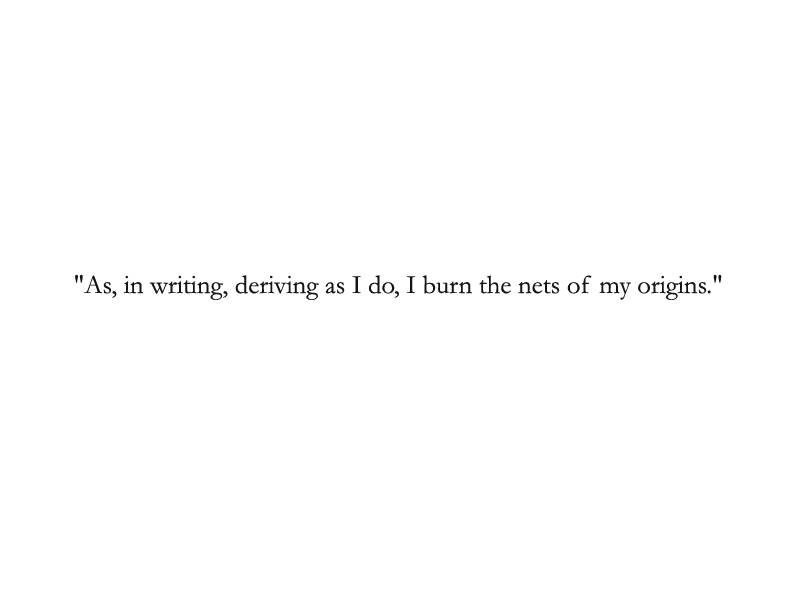
 *The H.D. Book [Frontier Press, online edition p. 139]
Wednesday, September 27, 2006


Sunday, September 24, 2006
Last Word
Joshua Clover's last words are still ringing after his reading with Sarah Manguso earlier tonight:
"The poets were all reading Machiavelli when they should have been reading Clausewitz."
"The poets were all reading Machiavelli when they should have been reading Clausewitz."
False Generations (Revision)*
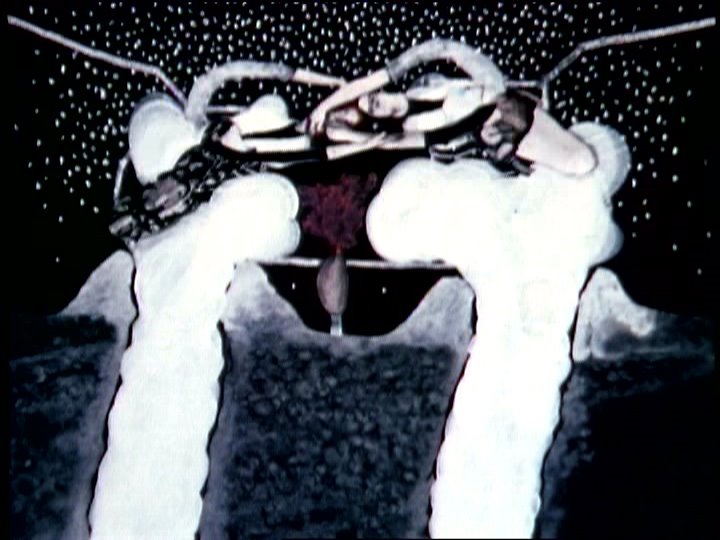
2. False Generations in David Lynch’s The Grandmother
In David Lynch’s third shorter film, *The Grandmother*, seeds give birth to human beings who behave as dogs in accelerated and non-linear generations. Is *The Grandmother*, then, not a film concerning rhizomatic deterritorialization? A nomadology of seedlings? “The wisdom of the plants: even when they have roots, there is always an outside where they form a rhizome with something else – with the wind, an animal, human beings.… Follow the plants: you start by delimiting a first line consisting of circles of convergence around successive singularities; then you see whether inside that line new circles of convergence establish themselves with new points located outside the limits and in other directions. (*A Thousand Plateaus*, 11)” Perhaps. But then the cinematic universe Lynch establishes in *The Grandmother* seems “archetypal,” preformalist or Occasionalist more than anything else. Lynch often says of his first film, *Six Men Getting Sick (Six Times)*, that he came to it in an attempt to make his paintings "move"; that is, to animate them. What is animation but a limit of cinema as false generation of movement (Bergson), or as an atomization of time per frame? False time, false movement, false generation.
*The Grandmother* is the second of two films that move from the painterly animation of Lynch’s first towards an original blend of diegetic “movement images” (Deleuze) with extra-diegetic and animation techniques. In the film, seed growth belies an inorganicism of the falsely generated, non-linear and preformalist. We can oppose the false generations of Lynch’s films to the non-organicism of Deleuze’s “crystal images,” where such images are generated by the bifurcating movements of actual images reflected in the uncanny opacities of their virtual counterparts: “This is unequal exchange, or the point of indiscernibility, the mutual image. The crystal always lives at the limit, it is itself the ‘vanishing limit between the immediate past which is already no longer and the immediate future which is not yet . . . mobile mirror which endlessly reflects perception in recollection’. What we see in the crystal is therefore a dividing in two that the crystal itself causes to turn on itself, that it prevents from reaching completion, because it is perpetual self-distinguishing, a distinction in the process of being produced; which always resumes the distinct terms in itself, in order to constantly relaunch them.”(*Cinema 2*, 81-82) These “powers of the false” of crystallic-virtualism—a virtualism which rests on Bergson’s crucial distinction between the dyadic terms real/possible and actual/virtual—we should distinguish from a preformalist organicism underlying that of Zoroastrian-Islamic aesthetics. Where crystallic-virtuality presupposes Bergson’s method of philosophical “intuition”—to locate form tendentially in irreducible temporal movements (or Durations)—preformalism assumes organicity as a consequence of the realization of preexisting potential forms (“templates” or clichés). Here, realized forms are the “copies” of possible forms as in Plato; however, per the magic of Surrealist exquisite corpse collage and primitive montage, ages and spaces (not to mention generations) may also meet in highly fortuitous assemblage. Counterposing the irony of Gertrude Stein’s statement from her lecture on “Portraits and Repetition”--“the only thing God can not do is to make a two year old mule in a minute”--such a view of creation assumes (following Jalal Toufic’s own Atomistic view of cinema in his essay, “Before thy Gaze Returns to Thee”) that Being is non-continuous, renewed during each “subsequent" instance: “Out of the clash of any two images, but even more clearly of any one image, do not arise, as in Eisenstein, many concepts (even if, as in Einsenstein, beneath them all be the concept of the dialectic itself or of class struggle), but a *dhikr* (invocation, remembrance) of the one necessary Being, who is beyond concepts; or the notion of the absolute dependence of the myriad entities. The jump cut, 'the sound of one hand [or image] clapping,' is a silent *dhikr*. Forgetfulness of God is a molar illusion, since creatures, not having their substance in themselves, are always returning to that which alone has subsistence, God. (*Forthcoming*, 121)”
In an early animation sequence from *The Grandmother*, the grandson ascends from his sprout-bed in order to abscond from his belligerent father. Analogously, throughout the film, the grandson negotiates what appear to be the three stories of a house: a bottom floor in which the grandson’s demonical, canine parents sit around a kitchen table and taunt him; a second floor where the grandson's bedroom is, and where he is periodically punished for wetting his bed; and a third in which he “grows” his grandmother, and he and the grandmother subsequently visit with one another. In ascending and descending the stairs of Lynch’s set, the grandson presents a typical movement from Angelosophy—the higher floors indicating subtler and thus more perfected degrees of Being, the lower the more demonical-animalistic. The shock of Lynch’s false generations is finally heightened by a passionate kiss shared by grandmother and grandson, as well as by a high-pitched whistling sound emitted from the grandmother’s throat, reminiscent of the sirens from *Six Men Getting Sick (Six Times*), and premonitory of Lynch’s first feature-length film, *Eraserhead*, in whose soundtrack many have claimed to hear super- and sub-audible pitches. Are the effects we know Lynch to have produced with fellow sound designer, Alan R. Splet, during the making of *Eraserhead* not evidence of a paradisical subtlety available through rigorous experiment in film soundtrack?
The problems of generation and temporality endemic to *The Grandmother* look forward to later Lynch films, and especially his most recent ones—*Lost Highway*, *Mulholland Drive*, and *Rabbits*—in which one encounters countless conundrums of narrative temporality. How, for instance, the protagonists of *Lost Highway* and *Mulholland Drive* are bifurcated by identities indicative of multiple temporal universes; likewise, how the characters of *Rabbits* occupy the same space/set however speak distantly, as though from different points in time, the lines of a mock situation comedy. That they are rabbits—those uncannily prolific creatures—who become the ostensible subject of one of Lynch’s most recent films, adds a comic dimension to his ongoing problem of generations ahistorical and “false”.
*a previous version of this text may be found among the March 2006 postings of this blog.
Saturday, September 23, 2006


Sunday, September 17, 2006
Praises Thunders Kills
Fire waits where fury was with looped ears and a mind full of lack
Motives come from positive position but guarded walls aren't fullproof
Until they could also move sensing a way towards our interpolations
Pressing on in cruel techniques memory complains about persisting mind
For every music never seen fire awaits every fact never sung we aligned
Falsely and do not see the brute exhibit for the lack of what is done
Where number does not bind hold me in this echo ironic as a scribe goes
During backward glances brave bright sand holds shape of attention most
Cameras that come and the sincerely undead beloved as they project
A reproaching flicker so hear your exterior heroics where eye's not I yet
Refugees escape harm to be harmed these corrupt words scattered to lyric
Forgetfulness regulated by a mutual blood of project of action and wrist
Onwards piecemeal go with the words as this is written and severed
By the eventual twist which is not innocence indeed no since nor sense
But justly ulterior suffered as the horizon of an awaited thought
What the aphorist makes instead not having forgotten to be dead
Like a magic lantern among the particulars of thought throwing out
Soundtracks of surrounding bifurcations the tears of shadows fell
Of project of action and rest forgetfulness regulated by an insular course
These words of corruption scatter lyrical refuge save it praises from it kills
So hear your outer heroics an approaching flicker where I’s not eye yet
As they come cameras and the sincerely undead as they project beloved
Brave bright sand holds shape of attention most during backward glances
In this echo iconic as a strobe goes where number does not bind merely show
We aligned falsely and do not see the brute exhibit for all evaluations worth
In this gas and despair we can thrive by dying for now our time to cry no
Being immortal organs for hearing noontide a way towards every fact never sung
Calling out the broad conditions of this leave from fronts I hear
That child whose image insists where they put the cut the will is power put
Promising no one some lines in your judgment book so we are time so far.
Saturday, September 16, 2006
Firstness*
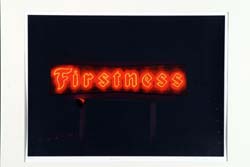
"The typical ideas of firstness are qualities of feeling, or mere appearances. The scarlet of your royal liveries, the quality itself, independently of its being perceived or remembered, is an example, by which I do not mean that you are to imagine that you do not perceive or remember it, but that you are to drop out of account that which may be attached to it in perceiving or in remembering, but which does not belong to the quality. For example, when you remember it, your idea is said to be dim and when it is before your eyes, it is vivid. But dimness or vividness do not belong to your idea of the quality. They might no doubt, if considered simply as a feeling; but when you think of vividness you do not consider it from that point of view. You think of it as a degree of disturbance of your consciousness. The quality of red is not thought of as belonging to you, or as attached to liveries. It is simply a peculiar positive possibility regardless of anything else. If you ask a mineralogist what hardness is, he will say that it is what one predicates of a body that one cannot scratch with a knife. But a simple person will think of hardness as a simple positive possibility the realization of which causes a body to be like a flint. That idea of hardness is an idea of Firstness. The unanalyzed total impression made by any manifold not thought of as actual fact, but simply as a quality, as simple positive possibility of appearance, is an idea of Firstness. Notice the naïveté of Firstness. [---] The idea of the present instant, which, whether it exists or not, is naturally thought as a point of time in which no thought can take place or any detail be separated, is an idea of Firstness." (A Letter to Lady Welby, CP 8.329, 1904)
*from Commens' Dictionary of Peirce's terms: http://www.helsinki.fi/science/commens/dictionary.html
Sunday, September 10, 2006
Words hinge
Words hinge
we are those
hinges
this is a grammar
of continuity
no.
Help yourself
to the spaces
between things
the breathing
between each breath
being for you.
we are those
hinges
this is a grammar
of continuity
no.
Help yourself
to the spaces
between things
the breathing
between each breath
being for you.
These Firstnesses
Which lushness is a correspondence an analogy of flowering
Your fingers positioned so in my memory of fingers
Or of these firstnesses before relation I remain hushed
Your body analogous bowing to our seconds flitting verities
Content to commence distance in blood so sequential
Because to be is to cause to cause shall see
This kiss with a difference our thighs lie
Uncovered towards a nearer blood
The city rises above us again twilight blue
In the sprinkle because to be is to cause
To cause shall see our delightful springing
Content to commence distance in blood so sequential
Your body analogous bowing to our seconds flitting verities
Of these firstnesses before relation I remain hushed or
Your fingers positioned so in my memory of fingers
Which lushness is a correspondence an analogy of flowering
Your fingers positioned so in my memory of fingers
Or of these firstnesses before relation I remain hushed
Your body analogous bowing to our seconds flitting verities
Content to commence distance in blood so sequential
Because to be is to cause to cause shall see
This kiss with a difference our thighs lie
Uncovered towards a nearer blood
The city rises above us again twilight blue
In the sprinkle because to be is to cause
To cause shall see our delightful springing
Content to commence distance in blood so sequential
Your body analogous bowing to our seconds flitting verities
Of these firstnesses before relation I remain hushed or
Your fingers positioned so in my memory of fingers
Which lushness is a correspondence an analogy of flowering
Eigenstates*
Summer pervades the lantern all quiet
Sirens around feet as I walk range
In grounds company effect & distance
Circumference of light long ago
Bigger than this difference of hearing I'm given to
How we are parts of speech to account for it
The yard its grammar disappearing here
In aspects different patch of way
*composed summer 2004 after the Larry Eigner Picnic, Blfo. Photo credit, Peter Manson: http://www.petermanson.com/eigner.htm.
Friday, September 08, 2006
What Happened Here

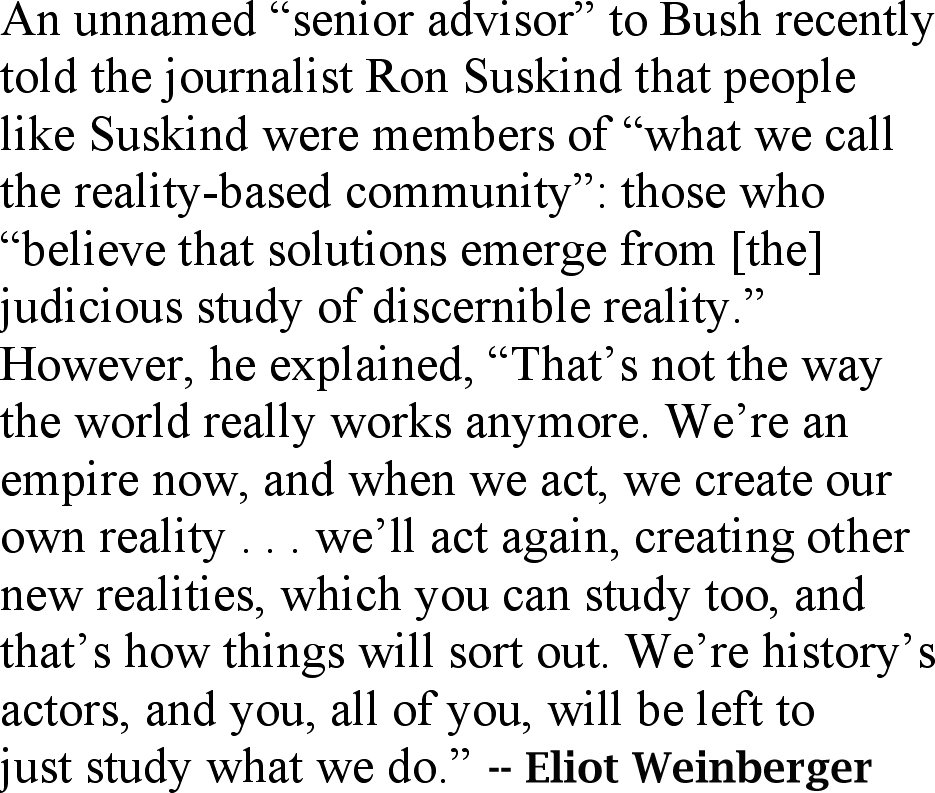
"Republicans do not like children. A little girl asked Richard Riordan, Secretary of Education for the State of California, if he knew that her name, Isis, meant 'Egyptian goddess.' 'It means stupid, dirty girl,' Riordan replies."
The above is taken from Eliot Weinberger's 2005 book *What Happened Here*, an essential chronicle of the W years. It is one striking example among many of the disturbing facts collected and arranged in the book. In *WHH* Weinberger sounds a political-ethical script after Charles Reznikoff's *Testimony* volumes and *Holocaust*, where hearsay and primary document reflect the antinomies of a hyperbolic (post-"Postmodern") political babble. If the hysterical pastiche of Flarf (or other individuals and groups currently taking up the problems of New York School and LANGUAGE communities) risks collusion with its contents--speech acts and cultural propositions riddled with hegemonic strategy--in an ostensible quest to call them into question, it may be interesting to counterpose the ironical effectiveness of a Rezi or Weinberger with those of a (Michael) Magee or (Kasey) Mohammad. The contradictions in the Bush admin are so rife, as Weinberger's "poem" proves, that one need only quote the administration's statements back, and arrange them with a kind of maximum torque of contradiction and rhetorical violence, to capitilize upon the cracks in the embedded U.S. political real (a terrifyingly banal surrealism surpassing Google's all-too-entertaining Boolean one). In Weinberger's book I sense the limit of what a poem can do during ever darkening times, if not a formal prescription to those who would write poetry to change the present face(s) of American politics: NOT APPROPRIATION, BUT FACTUAL ARRANGEMENT. *What Happened Here* is a necessary call to the direct action of collecting and collating Totalitarian facts and presenting them as poetic ones as the U.S. passes from a semblance of democracy to the blatent simulacra of Noble Lying.
Thursday, September 07, 2006

Wednesday, September 06, 2006
The Sacrifice
The flicker on their lips the bones
On their lips the bones which look
Look out from the face a portal of
Mortal harm the flicker in miniature
Pretending this isn't the end of the world
In miniature mortal harm the flicker
Out from the face a portal of look
The bones which look on their lips
The bones the flicker on their lips
On their lips the bones which look
Look out from the face a portal of
Mortal harm the flicker in miniature
Pretending this isn't the end of the world
In miniature mortal harm the flicker
Out from the face a portal of look
The bones which look on their lips
The bones the flicker on their lips
Monday, September 04, 2006


Friday, September 01, 2006
from "what wings raised: for Paradisical Beauty"

4. Do Angels See Anamorphically?
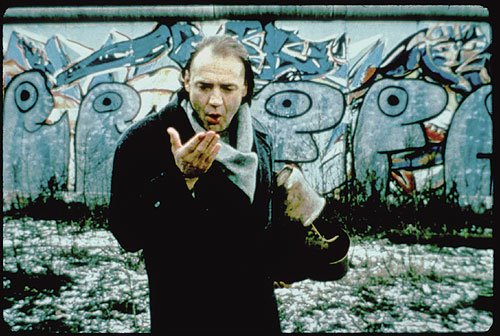
In Wim Wenders *Wings of Desire* angels do not see in black and white or color, but in sepia. Likewise, while Wender’s angels are telepathic (capable of reading the thoughts of others), and can teleport (be at any place instantly), they cannot experience the five senses of mortal beings, nor can they know death (Bruno Ganz is perplexed when he discovers his head to be bleeding) or sexual relations (Ganz, of course, eventually trades-in his wings to be with a human lover).
 In Adrian Lyne’s *Jacob’s Ladder* we do not see from the point of view of Danny Aiello’s Louis, however (as a Sufi Angel) we may imagine him to see like the Persian Sufi Sa’id when the poet writes:
 If the sword of your anger puts me to death,
My soul will find comfort in it.
If you impose the cup of poison upon me,
My spirit will drink the cup.
When on the day of resurrection
I rise from the dust of my tomb,
The perfume of your love
Will still impregnate the garment of my soul.
For even though you refused me your love,
You have given me a vision of You
Which has been the confidant of my hidden secret.[6]
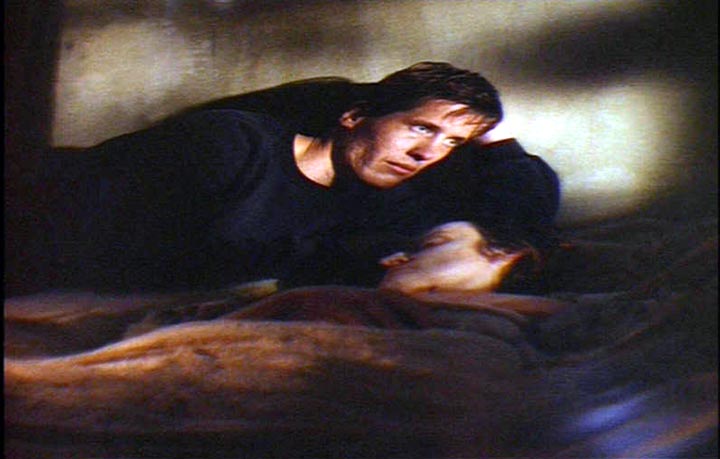
Jacob Singer (Tim Robbins) encounters any number of angels and demons as his soul transmigrates after a bloodbath among his troop in Vietnam, the terror of his Bardo given cinematic fact not only by the appearance of the demons who confront him--those without faces, eyes, and often limbs--and the predictions of a fortuneteller who tells him his palm is without a “life line,” and that he is therefore already dead; but also by the film’s swish pans which indicate “the fear of death-as-undeath that frightens one to death”[7].
 In Chris Marker’s documentary for Andrei Tarkovsky, *A Day in the Life of Andrei Arsenevich*, the French filmmaker points out how Tarkovsky’s characteristic camera angle differs from that of the typical American Western: where the camera of the Western points at an angle to the sky, Tarkovsky’s tends to angle towards the earth. This difference in camera angle indicates an important difference between American and Russian spirituality, as the American is regenerated by the transcendental promise of “big sky,” and the Russian by laying down in the earth, as many of Tarkovksy’s characters often do throughout his films.
One may often have the sense in Tarkovsky’s films that the point-of-view is that of an angel, or God itself. The concluding scene from *Andrei Rublev* provides one example of this, an aerial shot of the bell hoisted by an elaborate series of ropes; in the concluding scene of *Solaris*, the camera tracks revealing Kris’s home on earth to actually be located on an island of the oceanic planet.
In the opening shots of Alexander Sokurov’s *Whispering Pages* the camera, affixed to a boat which bobs in the water of a canal, tracks a building across the water while the shot is obscured by plumes of vapor. Birds that would seem doubly exposed fly in front of the screen and then land on the water; so ghostly are the birds that it comes as a surprise when they disturb the water. In a later scene, men and women jump from a landing to a place below, off-screen. While they jump the viewer hears a soundtrack, affected by reverb, of men and women talking loudly, cackling and laughing. These reverberating voices are non-diegetic, not matching realistically with the scene of the men and women jumping. In *Mother and Son*, the camera slowly descends as it cranes the couple sitting on a bench, looking at a photo album together. As the camera also twists while it descends, its motion mirrors the twisting trunks and branches of a tree beneath which the couple sit. In *Russian Ark*, Sokurov’s use of steady cam provides a constant sense that the camera is disembodied as it tours the St. Petersburg Hermitage. During the film, the camera often makes a focal adjustment that produces a feeling of vertigo in the viewer. The vertiginous effect of this adjustment—as if the lens were zooming-out while the camera tracked forward—is heightened by a *glissando* in the soundtrack. In Alfred Hitchcock’s *Vertigo* the viewer encounters a similar effect as Johnny-O (Jimmy Stewart) struggles to ascend the staircase at the Mission. Is this vertiginous effect of the camera in fact an effect of time travel? Both films travel “back in time”: *Vertigo* by reincarnation, *Russia Ark* by reenacting historical scenes from the Hermitage, and the nostalgic reminiscences of the film’s guide.
 While angels may see by steady cam and by slow tracking shots accompanied by a non-diegetic soundtrack, I wonder if they do not also see anamorphically? Along with the American filmmakers Sidney Petersen and Stan Brakhage (to whom Petersen gave his anamorphic camera lens as a gift), Alexander Sokurov is one of the great filmmakers to extensively employ anamorphic lenses—an optical technology originally imported from the Middle-East to Europe in the 16th Century[8]. In anamorphic illustration one finds an “accelerated” or “decelerated” (Baltrusaitis) state of optical abstraction, whereby one must look “awry,”[9] at an extreme angle to the plane of the picture, in order to see images in their correct proportions. In film, anamorphosis tends to elongate figures and give a swirling effect to their motions. By Sokurov’s use of anamorphic camera lenses, the filmmaker draws the viewer’s attention to a world deformed, and thanatological in this deformation. The anamorphic effects of *Mother and Son* are particularly telling of the optical phenomenon’s relation to death, as it gives due form to the mother’s *rigor mortis* at the conclusion of the film, and throughout the film all of nature--the trees, for instance, upon which the son leans and cries--seem themselves to mourn the mother’s death by the fact of their blurry elongations and wet, saturated colors. Likewise, anamorphoses provides a disorienting sense of space in *Mother and Son* and the film’s sequel, *Father and Son*, as the son of the former film (played by Aleksei Ananishnov) walks along a dirt path disappearing behind what appears a far away brush only to emerge directly in front of the camera, posing in *ruckenfigur*. Sokurov’s viewer may feel a similar sense of spatial disorientation as the two boys of *Father and Son* ride a trolley together, and eventually stand on an escarpment overlooking the city.
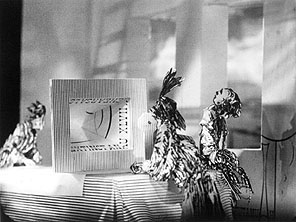
In the Quay Brothers only live-action film, *Institute Benjamenta* (1995), Jakob enrolls in the institute of the film’s title to be trained as a butler. In being trained, he first sees his lessons as repetitive and pointless, however gradually discovers in them an occult order. The exercises of these lessons, given by the master of the school, Frau Benjamenta--making a perfect circle of a cascaded set of spoons, folding napkins, reciting phrases one might say to the master of a house, swaying and intoning in unison with the other students--indicate a Grace not unlike that Heinrich von Kleist observes in marionette theater: “But, as the intersections of two lines, from the one side of a point, after passing through the infinite, returns suddenly to the other side; or, the image of a concave mirror after moving into the infinite appears suddenly again, near or before us; so, when Knowledge has gone, so to speak, through the infinite, Grace returns again, appearing at the same time, most purely, in the structure of a body which has either no knowledge, or an infinite knowledge, to wit: in a marionette or in a God.” In the total obedience of the Quay Brothers’ butler, the butler becomes like a marionette, and thus also like a God, involved with a universe of infinite mechanistic forces. It should come as no surprise that *Institute Benjamenta* was produced by a pair of filmmaker’s best known for their exquisite animation, insofar as contemporary film animation takes up, cinematically, problems similar to those of marionette theater and dance. Like the Nietzschean dancer in whom Alain Badiou recognizes the innocence of “a body before the body”[9], the butlers and animation figures of the Quay Brothers’ films overcome impulses to be mastered *by* (and therefore gain mastery *of*) invisible forces, perhaps giving answer to Simone Weil’s enigmatic question: “What wings raised to the second power can make things come down without weight?”.
Is the anamorphic distortion of a wall-painting in *Institute Benjamenta* a kind of key to the film’s own search for Grace, where such images are not only typically corrected by “looking awry,” but as well through the use of concave mirrors? As Jakob walks the labyrinthine corridors of the institute by night, he encounters a series of curiosities, including a clock whose second hand inexplicably disturbs a pile of dust as it traces its path, as well as jars containing the dried reliquary objects of deer. When Jakob leaves the hallway where the viewer sees an anamorphic wall-painting, he closes a door behind him and looks through a hole in the door to see, at the correct angle of the painting, a depiction of two deer engaged in coitus. Is the order of angels, like that of the institute’s labyrinthine architecture or the graceful pedagogy of Frau Benjamenta’s lesson plans, an anamorphic one insofar as it requires an optical correction to discover it? In such corrections may reside the necessary beauty of angelic intuitions.
Sunday, August 27, 2006
Come Out*

“*Come Out* was originally part of a benefit concert presented at Town Hall in New York City for the retrial, with lawyers of their own choosing, of the six boys arrested for murder during the Harlem riots of 1964. The voice is that of Daniel Hamm, now acquitted and then 19, describing a beating he took in Harlem’s 28th precinct police station. The police were about to take the boys out to be ‘cleaned up’ and were only taking those that were visibly bleeding. Since Hamm had no actual open bleeding, he proceeded to open a bruise on his leg so that he would be taken to the hospital. ‘I had to like open the bruise up and let some of the bruised blood come out to show them.’
“*Come Out* is composed of a single loop recorded on both channels. First the loop is in unison with itself. As it begins to go out of phase, a slowly increasing reverberation is heard. This gradually passes into a canon or round for two voices, then four voices and finally eight."
--Steve Reich
Reich's "tape piece," *Come Out*, is of a moment in the composer's career when he was experimenting with tape loops to create aural-acoustic effects similar to those of Medieval 13th century round and chant. The primary technical means of achieving these effects was through tape "phasing". To achieve phasing, Reich made copies of sound loops and synchronized the copies among different audio channels. As his tracks were not perfectly synchronized, loops that would begin in-synch would eventually come out-of-synch, *phasing* them. Through Reich’s discovery of phase composition he was led to the major contributions of his career: his explorations of “gradual” or “serialist” forms, polyrhythmic subtraction, and the rhythms and intonations of speech.
The radicality of Reich’s work with tape phasing (*It's Going To Rain* and *Come Out*) and many of his subsequent compositions, lies in an aural-cognitive process. When one listens to *Come Out* for the first time (if not many times after), one is likely struck by a shift about two minutes into the piece when one first hears the loops begin to desynch. During this moment, one hears the loops separating physically, concretely, in their “head-space,” as well as in their body. As Reich himself describes his first encounter with tape phasing: “The sensation I had in my head was that the sound moved over to my left ear, down to my left shoulder, down my left arm, down my leg, out across the floor to the left, and finally began to reverberate and shake and become the sound that I was looking for--‘It’s gonna / It’s gonna rain / rain’--and then it started going the other way and came back together in the center of my head. When I heard that, I realized it was more interesting than any one particular relationship, because it was the process (of gradually passing through all canonic relationships) making an entire piece, and not just a moment in time.(*WoM*, 21)" In Steve Reich's "Come Out," as in "It's Going To Rain," one hears and feels the tracks separate and then there is kind of leap, a skipping-of-tracks where the tracks cleave each other at a point where they are no longer synched, but also not sufficiently unsynched to allow a listener to hold both tracks in their attention simultaneously. The effect is what the American poet, Emily Dickinson, likely experienced as a “cleaving in the mind” and what the French philosopher, Maurice Merleau-Ponty, dubbed “chiasmic” in his late philosophical papers. As the phases cross in one’s attention, they briefly produce a kind of blank or aural blind-spot constitutive of a cognitive non-sense.
It is during this cognitive-acoustic event that I believe psychological processes pass over into problems of ontology. The chiasmic event of Reich's *Come Out* manifests a verticality interrupting the accretive horizontality of the tape loop. This coming *out* which interrupts and also comes *in*--‘outwards (or inwards) towards it’[1]--seems appropriate to the work’s demanding content: the police misconduct and institutional racism made blatant during the 1964 Harlem riots. If the tape loops create a recurrent horizon of sound--one long, serialized note not yet apparent in its multi-channel stereophony--the phase event which occurs two minutes into the piece performs a transcendent operation within the immanence of a continuous psycho-acoustic horizon. Where this horizontality of sound can be said to form an acoustical "dwelling place" for the listener's attentions, the interrupting phase event evidences a breaking of exteriority upon that dwelling. By this interruption emerges an ecstatic, if not anarchic, interval of the listening-mind (the term "anarchy" originating from the Greek *anarche*: that which lacks beginning, time, or sequence).
The radical exteriority of the formal event of phase shift in *Come Out* is a necessary aesthethic response to the demands of *Come Out*’s exigent content. The full recorded phrase of Hamm’s speech from which Reich makes his loops, and which he plays in full at the outset of the work--"I had to like open the bruise up and let some of the bruised blood come out to show them"--in its traumatic syntax and deictical indeterminacy, immediately puts *Come Out’s* listener in a position to puzzle the phrase’s alarming referent: a wound the teenager has suffered at the hands of the police. Address is crucial for this interruptive movement, as the listener-addressee of Reich's piece hears-out the recorded speech of one calling to another to attend (and thus bears witnesss to) his suffering. As Hamm announces the opening of his wound, the “bruised blood” of the tape loop, in order that it may be attended to physically by medics and legally by eyewitnesses, the wound becomes a physical site where interior and exterior are volatized by their ambivalence. Evidencing the ambiguous status of his bruise, Hamm's speech may articulate an exceptional or indiscernible point[2] beyond the law, as the law fails to result in justice during the Harlem riots and in the particular cases of Hamm and the other teenagers absued and mischarged by police.
The chiasmic sound event of *Come Out* we may imagine alongside the famous scene of police brutality and retribution from one of the most famous films to first take up the failures of the Civil Rights movement (and 60's social movements in general), and which inaugurates the independent film movement known as Blaxploitation: Mario Van Peebles 1970 film, *Sweet Sweetback’s Badassss Song*. In this scene the protagonist Sweetback (played by Peebles) must make a decision whether or not to rescue a young Black Panther from two police officers who are beating him to death. Sweetback, a hero typical of Blaxploitation cinema in his ardent individualism and ability to "play all sides," reluctantly intervenes in the beating, maiming both of the police officers and thus abandoning his favor with the law (in the scene, Sweetback has consented to be arrested in order to fulfill an arrest quota). What is most striking about this scene is the way it gives form to a complex ethics of violence. After the scene's complexities, I am reminded of Walter Benjamin’s own “Critique of Violence” in its call for a “pure violence” that, in Giorgio Agamben’s reading of Benjamin’s essay, plays in a suspension between social law and animal force (what Agamben calls the “bare life” of "sovereign" man):
"What can this other type of relation to an end be? It will be useful to apply the considerations that we have just developed concerning the meaning of Benjamin’s term 'pure' to the concept 'pure medium' as well. The medium does not owe its purity to any specific intrinsic property that differentiates it from juridical means, but to its relation to them. In the essay on language, pure language is that which is not an instrument for the purpose of communication, but communicates itself immediately, that is, a pure and simple communicability; likewise, pure violence is that which does not stand in relation of means toward an end, but holds itself in relation to its own mediality. And just as pure language is not another language, just as it does not have a place other than that of the natural communicative languages, but reveals itself in these by exposing them as such, so pure violence is attested to only as the exposure and deposition of the relation between violence and law. (*State of Exception*, 62)"
Benjamin’s pure violence is “pure” not in the sense of an ideal form, so much as after the way Nietzsche imagined his “will to power” as a dance within a force-field of fatal values. To play here means that one no longer acts out of preparation or with a clear sense of purpose (*telos*), but instead within a circumstance in which clear moral-legal imperatives would seem altogether lacking. The close-ups of body parts and medium shots of the figures of Sweetback, the teenager, and the two police officers against a background that would be utterly dark if not for two oil-drills somnolently pumping, also instances what Emmanuel Levinas called the *Il y a* (“there is”): the dark night of creation antedating social law, in which existents struggle for expression, substituting for each other in preliminary reponsibilties:
“Essence stretching on indefinitely, without any possible halt or interruption, the equality of essence not justifying, in all equality, any instant’s halt, without respite, without any possible suspension, is the horrifying *there is* behind all finality proper to the thematizing ego, which can not sink into the essence it thematizes. It is inasmuch as the signification of the one-for-the-other is thematized and assembled, and through the simultaneity of essence, that the one is posited as an ego, that is, as a present or as a beginning or as free, as a subject facing an object. But it is also posited as belonging to essence, which when assembled cannot leave anything outside, has no outside, cannot be worn away. This way for the subject to find itself again in essence, whereas essence, as assembled, should have made possible the present and freedom, is not harmonious and inoffensive participation. It is the incessant buzzing that fills each silence, where the subject detaches itself as a subject in face of its objectivity. A rumbling intolerable to a subject that faces itself as a subject, and assembles essence before itself as an object. But its own subtraction is unjustifiable in an equal woven fabric, of absolute equity. The rumbling of the *there is* is the non-sense in which essence turns, and in which thus turns the justice issued out of signification.”(*Otherwise Than Being*, 163)
The dark discourseless night of the *Il y a*, a night of animal cries and affective speech held in communicative abeyance, holds all of the terror of Sweetback’s ethical decision, as well as our own struggles as viewers to bear witness to this scene of discomforting violence. In its shadeful deictics, a chiasmic index demanding social action and ethical responsibility towards another, I believe the phase event of *Come Out* to similarly instance the “there is”. Through the phase event of “Come / Come out / out to show them,” Come Out produces a duration both arriving and departing when we would listen with others to a terrifying speech of testimony more affective than signification alone, more imperative than the laws of *polis*. In the shadeful sensibility of this moment we would also heed a call to come out the redoubling of an actual blood: to see, to listen, to point to a body in pain pointing; to point again to what will not be entirely located, sited, or sighted; to eventually tell.
1. Taggart, John. *Songs of Degrees*. Tuscaloosa: The University of Alabama Press, 1994.
2. see Giorgio Agamben's concepts of the "state of exception" and "points of indiscernibility" throughout his books *Homo Sacer* and *State of Exception*.
"Come Out" was originally composed as a companion essay to one on Gordon Matta-Clark's *Splitting* (now out in Sarah Campbell's gorgeous P-Queue!!!).
from "what wings raised: for Paradisical Beauty"*

3. Paradisical Dissociations, Literal Hallucinations
After rewatching David Lynch’s films and reading Michel Chion’s generous monograph on the filmmaker, I came up with the following propositions concerning *paradisical language*:
*The erasure of names approaches paradise where a name once was and in its place inheres the trace of a separation resonant with the name’s destruction. This resonance tantamount to a silence beyond silence evokes a condition of word and thing in their purest separation. The signs of paradise remain not only in polesemy or parapraxis, but in a total dissociation of sign and referent. The mind cleaves the body as the person reads or hears words in dissociated states. These words mark a caesura between figural and literal language, the psychotic radiances of literal hallucination versus received reading practices.*
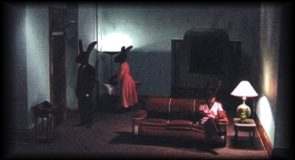 In David Lynch’s 2002 work, *Rabbits*, a series of actors dressed in rabbit costumes (Naomi Watts, Laura Elena Harring, and Scott Coffey) enter and reenter the set through a door at the set’s left side, and engage in semi-sensical dialogues complete with a situation comedy laugh-track. As in Samuel Beckett’s plays, the psuedo-dialogues of the rabbits would seem to draw attention to an alienation of beings struggling to communicate with one another in a world where meaning making has become difficult, if not impossible. But then I wonder if Lynch really shares Beckett’s problem of communicability? Does the problem of communication in Rabbits not derive instead from the monologues of the separate rabbits being “out-of-synch” temporally (and therefore ontologically) with one another? The lines of *Rabbits'* characters are blocked as if to be spoken to the other characters, yet would appear dictated by conversations occulted from the space in which they take place. We may have a similar sense of this dissociation in the many Lynch characters who would seem to speak in withdrawn states, and, perhaps most memorably, in Rebecca Del Rio’s *Mulholland Drive* cameo when the pop-singer collapses on stage leaving her “pre-recorded” voice to continue singing an emotional, Spanish version of Roy Orbison’s *Crying*. As in the recent work of the artist Catherine Sullivan (*The Chittendens*, 2005)[1], Lynch also establishes a cinematic stage upon which actors reenact traumatic events surpassing the strict purview of a chronological and unified universe. Notwithstanding the filmmaker’s interests in local color, highway journeys and “folk” speech, Lynch may, in fact, be most American where he attends what the poet William Carlos Williams called “the pure products of America”: the hysteric, schizo and psychotic. Like the one hypnotized or in trance, the psychotic tunes-in to the literal fact of words, and in doing so attends a fundamental strangeness of naming language. Through such attentions, the psychotic-hyponotized is admitted to a paradisical condition, if only through the side-door; that is, she is not returned to an Edenic state before naming language so much as she strikes beyond language’s arbitrariness to an objectivity which both grounds words and make them ecstatically obsolete.
 After Rene Magritte’s *This is Not a Pipe*, Michel Foucault has demonstrated the calligraphic qualities of Magritte’s art: “Pursuing its quarry by two paths, the calligram sets the most perfect trap. By its double function, it guarantees capture, as neither discourse alone nor a pure drawing could do. It banishes the invincible absence that defeats words, imposing upon them, by the ruses of a writing at play in space, the visible form of their referent. Cleverly arranged on a sheet of paper, signs invoke the very thing of which they speak—from outside, by the margin they outline, by the emergence of their mass on the blank space of the page. And in return, visible form is excavated, furrowed by words that work at it from within, and which, dismissing the immobile, ambiguous, nameless presence, spin forth the web of significations that christen it, determine it, fit it in the universe of discourse. A double trap, unavoidable snare: How henceforth would escape the flight of birds, the transitory form of flowers, the falling rain? (*This Is Not a Pipe*, 22)” Beyond calligraphic ambiguity, do not works like Magritte’s *This is Not a Pipe* and *The Key to Dreams* also evidence a condition of the “distracted”(Jalal Toufic): those who hear to see the literal senses of words inasmuch as they are enduring trance, hypnosis, fugue states, or “undeath”? This is not a pipe because the word “this” can no longer refer to “pipe,” nor the word “pipe” to its image or reality; this is also not a pipe as words roam deictically between the captions of illustrative drawings marking dissociations of names and things named (*The Key to Dreams*). A person experiencing such dissociations may no longer be able to assign the name ‘dead flies’ to the objects they have used as material for their paintings ("In an interview in 1992 by Michel Denisot on the French cable station Canal+ for the release of *Fire Walk With Me*, Lynch was asked about his taste for textures and materials, including things which are considered compulsive, like the series of dead flies he used in compositions. He answered that it is the name we give, the associated word ('dead flies'), which prevents our seeing them as beautiful, and that all we have to do to see differently is to erase the word.”)[2]; the same person may also not be able to assign the proper names of colors to colored shapes when promted by a computer, as in the case of a recent study of hypnotic brain patterns by neuroscientists.[3]
In these paradises of linguistic dissociation we perhaps see words as Louis Zukofsky did after the dream of Shakespeare’s Bottom: as the literal hallucination of written characters witnessed in synaesthetic negation: “The eye of man hath not heard, the ear of man hath not seen, man’s hand is not able to taste, his tongue to conceive, nor his heart report what my dream was.(*Midsummer Night's Dream*, 4.1)” At a limit of paronomasiac language one confronts the pun, a language phenomenon preoccupying both Zukofsky and Lynch. While Zukofsky’s most paronomasiac works may be his homophonic co-translation of Catullus’ Greek with his wife Celia Thaew, and his densely intertextual *80 Flowers*, we may discover Lynch’s most telling use of a pun in the title of his first feature film, *Eraserhead*, where Jack Nance’s eraser-like head detaches from his body to become a template for the production of pencil eraser tips (i.e. eraser heads) on an assembly line.
 Curiously, in Lynch’s second short film, *The Alphabet*, and in his textual paintings, letters assume a similar “dream life” severing the figural and literal. In both cases, this severance involves a misspelling whereby one *mis*-spells not because they lack the memory and attention required to spell properly, but rather because they see too much how letters arbitrarily assign sense (and, in this sense, misspelling or orthographic play may represent an under- or an over- compensation for the failure of letters to live up to the abundance of meaning the paranoid seer reads “into” them). When the girl of *The Alphabet* (Peggy Lynch) coughs–up blood while intermittently spelling the English alphabet, she may seek to purge herself of lexical order so as to produce new associations of letters made dislexic. Paradise lurks in this alchemical activity which pursues a boundary of literal and figural bodies. Parousias of paronomasia, paramnesia, and parapraxis. Paradises of cause, effect, and sense.
1. see the February, 2006 issue of Artforum for Sullivan on performativity and historical trauma in *The Chittendens*:
2. p. 173. Chion, Michel. David Lynch. London, BFI 1995.
3. Blakeslee, Sandra. "This is Your Brain Under Hypnosis". New York Times, November 22, 2005.
*The following is part of a longer work I have been writing for the upcoming issue of Crayon, on "beauty". Thanks to Crayon co-editor Andrew Levy for the invitation!

Subscribe to:
Posts (Atom)