Tuesday, April 18, 2006

Michael Cross's "Sacred"*


Sacred


Evental grace governs a multiplicity in excess of itself, one that is indescribable, superabundant relative to itself as well as with respect to the fixed distributions of the law.

Alain Badiou


For the abyss is the poet’s figure for the perpetual suspension of the right measure or law—that crisis, that “state of exception” in which, sent on our way by the gods, we are—for the time being—destined to live.

David Michael Kleinberg-Levin


What is called “grace” is the capacity of a postevental multiplicity to exceed its own limit, a limit that has a commandment of the law as its dead cipher. The opposition grace/law encompasses two doctrines of the multiple.

Alain Badiou


foregone for what’s wanting the bridge sez the size of the _quodlibet_

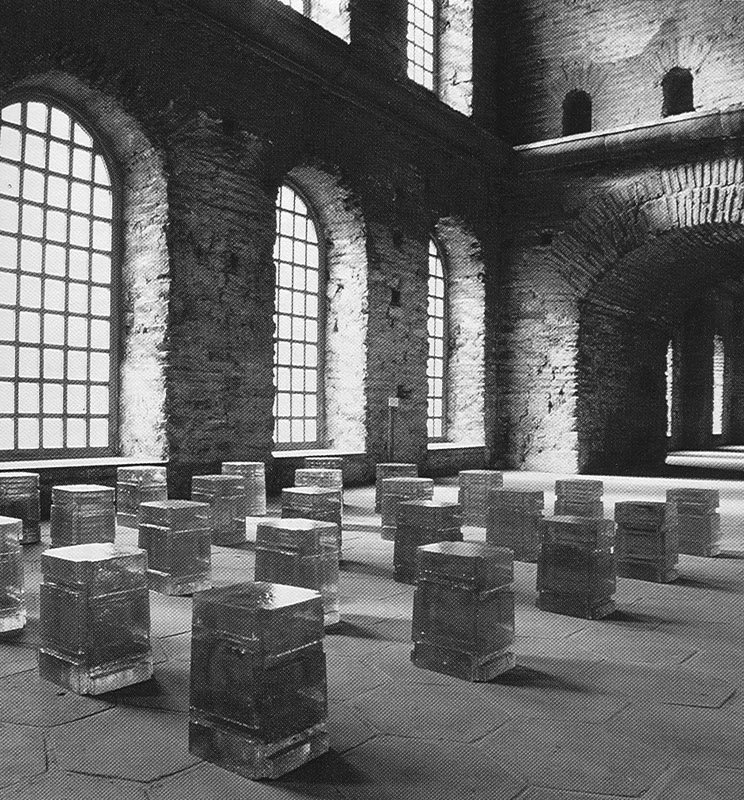
twenty-some casts (2001, 900 x 510 x 240 cm) according to gauge accordingly resin to gauge

scant forth attuned his plinth abut the Square, in-set coat disclose

the Tangerine dais as the _count-for-one_, then, thousands of mouths in the round,

black resin LAW in each slit has an animal upright, lash against the Ister, all

whilst warrant the monarch’s cairn, ‘his’ trestle (1765-1837) vantage for the pigeon

certainly bound by militant pitch certainly viscous amber

slag against the asphalt does to thinking for a turn involve


the militant wants the pass a bare right planar face

degrees from the flat while / transalpine coup as mare portraiture

circa 1848: a hand at degrees against the ribs—hock or tarsus, knee or stifle, brisket, feathering

this is a grid according to one’s planar order is a length and breadth mantled at degrees against the
ribcage]

opens out munitions piece—the flank I counter munitions in pantone grays, presumably liters

of blood wet the pavement, pierce Juliette Récamier, married to recline at the chaise

for François Gerard’s limit demands her bare pig’s kind of lawlessness or else the leap

from _condition_ to the morass of tempo-nodal captivation in terms of the eschatological

limits of lake-red-belts adjacent the starred asphalt lot’s blood and pencil pointing from Ashura,

sublimation once intoxication of interior / machete as the rite null set


two skulls slightly askant as the scale of communion and the police draped

summa (_whole_) crushed velvet, C, supremast, girder forms an intercessor for

what’s inside and what cant lead, obsessed with the shoulder and the lion

mouth full twined mail (entwined scales) or the face in repose of one slate,

here the joist immured of snakes and worms cant cede in lieu of bronzed

yoke wagging from the firth at croisillon nord / the corpses in fans

breast-width at the crest south and the west enforced walls of the thirteenth

century, the bodied knots of incisors against the barricades of the fifteenth,

these veils tear the eyes this sovereign paraclete, more LOW


inside, cerates both alum twice over / portage _purely formal void_ as anterior place holder,

cartouche, one margin slightly landed, Sovran—repose // serried ranks,

the “Hexe” moored higher if deterred this special rank the diagrammed grounds

once more hundreds by the ankles of a steel pylon, in other words, the lawlessness

I’ve swoll the fundament’s juridical torque so they won’t see the liter or the mote

or re- / enframed Peter Eisemen’s _House VI_ for the ENCLOSERS say a strophe,

from pewter’s repose’ve wandered / from one convex strophe to standstill

descendible: _the colonized future may be something like one of Veblan's “imponderables,”

as Zukofsky cites, and the blank becomes the only space from which to unsettle the habit of

its axiomatic power in the interest of an other future //_ grace this “sets” imponderable

a tympan is to sound between relief and its impression, the recessed face of a pediment

juridical sites of dissensus because on this one, the resin slightly elevated, it’s a room,

the _demos_, three elements of plastic and urethane foam (prolix plinths)


the second dual-monitor plaster in relief to _Breathless_

lake-fans asymmetry, lake-red symmetrical rivulets, alluvial fans one print in the window’s

an octagon in Algeria this one octagon _Kenya Boran_ (1974) removed to Houston

and finally Rice one’s back against the eight to view the rhombus (brown/shed/slake)

above the ziggurat and falls: grace in the _light_ of the rhombus—_Spirit’s watted filament_

in the hands in whose hands lie means, dope and cue of one’s own _dure_ // (chapter/verse)

_ochereous and lynx-barred in lengthening might; / Patience! and you shall reach the biding place! //

Here are lynxes Here are lynxes, / Is there a sound in the forest / of pard or of bassarid /

or crotale or of leaves moving //_

Sweaters of the corpuscle, twain labor, the lynx heads, a dazzle


red grace of sellotape and air paired next “folk” heads sleckit, cowrin

folk for the serotype of grace seemed lately to plait, agnate by a toxin

as many wolves as bird-roads red scotch such vast, timorous interface

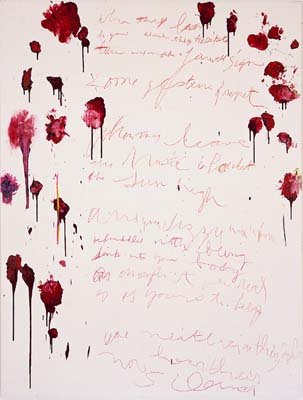
sans surface dimension so to socius as “white eschatology” in Twombly’s coronation of seostis

his socle, frame, pedestal, seal an infinite sovereign efflux, fens drained, its waste Enclosure

arrived at Helpstone in 1809 to mount and did duration’s a quality chalk and charcoal matrices

held by condition of score—held to grooves and yet to flute the rim—held by abeyance of white, chariot

volant athwart the grass air held to—the chariot harbors calm, seven frames in bed when you age, a gilt

wink of art’s autonomy / sovereignty swoll on the general matrices aver to contact each

each nominal surface a face, each press and rivet face, tocsin, period of vibration off the tangerine ring of autonomy


horn’s portraits prolix matte bulbs for eyes how weather renders

the dome identically vacuous, carriage on the trunk brushed orange as a product of _policing_

some six by ten grills a jerk from the down-orange grip of plumule descending his neck

he’s radiating, this man, somatic folds of deep ontic orange limbic arcs

slacks sticking from the hedge mark a thin rim of dissensus Scalapino calls _event horizon_

yellow circle-concepts sitting on the thorax reading for corpses are a dozen balloons from the vantage

above the field of bodies painting Augustin Lesage’s sublime symbolic composition of the spiritual world

with tunneling lamp recurrent as the vortices of “Zodiac Houses” contra passione, contra mille acque, contra

fonte, contra voce, contra requiem, contra the fold’s lip the deep orange pleat its intimate orange fosse, I draw a circle

I draw a cluster of arcs from the circle labeled _monads_, I write _WORLD AND EARTH_


*Sacred was sent to me by Cross, April 2006. He has kindly allowed me to post it for eventual comment.

Hollywood Studios In a Salt Mine

"Holly-
wood studios
In
A salt mine."

Or:

"60
Years on
An i
Pod."

You decide.

(((For
R
Ob
eRT
SMI
TH
S
ON)))

Eternity And*


A day, frozen

In motion,

Frozen

By the sea.
Such rocks are

Singing,

This more of day.


*


The fire on their faces
In this great wide world

Talk to us the fire
Lighting their faces

The entire world
Being all we had

The fire
Of the entire world

Being all we had
The entire sea

What is there
To fear?


*


All is true and waiting for the true.

The words sounding beyond
His back.

The sea
As he also turns.

*composed Summer '05

Monday, April 17, 2006

"the trap of the assimilation ... committed by themselves"

"The mystery of the Cross of Light was the mystery of *Christus impatibilus*, saving his own through the love born of their common origin; it was this love of the heavenly angel that acted as a magnetism upon "His" terrestrial soul, *His* "member," to make it reascend toward him, to recall it to their common angelicity (here a homoousia as eschatological anticipation). The form of love thus lived and meditated upon was wholly different from that meditated upon and "realized" in the Divine Incarnation, in compassion with the sufferings of the God incarnate, with the death of the Redeemer who was "the true God and true man." But consciousness would fully "realize" the event that had taken place, and Nietzsche would cry out: "God is dead, he has died of his pity for men." That is to say, in the context of consciousness, God has died of this homoousia, of his consubstantiality, his identity with his Incarnation. But what *meaning* would Nietzsche's words have had for Gnostics who knew the true meaning of the epiphanies of the "One for the One," the meaning of the Angel? In the opposition between epiphanic Figure and Incarnation, *mazhar* and *hulul*, we can perceive, both in Gnostic Christology and in Ismailian Imamology, the same demand for Mystery and the same protest against the violence done to this mystery by a conception implying that the godhead can have suffered death. We are compelled to note that the facts of the problem are mutiliated if we content ourselves with opposing the Christian idea of the divine Incarnation and the strict transcendence of orthodox Islamic monotheism. Between the two there is a middle term, and this is the entire meaning of Shiite Islam, eminently of Iranisn Shiism, and most particularly of Ismailian Imamology. It is impressive that we should find here certain traits characteristic of a Christianity that has vanished from the historical scene, for this modifies the meaning of our encounter as men of the West with an Orient that is, to be sure, very different from the "modern" Orient. We perceive a kind of protest against a form which has become constitutive of our consciousness, which dominates our Christian theology of history as well as the secularized philosophies of a post-Christian era. And this protest, coming from the part of spiritual Islam in which Imamology assumed the features of an ancient Christology, also brings to our ears the voice of the vanished Christianity. It comes to us like a question, perhaps urgent and imperious, and at the same time it rises up as an answer, the answer of those who know the mystery of the Cross of Light and who reply to the "god is dead" with the protest uttered in the Koran verse: "No, they have not killed him, they have not crucified him! They have been caught in the trap of the assimilation (*tashbih*) committed by themselves."
--Henry Corbin

Sunday, April 16, 2006

"Beings whose being is care..."

Beings whose being is care can not only burden themselves with factical guilt, but they *are* guilty in the ground of their being. This being guilty first gives the ontological condition for the fact that Da-sein can become guilty while factically existing. This essential being guilty is, equiprimordially, the existential condition of the possibility of the "morally" good and evil, that is, for morality in general and its possible factical forms. Primordial being guilty cannot be defined by morality because morality already presupposed it for itself.

But what experience speaks for this primordial being-guilty of Da-sein? Nor may we forget the counter-question: "is" guilt "there" only if a consciousness of guilt is awakened, or does not the most primordial being guilty make itself known in the very fact that guilt "is sleeping"? The fact that this primordial being-guilty initially and for the most part remains undisclosed and is kept closed off by the entangled being of Dasein only *reveals* this nullity. *Being* guilty is more primordial than any *knowing* about it. And only because Da-sein is guilty in the ground of its being and closes itself off from itself as thrown and fallen prey, is conscience possible, if indeed the call basically gives us to understand *this being guilty*.

The call is the call of care. Being guilty constitutes the being that we call care. Da-sein stands primordially together with itself in uncanniness. Uncanniness brings this being face to face with its undisguised nullity, which belongs to the possibility of its ownmost potentiality-of-being. In that Da-sein as care is concerned about its being, it calls itself as a they that has factically fallen prey, and calls itself from its uncanniness to its potentiality-of-being. The summons calls back by calling forth: *forth to the possibility of taking over in existence the thrown being that it is, *back* to thrownness in order to understand it as the null ground that it has to take up in existence. The calling back in which conscience calls forth gives Da-sein to understand that Da-sein itself -- as the null ground of its null project, standing in the possibility of being -- must bring itself back to itself from its lostness in the they, and this means that it is *guilty*.

What Da-sein thus gives itself to understand would then, after all, be a knowledge about itself. And the hearing corresponding to that call would be a *taking notice* of the fact of being "guilty." But if the call is indeed to have the character of a summons, does not this interpretation of conscience lead to complete distortion of its function? Summoning to being-guilty, is that not a summoning to evil?
--Martin Heidegger

"an exigency of ones"

--after Michael Cross's "Sacred"

Monads from the sky and monads for the earth
Bird’s eye god’s of lucidity form quiddity open wide
Like the animal chewing we start from a system of ducts
And holes duets like the chirp of other worlds
Radically foreclosed, the box of your mouth
Not speaking in time, a prison disposes
One to this violence, the sudden appearance
Of neighbors made strange by these foreclosings
Each beholden to wear out his face the face
Of thought’s forfeiture, that a weapon is unlike.

We are this event, of conscience the sky
Opening to a stripe (*tsim tsum*) the vertical
Will a virtual zipper, making numerous the innumerable
Faces, the faces of other things, the sudden thunder
Above the lip of us, *Sinai* speaking the soft divide
Gathering the light to sing of whence we come
Holes folding holes, hands hands
The face burrowing slowly and suddenly
Emerging from under such images, thusly striking
Like fire illuminating an exigency of ones.

This series called grace, called sacred or divine.
The inhuman in men, another force, another falling.

Separate


What remains is a wound disembodied.
--Chris Marker


Lying full length
On the bed in the white room

Turns her eyes to me

Again,

--George Oppen


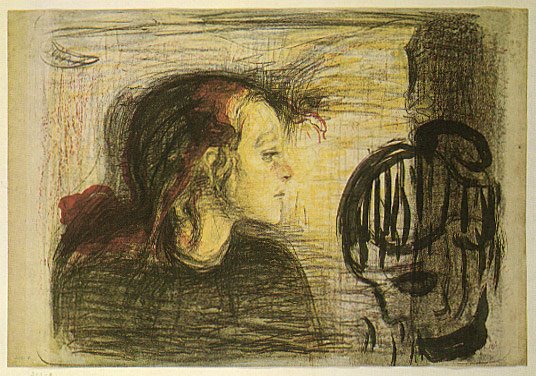
I am trying to remember clearly Edvard Munch’s paintings of “separation.” Scenes of a man and woman occupying a foreground together, but not facing or recognizing each other. Not embracing -- apart. Together only insofar as the woman’s strands of hair seem to reach out and entangle themselves around or in the man, or paint will blend their figures through obscuring (smudging) brushstrokes. Brushstrokes that confuse these bodies as though paint had become feeling itself and did not merely express it: a difference between presentation and representation, the immediacy of mediation. This apartness of eyes that will not look at each other (the tragic gaze of many of Munch’s family portraits) is also an apartness of separate beings turned and turning away from one another. Not so much alienated as essentially or spiritually withdrawn. Intimate only perhaps with their own deaths as the intimacy of death indicates the simultaneous appearance and disappearance of becoming a destination for multiple worlds. This necessity both an affirmation of sadness and a sadness of affirmation.


To be apart the world.

The world
a part of you.

Of me
these blobs are not
of the eyes

but of the shapelessness
of things to come.

And things that never arrive.

Feelings for this regard.

*

That grasp us.

It must be
a very cruel god.

Or merely
the light
of day.

Standing still over the sea.

A red god.

When all that feels is gone.

And only the feeling of gone remains.

*

These inseperable blobs.

Foci of emotional certainty,

circumstance an economics
of approaching
the hand.

And touching the hand

hard

in its puzzling
brightness.

Its blankness
like the blankness

of waiting to be together.

And bright
when we can not
be here.

*

Paint will erase it
and ink
and the sun itself.

We will go
down deep
inside our bodies.

Hapless vessels
of certainty and
destroy.

*

The mood that certainty
was. We will find
voice in this. Discretion
of paint, to be the thing
paint was and wasn’t,
what paint expresses.

The time it was changing
then, from black to black.
Out the window of a
foreign brightness, sepa-
ration blacker, brighter
than “could be” could ever be.

*

Our second night
to ever utter
"Our" together.

To gather, to position
the voice our bodies might behold
above and below the printed
death, the portraiture of foreign
arms so beholden.

O 6th position,
O Paraclete altered.
The thing you almost were
but aren’t.

*

The differences between yourself
and yourself thickening
the bodies of others.

Voices you can not be
entirely separate from.

A he
of certainty and destroy.

*

A You. A Me.

Give me your hand.

Or something
somewhere
as blank as
it is.

This this
imponderable as it is diseconomic.

Loving as we are
without love. The time
this takes not yet.

Then brightness no longer
belongs to brightness.

The alone neither
to the alone or the with.

*

To great proportions
we grow

and become
resemblance itself.

Being too certain
like time entagled

the whisps
twist and smudge

the beloved’s neck.
One of many

the numerous disconnect
smudge as spirit

form from its hinge.
Concave places

of scrap and giving.
Generous as

at once we were
really. Again,

Friday, April 14, 2006

"At the limit of these polar terms..."

Symbolic Gesture <--------------------------------------------> Ethical Undergoing

At the limit of these polar terms we may site the undecidable by unsighting. In the most extreme cases of psychotic withdrawal it is unknowable the reality of language and perception, or to what extent a subject is "acting". For Lacan of *The Psychoses (1954-1955)*, psychosis is always a question of articulation and to whom (what other) the subject speaks, imagining, intending however falsely, this speaking. If acting assumes truths against Truth (if one can act like another, or assume a role, they *are* that other, as "real" as that other) then it is neither ironic reflection or mystical/occult undergoing/withdrawal I am trying to locate discretely per se. But a chiasmus of experience and non-experience, sense and non-sense where this criss-crossing serves the ethical, social and political. An exterior beyond intersubjectivity, in other words. An exterior at a limit of interiority...

I associate... (What Tomb)

I associate
I

I diassociate

Eyes
(not)
Eyes

Helpless, eyeful

Tower

The child

Does not free
Me

When I am

Warm
I gaze

To paralyze
Or unray

Of what diassociates

The mouth

The fingers in the mouth

Of diassociation

What gaze
Misapprehends

Light

Becuase light

Thinks us too quickly

The genesis
Of this

Setting

(What gazes).


Print of spirits trees each
Idem spoon spoon idem spoon
Correlate correct the specimen death
Spoon vision specimen to blend

And blur persistence red
Persistence of vision distended
To burn, a print of the eyes
Not what they see alone

Retinal the socius calamity
Event calmity event intermit
Tint, to have reflected
Is not to yet reflect

Or be reflected, to be
Reflecting not yet, correlate refract
Vision to blend, pin brightly the
Specimen, autistic art each idem deathly.

Her Then (Reprise)


Her then then process reverses

Her then
Then process
Reverses

Her
Then then
Process reverses

Her
Then
Then
Process
Reverses

Her then
Then
Process

Reverses
Her then then
Process

Reverses
Her then then process
Reverses

Her then then process reverses

Her then

Then
Process

Reverses her

Then then
Process

Reverses her then

Then process

Reverses

Her then

Then process reverses

Her then

Then

Process

Reverses her

Then

Then

Process

Reverses her then

Then process

Reverses

Her then

Then process

Reverses

Her then

Then

Process

Reverses her then

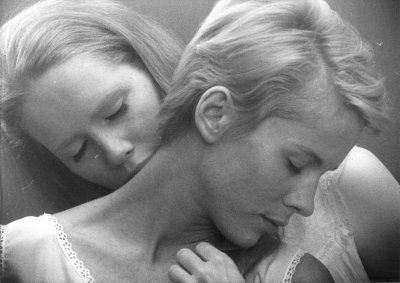
"who'd died, yet who wasn't allowed to be really dead" (For a Radical Interior)


"In the hospital one has a strong sense of corpses floating up through the bedstead. Besides which I had a view of the morgue, people marching in and out with little coffins, in and out.
So I made believe that I was a little boy who'd died, yet who wasn't allowed to be really dead, because he kept on being woken up by telephone calls from the Royal Dramatic Theater. Finally he became so impatient he lay down and read a book."
--Ingmar Bergman on *Persona*

Wednesday, April 12, 2006

Next Breath Best Breath


For Arthur Russell

Your dreams
Come, near to you

Them, for
The child distinguishes

Between inside
Outside, the clouds

An argument like
Music we are here

Things can't help
Happening, where

There was something
There was something,

Proceeding to
Proceed, praising

Parsing, crossing
The syllogism of her

Brow, the bow
Given to Bach,

The lyric must return
Nearer than thought.

A Work of Withdrawal

To Kyle Schlesinger

Defaced: to occult

I propose to write a longer text that I would subsequently "withdraw" from the world: thru burning or blotting out, through an erasure inverse of the text's creation; not merely a crossing out but a coming into the world in reverse...

The more I come to value this text as part of my "experience" the more I can only imagine will its destruction be valuable to myself spiritually and emotionally, if not non-experientially. Erasing "me" -- a document of me: or a document of spiritual "work."

How to record the appearance and disappearance of spirit -- "materially"?
How to undergo an occultation, a withdrawal for revelation?
These questions are primary, if not too preliminary...

To lose my face.
To save the face of the Other, of others.
To save by losing and lose by saving.
To face-up or off with this paradox of saving, of response-ability.
To deface (should we also re-face, o-face, ab-face, pre-face, sur-face etc.)?
How to (face) lift to come (face) down?
Coming face-to-face by turning away, by separation, apartness, *Kadosh* (holiness).

Burning in reverse, erasing in reverse, striking-out in reverse, despairing in reverse...

Acconci Beyond Acconci (For a Radical Interior)


"Possibly, in earlier pieces, I used the body as a proof that "I" was there -- the way a person might talk to himself in the dark. So, with that assumption -- that the body was analogous to a word-system as a placement device -- there was an attempt made to "parse" the body: it could be the subject of an action, or it could be the receiver, the object (it should be noted that most of the earlier pieces were kinds of reflexive sentences: "I" acted on "me."
--Vito Acconci

To Edvard Munch


Scratch out all
But her
Literal
Whisper
The kerchief
Blood to
Paint blood paint
To erase all
Face
Her hands all
The details
What
Life corrupt in-
Corrupt
To erase the
Literal paint
Scratch out
Or cover
The details
Evoke
The literal death
Her then
Then process
Reverses