Does matter have eyes?
Is there a vision of matter, that belongs to matter its self?
Maurice Merleau-Ponty, in his late MS., *The Visible and the Invisible*, recognizes that all matter, organic and inorganic, sees, and that the "subject" so-called is located in relation to this inordinate, ongoing gazing.
The subject is only a subject as it gazes and is gazed at, and partakes of a common gaze that is the gaze of the created, Univocal or 'General Being'.
This mutual gaze of 'General Being', the gaze of all emergence, is neutral, true in and of itself, a universal form of power or power dispersed (& Foucault may recognize such an ideal economy of power in Benthem's project for a Panopticon)
What I am concerned with after Merleau-Ponty is a radical mutuality of the gaze extended to the sensorium in its relation to nervous system / mind, a mutality called 'General Being' and recognized in 'chiasmic' relation. Interpenetrating, intussuceptive -- however both terms seem inadequate, not radical enough. The best image of chiasmus may not be an image at all; but pre-cognized (ek-cognized?) by the one who, touching their self, loses the self at an edge where the self as thing and as reflective consciousness blend indefinitely. The result is a blindness. The blank of simulatenously cognizing the sensible and insensible in one other.
In this mutuality all beings emerge and exist, being for and in themselves. "Subject" / "Object" radicalized beyond cognition. Can we imagine this mutuality comprising a film; a total film, a view of all views, that can never be seen except in some never realized eternity? Which are yet, practically, for the purposes of memory and action, always present... Virtually present?
*composed September '05
Monday, December 12, 2005


Saturday, December 10, 2005
"Art is ethics by other means" (review)
This past Thursday, Dec. 8th I attended an event at PS1 celebrating the recent “visual issue” of The Believer. Here is a cross-section of a review I started writing:
Leading up to Matthew Ronay and Brandon Stosuy’s live “interview,” Eric Fischl extemporized on the “death of painting,” beginning with the observation: Vincent Van Gogh cut off his ear and made a self-portrait of himself afterwards and the painting was considered art; approximately a century later Chris Burden had an assistant shoot him in the arm with a rifle and this action, and not its “documents” and reliquaries, was instead considered the work of art. Throughout his presentation, Fischl proceeded largely by surveying particular sculptural and painted works and considering an evolution of painting and sculpture towards their dematerialization (or “death,” as he referred to it) and works after. Where I thought Fischl was connecting some interesting dots, he seemed careful or unwilling to draw conclusions during his talk, putting forward instead questions and conjectures that “interested” him.
Fischl concluded his presentation with some remarks about the current “state of art” (and NYC-based visual art in particular) post 9/11. His moralizing finale was both traumatic and pedestrian: artists failed to respond adequately to 9/11, to take “action” through their work, and this failure represents a "paradigmatic shift" in art’s claim to a moral and/or political efficacy. In response to Fischl’s conclusion the artist and self-proclaimed "amateur materialist” sitting beside me, Eliza Newman-Saul, conveyed a more radical conclusion, one that may go productively against the grain (and the refrains) of ongoing assessments of that “disaster”: that merely siting a “paradigmatic change” after 9/11 obviates the critical imperative to investigate the event’s historicity, and History itself as both a synchronous and diachronous procession. Or, in other words, that there is in fact no “paradigmatic change” nor necessarily an “event character” about 9/11 in its relation to “art,” but only, perhaps, what Barrett Watten calls "bad history": history traumatically cathected by the dialectical “blindspots" and "traumatic kernels" of a truth content neither arbitrarily unprecedented or absolutely discontinuous.
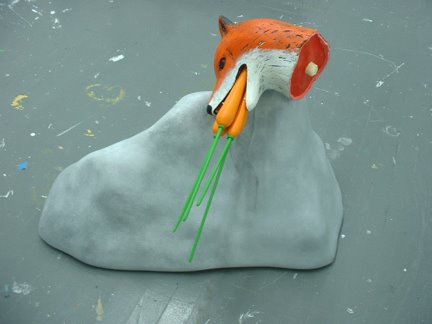
Where Fischl presented a moral response to art after 9/11, coincidentally Ronay / Stosuy presented what I took to be an ethical or ethological one. So much depends upon the distinction. Beginning with clips of football injuries in which one could see knees fully dislocated from their joints and legs hanging from their ligaments, Ronay proceeded mainly to address his own work after 9/11. His conclusion: artists tended to “internalize” the event and in turn responded by making work around problems of “death,” “sexuality,” and “the body”. As Ronay admitted, these are problems of “existential” concern; but they are also “ethological” ones insofar as they investigate “what a body can do” (Spinoza) and what one is capable of believing in (Deleuze’s Philosophy should give us something in which to believe qua Art should give us something to believe in). As Stosuy fed Ronay leading questions, the artist continued to ponder “love” and “hedonism” during a time of “empire”. Should not love have to account for, even provide for, “anal cupcake beads” -- the artist cunningly asked. Ronay’s work, a work I have only recently become familiar with, seems to present questions concerning the production of bodies in relation to a cultural “imagination” and a “real” both radically profaned and spiritualized. This chiasmus of the imaginary and the real may account for a work of Ronay’s in which one sees the plastic representation of a dog’s backside observing the dog’s genitals to be in the shape of a young girl’s. Ronay’s world thus seems a plastic one in which actuality has given way to the "virtual" in a material form.
If not for Fischl’s moral claims after 9/11, I could see the artist struggling to make a point similar to Ronay's in his presentation, where his constellation of 20th century works of art culminated with pics of Paul McCarthy’s own cartoonish sculptural monstrosities, and the haunting flockings of the Chapman Bros. sexualized and ambigendered children: that the flip-side of events like the torture of prisoners at Abu Gahib -- and ultimate degradation of the body torture always entails -- is an ongoing proliferation of hellish and disorganizied bodies in the "American"-Western imagination. If we can make a basic distinction between morality and ethics we might say that morality attends the “ideal” while ethics does the dyad “real” / "unreal" – the fluctuating conditions of bodies, of relations and fields of force.
The scene of Ronay / Stosuy unflinchingly encountering pornography, pedophilia and extreme bodily states presents the problem of the “real” where moral prescription a la “artists should have done something else after 9/11” will continue to fail. Never is there the moral imperative of “something else” (not even after the most despicable acts of humanity to which, I might add, 9/11 can hardly compare) but only historical consciousness always trying to keep pace with events in the world and tragically lagging behind (or retrospectively pressuposing them, as the case may also be). The final irony of Fischl’s talk may then be his devotion to the sensitivities of artists, which makes me think that it is not the individuated artist who fails, but the society of which she partakes. Art is ethics by other means insofar as the artist may present the problem of this failure and a culture may struggle to participate in this presentation and make conscious to itself what is being presented.
The final presentation of the evening was given by artist Cory Archangel. Archangel’s performance may serve as a kind of third party to Fischl and Ronay / Stosuy, where I have always found the artist to chase his timely critiques of art trends in relation to electronic culture with an endearing and effective showmanship.
My first glimpses of this crucial balancing act in Archangel’s work were taken when I knew him as a student at Oberlin College. In addition to presenting numerous videos and tape pieces with his collaborator, Paul Davis, during their junior recital in Oberlin’s music conservatory, Archangel concluded the recital with a simple yet radical lesson. Using an obsolete Apple software called Lisa, and addressing his audience thru a “real-time” video feed, Archangel revealed the software’s coding to the audience. He proceeded to explain how binary code works to encode information -- and specifically information pertaining to licensing and copying permission -- and, for his final trick, pointed to a particular moment in Lisa's code where one could turn the copy protection on or off.
The activism and didacticism lurking behind Archangel’s deceptively self-evident projects were pervasive during the period we overlapped at Oberlin (1996-1999), and especially among a group of students actively investigating questions of emerging media: Archangel, Jacob Ciocci (Paper Rad), Jen Liu, Laboratory Theater and Ray Sweeten to name just a few. I found the spirit of these investigations to be in full effect the other night as Archangel performed the not-so-simple (as we were all too learn) action of closing his Friendster account (and thus, in his words, committing online “suicide”).
What struck me again was how a relatively routine action could become an important object lesson in the pragmatics and metaphysics of electronic media in Archangel’s hands. If there is a trick to Archangel’s didactic performances it is likely the very opposite of the one used by con men in the three card monty, where the artist's conceit is not in making the card appear where it did not seem to be, but in revealing that which we imperiously keep track of but so often can not recognize in its value and significance. Artists often talk about their work as being “participatory” or “democratic”; Archangel’s art is genuinely participatory and popular where the majority of art that intends participation and democratic-populism fails. The evidence is not in the show of hands from his audience or a gratuitous Q&A, but in his audience’s frequent shouting out of instructions about how to use technologies constitutive of their common experience. It is in recognition, a recognition that goes back to an ancient "state of the art": that we use technology, but that technology also uses us; and this mutual using reflects real conditions of experience and appearance.
After countless interruptions, technical difficulties, digressions, shaggy-dog stories and witty banter the actual moment of deletion was once more prolonged by a survey requesting Archangel’s reason for deleting his account. To which he typed (not without typos and excessive exclamations marks): “the advancement of artistic performance”. Indeed!!!!!!!!!!!!!!!!!!!!!
Monday, December 05, 2005
3 after Bresson*
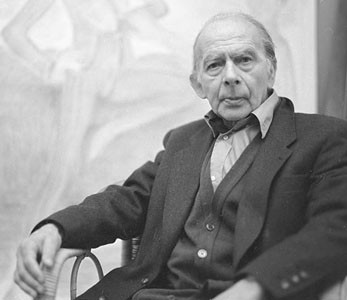
Vicious Circles (Bresson)
with Gregg Biglieri
Love cannot exist between people
-- Jack Spicer
as the tremendous volume of the music
takes over obscured by their long hair
they seem to be mourning
-- George Oppen
1.
Children again
Do you hear children
Again
Do you sight
Like a horse
One eye sees
This good wicked throne
Too soon
To be future too
Soon to be past
Bullets fly again and
Broken blood pumps
My love whose eye is this
Don’t
Forsake me
Community
Round round
Community
For the trees with
Bright flags we go
For the darkness of love
Love
The dark forest
No justice just don’t kill
The king yet
Like a vicious carousel
The horses go round
A round a round community
With nowhere to go
A forest fossilizes
With bright flags and sharp
Tongues and lances
We go
This justice this
Justice perhaps
The trees for the forest
Camera attests
The torso simply framed
A lovely
And brute objecthood
With dark hearts we go
In love where the camera
Cares to wait
Horse whose eye is this
To risk
Don’t forsake me
Roundness the thing is
A universe
Bright camera with a mind
Of its own
Mind of the eye
Lovely a brute dark kiss
Kiss me
I battle to risk
With mind’s bright swords
Swiftly we go
Justice is
Eye’s apocalypse
Blindful injustice
The round community without
Head
Brain needs eyes like
A hole to risk
This bright lance
Love’s body
For the trees
The trees for bloody
Community
A
Bloody pile all these
Horses
All these flags go
For the headless
I am afraid eyes need brains
I am
Afraid I
Love you so
2.
Free radicals children
With a bullet graze
This grassy open
Do sheep gather to shepherd
This thought of death?
Because this time is corrupt
Because
A human community is lacking turn
The other cheek
Kill
While no one is watching
No kid too bold
None are guilty enough
None guilty
Enough to love
To hate to love them
All protect
Nothing
Sheep gather at
The end of this
Roll to our own death
Happily bundle
There is no cold so cold as this
To love to hate to love
This generous violence
A world of mud
I fling no child
Left behind
No kid too bold
Don’t kiss me
Not cruel enough to be
A real beauty
We fall dead at the end
Of any noble thought
This opening
Because they will always
Be corrupt
Because
They will always presume
Their guilt is not free enough
There is no cold so cold
As cauterizing
3.
The wind bloweth
O my breath
Our breasts the lisp of little
And wicked things
Things
Wicked in their thing-ness
The eyes of animals follow
My breath
A wicked thesis
Saintly judgement
Bullets blow
Over this hill how pastoral
Without morality without
Conscience
The wind bloweth with an inhuman will
To escape disaster
Saintly eyes follow
The gazes of other animals
And children without
Morality they
Are wicked children
The camera finds the place
From which no one looks
In the rearview
Of a bus
In the eyes the eyes
Of a blameless beast
Sing sweetly and long
For that ass
The wind bloweth where it listeth
That gaze will survive
Sheep and rape
Bottles broken over the tain
*composed spring-summer 05. Thanks to Gregg Biglieri who offered suggestions for revision.

Cruelty (an analogy)
Cruelty is to nobility
as meanness
is to
bourgeois
subjectivity and other
drudgerous levels
of "selfhood"
...where nobility = aristocracy
of the will
and drama
of intensified thinking.
Thinking
at the level
of drive?
The thots very much
of children
and
"psychotic" / imaginative
adulthoods?
as meanness
is to
bourgeois
subjectivity and other
drudgerous levels
of "selfhood"
...where nobility = aristocracy
of the will
and drama
of intensified thinking.
Thinking
at the level
of drive?
The thots very much
of children
and
"psychotic" / imaginative
adulthoods?
Thursday, December 01, 2005
"the world / is a stage but we are too"
The awaited bombs,
the mounds of skulls,
the Kalashnikov guns,
the infant dressed for fame,
they are all now too
not that they would admit it
The awaited bombs,
the appointed coordinates,
the fake blood,
the real blood,
the recreation
of the whole world
by non-mastery
This is the guilt
the blood by guilt
of the vicious and uneven
circle
never touched
Upon except
at its edges and least
coherent points
the places
from which one
talks distractedly
The martyrologies,
the hagiographies,
those who cathect
the world not yet
lost
lost already
to not be lost yet
A terminal world
of discomfort I want
to love them all, but I can’t
think of a single name,
not a single shelter
or point commensurable
for naming itself
The names of histories
and actions
until it is too late…
a serial of late commas,
of commas arriving
too late in premeditation
Another “avant-garde”
acting forgotten until
it was too late these words
of apostrophe and asides
and interior chatter, the world
is a stage but we are too
Perhaps your insomniacs
dream of action,
perhaps a world or worlds far beyond
any point of being woken
so surpassed are they
by the senseless
The actions performed
out of concern
for free-fall and dance,
the “floating leaps” again,
the vertiginous precisions,
cuts and points which must
be finally of this dance
Are the unnamable points
of action, are
actions taken
because there is not
sleep
and only the non-
ability to be vigilant
The unnameable
points
where we find each other again,
an image
before an image
in abeyance of unmitigatable ambivalence,
possession not to be possessed
Thoughts then make
these gestures with the hand
somnolently of what
the bouncing and faceted
body can do
You take them to sleep with you.
the mounds of skulls,
the Kalashnikov guns,
the infant dressed for fame,
they are all now too
not that they would admit it
The awaited bombs,
the appointed coordinates,
the fake blood,
the real blood,
the recreation
of the whole world
by non-mastery
This is the guilt
the blood by guilt
of the vicious and uneven
circle
never touched
Upon except
at its edges and least
coherent points
the places
from which one
talks distractedly
The martyrologies,
the hagiographies,
those who cathect
the world not yet
lost
lost already
to not be lost yet
A terminal world
of discomfort I want
to love them all, but I can’t
think of a single name,
not a single shelter
or point commensurable
for naming itself
The names of histories
and actions
until it is too late…
a serial of late commas,
of commas arriving
too late in premeditation
Another “avant-garde”
acting forgotten until
it was too late these words
of apostrophe and asides
and interior chatter, the world
is a stage but we are too
Perhaps your insomniacs
dream of action,
perhaps a world or worlds far beyond
any point of being woken
so surpassed are they
by the senseless
The actions performed
out of concern
for free-fall and dance,
the “floating leaps” again,
the vertiginous precisions,
cuts and points which must
be finally of this dance
Are the unnamable points
of action, are
actions taken
because there is not
sleep
and only the non-
ability to be vigilant
The unnameable
points
where we find each other again,
an image
before an image
in abeyance of unmitigatable ambivalence,
possession not to be possessed
Thoughts then make
these gestures with the hand
somnolently of what
the bouncing and faceted
body can do
You take them to sleep with you.
Wednesday, November 30, 2005
The Ambivalent Image
Deren's final image of a woman 'suicided' in Meshes of the Afternoon is an ambivalent image. It is, what's more, an ambivalent image FOR other images ambivalent or not. In this case, it is an image radicalizing a situation of 'understanding' (accreting coherence in disjuncture) a woman's action or impulsion to kill herself. For other ambivalent and non-ambivalent images in my attention, Deren's image supplements against a finally coherent stucture (an understanding) for the desperate women of Palestine and elsewhere whether actually suicided or not.
This first image of a woman suicided is supplemented by another ambivalent image from her film: that of a woman's legs in profile stepping across four spatially (if not temporally) discrete terrains by means of film editing (cuts); as Deren herself tells us, this image is intended to present a woman walking across eternity to initialize the first ('primeval') in the last ('killing one's self') of a (recurrent, aleatory) series.
The ambivalence of this second image may be said to supplement that of the first insofar as it raises the dual specters of religious belief and contemporary scientific-philosophical consideration for immortality / resurrection. Can we use the ambivalence of these images to accrete a disjunctive coherence of the present crisis of belief as it is linked to "liberation" struggles and "fundamentalist"-materialist power plays alike (Bush Admin. preempting and augmenting [conjuring?]ubiquitous 'terrorist' threats for territorial advantage and control of natural resources)?
There is an elaborate (and kitschy) iconography / hagiography that glorifies one's decision to take their life and the lives of an enemy population in the current Islamic world. Videos of "martyrs" typically w/ Kalashnikovs, air-brushed wall posters, public service announcements / TV commercials honoring "suicide bombers," "martyr's picture goes here"-esque plaques, children's cartoons. Yet something rings false in an assumption that such an iconography would be merely enough to lend belief supportive of a will to die. The images from Deren's film lead me to this final ambivalence: that the situation in Palestine seems a kind of 'perfect storm' whose unaccounted variable is an uncanny and widespread willingness to die, a willingness that it is difficult to believe is the result of humiliation, material deprivation and effective ideology / propaganda alone.
This first image of a woman suicided is supplemented by another ambivalent image from her film: that of a woman's legs in profile stepping across four spatially (if not temporally) discrete terrains by means of film editing (cuts); as Deren herself tells us, this image is intended to present a woman walking across eternity to initialize the first ('primeval') in the last ('killing one's self') of a (recurrent, aleatory) series.
The ambivalence of this second image may be said to supplement that of the first insofar as it raises the dual specters of religious belief and contemporary scientific-philosophical consideration for immortality / resurrection. Can we use the ambivalence of these images to accrete a disjunctive coherence of the present crisis of belief as it is linked to "liberation" struggles and "fundamentalist"-materialist power plays alike (Bush Admin. preempting and augmenting [conjuring?]ubiquitous 'terrorist' threats for territorial advantage and control of natural resources)?
There is an elaborate (and kitschy) iconography / hagiography that glorifies one's decision to take their life and the lives of an enemy population in the current Islamic world. Videos of "martyrs" typically w/ Kalashnikovs, air-brushed wall posters, public service announcements / TV commercials honoring "suicide bombers," "martyr's picture goes here"-esque plaques, children's cartoons. Yet something rings false in an assumption that such an iconography would be merely enough to lend belief supportive of a will to die. The images from Deren's film lead me to this final ambivalence: that the situation in Palestine seems a kind of 'perfect storm' whose unaccounted variable is an uncanny and widespread willingness to die, a willingness that it is difficult to believe is the result of humiliation, material deprivation and effective ideology / propaganda alone.
Tuesday, November 29, 2005
Meshes (notes, discursus)
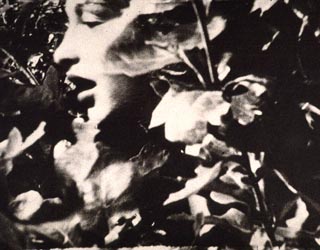
Motor co-ordination (or lack thereof) of Deren's figure (in dream). This is a film abt. dream experiences, a descent into Bergson's virtual as it is made / becomes actual, as dream images become actualized, “triggered” or “thrown up” as such: "And it may occur that, of an afternoon, these restive captives of memory – refreshed by new contexts and released by the lax discipline of sleep – may triumphantly regain the province of actuality."*
It is also a Bardo (taking my lead from Toufic's work on film)... a film form for reincarnation, recurrent resurrection (eternal return), where through / upon / within dream Deren's figure is reborn (dream within dream within dream) and dies (or is, rather, ‘suicided’? / substituted by her lover)
So the end does not feel like an "end" proper, the one to which all good “psychological” dramas lead (and as much of Deren's writing shows (cf. "Magic is New") she was constantly struggling to describe an "experimental" cinema against "psychological," action-driven narrative film), but as Deren demonstrates by her bifurcating "narrative" structure only a possible end, one of many ends.
One can imagine the multiple lives / moments of Meshes’ protagonist through a continuous film sequence / montage -- both the life in which she commits suicide / is suicided and that of other percepts, movements, emotions etc. As in dream experience we should not assume any of these moments are of a continuous identity, life or body... but of an accreted body coherent only in multiplicity and discontinuity.
Deren's woman is a sleepwalker, a sonambulist for whom the (cinematic) world is an objective "people mover" conveying her up stairs, providing wind-sources, creating the illusion she is being thrown about by camera movement... Her movements become necessary, or necessity's opposite -- where the will / effort is not active but the person is acted upon.
Aleatory in resentiment? Reactive? Should one be said to be reactive in all dream states insofar as they are felt involuntarily and not ‘re-acted’? "As a result of his type the man of ressentiment does not 'react': his reaction is endless, it is felt instead of being acted."**
What may complicate a reading of Deren’s figure in Meshes of the Afternoon as a figure of ressentiment (among other things) is Deren’s own commitments to dance as well as her crucial move towards the “dance film” after Meshes. We might even say that Meshes is already a dance film, or at least a film about movement, insofar as it describes a woman moving as a body within spaces, and amidst objects and people by the particular “magic” of montage, camera work and special effects creative of “unreal” spatial and temporal configurations.
In lieu of Nietzsche’s privileging of dance as a “metaphor for thought” (Badiou)*** and as a primary image of “eternal return,” can we view Deren’s films after Meshes as a resurrection / reincarnation of the body ‘suicided’ in Meshes's final scene?
It is interesting to read Deren’s descriptions of her films as a series. Typically, the filmmaker reserves Meshes as a first effort nevertheless significant, but not as important to her as later films; she also reserves Meshes as a film about “emotional” complexity. Deren’s next film, At Land, she claims to be ostensibly “about” stable identity in changing environments, and the films afterward to address specific problems of dance: “Choreography for Camera” how camera / editing will be part of the dance; “Ritual in Transfigured Time” how a “widow” can become a “bride,” things their transfigured (substantiated?) inverses; Meditation on Violence presents a furthering of the problem of the camera person / editor / filmmaker participant in the dance, how camera itself dances, as well as the sense of dance coming from “unconstrained interiority” (Badiou); her last film before Divine Horsemen, The Very Eye of Night, I read as addressing a dance beyond interiority and intersubjectivity towards the cosmic (unconstrained exterior).
The last move of Deren’s shortlived career is obviously towards experimental and participatory ethnography, where the move towards exterior is thrown back on interior thru moments of possession, possession being a meeting between immortal exterior and interior human in the mortal body of the human being. Seeing Divine one is reminded, finally, that Deren’s main concern is with movement, and how the camera and editing can give appropriate form to the singular psychotic-hysterical moment of possession (the body “jerking” about, the wide eyes tending to roll back).
As with the case of other artists who “died young” (on time?) one wonders where else there was for Deren to go, possession seeming a telos for the movements of her films about movement… or a coming full circle insofar as her primordial image, her primitive scene, may be the “signature” shot from Meshes of a woman’s leg stepping by means of cuts across four different terrains (beach, asphalt road, carpeted room, lawn with tall grass), and this movement by cut constitutes a movement across eternity to kill oneself the very inverse of genetic coming-to-be (where in genetic survival one has “beat the odds” to live, here one has beat the same odds to die).
The move that concerns me in the film, and that I imagine may trouble “feminist” film critics is that from the bedroom where the woman confronts her lover, to the objective shot where we find the woman dead, broken glass surrounding her on the floor. In the bedroom scene, Deren’s woman of course draws a knife on her male counterpart only to discover him an image (photogram), and to shatter the image as though it were a mirror. It is the glass of this broken photogram that we see collecting on the shores of a beach in the next scene, and in the scene after that piled at the feet of the dead woman. A psuedo-psychoanalytic reading of this scenario may have it that Deren has displaced the object of her murderous aggression / desire (her male counterpart) upon her self; in Nietzsche, such an interiorizing displacement of drives, may be read as an instance of ressentiment, where that which is re-feeling is that unwilling to “re-act,” to express feelings actively towards a present verticality of eternity, to express towards forgetting where forgetting is a means of “health” or joy, a moment decided and divided (bifurcating) in eternal return.
The final image of Meshes, I read as deeply ambivalent. It is an image that fortuitously presents itself to me as I have been reading about the situation of women “suicide bombers” / “martyrs” in Palestine and elsewhere. If journalist Barbara Victor is correct in her assessment of the four women martyrs she discusses in her book, Army of Roses, these women are the victims of a double-bind, whereby to not act as “martyrs” they forego the same rights / honors as their male counterparts in a society in which women struggle for gender equality; on the other hand, Victor makes the case that the women she discusses martyr themselves in last resort to find exonerated “ways out” from limited social roles. Are these women not “suicided” then in the sense that Artaud uses the term to discuss Van Gogh's death? The gramatically awkward term “suicided” presents an impasse: that what would seem to be an act committed by a self of agency is in fact committed by that self as the agent of larger social desires and mores. In this case, the general desire (or particular, insofar as it may be that of a privileged authoritative leadership or hierarchial belief-structure) both to defeat a collective enemy (Israel and collaborators / supporters) while also to maintain conservative social values. To suicide someone, as in the case of Van Gogh, is to direct the energies of self against the self, and for such a direction of energy – of drives and emotions – to end up destroying that self, "self-destructing". This suiciding direction of energy may describe the “emotional complex” of Deren’s protagonist in Meshes; it may also belong to the case of women not allowed to “re-act,” to “move,” or to “dance” insofar as they belong to a culture utterly humiliated by an enemy, and which would use this humiliation as a means of regulating desires and values.
An ambivalence about the position of Palestinian women lingers for me in Deren’s description of her own figure having to pass through all of time to kill herself: “What I meant when I planned that four stride sequence was that you have to come a long way – from the very beginning of time – to kill yourself, like the first life emerging from the primeval waters.”**** Such a suicide is a joy not the opposite but inverse of the joy to live. If Nietzchse’s ethics is founded on “dice throws” in eternal recurrence, that an individual should act as if that action should be committed for all time, and that to make decisions, as such, is to affirm aleatory-becoming as the only means of being; then can one not destroy themselves willfully as a dice throw, and therefore in ethical affirmation?… Such a view of suicide would seem to tread against the foundations of Western philosophy, where Spinoza’s notion of the “conative” as a being’s effort to prolong its existence indefinitely remains central, if not a priori.
*Maya Deren from a letter to James Card, April 19th, 1955
**from Deleuze's *Nietzsche & Philosophy*
***from Alain Badiou's "Dance as Metaphor for Thought" in *Handbook of Inaesthethics*
****Maya Deren, from 1960 “program notes”*

Monday, November 28, 2005
L'Ange cont'd
"Dance is innocence, because it is the body before the body."
-- Alain Badiou
A drawn out time
of pictures
are twigs of us
carried
are twigs of us carried
carry us twigs of us and milk to parry
To parry of us the forgetting
of us broken
and forgotten again
across time
broken and the almost dark
forgetting of having watched
In trance
painting is in the strokes
the strokes
of painting frozen
and stopped stopped but not broken
on a vast
desert of paint
Is us watching one climb
a case
of image is us watching
the body
move the body ascend
stairs
Is to repiece replace the body again
as image this again
of animation to ascend
the image again
This body thought it was not one to comprehend
it thought the body again
in all good hearing of image
it thought this body falling to accrete to ascend
in one tableaux in another it thought
this body again
Repeatedly of parries of twigs it thought
the burden of seeing again
of enduring these tours of the dark
I am not one for spilt
milk I am
not not one split for split pictures
I am not one for
the whole to be broken
for the hole too broken
so I could be
The stuttered body
picture a thought
for stuttering
the whole of a falling
light a failing
light
I am not for the composited split the deposited split
I am a light source again stuttered
and falling through a painted source
Which is light for now
I am not for not spilt milk
I am the paintedness
the stop and start of this hellish
body the body we remember
to intend
I am only an instrument
a light box when I want
to be a sky
as it rolls over and darkens a sky
of bluest paint
I am part of the fallen
I am of the risen again
the risen discretely I am
an image of paint departing
from light sources uncertain
These are the holes we make in hellish dark to descend to rise to descend again
This is
The body
we remember
to attend
I am a reason for this line
of dark the line
of light
diagonals break
the dark
of climbing
figures I am merely
a picture
an image recapitulated
of the body
We remember
to resuscitate and
break
setting into motion
flight of burden
flight of of and twigs to be
resurrected and descend again
on projected wings
I will not be split milk and I will
not be entirely a light
accreted by these sensed figures I am
Riven into the light
dawns draws twilight of flayed flying
I intend clouds a sense of flying
if you will make like an animate dance
histrionics are hell
Reacting the line activates a line again of light
driven risen into
no longer
a no longer to be hell
I have passed the time parried
I am
a puppetry of disjunctive
force
image parries
an angel climbs an angel again
in discernible pictures
I am a grade I am a degrading
of angel image
parried to be for the body
Reunite with the body
like film projects in a light
box to be projected
blow like that imminent
wind his wind of late day
Over time
this re-acting landscape over
and over
this insensuous
movement
The Kleistian line then dances an Antichrist
diagonal lines of stairs to descend to ascend again
A line to descend is not to decline
in grace to descend is not to decline
in grace the painted night it is to cover
night light paint to repulse these makes
these masks of paint
It is to ascend actually and weightless not unlike
-- Alain Badiou
A drawn out time
of pictures
are twigs of us
carried
are twigs of us carried
carry us twigs of us and milk to parry
To parry of us the forgetting
of us broken
and forgotten again
across time
broken and the almost dark
forgetting of having watched
In trance
painting is in the strokes
the strokes
of painting frozen
and stopped stopped but not broken
on a vast
desert of paint
Is us watching one climb
a case
of image is us watching
the body
move the body ascend
stairs
Is to repiece replace the body again
as image this again
of animation to ascend
the image again
This body thought it was not one to comprehend
it thought the body again
in all good hearing of image
it thought this body falling to accrete to ascend
in one tableaux in another it thought
this body again
Repeatedly of parries of twigs it thought
the burden of seeing again
of enduring these tours of the dark
I am not one for spilt
milk I am
not not one split for split pictures
I am not one for
the whole to be broken
for the hole too broken
so I could be
The stuttered body
picture a thought
for stuttering
the whole of a falling
light a failing
light
I am not for the composited split the deposited split
I am a light source again stuttered
and falling through a painted source
Which is light for now
I am not for not spilt milk
I am the paintedness
the stop and start of this hellish
body the body we remember
to intend
I am only an instrument
a light box when I want
to be a sky
as it rolls over and darkens a sky
of bluest paint
I am part of the fallen
I am of the risen again
the risen discretely I am
an image of paint departing
from light sources uncertain
These are the holes we make in hellish dark to descend to rise to descend again
This is
The body
we remember
to attend
I am a reason for this line
of dark the line
of light
diagonals break
the dark
of climbing
figures I am merely
a picture
an image recapitulated
of the body
We remember
to resuscitate and
break
setting into motion
flight of burden
flight of of and twigs to be
resurrected and descend again
on projected wings
I will not be split milk and I will
not be entirely a light
accreted by these sensed figures I am
Riven into the light
dawns draws twilight of flayed flying
I intend clouds a sense of flying
if you will make like an animate dance
histrionics are hell
Reacting the line activates a line again of light
driven risen into
no longer
a no longer to be hell
I have passed the time parried
I am
a puppetry of disjunctive
force
image parries
an angel climbs an angel again
in discernible pictures
I am a grade I am a degrading
of angel image
parried to be for the body
Reunite with the body
like film projects in a light
box to be projected
blow like that imminent
wind his wind of late day
Over time
this re-acting landscape over
and over
this insensuous
movement
The Kleistian line then dances an Antichrist
diagonal lines of stairs to descend to ascend again
A line to descend is not to decline
in grace to descend is not to decline
in grace the painted night it is to cover
night light paint to repulse these makes
these masks of paint
It is to ascend actually and weightless not unlike
...This empty yet emphatic phallus
to Chantal Akerman
The most
angelic sex
may be between
two women
(or so many more)
after the open
road of men
and after a mirror
of one's own
...This empty
yet emphatic phallus
The most
angelic sex
may be between
two women
(or so many more)
after the open
road of men
and after a mirror
of one's own
...This empty
yet emphatic phallus
L'Ange*
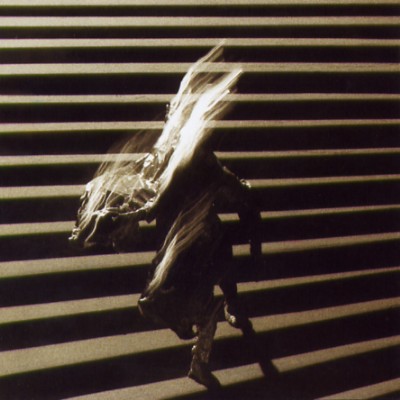
To repeat a light to
repeat
before before the stairs
ascending
stairs like a ladder
with dolls and twigs as if
a burden
a suffering of each
body like a burden
to be carried across
The locks of hair
from hell
a hell
of light (optical)
each body
image a burden
to carry child from
light boxes
situ of graven
situ of gravity
The gravity of a doll’s
hair to parry
slow
the blows to pray
to parry
stairs of breath
books reference if we
are to carry
up the stairs in disjunct
rhythm of light
up the stairs dark
an expression of expressionless
carrying
Of hair of living tableux
stand
still and rhythmic to bear
the light of light
boxes
projector exhaust
stop action of craven
light broken
light to bear
Shadow to bear
light
I am then this body
this despairing body to bear
up the stairs
of twigs where flashlight
light
won’t do us any harm
shadow not this moment shadow
light won’t do
us harm
Won’t do this moment
harm to parry
bathwater
and sex it won’t
make a difference if it is him
or if it is us
it is us carrying
the empty sex of us up
The stairs in Being’s empty
house
Being's empty
walk
of us up and
up these stairs by degree
to repeat a moment
to repeat
moment upon moment
of moment up the stairs
of light
A momentum
those stairs
of light if we repeat
enough
this is not to reflect
the empty image
the images of stairs enough the split
milk
we always carry
a feeling for split pictures
pitchers split
milk of the body
about us mounting spilt stairs
An enclosure
of light a slit
of light the falling aperture
of light
it is a burden
to carry twigs unto the whole
*after Patrick Bokanowski's *L'Ange*
Sunday, November 27, 2005
Difference & Resurrection
What the eternal return expresses is this new sense of the disjunctive synthesis. It follows that the eternal return is not said of the Same (“it destroys identities”). On the contrary, it is only Same, which is said of that which differs in itself – the intense, the unequal, or the disjoint (will to power). It is indeed the Whole, which is said of that which remains unequal; it is Necessity, which is said of the fortuitous alone. It is itself univocal: univocal Being, language or silence. However, univocal Being is said of beings which are not univocal, univocal language is applied to bodies which are not univocal, “pure” silence surrounds words which are not “pure.” One could thus search in vain within the eternal return for the simplicity of a circle and the convergence of series around a center. If there is a circle, it is the circulus vitiosus deus: difference here is at the center, and the circumference is the eternal passage through the divergent series. It is an always decentered circle for an ex-centric circumference. The eternal return is indeed Coherence, but it is a coherence which does not allow my coherence, the coherence of the world and the coherence of God to subsist. The Nietzschean repetition has nothing to do with the Kierkegaardian repetition; or, more generally, repetition in the eternal return has nothing to do with the Christina repetition. For what the Christian repetition brings back, it brings back once, and only once: the wealth of Job and the child of Abraham, the resurrected body and the recovered self. There is a difference in nature between what returns “once and for all” and what returns for each and every time, or for an infinite number of times. The eternal return is indeed the Whole, but it is the Whole which is said of disjoint members or divergent series: it does not bring everything back, it does not bring about the return of that which returns but once, namely, that which aspires to recenter the circle, to render the series convergent, and to restore the self, the world, and God. In the circle of Dionysus, Christ will not return; the order of the Antichrist chases the other order away. All of that which is founded on God and makes a negative or exclusive use of the disjunction is denied and excluded by the eternal return. All of that which comes once and for all is referred back to the order of God. The phantasm of Being (eternal return) brings about the return only of simulacra (will to power as simulation). Being a coherence which does not allow mine to subsist, the eternal return is the nonsense which distributes sense into divergent series over the entire circumference of the decentered circle – for “madness is the loss of the world and of oneself in view of a knowledge with neither beginning or end.”
-- from Deleuze's The Logic of Sense
-- from Deleuze's The Logic of Sense
Thursday, November 24, 2005
Meshes of the Afternoon (2nd Meditation)
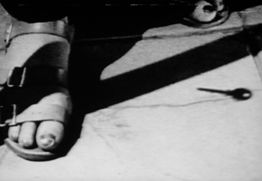
“What I meant when I planned that four stride sequence was that you have to come a long way – from the very beginning of time – to kill yourself, like the first life emerging from the primeval waters.”
Maya Deren from a letter to James Card, April 19th, 1955
“…and finally, film itself, changes the widow into a bride.”
Ibid
And it may occur that, of an afternoon, these restive captives of memory – refreshed by new contexts and released by the lax discipline of sleep – may triumphantly regain the province of actuality.
Maya Deren, from 1960 “program notes”*
You can imagine the not yet
the no longer
dead shadow picks
a shadow a
shadow to begin
With subjective
shots
to begin
one desires across
time form
The form of
the shadows of
a flower - here
we begin yet
to double here
You decide
this double the
widow not yet
of ritual
No longer dead - or not
a widow any
longer when you move
when you
move with
what the shadow starts
the subject
of song to initialize
Your death not yet
not
yet a universe
for your death
and the objective
shot
the objective
of all form
For the widow to become
a bride
transfigured
key to palm
Sunday – those girls
always sung
by carol / canon
to become
Disciplines
of a weapon – in spring
time again
floating - a leap
in reverse
floating
cuts to dance form
Form Sunday
again no longer
seeing to be
seeking
With mirrors
for eyes a critical
emotion a complex
to be sung
to transfigure or
carry over
from verse to verse
inverse
mirrors for eyes
Or eyes for mirrors
Years or
A single
mirror for the
accreted
face those girls
if taking life would not be
taking life
as if at the end again
of every evolution cut
to carry across
torturous
forms the rigors
of which we are always
you are always
to take
Again no longer
seeking merely to be
Recussitated and suicided both in a dream
Is to keep dreaming and is to
no longer dream
however unwoken
by a form
The shadows
of form to pick
a flower is to recur
to all time it is to entrance
to find
entrance – the portal
of all lives
Images to pick
a key or a knife
Dynamite is no choice
emotional volitions objects
to which
the shattered the
accreted recur –
a complex
This too is experience
the occulted
bride not spoken
on film
the throat
one must imagine
broken but not slit
Are these the hells you must pass
through the mirrors through which
you shoot holes to ever be?
To keep seeking
To by necessity
be the bride
the widow
turned bride
of all these walks
cuts of life
Suicided
again in a time
not yet your own
the mirror-breath
the breath on
the mirror
in a time not yet
and again memory
nearly as inexhaustible
and shattered by
blood
*all three epigraphs from Essential Deren (Documentext, 2005), ed. Bruce McPherson
Wednesday, November 23, 2005
This Is Your Brain Under Hypnosis
Below is a transcript of an interesting article published yesterday in the NY Times, compliments of the "virtual" subscription of my friend, Abby Walton. Perhaps this article confirms what many of us already suspected about mind / body relations?
There is only one time any one has tried to hypnotize me with my consent (of course we are suspeptible to hypnosis all the time from media sources, attentional dynamics of "every day"), and that was in Tony Conrad's 2000 Contemporary Alternative Media seminar. During one of the class periods Conrad read from the sessions and exercises of the "hypnotherapist," Milton Erickson (who's a good read for any one interested in hypnosis and language pragmatics / performance). Conrad's performance of the text was very effective, putting most of the class in trance as far as I could tell. Confirming the below findings, the people who seemed least affected were myself and others pursuing degrees in English / languages, etc. (ones involving extensive "close" reading / writing). Those students working primarily with (tele)visual media seemed to "fall" much more easily.
I am glad to know hypnosis is being taken seriously by science since understanding it better is obviously a "key to consciousness". If only such researchers could link up w/ folks like Conrad who have brought research into aesthetic, pedagogic, and practical realms. As a threshhold for attention and therefore mind is hypnosis not a means to analyzing disciplinary modes and flows of power within cultures, especially highly mediatized ones? A politics of "feedforward" and "feedback"? Not to mention, as always, a poetics...
This Is Your Brain Under Hypnosis
By SANDRA BLAKESLEE
Published: November 22, 2005
Hypnosis, with its long and checkered history in medicine and entertainment, is receiving some new respect from neuroscientists. Recent brain studies of people who are susceptible to suggestion indicate that when they act on the suggestions their brains show profound changes in how they process information. The suggestions, researchers report, literally change what people see, hear, feel and believe to be true.
The new experiments, which used brain imaging, found that people who were hypnotized "saw" colors where there were none. Others lost the ability to make simple decisions. Some people looked at common English words and thought that they were gibberish.
"The idea that perceptions can be manipulated by expectations" is fundamental to the study of cognition, said Michael I. Posner, an emeritus professor of neuroscience at the University of Oregon and expert on attention. "But now we're really getting at the mechanisms."
Even with little understanding of how it works, hypnosis has been used in medicine since the 1950's to treat pain and, more recently, as a treatment for anxiety, depression, trauma, irritable bowel syndrome and eating disorders.
There is, however, still disagreement about what exactly the hypnotic state is or, indeed, whether it is anything more than an effort to please the hypnotist or a natural form of extreme concentration where people become oblivious to their surroundings while lost in thought.
Hypnosis had a false start in the 18th century when a German physician, Dr. Franz Mesmer, devised a miraculous cure for people suffering all manner of unexplained medical problems. Amid dim lights and ethereal music played on a glass harmonica, he infused them with an invisible "magnetic fluid" that only he was able to muster. Thus mesmerized, clients were cured.
Although Dr. Mesmer was eventually discredited, he was the first person to show that the mind could be manipulated by suggestion to affect the body, historians say. This central finding was resurrected by Dr. James Braid, an English ophthalmologist who in 1842 coined the word hypnosis after the Greek word for sleep.
Braid reportedly put people into trances by staring at them intently, but he did not have a clue as to how it worked. In this vacuum, hypnosis was adopted by spiritualists and stage magicians who used dangling gold watches to induce hypnotic states in volunteers from the audience, and make them dance, sing or pretend to be someone else, only to awaken at a hand clap and laughter from the crowd.
In medical hands, hypnosis was no laughing matter. In the 19th century, physicians in India successfully used hypnosis as anesthesia, even for limb amputations. The practice fell from favor only when ether was discovered.
Now, Dr. Posner and others said, new research on hypnosis and suggestion is providing a new view into the cogs and wheels of normal brain function.
One area that it may have illuminated is the processing of sensory data. Information from the eyes, ears and body is carried to primary sensory regions in the brain. From there, it is carried to so-called higher regions where interpretation occurs.
For example, photons bouncing off a flower first reach the eye, where they are turned into a pattern that is sent to the primary visual cortex. There, the rough shape of the flower is recognized. The pattern is next sent to a higher - in terms of function - region, where color is recognized, and then to a higher region, where the flower's identity is encoded along with other knowledge about the particular bloom.
The same processing stream, from lower to higher regions, exists for sounds, touch and other sensory information. Researchers call this direction of flow feedforward. As raw sensory data is carried to a part of the brain that creates a comprehensible, conscious impression, the data is moving from bottom to top.
Bundles of nerve cells dedicated to each sense carry sensory information. The surprise is the amount of traffic the other way, from top to bottom, called feedback. There are 10 times as many nerve fibers carrying information down as there are carrying it up.
These extensive feedback circuits mean that consciousness, what people see, hear, feel and believe, is based on what neuroscientists call "top down processing." What you see is not always what you get, because what you see depends on a framework built by experience that stands ready to interpret the raw information - as a flower or a hammer or a face.
The top-down structure explains a lot. If the construction of reality has so much top-down processing, that would make sense of the powers of placebos (a sugar pill will make you feel better), nocebos (a witch doctor will make you ill), talk therapy and meditation. If the top is convinced, the bottom level of data will be overruled.
Skip to next paragraph
This brain structure would also explain hypnosis, which is all about creating such formidable top-down processing that suggestions overcome reality.
According to decades of research, 10 to 15 percent of adults are highly hypnotizable, said Dr. David Spiegel, a psychiatrist at Stanford who studies the clinical uses of hypnosis. Up to age 12, however, before top-down circuits mature, 80 to 85 percent of children are highly hypnotizable.
One adult in five is flat out resistant to hypnosis, Dr. Spiegel said. The rest are in between, he said.
In some of the most recent work, Dr. Amir Raz, an assistant professor of clinical neuroscience at Columbia, chose to study highly hypnotizable people with the help of a standard psychological test that probes conflict in the brain. As a professional magician who became a scientist to understand better the slippery nature of attention, Dr. Raz said that he "wanted to do something really impressive" that other neuroscientists could not ignore.
The probe, called the Stroop test, presents words in block letters in the colors red, blue, green and yellow. The subject has to press a button identifying the color of the letters. The difficulty is that sometimes the word RED is colored green. Or the word YELLOW is colored blue.
For people who are literate, reading is so deeply ingrained that it invariably takes them a little bit longer to override the automatic reading of a word like RED and press a button that says green. This is called the Stroop effect.
Sixteen people, half highly hypnotizable and half resistant, went into Dr. Raz's lab after having been covertly tested for hypnotizability. The purpose of the study, they were told, was to investigate the effects of suggestion on cognitive performance. After each person underwent a hypnotic induction, Dr. Raz said:
"Very soon you will be playing a computer game inside a brain scanner. Every time you hear my voice over the intercom, you will immediately realize that meaningless symbols are going to appear in the middle of the screen. They will feel like characters in a foreign language that you do not know, and you will not attempt to attribute any meaning to them.
"This gibberish will be printed in one of four ink colors: red, blue, green or yellow. Although you will only attend to color, you will see all the scrambled signs crisply. Your job is to quickly and accurately depress the key that corresponds to the color shown. You can play this game effortlessly. As soon as the scanning noise stops, you will relax back to your regular reading self."
Dr. Raz then ended the hypnosis session, leaving each person with what is called a posthypnotic suggestion, an instruction to carry out an action while not hypnotized.
Days later, the subjects entered the brain scanner.
In highly hypnotizables, when Dr. Raz's instructions came over the intercom, the Stroop effect was obliterated, he said. The subjects saw English words as gibberish and named colors instantly. But for those who were resistant to hypnosis, the Stroop effect prevailed, rendering them significantly slower in naming the colors.
When the brain scans of the two groups were compared, a distinct pattern appeared. Among the hypnotizables, Dr. Raz said, the visual area of the brain that usually decodes written words did not become active. And a region in the front of the brain that usually detects conflict was similarly dampened.
Top-down processes overrode brain circuits devoted to reading and detecting conflict, Dr. Raz said, although he did not know exactly how that happened. Those results appeared in July in The Proceedings of the National Academy of Sciences.
A number of other recent studies of brain imaging point to similar top-down brain mechanisms under the influence of suggestion. Highly hypnotizable people were able to "drain" color from a colorful abstract drawing or "add" color to the same drawing rendered in gray tones. In each case, the parts of their brains involved in color perception were differently activated.
Brain scans show that the control mechanisms for deciding what to do in the face of conflict become uncoupled when people are hypnotized. Top-down processes override sensory, or bottom-up information, said Dr. Stephen M. Kosslyn, a neuroscientist at Harvard. People think that sights, sounds and touch from the outside world constitute reality. But the brain constructs what it perceives based on past experience, Dr. Kosslyn said.
Most of the time bottom-up information matches top-down expectation, Dr. Spiegel said. But hypnosis is interesting because it creates a mismatch. "We imagine something different, so it is different," he said.
There is only one time any one has tried to hypnotize me with my consent (of course we are suspeptible to hypnosis all the time from media sources, attentional dynamics of "every day"), and that was in Tony Conrad's 2000 Contemporary Alternative Media seminar. During one of the class periods Conrad read from the sessions and exercises of the "hypnotherapist," Milton Erickson (who's a good read for any one interested in hypnosis and language pragmatics / performance). Conrad's performance of the text was very effective, putting most of the class in trance as far as I could tell. Confirming the below findings, the people who seemed least affected were myself and others pursuing degrees in English / languages, etc. (ones involving extensive "close" reading / writing). Those students working primarily with (tele)visual media seemed to "fall" much more easily.
I am glad to know hypnosis is being taken seriously by science since understanding it better is obviously a "key to consciousness". If only such researchers could link up w/ folks like Conrad who have brought research into aesthetic, pedagogic, and practical realms. As a threshhold for attention and therefore mind is hypnosis not a means to analyzing disciplinary modes and flows of power within cultures, especially highly mediatized ones? A politics of "feedforward" and "feedback"? Not to mention, as always, a poetics...
This Is Your Brain Under Hypnosis
By SANDRA BLAKESLEE
Published: November 22, 2005
Hypnosis, with its long and checkered history in medicine and entertainment, is receiving some new respect from neuroscientists. Recent brain studies of people who are susceptible to suggestion indicate that when they act on the suggestions their brains show profound changes in how they process information. The suggestions, researchers report, literally change what people see, hear, feel and believe to be true.
The new experiments, which used brain imaging, found that people who were hypnotized "saw" colors where there were none. Others lost the ability to make simple decisions. Some people looked at common English words and thought that they were gibberish.
"The idea that perceptions can be manipulated by expectations" is fundamental to the study of cognition, said Michael I. Posner, an emeritus professor of neuroscience at the University of Oregon and expert on attention. "But now we're really getting at the mechanisms."
Even with little understanding of how it works, hypnosis has been used in medicine since the 1950's to treat pain and, more recently, as a treatment for anxiety, depression, trauma, irritable bowel syndrome and eating disorders.
There is, however, still disagreement about what exactly the hypnotic state is or, indeed, whether it is anything more than an effort to please the hypnotist or a natural form of extreme concentration where people become oblivious to their surroundings while lost in thought.
Hypnosis had a false start in the 18th century when a German physician, Dr. Franz Mesmer, devised a miraculous cure for people suffering all manner of unexplained medical problems. Amid dim lights and ethereal music played on a glass harmonica, he infused them with an invisible "magnetic fluid" that only he was able to muster. Thus mesmerized, clients were cured.
Although Dr. Mesmer was eventually discredited, he was the first person to show that the mind could be manipulated by suggestion to affect the body, historians say. This central finding was resurrected by Dr. James Braid, an English ophthalmologist who in 1842 coined the word hypnosis after the Greek word for sleep.
Braid reportedly put people into trances by staring at them intently, but he did not have a clue as to how it worked. In this vacuum, hypnosis was adopted by spiritualists and stage magicians who used dangling gold watches to induce hypnotic states in volunteers from the audience, and make them dance, sing or pretend to be someone else, only to awaken at a hand clap and laughter from the crowd.
In medical hands, hypnosis was no laughing matter. In the 19th century, physicians in India successfully used hypnosis as anesthesia, even for limb amputations. The practice fell from favor only when ether was discovered.
Now, Dr. Posner and others said, new research on hypnosis and suggestion is providing a new view into the cogs and wheels of normal brain function.
One area that it may have illuminated is the processing of sensory data. Information from the eyes, ears and body is carried to primary sensory regions in the brain. From there, it is carried to so-called higher regions where interpretation occurs.
For example, photons bouncing off a flower first reach the eye, where they are turned into a pattern that is sent to the primary visual cortex. There, the rough shape of the flower is recognized. The pattern is next sent to a higher - in terms of function - region, where color is recognized, and then to a higher region, where the flower's identity is encoded along with other knowledge about the particular bloom.
The same processing stream, from lower to higher regions, exists for sounds, touch and other sensory information. Researchers call this direction of flow feedforward. As raw sensory data is carried to a part of the brain that creates a comprehensible, conscious impression, the data is moving from bottom to top.
Bundles of nerve cells dedicated to each sense carry sensory information. The surprise is the amount of traffic the other way, from top to bottom, called feedback. There are 10 times as many nerve fibers carrying information down as there are carrying it up.
These extensive feedback circuits mean that consciousness, what people see, hear, feel and believe, is based on what neuroscientists call "top down processing." What you see is not always what you get, because what you see depends on a framework built by experience that stands ready to interpret the raw information - as a flower or a hammer or a face.
The top-down structure explains a lot. If the construction of reality has so much top-down processing, that would make sense of the powers of placebos (a sugar pill will make you feel better), nocebos (a witch doctor will make you ill), talk therapy and meditation. If the top is convinced, the bottom level of data will be overruled.
Skip to next paragraph
This brain structure would also explain hypnosis, which is all about creating such formidable top-down processing that suggestions overcome reality.
According to decades of research, 10 to 15 percent of adults are highly hypnotizable, said Dr. David Spiegel, a psychiatrist at Stanford who studies the clinical uses of hypnosis. Up to age 12, however, before top-down circuits mature, 80 to 85 percent of children are highly hypnotizable.
One adult in five is flat out resistant to hypnosis, Dr. Spiegel said. The rest are in between, he said.
In some of the most recent work, Dr. Amir Raz, an assistant professor of clinical neuroscience at Columbia, chose to study highly hypnotizable people with the help of a standard psychological test that probes conflict in the brain. As a professional magician who became a scientist to understand better the slippery nature of attention, Dr. Raz said that he "wanted to do something really impressive" that other neuroscientists could not ignore.
The probe, called the Stroop test, presents words in block letters in the colors red, blue, green and yellow. The subject has to press a button identifying the color of the letters. The difficulty is that sometimes the word RED is colored green. Or the word YELLOW is colored blue.
For people who are literate, reading is so deeply ingrained that it invariably takes them a little bit longer to override the automatic reading of a word like RED and press a button that says green. This is called the Stroop effect.
Sixteen people, half highly hypnotizable and half resistant, went into Dr. Raz's lab after having been covertly tested for hypnotizability. The purpose of the study, they were told, was to investigate the effects of suggestion on cognitive performance. After each person underwent a hypnotic induction, Dr. Raz said:
"Very soon you will be playing a computer game inside a brain scanner. Every time you hear my voice over the intercom, you will immediately realize that meaningless symbols are going to appear in the middle of the screen. They will feel like characters in a foreign language that you do not know, and you will not attempt to attribute any meaning to them.
"This gibberish will be printed in one of four ink colors: red, blue, green or yellow. Although you will only attend to color, you will see all the scrambled signs crisply. Your job is to quickly and accurately depress the key that corresponds to the color shown. You can play this game effortlessly. As soon as the scanning noise stops, you will relax back to your regular reading self."
Dr. Raz then ended the hypnosis session, leaving each person with what is called a posthypnotic suggestion, an instruction to carry out an action while not hypnotized.
Days later, the subjects entered the brain scanner.
In highly hypnotizables, when Dr. Raz's instructions came over the intercom, the Stroop effect was obliterated, he said. The subjects saw English words as gibberish and named colors instantly. But for those who were resistant to hypnosis, the Stroop effect prevailed, rendering them significantly slower in naming the colors.
When the brain scans of the two groups were compared, a distinct pattern appeared. Among the hypnotizables, Dr. Raz said, the visual area of the brain that usually decodes written words did not become active. And a region in the front of the brain that usually detects conflict was similarly dampened.
Top-down processes overrode brain circuits devoted to reading and detecting conflict, Dr. Raz said, although he did not know exactly how that happened. Those results appeared in July in The Proceedings of the National Academy of Sciences.
A number of other recent studies of brain imaging point to similar top-down brain mechanisms under the influence of suggestion. Highly hypnotizable people were able to "drain" color from a colorful abstract drawing or "add" color to the same drawing rendered in gray tones. In each case, the parts of their brains involved in color perception were differently activated.
Brain scans show that the control mechanisms for deciding what to do in the face of conflict become uncoupled when people are hypnotized. Top-down processes override sensory, or bottom-up information, said Dr. Stephen M. Kosslyn, a neuroscientist at Harvard. People think that sights, sounds and touch from the outside world constitute reality. But the brain constructs what it perceives based on past experience, Dr. Kosslyn said.
Most of the time bottom-up information matches top-down expectation, Dr. Spiegel said. But hypnosis is interesting because it creates a mismatch. "We imagine something different, so it is different," he said.
Tuesday, November 22, 2005
"fallenness in reverse" (Reply)
thanks for the comment on the blog, Devon. It is the best first comment I could have hoped for -- other than ones selling penis enlargement pills. Of course there is no "perfect pulse" / perfect infamous willful body -- except in the imagination? Hence "the survival of images"? The virtual body?
I was just reading today the debate between Kojeve / Leo Strauss after Strauss's *On Tyranny* and Kojeve's quotation of Hegel (which I paraphrase): Spirit is that wound which leaves no scars. Maybe I want to reverse that -- wanting to locate scars where there were never wounds. A "perfect" scar? My ongoing "traumatic discourse".
Haunted also right now by these Mandala tapestries I just saw at the Natural History museum, especially the spaces reserved for "tortured souls" and wondrous masks hanging behind displays. Of the Mandalas we might say the same thing my friend Gordon observed of the dinosaurs: that they are entirely "too much of this world," where I take the normality of tortured souls and dinosaurs alike as a sign of our virtuality or fallenness in reverse (perhaps more terrifying than being fallen, Felix Culpa, etc.)
I was just reading today the debate between Kojeve / Leo Strauss after Strauss's *On Tyranny* and Kojeve's quotation of Hegel (which I paraphrase): Spirit is that wound which leaves no scars. Maybe I want to reverse that -- wanting to locate scars where there were never wounds. A "perfect" scar? My ongoing "traumatic discourse".
Haunted also right now by these Mandala tapestries I just saw at the Natural History museum, especially the spaces reserved for "tortured souls" and wondrous masks hanging behind displays. Of the Mandalas we might say the same thing my friend Gordon observed of the dinosaurs: that they are entirely "too much of this world," where I take the normality of tortured souls and dinosaurs alike as a sign of our virtuality or fallenness in reverse (perhaps more terrifying than being fallen, Felix Culpa, etc.)
Monday, November 21, 2005
The Survival of Images*
As yet
what you didn’t
remember before
comes back
the consequence of what
you didn’t
remember before
keeps coming
back
the way he
will be remembered
not yet beside
himself
in perfect pulse
of consequence
what you couldn’t
remember
to not die
and come back.
*
My consequence
of the light
(the clear light)
not breathing
and again - not yet stuck
to the walls again
in pieces of consequence
accretions
of this and that
moment to not forget
and to forget.
*
What you can’t
term time you call
the will
the immense
will to promise
things and write
a parent’s fate
in blood
what you can’t term time.
What you shouldn’t
term actual you must
imagine, caroling
in another spring-
time
of the image:
the blood you choose to enact
closing the tragic
circles of cruel performance,
of willingnesses
enacted
promising another
means of ascension.
Sprit dictates this: that we
be punctual in not having grasped
our death.
Liberation, then
of all time in
“hearing” time
spririt dictates
what we must term here:
The event of them taking the bus in
or us
taking the train out.
The accretion of bad moments.
The event of her speaking
without music
to imagine
to reveal
again.
*for DP & EN-S
what you didn’t
remember before
comes back
the consequence of what
you didn’t
remember before
keeps coming
back
the way he
will be remembered
not yet beside
himself
in perfect pulse
of consequence
what you couldn’t
remember
to not die
and come back.
*
My consequence
of the light
(the clear light)
not breathing
and again - not yet stuck
to the walls again
in pieces of consequence
accretions
of this and that
moment to not forget
and to forget.
*
What you can’t
term time you call
the will
the immense
will to promise
things and write
a parent’s fate
in blood
what you can’t term time.
What you shouldn’t
term actual you must
imagine, caroling
in another spring-
time
of the image:
the blood you choose to enact
closing the tragic
circles of cruel performance,
of willingnesses
enacted
promising another
means of ascension.
Sprit dictates this: that we
be punctual in not having grasped
our death.
Liberation, then
of all time in
“hearing” time
spririt dictates
what we must term here:
The event of them taking the bus in
or us
taking the train out.
The accretion of bad moments.
The event of her speaking
without music
to imagine
to reveal
again.
*for DP & EN-S
Friday, November 18, 2005
Meshes of the Afternoon (Quotes, Meditation)

"From the moment the first drop of blood is spilled, the martry does not feel the pains of his injury and is absolved of all his bad deeds; he sees his seat in Paradise; he is saved from the torture of the grave; he is saved from the fear of the Day of Judgment; he marries seventy-two beautiful black-eyed women; he is an advocate for seventy of his relatives to reach Paradise; he earns the Crown of Glory, whose precious stone is better than all this world and everything in
it."
--Sheik 'Abd-Salam Abu Shukheudem quoted in Barbara Victor's *Army of Roses*
“On February 25, 2002, Dr. al-Rantisi stated in an article in the Al-Ayat newspaper, published in London and Beirut, “Suicide depends on volition. If the martyr, whether a man or a woman, intends to kill him or herself because he or she is tired of life, it is suicide. However, if he or she wants to sacrifice his or her soul in order to strike the enemy and to be rewarded by Allah, they are equally considered martyrs. We have no doubt that those carrying out these operations are martyrs.”
-- Ibid.
“Thus at the same time as reaction to traces becomes perceptible, reaction ceases to be acted. The consequences of this are immense: no longer being able to act a reaction, active forces are deprived of the material condition of their functioning, they no longer have the opportunity to do their job, they are separated from what they can do.”
-- from Gilles Deleuze’s *Nietzsche & Philosophy*
This locution may be one of the major investments of the Lebanese war. It can only issue from someone who not only is unaware that he or she is already dead even as he or she lives, but also wants to extend his or her life even into death. Thus the testimony of Bilal Fahs, who drove a car filled with 150kg of explosives into an Israeli convoy on 6/16/1985 at Zahrani, Sayda, begins with the following Qur’anic aya: “And call not those who are slain in the way of Allah ‘dead.’ Nay, they are living, only ye perceive not” (Qur’an 3:169), and Sana’ Muhaydli says in her testimony: “I am not dead, but alive amidst you…” Notwithstanding over a hundred thousand dead in the years of war and civil war, the Lebanese seem not to have learned to die. Therefore, one of the great tasks of art and writing in Lebanon for the foreseeable future is to teach this people famed for being ‘life-loving’ to die, that is that they are already dead.
-- from Jalal Toufic’s *(Vampires): an uneasy essay on the undead*
“So the camera is moving as an eater of space, or a representation of space, and it is leaping in time. And the effect is that this is an amalgam of many walks, many men.”
-- Stan Brakhage on Maya Deren in *Film at Wit’s End*
Vengeance, the indefinite par excellence, here becomes a circle, therefore contained; with the consequences that guilt is as it were done away with, since we are dealing with a series of reactions with no initial action. Yet guilt is not really addressed and mitigated through recourse to either this perfect circularity where the constitutive injustice in the realm of the dead – due to the blindness of the vengeance of the shards of the minds of the dead – is occulted; or to ignorance, which is the result of self-interest (one is guilty of one’s ignorance). Indeed, what most often occurs as a result of the attempt at expunging any trace of guilt through a perfect circularity is the eruption of an unoriginated guilt (“I was guilty, abominably, intolerably guilty, without cause and without motive:”), the constitution of a vicious circle of a guilt that “demanded punishment… [which] consisted, fittingly enough, of being guilty.” One can be truly innocent only after confronting the aforementioned two guilts and even if one cannot extricate oneself from them.
-- from Jalal Toufic’s *Forthcoming*
*
The Lazarus Girls Dance
In that hell that is now – in the now
that is hell –
the now that is / now
and then and after / given as such
to space and time – your patience, our urgencies / your urgencies
She didn’t see – the body she – when she walked in – arrived / and on time yet – for the wind keys
She didn’t see - she yet the / body - as a tunnel - for dreaming - accretes
Undying -
the appearance of love
A fatal grip – of flowers - flowers / have not half-heartedly - fell / to shadow
To shimmey
this key
to Paradise
a key to dreams
This key to shadow - not yet a seizure
of the person - woman, women – not yet and / often
Having not grasped – her death / (yet) a woman – lifting the fatal / needle to not
Hear (the needle) / there is - no / soundtrack / no marks / of
falling
but the fatal / Raga gravel
on this endless path of appear
And mirror
the face
is a mirror – having / (not yet)
grasped - the face
(is) a mirror – suicided
inside
(inside) by her self / in fatal time – to leap - a breaded knife – but not yet / hurt – to repeat and combine
In fatal time - time repeat
And combine
time now – is itself – a / woman
(space) – holding
the key
on / her tongue
suicided – not yet
(by) her beloved / bereft
even – on the lips – of / consequence
her children –
call her the breaded one
A breaded – knife will / not help – your double (time) to kill –
the / key to shattering – and left alone / by these unwilled devices – what / device
left – alone will / accrete – not yet – or not any longer – multiple
Multiply a number of doubles / a number of devils
To accrete - holding the key
In clear shadow – clear shade / of mesh
What veil accomplice – of mesh what / mirror face felt – mirror this - is a song / for all – for no one – (women) suicided / by themselves – and others – binding – dynamite
turns inwardly for time itself
Reacted - and not at all - for time
To accrete
What veil accomplice – what
menace – (not) across / time – any longer
to bear
the longing - and / tears she
is –
compelled / sonambulist – rising by effort
of his limbs
why don’t you just hang / up – evidence – we are not
here – to be born across time
Not substituted – not a
mirror / face – a shattered
mirror – she / is walking
so – to swallow
to surface – what she can not / get – the key
to wind
the key – to wind is death
To Kingdom come / what don’t you get – not
your / death – born witness (martry)
across
unremembered time – the impossible
effort – agility
to climb – stairs and wake
a sonambulist
Waking to
your own death
as it – is not Paradise / delivered upon not arriving / having passed the chance trouble of
your doubles
the shattered mirror / of time – still waiting
Knowing less well – self-reflexive / the double – and her double – astral
or a virtual
corpse – you are not yet / Clear Light
Clear - Light
obscured
light of tunnel – back-tracking
camera
tracking back
Tunnel knowing not well – not / recognizing (the knife) yet – not the / dynamite or key – of plastic / to Paradise – us all
No one
Not the wind - no / one yet divine – not / the staircase (yet) you will / ascend / to descend (the fatal) – Ladder – re-creation / of the whole - world unwoken / world broken
Let us be for the having missed / do for the just missed - justice
the missing
to be just - and the blink
She – can only / catch – a camera
by missing
another – universe
a camera of accretions / substitution –
of the false
face for / another – false face shatter the / mirror in transit trance
Dream entrance a state in this (trance) is he and not / you dead (dream) this (he) dream / this he again
Dream this trance he (is not) yet / dead you - are dead until the end / there must be - another
created picture / picture dynamite stacks – or (the will) we pretend / to sublime melancholy –the figure / not
(in trance) again
Again affirmed / not in trance again
Chants / chance
Affirm
This is not
his will this / is not
your will not yet
To be suicided to be
Or accreted
Multiple -
this condition – our state
of health / leading you
back to you (as you) / (and you)
as him
Now ended
but not there / complete in / shattered accretion
For Maya Deren, for Eva Hesse, Wafa Idris -- 'suicided'?
Schlesinger's "To" / Conative Verse
Receiving Kyle Schlesinger’s poem “To” by e-mail, a work the poet composed after watching Scorsese’s Dylan documentary on television (Kyle BTW has long been a Dylan fan), I am reminded of the possibilities for conative, affecting verse through the use of recurrent syntactical patterns and serialist word combination on-the-fly. Here is the poem:
To*
Mind to tend
Mind to mind
Mind to mend
Mind to mine
Tend to mind
Tend to tend
Tend to mend
Tend to mine
Mend to mine
Mend to mend
Mend to tend
Mend to mind
Mine to tend
Mine to mine
Mine to mend
Mine to mind
To tend mind
To tend tend
To tend mend
To tend mine
Mind to time
Tend to time
Mend to time
Mine to time
To to time
To to mind
To to tend
To to mine
Time to mine
Time to mind
Time to tend
Time to mend
Time to time
Time to tone
Tone to time
Time to tone
To tone mind
To mind tone
To tend mine
To mind tone
Tone to hurt
Tone to mind
Tone to tone
Tone to mine
Hurt to hold
Hold to hurt
To hurt tone
To hold hurt
Such a work puts Schlesinger in the company of some of my favorite and most valued recent and contemporary poets, reminding one, perhaps, of many of Louis Zukofsky’s experiments in verse, and his insistence in *Bottom* and elsewhere on “recurrent” words and word-patterns as bearing evidence to the major tendencies, ideas, if not obsessions of a writer’s “lifework”; I am also reminded of that poet very much after Zukofsky, and particularly the rigorous serialisms of “Come shadow come and take this shadow up” and “Songs of Degrees”, John Taggart; as well as Charles Bernstein, in whose recent *Shadowtime* we find the harrowing and pulsating homage to Celan, “Dew and die”. To quote the first few lines:
“can dew and die can and die can tie his sin tap and
the war dew hoe and die has him and her and tar the
pry and […]”**
Truncating Bernstein’s poem as I have just done seems an inappropriate thing, the poem compelling the reader beyond itself to keep chanting the rhythms of the poem, if not the particular words themselves, taken up into a kind of perpetual motion machine of lyric. Not a small (or large) machine made of words, but a simple machine achieving maximum effect (and affect) by monosyllabic and conjunctive insisting.
One constantly asks (and should of course continue to ask) what a poem can do? That is, what words can effect, how they can move, inspire, enlarge or intensify experience, how can they produce consciousness, and how they can exist as practical objects -- not so much functionally (in what sense could a poem be a function?) or instrumentally, as being pragmatically towards actions taken in the world: towards actual bodies, interactions, things. Such a question is a practical one, but it is also one of what Spinoza called “conatus” -- the co-striving of beings for continued existence. Literalizing Spinoza’s term (and allegorizing "our" letters) I wonder if words don’t also exist conatively?
Spinoza’s term conatus is grounding of his Ethics, insofar as ethics can no longer be founded on ‘truth’ but, to paraphrase Deleuze, upon ‘what bodies can do’ – an evaluating akin Nietzsche. And not only what bodies can do, but what they do by the fact of what they are necessarily -- by their ontological tendencies. Therefore what is ‘evil’ is only that which will not cooperate with a given body by its chemical, biological or (problematically, as the heads of social Darwinism rear) cultural composition. The problems of human good and evil, an ethics of human animals, is a problem of to what extent bodies affect one another in ways given to cultural production, and cooperation within social interaction and affiliation.
A means for this costriving as an ethics of cultural production is, I would argue, the poem itself. The poem, as much as it is an intellectual thing, a thing of consciousness raised and made complex, is also a site where mind and body engage each other, and, perhaps more importantly, ARE for and of each other. Perhaps what we feel before we think, what we feel as we think the words we are reading (just as we might also hear them reverberate by voices in the air), are both emotions the stirrings of ideas and ideas the stirrings of emotions -- simultaneously, and inextricably. Or says Blake (and notably Bernstein quoting him in his essay “Words and Pictures” and his address to Bernadette Mayer, “The Only Utopia is Now”): “The tear is an intellectual thing.”
Or as Schlesinger writes to me, giving me permission to publish his poem "virtually" and comment on it:
"If you’re inclined to stomp on the chorus pedal, by all means, reverberate with vertebrae."
*
Notes reading “To”
In affectivity mind and body are bound mutually to the nervous system – and centrally, the discs of the vertebrae as those portals of mind / body, sense / non-sense. To move is to weave mind and body intensely, by sense in duration. To rest to act and act to rest. To find “perfect rest” - in Zukofsky’s Spinozan parlance – as a means to action.
To be ‘to’… the poem is an address, a speech act with an indefinite addressee; ‘to’ also intends an action virtual not yet or no longer made actual. A preposition = virtual action. Pre-position. One doesn’t “do” but one is ‘to’: about ‘to’, doing “this” ‘to’ do “that”. Equi-vocating?
Equivocalizing as affecting.
The first 4 stanzas establish a cross-bred equation / equivocalizing of the words 'mind' 'tend' and 'mend' and of the phonemes “m” “t” “i” “e” “n” “d”.
The spell / accumulated effect of these textual units becomes broken at the 5th stanza where the insistent pattern “x” 'to' “x” / “do this” 'to' “do that” turns to what I read as declarations of virtual action: 'To tend mind', etc. However we must shift our attention between two ways of reading the statements, to 'tend mind' inviting a reading of 'mind' as a verb and a noun, and this flickering between verb and noun slowing and speeding the reading of the poem -- noun delaying, verb accelerating.
Stanza 6 is a jumbling coda of the first 4 stanzas.
Stanza 7 I immediately read after the early “Phase” pieces of Steve Reich, 'to' first doubled in my reading attention – an echo of attention. But then I realize the 1st 'to' is not so much a stutter double-timing, but an activating word (for lack of a better term). A word highlighted in what it enacts and therefore is. ‘To to time’ as in “Use the word / the preposition 'to' to time” or “'To' is to / for time / timing”. By using the preposition 'to' (as I’m using it) I position myself to / towards time, I act within it while being acted upon, affected. The time of the poem / poem as time as inter-action. The attending of my being affected in a duration the partaking with the words comprising the poem.
“To” to affect being always duration. A matter of how the words are read in their ambivalent arrangement.
Reading throughout the poem, but especially in the final stanzas as words are recombined quicker, more intensely, the ambivalence of the words, not to mention their "abstraction", wear the attention down – attenuate consciousness. Like prayer? Chanting, meditation, incantation. Sense or meaning giving way to "pure" sense of sound – the sonority of words woven, recurrent, held (and 'hurt') in my reading attention. The poem stares /sounds back at us, echoes, reflecting as it enacts, enacting as it attends, as we attend it and it us – 'to'. Positioned 'to' and we 'to' us...
Finding rest (not "perpetual peace") to perhaps 'hold hurt' (index), to 'tone' down (chill out), to 'mend' 'time' (heal), to 'mind' what is 'mine' and what is Mind (shared).
Since I can’t remember an appropriate Dylan line right now, Steve Reich will have to do:
“While performing and listening to gradual musical processes, one can participate in a particular liberating and impersonal kind of ritual. Focusing in on the musical process makes possible the shift of attention away from *he* and *she* and *you* and *me* outward toward *it*.”***
*"To" as received by Schlesinger in e-mail attachment is centered on the page, in Helvetica 12 pt.
**There should be regular tabs between all the discrete words of this excerpt from "Dew and die", however I have yet to learn how to re-code the Blog format. Please forgive!
I emphasize the absence of the tabs because they are crucial to the reading of the poem in its propelling and plosive energy. An energy where the breath picks up the energy it leaves behind wherever it left off. What occurs to me reading the poem to myself and aloud is how the absence of grammar (other than of course tabs) doesn't matter, so long as you keep articulating the words, keep pace and tendential rhythms.
***From Reich's "Music as a Gradual Process"
To*
Mind to tend
Mind to mind
Mind to mend
Mind to mine
Tend to mind
Tend to tend
Tend to mend
Tend to mine
Mend to mine
Mend to mend
Mend to tend
Mend to mind
Mine to tend
Mine to mine
Mine to mend
Mine to mind
To tend mind
To tend tend
To tend mend
To tend mine
Mind to time
Tend to time
Mend to time
Mine to time
To to time
To to mind
To to tend
To to mine
Time to mine
Time to mind
Time to tend
Time to mend
Time to time
Time to tone
Tone to time
Time to tone
To tone mind
To mind tone
To tend mine
To mind tone
Tone to hurt
Tone to mind
Tone to tone
Tone to mine
Hurt to hold
Hold to hurt
To hurt tone
To hold hurt
Such a work puts Schlesinger in the company of some of my favorite and most valued recent and contemporary poets, reminding one, perhaps, of many of Louis Zukofsky’s experiments in verse, and his insistence in *Bottom* and elsewhere on “recurrent” words and word-patterns as bearing evidence to the major tendencies, ideas, if not obsessions of a writer’s “lifework”; I am also reminded of that poet very much after Zukofsky, and particularly the rigorous serialisms of “Come shadow come and take this shadow up” and “Songs of Degrees”, John Taggart; as well as Charles Bernstein, in whose recent *Shadowtime* we find the harrowing and pulsating homage to Celan, “Dew and die”. To quote the first few lines:
“can dew and die can and die can tie his sin tap and
the war dew hoe and die has him and her and tar the
pry and […]”**
Truncating Bernstein’s poem as I have just done seems an inappropriate thing, the poem compelling the reader beyond itself to keep chanting the rhythms of the poem, if not the particular words themselves, taken up into a kind of perpetual motion machine of lyric. Not a small (or large) machine made of words, but a simple machine achieving maximum effect (and affect) by monosyllabic and conjunctive insisting.
One constantly asks (and should of course continue to ask) what a poem can do? That is, what words can effect, how they can move, inspire, enlarge or intensify experience, how can they produce consciousness, and how they can exist as practical objects -- not so much functionally (in what sense could a poem be a function?) or instrumentally, as being pragmatically towards actions taken in the world: towards actual bodies, interactions, things. Such a question is a practical one, but it is also one of what Spinoza called “conatus” -- the co-striving of beings for continued existence. Literalizing Spinoza’s term (and allegorizing "our" letters) I wonder if words don’t also exist conatively?
Spinoza’s term conatus is grounding of his Ethics, insofar as ethics can no longer be founded on ‘truth’ but, to paraphrase Deleuze, upon ‘what bodies can do’ – an evaluating akin Nietzsche. And not only what bodies can do, but what they do by the fact of what they are necessarily -- by their ontological tendencies. Therefore what is ‘evil’ is only that which will not cooperate with a given body by its chemical, biological or (problematically, as the heads of social Darwinism rear) cultural composition. The problems of human good and evil, an ethics of human animals, is a problem of to what extent bodies affect one another in ways given to cultural production, and cooperation within social interaction and affiliation.
A means for this costriving as an ethics of cultural production is, I would argue, the poem itself. The poem, as much as it is an intellectual thing, a thing of consciousness raised and made complex, is also a site where mind and body engage each other, and, perhaps more importantly, ARE for and of each other. Perhaps what we feel before we think, what we feel as we think the words we are reading (just as we might also hear them reverberate by voices in the air), are both emotions the stirrings of ideas and ideas the stirrings of emotions -- simultaneously, and inextricably. Or says Blake (and notably Bernstein quoting him in his essay “Words and Pictures” and his address to Bernadette Mayer, “The Only Utopia is Now”): “The tear is an intellectual thing.”
Or as Schlesinger writes to me, giving me permission to publish his poem "virtually" and comment on it:
"If you’re inclined to stomp on the chorus pedal, by all means, reverberate with vertebrae."
*
Notes reading “To”
In affectivity mind and body are bound mutually to the nervous system – and centrally, the discs of the vertebrae as those portals of mind / body, sense / non-sense. To move is to weave mind and body intensely, by sense in duration. To rest to act and act to rest. To find “perfect rest” - in Zukofsky’s Spinozan parlance – as a means to action.
To be ‘to’… the poem is an address, a speech act with an indefinite addressee; ‘to’ also intends an action virtual not yet or no longer made actual. A preposition = virtual action. Pre-position. One doesn’t “do” but one is ‘to’: about ‘to’, doing “this” ‘to’ do “that”. Equi-vocating?
Equivocalizing as affecting.
The first 4 stanzas establish a cross-bred equation / equivocalizing of the words 'mind' 'tend' and 'mend' and of the phonemes “m” “t” “i” “e” “n” “d”.
The spell / accumulated effect of these textual units becomes broken at the 5th stanza where the insistent pattern “x” 'to' “x” / “do this” 'to' “do that” turns to what I read as declarations of virtual action: 'To tend mind', etc. However we must shift our attention between two ways of reading the statements, to 'tend mind' inviting a reading of 'mind' as a verb and a noun, and this flickering between verb and noun slowing and speeding the reading of the poem -- noun delaying, verb accelerating.
Stanza 6 is a jumbling coda of the first 4 stanzas.
Stanza 7 I immediately read after the early “Phase” pieces of Steve Reich, 'to' first doubled in my reading attention – an echo of attention. But then I realize the 1st 'to' is not so much a stutter double-timing, but an activating word (for lack of a better term). A word highlighted in what it enacts and therefore is. ‘To to time’ as in “Use the word / the preposition 'to' to time” or “'To' is to / for time / timing”. By using the preposition 'to' (as I’m using it) I position myself to / towards time, I act within it while being acted upon, affected. The time of the poem / poem as time as inter-action. The attending of my being affected in a duration the partaking with the words comprising the poem.
“To” to affect being always duration. A matter of how the words are read in their ambivalent arrangement.
Reading throughout the poem, but especially in the final stanzas as words are recombined quicker, more intensely, the ambivalence of the words, not to mention their "abstraction", wear the attention down – attenuate consciousness. Like prayer? Chanting, meditation, incantation. Sense or meaning giving way to "pure" sense of sound – the sonority of words woven, recurrent, held (and 'hurt') in my reading attention. The poem stares /sounds back at us, echoes, reflecting as it enacts, enacting as it attends, as we attend it and it us – 'to'. Positioned 'to' and we 'to' us...
Finding rest (not "perpetual peace") to perhaps 'hold hurt' (index), to 'tone' down (chill out), to 'mend' 'time' (heal), to 'mind' what is 'mine' and what is Mind (shared).
Since I can’t remember an appropriate Dylan line right now, Steve Reich will have to do:
“While performing and listening to gradual musical processes, one can participate in a particular liberating and impersonal kind of ritual. Focusing in on the musical process makes possible the shift of attention away from *he* and *she* and *you* and *me* outward toward *it*.”***
*"To" as received by Schlesinger in e-mail attachment is centered on the page, in Helvetica 12 pt.
**There should be regular tabs between all the discrete words of this excerpt from "Dew and die", however I have yet to learn how to re-code the Blog format. Please forgive!
I emphasize the absence of the tabs because they are crucial to the reading of the poem in its propelling and plosive energy. An energy where the breath picks up the energy it leaves behind wherever it left off. What occurs to me reading the poem to myself and aloud is how the absence of grammar (other than of course tabs) doesn't matter, so long as you keep articulating the words, keep pace and tendential rhythms.
***From Reich's "Music as a Gradual Process"
Tuesday, November 15, 2005
"Karbala on Their Lips"
IRAN 1979 (The Necessary)*
The ‘human wave
attacks’
represented
the most
disturbing
and gruesome
parade
of mass self-
sacrifice
in
living
memory comparable
only to
battles
at Flanders during
the First World War
in which
tens of thousands
of men were hounded
from
their trenches
into
the firing range of the newly
developed machine guns in
the seventy
years since
no officers
or army leaders had been
willing to pay
such an
inconceivable
price
for such tiny territorial
gains
the most striking
thing about
the Iranian
‘human
wave attacks’
however
was the degree
of readiness to die
it caused
Iraqi machine
gunners to flee
not only because
they ran out
of
ammunition
but also because they were driven
almost mad because
they could no longer bear
to shoot children
the same
age as their own
until the 1979
revolution
these children
grew up just
like
children
anywhere
else poor
perhaps not
entirely happy but
all the same
with a profound
sense that it was better
to be alive
then
dead now
they
were
rushing to
their deaths as if
the world
had been
turned upside
down
and it was always
the same
word Karbala
Karbala
on their lips
Karbala
on their flags.
*all words from Christopher Reuter's *My Life is a Weapon* (2004)
The ‘human wave
attacks’
represented
the most
disturbing
and gruesome
parade
of mass self-
sacrifice
in
living
memory comparable
only to
battles
at Flanders during
the First World War
in which
tens of thousands
of men were hounded
from
their trenches
into
the firing range of the newly
developed machine guns in
the seventy
years since
no officers
or army leaders had been
willing to pay
such an
inconceivable
price
for such tiny territorial
gains
the most striking
thing about
the Iranian
‘human
wave attacks’
however
was the degree
of readiness to die
it caused
Iraqi machine
gunners to flee
not only because
they ran out
of
ammunition
but also because they were driven
almost mad because
they could no longer bear
to shoot children
the same
age as their own
until the 1979
revolution
these children
grew up just
like
children
anywhere
else poor
perhaps not
entirely happy but
all the same
with a profound
sense that it was better
to be alive
then
dead now
they
were
rushing to
their deaths as if
the world
had been
turned upside
down
and it was always
the same
word Karbala
Karbala
on their lips
Karbala
on their flags.
*all words from Christopher Reuter's *My Life is a Weapon* (2004)
Monday, November 14, 2005
Smithson’s Katrina (Notes)

Library-late-concerns
‘Non-site’ as ‘mediation’ (Adorno) enfolding the ‘real’ / ‘site’.
Katrina photos – as ‘dialectics at a standstill’ (Benjamin) where ‘site’ / ‘non-site’ produces a lightning of reason and imaginative blindness at a nexus of the culturally antagonistic.
Attending the Whitney’s Smithson retro. with Jane Lea and Brandon Stosuy and looking at New York Times photos of New Orleans afterwards, Brandon comments how the photos remind him of Smithson’s non-sites.
“Before / After” from space (aerial photo) = the mark of ‘occurrence’, ‘there is’, ‘now time’.
‘Natural’ – as neutral terror.
Problem: to aestheticize natural disaster. But what if aestheticized (graphed) natural disaster leads back to our ‘anthropocentrism’ / ‘Humanisms’. A floodgate of the particular, of the lived-intuited.
From outer space ‘we’ is the ultimate abstraction, like money or art. Apropos Stein’s writing on ‘human mind’ in *Geographical History*, money, masterpieces, etc. But abstract must lead us back to ‘real’ in its eruptions.
Imagine: a Smithson non-site not w/ rocks and typical geological contents, but with the objects of the dead and survived – articles of clothing, water bottles, objects describing race / class conflict. A recuperation of Smithson as political, the play ‘abstract’ / 'particular' as unavoidably political.
Or could water simply evoke such contents now?
The artist must be mediator between industrialist / environmentalist (Smithson’s late dicta).
The artist must be mediator between
FEMA / people ‘on the ground’,
State / Inhabitant-Citizen,
Environmental / State–designed terror (the conditions which make for terror)?
The tears of this grid become the tears of real people. The tears of this grid broken, the tears of force.
Reduced to the animal, the ideal / abstract presents itself in its fragility, its lack of support.
The tears of our abstractions, our plans, our projects.
The tears of non-sense.
A fragile word: “tears”
Conveyed in pictures (reproducible) more than the eye. Words vs. pictures. Non-sense and sense.
Our plans, our projects.
Which is more particular?
Fragile newsprint, and collage of newsprint that will both decay.
Despite reversing our steps in the sandbox, playing the film backwards.
Benjamin’s storm made literal. Geo-graph-crit-ical.
Composed c. 9/26/05

Nevelson, Again

Colorless guilt
This self-fashioned
Light
Of the shipyards
Shore grey
Beardless
Presence of an after
Math after
An aftermath
Wood assumes
Number to not forget
This distance
Beyond the pale
Of settlement
Into
The arms of this shadow now
An uncolored
World we sing
Pogram’s program
A more
Immediate Kiev
They destroy destroy
Again
For the 29th
Time to ruin
Ruins affix stack
This not world
Variations
On seen things
Seen
Words and wood
What definition
Variation
Of the present
To measure slivers
Through the city scraping
The eye
Fresh it seemed
Pure conscious, pure
Sense pirch
On rocks for thousands
Of years we stand
In this night-
Mare,
Counting
Shadows
As they fall
From earth
Composed 9/12/05
after extended time w/ Louise Nevelson’s
catalogues, JPEG's of *Black Garden Wall III* courtesy
Anne Grady, & Nevelson's biography, *A Passionate Life*
Subscribe to:
Posts (Atom)