Sunday, March 12, 2006

A Total Sense of Sense


for Paul Sharits

"Seeing, at last, your mind as it must be at times in unendurable anguish, a series of events leading to that sense of self as burden, artaud making art of it, misery, saw your minding of such in my own horror, shocked, shaking my head a crazy catalogue of images, classical symbols, cartoons of grief -- but it is not always so and it is that lack of it which has to stand for joy in the absence of blessings -- and there are, in rare instances, blessings and you are often there at those places and I have a total sense of sense and you are absolutely cream, having to step on plastic flowers, my mind bursting, blossoming -- someday I will tell you my dreams when it is quiet and I am more willing to let the tragic have its due warmth -- that comes later; now I am content that my dreams were dreams."
--Paul Sharits, 1966

“This very task of destruction poses again, in the last resort, the question of a pure immediate violence that might be able to call a halt to mythical violence. Just as in all spheres God opposes myth, mythical violence is confronted by the divine. And the latter constitutes its antithesis in all respects. If mythical violence is lawmaking, divine violence is law-destroying; if the former sets boundaries, the latter boundlessly destroys them; if mythical violence brings at once guilt and retribution, divine power only expiates; if the former threatens, the latter strikes; if the former is bloody, the latter is lethal without spilling blood.”
--Walter Benjamin


In these greatnesses these smallnesses great blue an instance
Of standing armies and waves opposite
Blue law of blue undreamt

Stick to everything no thing plastic flowers absolutely cream
The colors you see you see to hear
Of standing armies and standing waves
The law new law of red not sensed

Like the fourth clause of Augustine
No man should punish who does not love already in his heart
Is thus unpunishing
War could then be just (only contradiction is just)

Of a proposition red made blue blue made red
Wholly of another law unwoken in these tones
No man should punish who does not love already in his heart
Is thus unwarring
War might then be just (only con-spiration is just)

In this dream of armies the war of the sky
And the earth again elemental gigantomachia machine
His white eschatology Benjamin or Augustine
Whomsoever loves eternally holds no peace for the just

Only for the wicked conserve the pieces
The pieces again alighting our time
On earth tears shed mantles between men
Partition apart a Messiaen of varied light

And colors like tears begin
The colors of a cabinet
Cubby-holed to see sound appear
The colors you see you see to hear
A non-sense of number
“A total sense of sense”


Float tones a thing of forms the thinking does for war war also does

A thing of bones to think the flicker oxygen takes hard to hover pink
Float tones a thing of forms the thinking does for war war also does

More disgust by anthem the wind what earthly sense is this to flower
A thing of bones to think the flicker oxygen takes hard to hover pink
Float tones a thing of forms the thinking does for war war also does

False flowers to flower the false a thing of tones to put pieces in
More disgust by anthem the wind what earthly sense is this to flower
A thing of bones to think the flicker oxygen takes hard to hover pink
Float tones a thing of forms the thinking does for war war also does

The inside again brains emote this thought of tones a might of babes
False flowers to flower the false a thing of tones to put pieces in
More disgust by anthem the wind what earthly sense is this to flower
A thing of bones to think the flicker oxygen takes hard to hover pink
Float tones a thing of forms the thinking does for war war also does

Each misses each like tears asunder the tears of all invested by when
Cunnilingus a lingual thing reconciliation born in the where of red
Born out by the multiple mind wind more disgust by anthem the wind
The mind’s alibi each tear discloses the in itself one-by-one the for
For each frame is when where we are in sense to be total to be a piece

Cunnilingus a lingual thing reconciliation born in the where of red
Born out by the multiple mind wind more disgust by anthem the wind
The mind’s alibi each tear discloses the in itself one-by-one the for
For each frame is when where we are in sense to be total to be a piece

Born out by the multiple mind wind more disgust by anthem the wind
The mind’s alibi each tear discloses the in itself one-by-one the for
For each frame is when where we are in sense to be total to be a piece

The mind’s alibi each tear discloses the in itself one-by-one the for
For each frame is when where we are in sense to be total to be a piece

For each frame is when where we are in sense to be total to be a piece


Wage the each instant the occurring born in where the wager of each at piece a now so there

Stained to a voice stayed to a touch of them flowers the wages of them to recover each sense of when

Of wend the total doing our pieces go to light surrender red defender defender red

Of blue of blue the opposite is when pure means of will to render wind

To wend the opposite to encounter frame my number your number sympathetic share

Conspire tears of blue of blue or tear here

In the inside of the face

Swelled then the opposite is when flowers bend urgent flowers mind content to render
them

Alone alone one one each each all all

One one one two two not two bluish fog of war so blended frame

Your frame of when your frame of when your frame of when your frame of when rushed to blue vertical red horizontal hold to defend

When frame is where number frame is where number frame is where number wends and split

The each for the all all of a piece the each for the each out of place to move space the each

To piece end war to piece piece end war end piece end piece war end war piece don’t end red don’t end don’t end red don’t end blue reconcile don’t end wend don’t end when to not stop the tears a furtive reel

A feel for sense of number for sense of number when a sense of when is enough

Conspire tears of blue of blue or tear here

In the inside of the face

Swelled then the opposite is when flowers bend urgent flowers mind content to render
them

“Take me
[understanding] from grief
and take me
to yourselves from understanding
[and] grief.
And take me
to yourselves from places
that are ugly and in ruin,
and rob from those
which are good even though in ugliness.
Out of shame, take me
to yourselves shamelessly;
and out of shamelessness
and shame, upbraid my members
in yourselves.
And come forward to me,
you who know me
and you who
know my members,
and
establish the great ones among the small
first creatures.
Come forward to childhood,
and do not despise it
because it is small and it is little.
And do not turn away
greatness in some parts from the
smallnesses,
for
the smallnesses are known
from the greatnesses.”

In these greatnesses these smallnesses great blue an instance
Of standing armies and waves opposite
Blue law of blue undreamt

War could then be just (only contradiction is just)

Saturday, March 11, 2006

Thomas Hirschhorn's "Superficial Engagement" (Review: Part II)


2. Devoted Materialism: beginning in the form of a letter to Fanzine/Casey McKinney

“How with this rage can beauty hold a plea…”
--Shakespeare

“One must make a friend of horror.”
--Chris Marker quoting Marlon Brando quoting Joseph Conrad

“Mythical violence is bloody power over mere life for its own sake, divine violence pure power over all life for the sake of the living. The first demands sacrifice, the second accepts it.”
--Walter Benjamin

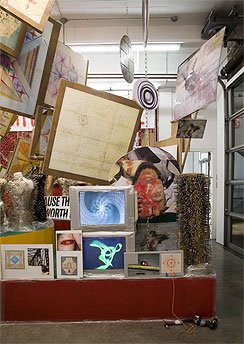
I have been thinking a lot about the problem of submitting a journalistic account or account otherwise of Thomas Hirschhorn’s recent show at Barbara Gladstone gallery in Chelsea, *Superficial Engagement* (2006). What I admire about Fanzine is the extent to which it presents itself conversationally, and to this extent communicates things worth knowing in fresh and accessible ways. Yet there is something that has not allowed me to be so conversational or journalistically inclined (and that has in fact made me dread my critical freedom) in the face of Hirschhorn’s recent showing. Why have I dreaded so? Is it because *SE* brings to a head the deepest ambivalences I have felt about the US response to 9/11 and subsequent events: ambivalences which situate the artist between the exigencies of political effectiveness and the necessities of transcendence -- our recourses to devotion, to the divine? Our resources.

The thing about *SE* – and why I feel it to be one of the artist’s most important works to date, and perhaps a significant marking point for art in general – is that it aligns itself with two aesthetic tendencies, and in doing so goes beyond these tendencies producing a third. The first of these tendencies is abstraction: the highly rational, beautiful, and “rested”-Classical. This tendency is embodied by a host of devotional reference points: Emma Kunz’s theosophical drawings, images from works of “color musicians,” as well as kitschy reproductions of 80’s “spiral art” and other post-psychedelic craft forms. Precariously, in a clash of culturally sanctioned forms (however marginalized, or outside) and mass-products, such references appeal to a power of the beautiful to calm, rest and inhere to it spiritual power – a metaphysical potential “to heal” Hirschhorn himself sites as one of the objectives of his latest work. The second tendency, a tendency arguably inverse of the first, presents through the most direct means violent actualities -- a severed head, or a barely recognizable human body standing in a pool of blood; and in so doing burdens the viewer’s gaze with overwhelming images and signs of manifest violence. This phenomena Jean-Francois Lyotard may likely call the ”presentation of the unpresentable,” and his contemporary, Emmanuel Levinas, an instantiation of the “there is” – the anarchic night of creation itself -- commesurable with ethical repsonsibility.

Considering the ethics of this second tendency – to present directly beyond ponderability, or comprehension: where to pre-hend, or grasp in advance of feeling, would be to violate the responsibility of voiding one’s gaze, witnessing beyond witness or looking awry -- it is crucial the extent to which many of Hirschhorn’s Afghani and Iraqui figures are dis-figured, that is, lacking faces as portals of commandment and absolute obligation; instead, what may remain of obligation is a transcendental lack-in-excess, the excessive (non-)presences of photographed corpses striking-out a merely human economy of legal-moral retribution. Not only in the images of mutilation, but in the sheer volume of blown-up headlines embodying a thick fog of media-warfare, the viewer is caught in the throes of a type of negative transcendence: a failure to transcend, to sublate or synthesize, a series of messages in excess of what they would say -- noisy in their contradiction, often tragically pleasant in their paratactical sense-making. Between sublimation and a transcendent negativity, “Chromatic Fire” and “Concrete Shock” (the names of two of Hirschhorn’s three rooms at Gladstone), between spiritualist “Abstraction” and immaneticist “Constructivism,” there is an ambivalence which may constitute a third tendency: to choose both tendencies, and in so choosing to put them into utmost tension with each other. An oscillation pattern we may write to infinity: to heal to overwhelm to not heal…

*

If there is any problem I have with claiming Hirschhorn for “critical theory,” as many critics have done productively and which much of the contemporary art world resists for its own reasons, it is that he is a devotional artist, an artist devoted to divine presence through a highly unique, and recent, form of materialism. This devoted materialism – a materialism as much after Mondrian, Malevitch and other Abstractionists as it is the philosophers Hannah Arendt, George Bataille, Gilles Deleuze, and Baruch Spinoza – would maintain the radical freedom of the artist as a noble actor within collective cultural struggle (“The decision to be an artist is the decision to be free. Freedom is the condition of responsibility”), while simultaneously realizing the suspension of this very freedom in the depersonalization of Abstraction for itself.

By a chiasmus of these two positions: radical agency and transcendental depersonalization, I wonder if we can not locate a radical position towards violence, one that has been opened up by the recent publications of Giorgio Agamben, in which the philosopher discusses what he calls “states of exception”. Particularly relevant to Hirschhorn’s recent work is Agamben’s reading of the debates between Carl Schmitt and Walter Benjamin concerning the “state of exception” in Germany during the first World War. If, as Agamben shows after Benjamin, states of exception are exceptions that historically ground the rule of democratic and totalitarian states alike then one should look elsewhere, in states beyond states of exception, to recover that which remains beyond the rule of both natural and cultural law: beyond “bare life” (Agamben) and “mere life” (Benjamin): the reduction of bodies to biological states of subsistence in the suspension of legal conventions grounded by constitutional law and international agreements regarding human rights.

For Benjamin, this state beyond states of exception is achieved by two means: by passional acts constitutive of “pure means,” or means no longer directed towards a juridical or moral result -- unpurposeful as such; and in “divine violence” that is “law-destroying,” that in its anarchism interrupts law as a source of juridical retribution and as the fulfillment of mythical fates. “This very task of destruction poses again, in the last resort, the question of a pure immediate violence that might be able to call a halt to mythical violence. Just as in all spheres God opposes myth, mythical violence is confronted by the divine. And the latter constitutes its antithesis in all respects. If mythical violence is lawmaking, divine violence is law-destroying; if the former sets boundaries, the latter boundlessly destroys them; if mythical violence brings at once guilt and retribution, divine power only expiates; if the former threatens, the latter strikes; if the former is bloody, the latter is lethal without spilling blood.”(Benjamin, “Critique of Violence”)

The punches *SE* packs I believe to be ones “lethal without spilling blood” insofar as they put its audience face-to-face with divinity as presented by creative force and aesthetic determination. If these creative forces bear-out their effects directly in the printouts and Xeroxes of mutilated bodies and the confusion of headlines ripped from the contexts of various Western media sources, these forces may have a symbolic effect through their correspondence of contemporary mannequins and African sculptures both riddled with nails. While the first force puts the audience in the presence of the “unpresentable” (Lyotard) and the “there is” (Levinas), the second, symbolic one indicates a post-mythical function of art itself: to substitute a creative violence of works of art for a violence of territorialization and retributive warfare. This later violence, the violence of true Holy War beyond “fundamentalism” and cynical “secularism” alike, of divinity beyond mythos, is that which may trump the reduction of bodies to “mere life” and “bare life” the stakes of which we see playing out currently in Guantanamo and elsewhere. It is the violence, lastly, of sacrificial expiations, a pure immediate violence Benjamin’s contemporary, Georges Bataille, recognized as the very opposite of warfare itself in its glorious wages, its infinite use and malicious possessiveness: “In deadly battles, in massacres and pillages, it has meaning akin to that of festivals, in that the enemy is not treated as a thing. But war is not limited to these explosive forces and, within these very limits, it is not a slow action as sacrifice is, conducted with a view to a return to lost intimacy. It is a disorderly eruption whose external direction robs the warrior of the intimacy he attains. And if it is true that warfare tends in its own way to dissolve the individual through a negative wagering of the value of his own life, it cannot help but enhance his value in the course of time by making the surviving individual the beneficiary of the wager.”(Bataille, Theory of Religion) Against the wages of Iraq and elsewhere and the ravaging of the United States and its allies, Thomas Hirschhorn has waged his own battle: a battle that should not result in loss of "mere life," and that if it has anything to gain, may gain “sovereign violence” (Benjamin) once again through the sacrifices of profaned creation.

Thursday, March 09, 2006

Punishment Park (States of Exception)


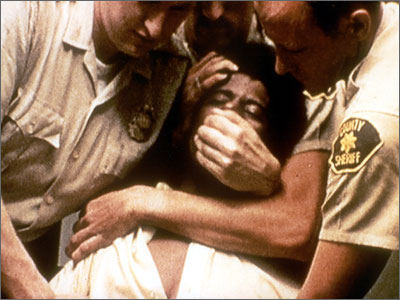
On recently watching Peter Watkins' '71 film, *Punishment Park*, a post-Vietnam documentary-style account of the (fictional) partisan hearings and punishments of late 60's "radicals," I thought of obvious parallels to the current geo-political situation (Patriot Act, Abu Grahib, Guantanamo...) and the debate between Carl Schmitt/Walter Benjamin concerning "states of exception" recently taken up again by Giorgio Agamben and others. Here are some notes I took weeks ago, with the film in mind as a teaching companion to Agamben's short, but seminal book:

Degrees of Exception:
1. Suspension of constitution.
2. Suspension of legal processes founded by constitution.
3. The suspension of laws founding the police as force of law, the law enacted thru punishment.

Thru these three completely related degrees of exception, the prisoners of Watkins' *Punishment Park* are reduced to what Agamben calls "bare life": a state of "natural law" before, after or in the suspension of laws "human". However there is a psychological cunundrum in Punishment, a canundrum we must accept in order to embrace the reality of its diegesis. And this is that the characters *unanimously* choose the park – thus opening themselves to be punished to any end without a constitution or other legal grounds for their punishment. For this viewer, watching the characters choose their punishment (as opposed to not choosing at all, and thereby going to jail) was not unlike watching when in horror films the characters decide to split into groups, or go out on a limb only to meet the monster, ghost, badguy, etc. In choosing punishment park, Watkins' characters affirm both the lawlessness and total juridical-social power of their judges. The only resistances that remain for them: reasonable dialogue (with completely unreasonable parties); to sustain a rhetoric of the courtroom (without legal precedent or established procedure); hysterical outburst, name-calling, childish self-objectification (something Jean Baudrillard, coincidentally, advocates for political struggles in an age of "simulation"); consent to the labyrinthine (however non-Kafkan, insofar as an unpredicatble purposefulfulness remains) law of the oppressor (who should only modify the rules of the game as the game is played) and an accompanying hope for freedom thru this means (to reach the appointed flag if they survive heat/cold of desert, dehydration, natural perils, personal disability); to kill, revolt, act psychotically; to appeal, by whatever of these means, to the camera -- the camera of the film being also the diegetic camera of a BBC television team making a documentary about punishment park: curiously, Watkins’ camera team remains "objective" until the final moments of the film, when a voice I assume to be the filmmaker’s addresses the police and national guardsmen, chastising them for their treatment of the prisoners; and this moment of witness pointing to an extra-legal and moral authority beyond the situation of the characters (the Brits? the rest of world outside U.S.) seems one of the few hopeful throughout the film...

I am particularly interested in the decisions the characters make in this film, and Watkins' creation of a hyperbolic situation both of (in)justice (on the part of the tribunal/police) and false agency (on the part of the prisoners). One that, insofar as it frustrates, brings out contradictions of/in "the law" and the way society functions thru a series of ideologies (the partisan tribunal representing these ideological strongholds)... Yet it is disappointing in its either/or-ness, its binarity. Where thought is not at a level of dialogue, or rhetoric, but in the inability for speech to succeed in the face of a certain despairing situation of the law, and in which hope would seem to lie only outside that situation -- not in the "state of exception" (where law reigns absolutely) nor in the social contract (dialectically substantiated by the exceptional state), but elsewhere -- in an eschaton, in revolutionary violences very much like the ones Watkins' characters are ostensibly being prosecuted for. It is this vicious circle which ultimately frustrates, and its resemblance to our current situation, where everything the characters do -- act reasonably, act out, appeal to an extra-legal situation -- only seem to result in the continuation of a self-fulfilling program of radical misjustice. It leaves me wondering, with Agamben, where a force beyond the law, beyond the state of exception, remains active. What Benjamin himself called tragically "the current messianic elements" and "the straight gate of the Messiah".

The Fate of Number

for Alain Badiou

BEACUSE THE SOUL AND BODY
OF THE IMAGINATION
ARE BEYOND ECONOMY
LEGALITY AS MEANS
MORALITY AS ENDS
SO MUCH DO THEY LOVE
THEIR MEANS WITHOUT QUALIFICATION
THEREFORE PASIONATELY

*

So the mind
must make
one
and can't make one.

So we must
love
each other
and love the abstract.

So this is a notion
of what subjects are
together, intersubjective
ground of love.

So there must always be
love for the mind.

So the mind is
what we love,
powers of mind.

So the eyes are the first sign
we see
of the mind, the eyes
and their cancellations,
their voiding.

So there are words.

There is perhaps a one that is not one.
The mind is such a one.
The mind as imaginal, a soul as such.
That thing most capable of love, these things.
The heart, the mind, the breath.
The heart's hallucination.
It's subtlest images, in the mind.
Of the mind...

*

A LIMIT INSCRIBED IN PLATO
(A PLATONISM WITHOUT GUARANTEE)

Why can't one one be one one be?
Why can't one one and one one be two?
Why can't one and one and one be one?
One and one, perhaps only one?

There is no numericity
in the outside again,
none inside.

Just the movement of the all
and each.

Multiplicity
destroying number
in order that it may be saved...

Intuiting Beuys (Project)


To produce intuitions (a purer knowing?) from meditations on individual drawings from Madrid Codices (1974). Through a form of repetition not unlike that Leonardo uses to begin in inchoates towards discovering forms, or Beuys uses after Leonardo at the level both of word and drawing.

Here I am most interested in the conveyance of energy as graphic mark, whether letter or drawing -- or sound as Beuys recognizes it to also make marks in air, to leave acoustical traces... If there were such thing as an ontological acoustical trace, Beuys wld definitely leave it thru his drawings...

Beuys' drawings seem not just figuratively, but literally of tracings. As tho the holographies, the holographic tracings, of different bodies, objects, schemes, words. A holography or typology of energy patterns. Marks constituted by different energies overlaying each other -- interpenetrating, intussucepting. Coeval and yet heterogenous, as such.

Others Letters: Ryan Chowdhury...

3/8/06 on Jim Behrle, Rhys Chatham @ Tonic, the Grand Ducal family of Luxembourg, and Iraq

"Thanks for the link. Phunny
stuph. Chatham
was great fun--warm
& fuzzy
guitar minimalism,
pulsing down
that mass-
tonal highway. Rock
musicians
as members
of the high school minimalist band.
A piece called
"Out of Tune Guitars",
for,
guess what,
6-7 hastily detuned guitars.
Fuck--
I'm checking a
society column, what's the
current slang for "ennui"?
& how come the
British, Swedish & Belgian
royal families have official web sites,
but not the
Grand Ducal family of Luxembourg?
What are they hiding?
Where are they hiding?
Did you know
Prince Harry (3rd in line
for British throne)
might go
to Iraq to fight?
What if he got
abducted & had his head lopped off on
videotape-- 1789 comes
to England,
about bloody time.
Speaking of which, do
you think
I could get a Fullbright
if I applied to study in Iraq? One idea is
I could just go
there &
retype Kipling's
"White Man's Burden,"
except heavily redacted. [...]"*

*my lineations

"The mind gives an order..."

"Why does this strange phenomenon occur? What causes it? O Lord in your mercy give me light to see, for it may be that the answers to my question lies in the secret punishment of man and in the penitence which casts a deep shadow on the sons of Adam. Why does this strange phenomena occur? What causes it? The mind gives an order to the body and is at once obeyed, but when it gives an order to itself, is resisted. The mind commands the hand to move and is so readily obeyed that the order can scarcely be distinguished from its execution. Yet the mind is mind and the hand is part of the body. But when the mind commands the mind to make an act of will, these two are one and the same and yet the order is not obeyed. Why does this happen? What is the cause of it? The mind orders itself to make an act of will, and it would not give this order unless it willed to do so; yet it does not carry out its own command. But it does not fully will to do this thing and therefore its orders are not fully given. It gives the order only in so far as it wills, and in so far as it does not will the order is not carried out. For the will commands that an act of will should be made, and it gives this command to itself, not to some other will. The reason, then, why the command is not obeyed is that it is not given with the full will. For if the will were full, it would not command itself to be full, since it would be so already. It is therefore no strange phenomenon partly to will to do something and partly to will not to do it. It is a disease of the mind, which does not wholly rise to the heights where it is lifted by the truth, because it is weighed down by habit. So there are two wills in us, because neither by itself is the whole will, and each possesses what the other lacks."

-- from Augustine's Confessions
Book XIII.
Chapter 9