Wednesday, September 06, 2017
Melissa Buzzeo's The Devastation (review)
My review of Melissa Buzzeo's The Devastation just hit the streets: She writes “not writing” (90), which is to say, writing at a threshold where to write is to enact the threat of the withdrawal of the very thing one would seem to be making: “a book that could be but isn’t” (118); “[B]ooks that lack cover or are all cover.” (20) It is to give the language the book would otherwise contain back to primary content, to matter after form, to text after words. It is to give the reader over to a process of healing towards the organization of new relations, new bodies, new books, new loves.


Sunday, September 03, 2017
Communal Presence: New Narrative Writing Today (conference)

Here is a link to the complete schedule:
https://communalpresence.com/complete-schedule/
Monday, August 28, 2017
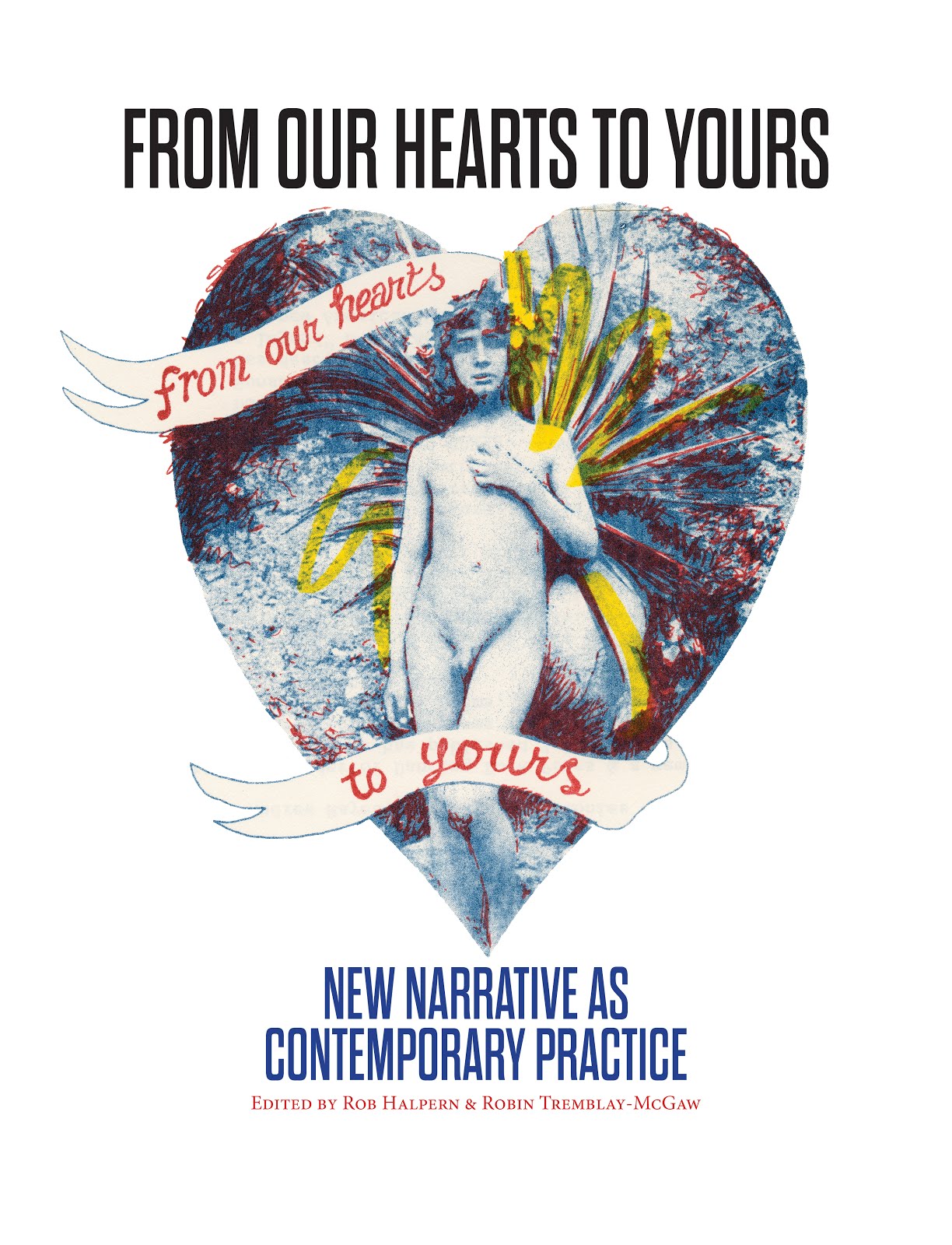
From Our Hearts to Yours: New Narrative as Contemporary Practice

From Our Hearts to Yours: New Narrative as Contemporary Practice offers the first comprehensive anthology of essays regarding New Narrative writing and community practices by a younger generation of practitioners and scholars. As editors Rob Halpern and Robin Tremblay-McGaw write in their introduction, “We are not interested in offering an ‘authoritative’ canon of New Narrative work, nor are we interested in consolidating an official version of New Narrative’s history. Rather, we want to use this as an opportunity to foreground New Narrative as a movement that is still coming into focus, a more or less unstable object that doesn’t want to be ‘fixed,’ codified, or hardened into a limited & limiting list of names and works. One of our motivating questions is Why New Narrative now? Or, What are the stakes of New Narrative for our contemporary moment? In other words, while we remain committed to a set of past works that have been identified as ‘New Narrative,’ we are equally committed to maintaining New Narrative as a dynamic and ongoing project, one with consequences for our present writing.” Roomy in the collective vision that they manifest, the twenty-four contributions to From Our Hearts to Yours address the AIDS crisis, the politics of race, the structural impacts of neo-liberalism on urban space, and the movement across queer, straight and transgender subject positions. Other topics of investigation include the category of queer art, the importance of “feeling,” the fiction of personality, the necessity of risk, the function of pedagogy, the strategy of appropriation, as well as scandal and gossip as these topics have been important to New Narrative and its expanded sphere of influence. Contributors include: Lindsey Boldt, Brandon Brown, David Buuck, Amanda Davidson, Robert Dewhurst, Thom Donovan, Joel Fares, Ariel Goldberg, Rob Halpern, Carla Harryman, Colin Herd, Kaplan Harris, Arnold J. Kemp, Trisha Low, Jason Morris, Trace Peterson, Ted Rees, Camille Roy, Kathy Lou Schultz, Eric Sneathen, Brian Teare, Robin Tremblay-McGaw, Catherine Wagner, and Stephanie Young.
Special pre-order price of $30 includes shipping. Order via PayPal here or send checks to:
Michael Cross
2556 Frances St.
Oakland, CA 94601
2556 Frances St.
Oakland, CA 94601
For a more comprehensive preview of the anthology's contents check-out PDFs of Rob Halpern's and Robin Tremblay-McGaw's introduction, "'A Generosity of Response': New Narrative as Contemporary Practice," and the Table of Contents.
Friday, July 21, 2017

Wednesday, July 12, 2017
Miranda Mellis on Visceral Poetics
"Justine’s regression to moaning inarticulateness, to apolitical idiolect, is like a detoxification from the suspect health she is surrounded by, which is predicated on the exclusion of the entire world from the single setting of the film. A rich citadel, until a world arrives to destroy it. Justine’s woundedness that cannot understand itself nor make its meaning known is arguably the very site of and condition of possibility for beginning to make meaning at all. Health, on the contrary, seems to entail, Stecopoulos argues, the paradoxical absence of a body altogether: the erasure of the body not only as mortal impingement and somatic vicissitude, but also as a poetic or hermeneutic agent. Justine is limited to being the unwilling, symptomatic recipient of unwelcome messages. She is not a hermeneut with no object; she is an object subjected to hermeneutics."
--Miranda Mellis on Eleni Stecopoulos' Visceral Poetics at The Believer Logger
--Miranda Mellis on Eleni Stecopoulos' Visceral Poetics at The Believer Logger
Conversations in Contemporary Poetics at Hauser & Wirth
Hauser & Wirth Publishers presents ‘Conversations in Contemporary Poetics: Thom Donovan and Simone White’ at Hauser & Wirth New York, 22nd Street on Tuesday 25 July 2017, 7 – 9 pm
Hauser & Wirth Publishers presents Conversations in Contemporary Poetics, a monthly reading series and discussion group that explores the diverse ways in which poetry integrates with life, media, and politics.
Organized by writer and curator Jeffrey Grunthaner, Conversations in Contemporary Poetics foregrounds what goes on behind the making of a poem. Rather than simply presenting poems as completed works (books, or finalized texts), the series acts like a studio visit, showcasing aspects of a poet’s creative practice that might otherwise go unnoticed.
The second installment of the series, held on Tuesday 25 July, 7 – 9 pm, will include readings by Thom Donovan and Simone White. The reading will be followed by a discussion and Q&A. A collectible program, featuring works by the readers and original artwork by Ánima Correa, will also be available.
Forthcoming readings will address poetry’s relationship to identity politics, popular music, visual art, and progressive movements toward social change.
Friday, June 16, 2017
from "Buffy's Two Bodies"
[...] Buffy, and
all of Whedon’s productions arguably, concern what Foucault called “new modes
of relation.” More than anything else, I think this is what attracted me to
Buffy. Beyond the nostalgic pleasure of the late 90s television series format and
the whip-smart dialogue of the show, Buffy,
from the get go, offers images of affiliation: the team, the band, the gang,
the ‘non-traditional’ (which is to say, non-straight, non-nuclear) family. As
much as Buffy is about gender politics, and specifically a populist (white) feminist
discourse in the 90s a la Naomi Wolf,
The Spice Girls, and “girl power,” it is also about how the collective is
conceived through a common struggle. This common struggle is ostensibly against
the apocalypse-happy demons that populate Buffy
and Angel. It is also against the negative
feeling states and social forces that those demons would often project: whereof
Willow’s fascination with magic, and her use of magic for the team, contribute to
her addiction in the 6th season; and Xander’s anxiety about his
contributions to the team make him literally split into two separate people
(“The Replacement”). This constant play of the metaphorical with the literal is
what sustains Buffy as a document of a shared imaginary, where the monsters
embody anxieties in the larger culture (and this would seem true of all monster
movies and films, since the very beginning of the genre).
I believe that the primary
anxiety of Buffy concerns the family,
and how specifically the family intersects with a larger sociopolitical
condition. Thinking back to 90s cultural politics, Buffy also seems to ask
whether certain affiliations can be considered a family. Can a gang, for
instance? Or a gay couple? Or an unruly assemblage of subcultural identities,
such as are a vampire slayer, a vampire with a soul, a watcher, a gypsy, a
werewolf, lesbian witches, and a poorly educated working class white male. In
José Munoz’s Cruising
Utopia, he makes an interesting, if passing and somewhat dorky, remark: that
Marvel Comics can be differentiated from DC Comics by its preoccupation with
“the freak.” Which is to say, the mutant, misfit, abject, and socially
non-normative. Something similar can be said of the characters of Buffy, who for the most part are
marginalized by some aspect of their identity or social position. The Scooby
Gang constitutes a band of outsiders. Though Joyce (Buffy’s mom) and Giles
(Buffy’s watcher) are parental figures, Joyce eventually becomes more like one
of the gang, and of course is ultimately offed in an episode that showcases the
muteness of her maternal presence (“The Body”). Giles is not Buffy’s father,
and only assumes a paternal function with reluctance. Buffy’s biological father
only appears in nightmares, and in the particular episode where she experiences
the divorce of her parents as a trauma at the core of her adolescent
development (“Nightmares”). In the 90s, when so many of my friends parents were
getting divorced; when so many of my parents’ contemporaries were dying from
AIDS; and when gay culture, as a result of the prominence of AIDS activism, was
coming into its own as a national political constituency, of course the family
would be the privileged site of cultural contestation. Not to mention on the
right, where the phrase on every politician’s lips was “family values.”
At times in Buffy, the monsters would seem to
represent right-wing America quite literally. The most insidious representation
perhaps being that of the secret government laboratory underneath the UC
Sunnydale campus, in the fourth season. Curiously, throughout this season of Buffy, it is the demons who have become
an embattled minority, and the humans who undertake experiments reminiscent of
Nazi and America genetic experimentation. In this regard, Buffy coincides with
another popular program from the same era, The
X Files, which also imagines an elaborate governmental conspiracy based on
genetic hybridization with an alien race. What one realizes through the fourth
season of Buffy is that Whedon’s vision of the demon world and the human one is
not Manichean, but relational; we might even say ecological. One needs the
other to coexist. And with the genetic experiments comes a dangerous imbalance
in that ecology of humans/demons, as Giles points out.
Though Whedon purports
publically little interest in left political histories or statist communisms, the
most radical images he offers us are of a fluctuating set of relations between
his characters, who at their most antagonistic still practice forms of mutual
aide. I think of Spike as a limit case of mutual aide, where he is gradually
converted from a cynic to a messiah (he is after all the key to preventing the
apocalypse in Buffy’s concluding episode).
At Spike’s most evil/other, there is still a desire to nurture the tenuous
ecology formed among the characters, and this is part of his appeal as a reluctant,
though eventually converted, ‘good guy’ (by the fifth season he is practically
a member of the Scooby Gang). All of Whedon’s work, from Buffy to his most
recent films, Through Your Eyes and Much Ado About Nothing, concerns relations
of affinity after the erosion of the traditional family by ‘globalization’
(i.e., post-Fordist neoliberalization). In Buffy,
Angel, The Avengers, Dollhouse,
and Firefly specifically, the team
offers an alternative affiliation based on mutual aide, cooperation, and a
minoritarian identity politics. I find it amusing that the dramatic tension of The Avengers revolves around such a
simple conflict: How will The Avengers cooperate as a team to defeat their
collective enemy? After a prolonged period of dissensus and antagonism, this
resolution comes about two-thirds of the way through the film, when it is
nearly too late.
Similarly, it may be
interesting to watch films that Whedon acted as screenwriter for, many of which
are not very good, to try to discern his ‘stamp.’ It is always there, however faintly.
In Alien: Resurrection (1997), one
immediately has the sense that there is a problem of team similar to that in
all of Whedon’s productions. It is curious, for instance, that the duration of
the film features a group trying to escape the aliens together, whereas in
previous installments of the Alien series
the escape tended not to be nearly so team oriented. Though a few of the
characters are picked-off, most remain until the end and more than in any other
of the Alien films actually survive. In
Toy Story, which was co-written by
Whedon, I wonder if his contribution to the screenplay was not of the
cyborg (or is it mutant? I’m not sure what to call them) toys, who help Sheriff
Woody and Buzz Lightyear escape from their sadistic, adolescent captor. The
cyborg toys present a kind of shadow team, in contrast to the toys of the house
next door, who have not had their body parts recombined into novel arrangements
a la Frankenstein. That the mutant toys signify non-normative genders
through their body parts, such as the fishing rod with Barbie doll legs, also
seems to me a possible contribution from Whedon.
After seeing Much Ado About Nothing, I wondered, how
does this fit into Whedon’s larger body of work? Much Ado About Nothing is obviously a comedy, and very much about a
battle of wits, which may relate to Whedon’s concerns as a screenwriter. One
might say that Much Ado About Nothing is
about reapproprating the Shakespearian comic genre. But as you watch the film,
you start to think about the set, and recognize actors from Whedon’s other
films and television series. You start to think: these are Whedon’s friends,
his ‘inner circle.’ [Wikipedia: Most of the cast had worked with Whedon before;
Acker and Denisof on Angel; Denisof,
Lenk and Lindhome on Buffy the Vampire Slayer; Fillion
and Maher on Firefly; Acker,
Denisof, Diamond, Kranz and Johnson on Dollhouse; Gregg,
Denisof, Rosemont and Johnson in The Avengers.] You also start to think about what it means for
a director to make a film in their home (the film was shot over a period of
twelve days in Whedon’s family’s house in Santa Monica, California). What gives
so many scenes from Much Ado About
Nothing their life is no doubt the fact that they are shot in contemporary,
upper-middle class domestic settings, the scenes of Benedick and Don Pedro,
shot in the bedroom of Whedon’s daughters, being among my favorites. The team
of Much Ado About Nothing consists of
Whedon’s closest friends and colleagues; and the drama that they enact, as in
all comedies, is about how to bring certain people into a happier or more
productive relation.
A certain affect derives from
Whedon’s use of domestic spaces and interiors, a common feature among
television programs obviously for establishing consistency through the set, but
unique, I believe, in Whedon. We might call it a we feeling or a feeling of
team. In Buffy, for example, the characters always have a central gathering
place, which becomes a kind of commons. In the early season, it is the library
at Sunnydale High, while in later seasons this meeting place is Giles’ dining
room, the magic shop, and finally Buffy’s family home. While there are other
more intimate domestic spaces (bedroom interiors especially) it is these spaces
that form the primary locus of affiliative relation. A similar we feeling is
established in Dollhouse, through the
house itself, which acts as one large common space; and in Firefly, through the interiority of the ship. It is in these
locations where plans are hatched, but also meals are shared, research takes
place, and gossip is exchanged. Following Sara Ahmed, these locations comprise
“kinship objects,” which “make a sense of relation possible.” (Queer Phenomenology, 81) When these
places are attacked one feels that the team itself is under siege, that affiliative
relation is threatened. The loss of these places, in Ahmed’s words, would seem
to “make social gathering impossible.” (ibid)
One of the most stunning
examples of this threat, completely unique in Whedon’s body of work, is in the
final episode of Firefly, “Objects in
Space,” in which a bounty hunter boards the Firefly, in search if its two
fugitives. The racial component of this encounter can’t be overlooked, since
the bounty hunter is black, and is marked as black by the way he speaks and his
manner of dress (a ‘funky’ red spacesuit and moon boots, reminiscent of 70s era
Blaxploitation costume). The threat that he poses, particularly to the white
women of the spacecraft, seems especially problematic, where rape is insinuated
more than once. One feels in this episode, more than perhaps any other, the
power of Whedon’s domestic enclosures, where the occupation of the enclosure by
an invading other creates a sense of violation among the characters. That Firefly concludes before Serenity (2005) with an image of such
racially marked violence is incredibly disappointing for any fan of the series,
where the bounty hunter is finally jettisoned in outer space, abandoned to an
absolute outside. This image is terrifying inasmuch as it coincides too
accurately with reality. Surprisingly, given Whedon’s sensitivity to a politics
of racial representation, he didn’t find some way to incorporate the bounty
hunter into the band, as a fellow traveler. A conclusion that would have been
more fitting with Whedon’s minoritarian themes.
So many new modes of relation
pervade Whedon’s work, and so many of these new modes include those of the non-
or barely considered human. Demons, vampires, gods, demi-gods, angels; queer
people, ethnic minorities, outlaw bodies and subjects. At the limit of the
human, we are also offered to reflect upon the problem of “exception.”
Following Giorgio Agamben’s Homo Sacer
and other books about biopolitics and sovereignty, we might say that Buffy and
many of the creatures of Buffy the Vampire Slayer are defined by the
fact that they are neither human nor non-human, that, in Agamben’s words they
constitute a “zone of indistinction” between the mortal and the non-mortal
(animal, demon). The vampire, as conceived within the series, is the spawn of
human and demon gene pools, and the slayer is also demonic, being the result of
a related hybridization. To be non-human is to be immortal, in the case of the
vampire, until they are staked or beheaded. In the case of the slayer, the
slayer has super human strength and sensory-motor skills, but remains mortal.
Lesser and greater states of exception exist among the characters of Buffy, depending
on which species of supernatural being they happen to be. At the limits of team
and affiliation, lies a basic problem: to what extent should the Scooby Gang
help Buffy and thus be put in danger; also, to what extent should the slayer
lead the team and to what extent should she remain independent in her
exceptionality? It is an aporia that appears in the first season of Buffy and is not resolved until the
final episode, when the powers of the slayer are disseminated among a multitude
of girls, whereas power is normally passed from one slayer to another upon the
first slayer’s death.
Buffy’s sovereignty—the fact
that she is exceptional and therefore outside the realm of social custom and
law—is a major problem for the team. How can power be shared when one team
member would seem so much more essential than any other? But Buffy’s
exceptionality, like that of all superheroes, is more a curse than a gift (we
might say that it constitutes the gift as
curse). As a result of her exceptionality, Buffy is deemed a juvenile
delinquent in the first three seasons of Buffy
the Vampire Slayer, as she is surveilled and policed by the principles of
Sunnydale High. Slaying by night, and sometimes during the day, she is also denied
normative relationships among her adolescent peers. Many times she would seem
an exploited laborer, inasmuch as she is expected to attend high school and work a full-time job, moonlighting
as the slayer. (The situation of her exploitation is foregrounded when she
drops out of college to care for her younger sister upon the death of their
mother, whereupon she takes a minimum wage position at a demon-infested fast
food chain [“Doublemeat Palace”]. It is not until Giles makes out a check for
her that she is finally able to have any financial security.) Finally, she is routinely
forced to keep secrets from her loved ones and has to die and be resurrected no
less than twice in order to fulfill her “birthright.”
The slayer’s job is
demanding, infinitely demanding one might say, because it asks that Buffy put
herself in mortal danger and offer herself voluntarily in death. As she
discovers in a dream, in the fifth season, “death is [her] gift” (“The Gift”).
The slayer is herself the munis that
binds and unbinds the community (where community derives from the Latin for
“those who share the gift”). She is the one who endures the “work’s demand”
(Blanchot) inasmuch as she is cursed to die and come back, Orphically returning
to reassemble her fragile and embattled community. A cult against the
apocalypse; against the triumph of the demonic; for the preservation of the
human; for the ecology of the human and the demonic.
In the absence of the law
Buffy becomes the law. (So rarely in Buffy do we see the presence of police;
it is only in the third season, with the introduction of Faith, that the law seems
concerned with the work of slayers and their watchers at all in fact.) From her
abandonment by the law issues her power. It is the problem of power—how power
is distributed among a demos
comprised of her friends, family, and comrades—that she must resolve. Democracy
won’t result from consensual politics, but from a counter-public comprised of
misfits and young girls (the break-down of consensual political structures is
dramatized in the seventh season by the conflicts between Buffy, the Scooby
Gang, and the slayers elect). Girlism. Buffyism. Willoism. At the fringes of
human society (ban), Buffy represents
the anarchic potential of our relationship with death. Through our lack of
power over it, our incapacity to administer or administrate it totally, death
becomes paradoxically a source of potency. The fact that the sovereign is also
the one who has been abandoned by society, and given up in sacrifice to higher
powers, is an irony of all exceptional beings.
Buffy
embodies the dream of a certain kind of politics. A necropolitics. A politics
of the one who has no choice but to tarry with death as the potentiating shadow
of life’s total administration. Beyond Whedon’s metaphors of cultural politics,
there is the literal fact that in the 90s biopolitics had come to a critical
juncture, particularly in the throes of the AIDS pandemic, and with the rise of
the Human Genome Project and other bioethical projects of a corporatized scientific
industrial complex. Curiously, Buffy
concludes at a moment in which state emergencies like 9/11 have come to dictate
a larger geopolitics centered upon the United States. Might we say that the
world of Buffy in the seventh season,
in which Buffy annuls her exceptionality through a spell performed by Willow, forms
an antithesis to the Bush regime? Where
Buffy represents a sovereign who
seeks to annul sovereignty itself rather than prolong its force. While we now
know that the era of Clinton in the 90s, while ‘progressive’ in comparison to
the Bush and Reagan presidencies which preceded it, was an extension of
neoliberal policies and trade agreements that ensured the debt and wage entrenchment
of a majority of the world’s population (a diffuse apocalypse if there ever was
one), Bush’s two terms in office appear in contrast as a grand apocalypse marking
a complete hiatus from any hopes of progress or social justice. [...]
--composed August, 2014
Thursday, June 15, 2017
Cornelia Barber on WITHDRAWN
There is always a re-publicization. In a poem like “All I Wanted Was To Be In A Band” we watch the poet, Thom’s process transform from personal to public and in questioning this transformation he questions the “public” itself. The fantasy public. The white public. The capital public. The patriarchal public. The public that both makes and unmakes this book.
Thursday, June 01, 2017
cris cheek's Pickles & Jams (blurb)
Creative mishearings, extemporized speech, pattern/algorithm/procedure, typos (“Your typos / leak wisdom”), phonemic salad, technological fuckery… this is the stuff that cris’ work seems made of to me. Often he retains a certain syntax—a syntax of official “English,” and of past (official) English poets—deterritorializing it by bringing the arbitrariness of the phrase to a saturation point—and by this means breaking into “englishes.” Yet, when these poems stop playing they become deadly serious, arresting us with their melancholic romance and/or rants against racial capital and/or precise indictments of the (white male cis) liberal subject. Pickles & Jams offers a sustained and multi-modal demonstration of an anti-authoritarian language practice where the poet seeks “not a plain language but / a poetry advocating on behalf of resistance to external authority.” It extends cris’ ongoing investigation into and manifestation of a late-Antinomian tradition.
Thursday, April 20, 2017

Friday, April 07, 2017
SEGUE Series reading on April 15th
On April 15th I will be reading for SEGUE Series with Marissa Perel, curated by Cornelia Barber and Emmy Catedral.
For more details, check SEGUE's website here.
For more details, check SEGUE's website here.
Friday, March 31, 2017
Responses to Eleni Stecopoulos's Visceral Poetics
via Charles Bernstein's weblog
Eleni Stecopoulos’ brilliantly provocative, syncretic manifesto, Visceral Poetics, identifies idiopathic disease with ideolectical poetics, pathology with anomaly – the flesh of the text and the text of the flesh — bringing home the liberatory potential for visceral readings of the unintelligible. For Stecopoulos, diagnosis is a practice of aesthetic translation and poetry a quest for knowledge outside the disabling strictures of Western rationalism. Written in lyric bursts of telegraphic intensity, Stecopoulos follows her guides, Artaud and Metcalf, through veils of suffering in order to repossess, from the jaws of evisceration, her own life — and ours.
On March 15, a group of poets gathered at New York's Poetry Project to celebrate the book and engage in a conversation on "opacity." The evening was organized by Stecopoulos and Thom Donovan. Here is the handout of statements by several people who could not be present at the event: Will Alexander, Margit Galanter, Petra Kuppers, Sean Labrador y Manzano, Miranda Mellis, William Rowe, and Robin-Tremblay-McGaw. Prefaced by Donvan's introduction.
Thursday, March 23, 2017
Annotation/Redaction*
*originally posted at Facebook, 3/22/2017
Tuesday, March 07, 2017
Pre-order WITHDRAWN

Composed between 2009-2012, Thom Donovan’s Withdrawn engages a social and political landscape through a densely speculative and intertextual lyricism. Proceeding through dedication and interlocution, the poems are ones of encounter (with art works, with specific individuals and communities, with social configurations and political events) where friendship, sociality, and politics interarticulate one another. Not unlike Arthur Rimbaud’s poetry in relation to the Paris Commune of 1871, the poems in the second half of the book write through the Occupy movement, resulting not so much in ‘Occupoems’ as meditations on a collective enunciation in the midst of its emergence. These poems might be said to be “meta-political” (or “meta-social”) inasmuch as they are reflections on the potential for (as well as the failure of) sociopolitical subjects to come into being. Through the proper name, others are called into urgent relation, an expression of both the actual (the world as it is) and the prefigural (the world as one would want it to be). In its non-discursive proclivities, poetry withdraws from meaning, taking flight into prosody (stress, sonority, noise) to record a politics without a proper locus—anterior, preposterior, post-expectant.
Excerpts from Withdrawn: a Discourse (Shifter 23):
Let’s remember that singing is the most complete of the physical endeavors, it unites body and soul like nothing else—this is why it started on the fields, there, where the spirit evaporates under the fusion of the temperature of the air and the pain of the body, and in the interstices, a strange feel of freedom takes place. What keeps Thom’s world convincing is his profound conviction that “the possible doesn’t end with words”. But we have words (most often, nothing else) and we use them, some of us, capable of doing it, create songs, “songs the object, and songs the subject”, and ripples are sent, going the goddess knows where!
—Etel Adnan
I still don’t know how to talk about Withdrawn, but I want to say that it mystically catches us “Dreaming when we cannot see / Waking from the archive again.” That it is here Thom’s complicated we that itself is the archive: we, unaddressable, in an inverted state of apocalyptic address. We, the bodies in whom all speaking is dispersed. In the face of a total vacuum of meaning, Withdrawn asks, “Who will resurrect / What we could not feel / The first time?” Bearing witness to “The way this tear in the eye / Becomes commodity,” it begins to propose the structures of a sadness beyond the reach of commodity. To “The mind bludgeoned / By a force without grace,” it offers the specter of a world where the relationship between grace and force has been reversed.
Excerpts from Withdrawn: a Discourse (Shifter 23):
Let’s remember that singing is the most complete of the physical endeavors, it unites body and soul like nothing else—this is why it started on the fields, there, where the spirit evaporates under the fusion of the temperature of the air and the pain of the body, and in the interstices, a strange feel of freedom takes place. What keeps Thom’s world convincing is his profound conviction that “the possible doesn’t end with words”. But we have words (most often, nothing else) and we use them, some of us, capable of doing it, create songs, “songs the object, and songs the subject”, and ripples are sent, going the goddess knows where!
—Etel Adnan
I still don’t know how to talk about Withdrawn, but I want to say that it mystically catches us “Dreaming when we cannot see / Waking from the archive again.” That it is here Thom’s complicated we that itself is the archive: we, unaddressable, in an inverted state of apocalyptic address. We, the bodies in whom all speaking is dispersed. In the face of a total vacuum of meaning, Withdrawn asks, “Who will resurrect / What we could not feel / The first time?” Bearing witness to “The way this tear in the eye / Becomes commodity,” it begins to propose the structures of a sadness beyond the reach of commodity. To “The mind bludgeoned / By a force without grace,” it offers the specter of a world where the relationship between grace and force has been reversed.
—Ian Dreiblatt
How do we orient ourselves, or fail to orient ourselves, in a moving and ever-changing surround? What are the conditions that withdraw us from any grasp of the society in which we live? How to find a pathway that leads forward, and not back, or worse, around in circles? These questions gripped me physically last week, behind the wheel. And I find myself asking them once again today, while reading Thom Donovan’s book of poems, entitled Withdrawn—a book in which I am somehow encrypted, and which I perceive as a subjective refraction of the experience of an entire political generation, those who traversed the Occupy movement. Faced with the demand to respond to the book, I wonder about the “post-expectant” moment in which Thom’s feeling of self now seems to be situated.
How do we orient ourselves, or fail to orient ourselves, in a moving and ever-changing surround? What are the conditions that withdraw us from any grasp of the society in which we live? How to find a pathway that leads forward, and not back, or worse, around in circles? These questions gripped me physically last week, behind the wheel. And I find myself asking them once again today, while reading Thom Donovan’s book of poems, entitled Withdrawn—a book in which I am somehow encrypted, and which I perceive as a subjective refraction of the experience of an entire political generation, those who traversed the Occupy movement. Faced with the demand to respond to the book, I wonder about the “post-expectant” moment in which Thom’s feeling of self now seems to be situated.
—Brian Holmes
Y’all miss each other, together, in the emergency. Gon’ sit in with y’all so we can miss each other at practice. Let’s practice missing each other, together, until, together, we don’t miss each no more. Then we just together. We just get together, then. It’s like we just finally get our shit together. Love just interinanimates our souls in communal luxury. We all we ever wanted.
Y’all miss each other, together, in the emergency. Gon’ sit in with y’all so we can miss each other at practice. Let’s practice missing each other, together, until, together, we don’t miss each no more. Then we just together. We just get together, then. It’s like we just finally get our shit together. Love just interinanimates our souls in communal luxury. We all we ever wanted.
—Fred Moten
With cover art by Harris Johnson.
Support Compline by preordering Withdrawn and receive the book early at 20% off the cover price, plus free shipping!
Preorder Withdrawn here!
Thanks for your support!
Michael Cross
Compline
2556 Frances Street
Oakland, CA 94601
compline.tumblr.com
Thursday, February 16, 2017
For Opacity: Visceral Poetics Now
"We clamor for the right to opacity for everyone."
- Édouard Glissant, "For Opacity" (tr. Betsy Wing)
A symposium that
continues the collective work of Poetics of Healing and takes Eleni
Stecopoulos's Visceral Poetics (ON Contemporary Practice,
2016) as a point of departure for new writing & dialogue to treat these times. Readings
& performances may engage opacity & transparency; anti-imperial
& anti-colonial poetics; "the chronic syndrome of the West";
healing & somatic practices; mother tongues & mongrel
tongues; otherness & immigrant poetics; the writing of Antonin
Artaud, Édouard Glissant & others.
Hosted by: Stecopoulos
& Thom Donovan, co-editor of ON Contemporary Practice for The Poetry Project.
Appearances by: Cornelia Barber, Charles Bernstein,
Melissa Buzzeo, Declan Gould, Jeanne Heuving, Madhu Kaza, Robert Kocik,
Liz Latty, Andrew Levy, Sean Labrador y Manzano, EJ McAdams, Marissa
Perel, Kristin Prevallet, George Quasha & Emji Spero.
Statements or video by: Will Alexander, Brenda Iijima, Mg
Roberts & TBA.
Tuesday, February 14, 2017
Resist Much / Obey Little

Inaugural Poems to the Resistance
Edited by Michael Boughn, John Bradley, Brenda Cardenas, Lynne DeSilva-Johnson, Kass Fleisher, Roberto Harrison, Kent Johnson, Andrew Levy, Nathaniel Mackey, Ruben Medina, Philip Metres, Julie Patton, Margaret Randall, Michael Rothenberg, Chris Stroffolino, Anne Waldman, Marjorie Welish, Tyrone Williams
ISBN 978-1-944682-32-3 740 pages $30.00
we can’t build a wall. we can only spout pure water again and again and drown his lies.
Eileen Myles
Racism, xenophobia, misogyny and their related malaises are to the U.S. what whiskey is to an alcoholic. The current occupant of the White House won the election yipping, against possible recovery, “Drinks are on me!” The rich, multitudinous voices in this anthology variously call for—having embarked on—the hard work of sobriety, sanity.
Nathaniel Mackey
Poets are summoned to a stronger imagination of language and humanity in a time of new and radical Weathers. White House Inc. is the last gasp of the dying Confederacy, but its spectacle is dangerous and addictive so hold onto your mind. Fascism loves distraction. Keep the world safe for poetry. Open the book of love and resistance. Don't tarry!
Anne Waldman
Subscribe to:
Posts (Atom)