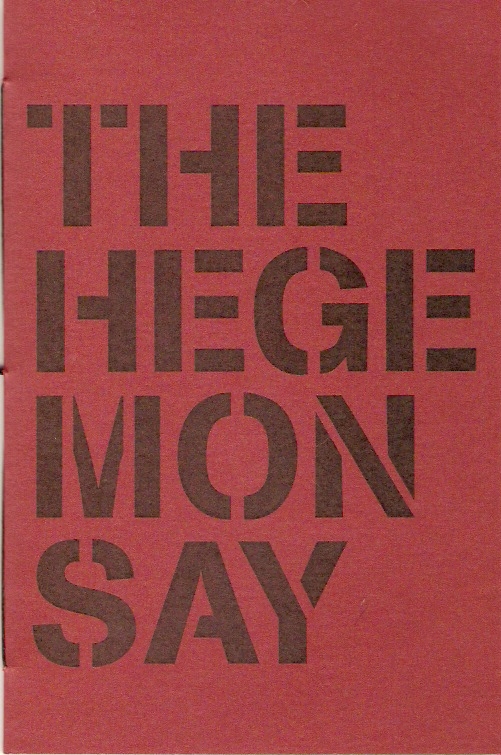
Kent Johnson has a provocative gallery currently up at MAYDAY magazine concerning the state of contemporary poetry criticism. The gallery includes a letter originally posted at Poetry Foundation, "Some Darker Bouquets," where Johnson argues for some kind of return to negative criticism as well as for the return of anonymous reviewing practices. It also includes responses to his letter by Kristin Prevallet, Rodrigo Toscano, Joe Amato and many others.
Personally, I am not interested in negative criticism (so called). In fact I'm not sure what a negative criticism would look like anymore--the field of poetry seems so heterogeneous and dispersed. The way I approach criticism tends to be from a position of desire. Mainly, I would like to understand my contemporaries better in relation to my own work. In the editorials for the magazine I coedit with Michael Cross and Kyle Schlesinger, ON Contemporary Practice, I have called this desire a desire for "discourse," sensing discourse's eclipse within a current culture of poetry. How can we understand our own problems as writers and culture workers better by writing critically about those we perceive as our contemporaries? How can this understanding lead to an encounter with larger cultural problems? How can poetry be a tool for the understanding, inquiry, learning--a way of getting to the whole shebang?
Negative criticism in poetry tends to chase its own tail. At best, it can clear the ground for evaluation; at worst, it is a mean-spirited gateway to legitimation compelled by the ego. Younger critics nowadays should attempt through discursive prose and critical experiment (which does not rule out non-discursive forms of writing) to make legible the writers they care about to themselves, if not to a larger readership. In other words, they should extend discourse. Any negativity, I believe, should issue from this initial impulse, which is an impulse of love, patience, and the desire for communication.
How to come to know our selves through our peers? How to come to know the world through a critical conversation? How to transform worlds coeval with this conversation? These are the questions I believe we must ask ourselves as "established" and "aspiring" critics. Criticism is only as "good" or "bad" as our desires and conduct. Critics should, thus, be asking themselves what they want through the production of criticism. None of this rules out having steady work, or even making criticism one's livelihood (as poets so often do out of economic necessity). It merely admits that the critic's livelihood should not overdetermine criticism as a form of action with certain consequences.
Saturday, May 02, 2009


from Colombo, My Wife

Take my wife my life is not my life
My wife your life is not your life
Taken into these bare hands which make us haptic eyes
And evidence which we sometimes see this dirt
Is only dirt except where it is where it’s not supposed to be
A technology is what we leave to experts except when seeing
Becomes a kind of evidence we see
In the play-back of all that was meant
In this intention which is us whenever we believe our eyes
That it is a crime to live Colombo grasps
He holds his wife somewhere else in bed
Her body her voice which is all body I hear
You my wife in this Colombo my wife
And I am not afraid to live I am not afraid
To die if this seeing gives our deaths meaning
If it is a kind of sunshine only seen off-screen
Adumbrating the darker deeds and mayhem of this world.
Friday, May 01, 2009
Tom Clark's blogs
Tom Clark sent me links to his blogs, which are definitely worth spending some quality time with. Especially for their curious play between image and word:
Beyond the Pale
http://tomclarkblog.blogspot.com/
Vanitas
http://vanitasmagazine.blogspot.com/
Beyond the Pale
http://tomclarkblog.blogspot.com/
Vanitas
http://vanitasmagazine.blogspot.com/
Sunday, April 26, 2009
Gricevich/Schlesinger on Levy's Memories of My Father

CANNOT EXIST editor, Andy Gricevich has written a thoughtful note on Andrew Levy's book, Memories of My Father at his blog, otherwise:
http://ndgwriting.blogspot.com/2009/04/where-to-house-that-lone-thought-little.html
And here is Kyle Schlesinger on the book a few months back: http://cuneiformpress.blogspot.com/2008/02/memories-of-my-father-by-andrew-levy.html
Saturday, April 25, 2009
Death to all Projects?
Dorothea Lasky has posted her treatise on why poets should avoid the term "project" as a convenient term to describe their ongoing work. Personally, I don't use the word since it connotes knowing what one is going to do before having done it, a predetermination, or prehension. I also associate it with many of the worst elements of Modernity (the Knowledge project, the Colonialist project, genocidal projects, etc.). Isn't the very notion of project what we've been working against after Modernity (as a project itself)? I prefer the term problem to project. Since poetry is an expert discourse, why shouldn't poets conceive more accurate terms to describe the status of their work?
Friday, April 24, 2009
A Strike for Rod Smith
What buttons to push
And what peaches how
Much would they be
Worth when every one
Demands a pound of
Flesh both gods and
Men in the eyes of la-
bor true value cries from
The wings dissembles
Power is power which-
ever forms it assumes
In this night of virtual
Demonstrations what
It would mean to find
Those buttons you speak
To those peaches to
Which Jack Spicer refers
What would we with-
draw from ourselves
To make a strike that
We have not with-
drawn already to make
The poem a kind of re-
distribution of wealth?
And what peaches how
Much would they be
Worth when every one
Demands a pound of
Flesh both gods and
Men in the eyes of la-
bor true value cries from
The wings dissembles
Power is power which-
ever forms it assumes
In this night of virtual
Demonstrations what
It would mean to find
Those buttons you speak
To those peaches to
Which Jack Spicer refers
What would we with-
draw from ourselves
To make a strike that
We have not with-
drawn already to make
The poem a kind of re-
distribution of wealth?
Health Care as a Human Right
Here is an interview at Democracy Now about a movement abreast in Montana arguing for Universal Health Care as a Human Right. It is such a sea change of thinking, which renders completely inadequate the current "private"/"public" oriented debates about health care reform in the United States, that is badly needed now...
Thursday, April 23, 2009
Younger Than Jesus at New Museum


This is one of the better art shows I've seen in a long time, especially large group shows/retros. What is especially impressive is how the show actually captures a generational range and spirit among people age 25-33 (rough estimate of artists' ages in show). While the work is not overladen with computer-based art, there is also a pervasive sense of how Web 2.0 in particular is changing the way we think about art as a social activity/product. And, as Jerry Saltz suggests, how an emergent generation of artists are the vanguard of a new affective culture.
Brandon Brown on Disaster Suites

I have been enjoying Brandon Brown's conversational blog, HI, which is ever breezy and yet concise (a rare quality in criticism). Here goes the longish entry, which you can also find here if you scroll down for awhile:
"1. Yes, I’ve been living with Rob Halpern’s Disaster Suites. There is so much to think about and so many various ways the conversation could go, but maybe I could just make some mentions.
For one thing, there is the fascinatingly fraught relationship with the lyric that’s both performed and discussed. In the prose piece which comes after the suites themselves, “Post Disaster,” Rob writes, “I hope these poems don’t persist. Or rather, I hope the conditions that make them readable do not.” This is shocking for the perhaps obvious reason that the lyric has always been obsessed with its own preservation. Catullus and Horace, to some degree typical of classical lyric practice, inscribed into their verses prayers that their works would endure. I read these sentences in Disaster Suites as the negative of those prayers. The “rather” is hopelessly, beautifully emblematic of the paradoxical desires and intentions that constitute so much of the text. How would you read an illegible work? Except, there is a way in which the world that makes such work illegible could then be read as bearing meaning. Or something like that.
There’s a terrific paradox in which what is to be desired is refusal itself, performed in the world No! One wants to say no to the disaster, no to the conditions that permeate and structure disaster. It’s a gorgeous affirmation of the desire to negate—but, viz. the last lines of the suites:
In words with no future we seek portals
Holes and faults hew new relations quicken
Chasing that persistent and ongoing no!
The meaning of the word “hew” and its use here really evokes Oppen for me, someone who I know is terribly important to Rob. To “hew” of course means to cut and to fashion. Like “render.” This chase after negation is critical for so many reasons: the “troika” of police, state, and capital demands obedience (framed as “yes”), the media representation around disaster is inevitably productive of, not resistant to, the disaster. The proliferation of imagery and analysis (Rob mentions the racialized distinction between “looting” and “finding” in post-Katrina coverage) is a sort of persistent and ongoing yes! to the disaster, etc.
There’s so much more to say—maybe there are things I’ll be able to say in the future (besides omfg stop reading fucking talking points and read this book), but I also think that this book demonstrates that uncanny relationship with the lyric in its form. I mean, this is so hard to talk about, so do you mind if quote:
So then I woke up wondering about the multitude
And whether I could ever vocally be a part of that i-
Dea or thing or whether I’d get stuck just trying to
---This is one stanza in one poem in one suite of the book and utterly excised out of its context. Sorry. But I find this so prosodically rich. The question “could I ever be a part of that I” emerges from “that idea”, following on an “I” which wonders about the multitude. It’s as if the statement is thus both “I woke up wondering whether I could be a vocal part of the multitude.” and “I woke up wondering whether I could be a vocal part of the multitude which after all is just an “I”.”
But then notice the repetition of length. The first and third lines are 14 syllables. The middle line is 15 syllables, or “one off”—that extra syllable at the end? “I” “I” then figures in this moment also as a surplus or excess; or appendix; or, to reference another anxiety of the book, it’s what you find when you start to count.
There are like dozens of moments in this text where such formal stratifications are at play."
--Brandon Brown
Tuesday, April 21, 2009
Nationalization of Banks and Auto-Industry?
Why is there not a strong and vocal movement abreast to nationallize (dare I say socialize) the banks and auto corporations that have been bailed out by the Obama admin/Geithner?
Is there one, and I'm just not aware of it?
If there is to finally be socialism in this country, shouldn't this be a ripe moment for it to come about?
Any info wld be appreciated in comment boxes or at tadonovan [at] hotmail [dot] com.
Is there one, and I'm just not aware of it?
If there is to finally be socialism in this country, shouldn't this be a ripe moment for it to come about?
Any info wld be appreciated in comment boxes or at tadonovan [at] hotmail [dot] com.
Thursday, April 16, 2009
Iwishtherewas*
I wish there was
is the name of a
site where you c
an do a want and
perchance it will
come true. Sounds
marvelous makes
n't it? The site
Iwishtherewas can
assist you encou
nter a solution
to your job. The
thought is great
I conceive, beca
use not simply is
it a opportunity
to verily chance
that solution, b
ut too because it
Holds the follow
ing logical meas
ure for companies
to cognize what p
eople really des
ire. All you sho
uld make is dire
ct in your want a
nd wait for a com
pany to pick it u
pwards. Or you may
happen out that
there already is
a solution to your
job! It is ally in
line with the ten
dency of utilizi
ng people (crowds)
to market your th
oughts or get fee
dback on your mer
chandises. See be
sides crowd sourc
ing. That is all
about linking peo
ple and companies
to excogitate bet
ter wares or to me
liorate merchandi
ses. Increasingly
the net is seen as
a spot where there
is more info, but
where there is a w
hole rootage of no
esis and thoughts,
free to utilize for
everybody. And, peo
ple care to be heard!
*all language lifted from http://marianowilliamry.blogspot.com
is the name of a
site where you c
an do a want and
perchance it will
come true. Sounds
marvelous makes
n't it? The site
Iwishtherewas can
assist you encou
nter a solution
to your job. The
thought is great
I conceive, beca
use not simply is
it a opportunity
to verily chance
that solution, b
ut too because it
Holds the follow
ing logical meas
ure for companies
to cognize what p
eople really des
ire. All you sho
uld make is dire
ct in your want a
nd wait for a com
pany to pick it u
pwards. Or you may
happen out that
there already is
a solution to your
job! It is ally in
line with the ten
dency of utilizi
ng people (crowds)
to market your th
oughts or get fee
dback on your mer
chandises. See be
sides crowd sourc
ing. That is all
about linking peo
ple and companies
to excogitate bet
ter wares or to me
liorate merchandi
ses. Increasingly
the net is seen as
a spot where there
is more info, but
where there is a w
hole rootage of no
esis and thoughts,
free to utilize for
everybody. And, peo
ple care to be heard!
*all language lifted from http://marianowilliamry.blogspot.com
Wednesday, April 15, 2009
The Plan
The plan is not the
Body as Creeley once
Wrote there is no
Plan not even the body
Is a plan my body wrote
And yours wrote where
We becomes one sub-
ject and theirs is an
Allergen to the dermis
Beginning in this situ-
ation to become these
Hives arrive what
Better oversensitivity
To matter little co-
lonies of them on
My hands without
Keeper my body sov-
ereign and your tears
This I this you apart it
Is situational an event
But it isn't a plan
Pain is not a plan
Irritation is not a plan
It is a mood defining
Our relationship to
Things mediated by
The skin 90% holes
Whenever I let you
Whenever you let
The world in what
Forms will this pro-
duce what will emerge
Through stress related
To the surface the
Body is an environment
It is an ecology but
It is not a plan it is
A hiccup to being
Also that which we
Notice conspicuous
When it breaks down
The flesh perhaps
That is the body con-
stituting itself an event
Inappropriate like
Everything else par-
ticular what gestures
It will bring what
Breakdown and un-
known causes these
Are also a metaphysics
Truth of matter when
It erupts there is an I
More sympathetic with
We there is an em-
pathy one feels with
One's self as though
It were another observing
Its symptoms and ef-
fects from afar the plan
Is not the body the body
Is an event amidst
Other events the body
Is an ethic which makes
An I them translating
Distances through skin.
Body as Creeley once
Wrote there is no
Plan not even the body
Is a plan my body wrote
And yours wrote where
We becomes one sub-
ject and theirs is an
Allergen to the dermis
Beginning in this situ-
ation to become these
Hives arrive what
Better oversensitivity
To matter little co-
lonies of them on
My hands without
Keeper my body sov-
ereign and your tears
This I this you apart it
Is situational an event
But it isn't a plan
Pain is not a plan
Irritation is not a plan
It is a mood defining
Our relationship to
Things mediated by
The skin 90% holes
Whenever I let you
Whenever you let
The world in what
Forms will this pro-
duce what will emerge
Through stress related
To the surface the
Body is an environment
It is an ecology but
It is not a plan it is
A hiccup to being
Also that which we
Notice conspicuous
When it breaks down
The flesh perhaps
That is the body con-
stituting itself an event
Inappropriate like
Everything else par-
ticular what gestures
It will bring what
Breakdown and un-
known causes these
Are also a metaphysics
Truth of matter when
It erupts there is an I
More sympathetic with
We there is an em-
pathy one feels with
One's self as though
It were another observing
Its symptoms and ef-
fects from afar the plan
Is not the body the body
Is an event amidst
Other events the body
Is an ethic which makes
An I them translating
Distances through skin.
Tuesday, April 14, 2009
Reading with WE ARE SCIENCE this Sunday in DC

I am reading with WE ARE SCIENCE (Jon Lee and Adam Good) this coming Sunday at the DC Arts Center in Washington D.C. Thanks to Tina Darragh for organzing the reading!
Sunday, April 19, 3:00 pm
Adam Good & Jon Lee are WE ARE SCIENCE & Thom Donovan
@ DC Arts Center
Location:
2438 18th Street in Adams Morgan
(south of Columbia Rd. on the west side of the street)
All readings are on third Sundays at 3 PM, Admission $3, FREE for DCAC members
http://www.dcpoetry.com/events/666
Chomsky on "too big to fail" and the recent push for nationalized healthcare
Perhaps useful for thinking about recent corporate bail-outs, and changes in "public" opinion about nationalizing healthcare:
http://www.democracynow.org/2009/4/13/noam_chomsky_on_the_global_economic
http://www.democracynow.org/2009/4/13/noam_chomsky_on_the_global_economic
The next corporatist encroachment
The end of an era?
http://www.npr.org/templates/story/story.php?storyId=103041709
And yet bandwidth prices continue to fall?
http://gigaom.com/2008/10/07/wholesale-internet-bandwidth-prices-keep-falling/
http://www.npr.org/templates/story/story.php?storyId=103041709
And yet bandwidth prices continue to fall?
http://gigaom.com/2008/10/07/wholesale-internet-bandwidth-prices-keep-falling/
Friday, April 10, 2009
I Am For the Pirates*

I am for the pirates
Who take what they want
When nothing's left
And haven't hijacked
The economy and don't
Block social welfare
Reform or laws to ensure
Universal health coverage
For all but who have to
Get theirs all the same
Even if it means taking
A few American hostages
Which is just a curfuffle
In this night of exceptions
Which is not even a skirmish
In this ridiculous night
Of substance I want their
Different lawlessness to
Prevail because the laws
Of the sea seem more fair
Than a presidential veto or
NATO or the U.N. or any other
Form of democracy so far.
*The following is from a transcript of an interview journalist Amy Goodman conducted with Mohamed Abshir Waldo, author of "The Two Piracies in Somalia: Why One Ignores the Other?"
AMY GOODMAN: Good to have you with us. Can you talk about what you think the two piracies are?
MOHAMED ABSHIR WALDO: Well, the two piracies are the original one, which was foreign fishing piracy by foreign trawlers and vessels, who at the same time were dumping industrial waste, toxic waste and, it also has been reported, nuclear waste. Most of the time, we feel it’s the same fishing vessels, foreign fishing vessels, that are doing both. That was the piracy that started all these problems.
And the other piracy is the shipping piracy. When the marine resources of Somalia was pillaged, when the waters were poisoned, when the fish was stolen, and in a poverty situation in the whole country, the fishermen felt that they had no other possibilities or other recourse but to fight with, you know, the properties and the shipping of the same countries that have been doing and carrying on the fishing piracy and toxic dumping.
Thursday, April 09, 2009
This martian framework

This martian framework
The brain that is not
In the head the hands
That are not there because
Language may have failed
Our anthems of being
The fact that we are silt
And words the bedrock
At the bottom of all our
Myths shifting as they do
The imagination is vivi-
parous to all culture.
Wednesday, April 08, 2009
Undoing
Put your hands in the air
Guilty as charged
A name must deserve
Its identification with the dead
No pronouns any more
Just the helplessness of being
Heard
Gestures you were searching for
On the forest floor
In the pastoral that was
Never ours
To claim as true or burn
Someone fires a flare
And it was as if we were
Not here watching
The world in its emergency
This is all the despair
One needs to cease
Believing
In systems they didn’t make
But cannot undo yet
Occupying
The bridges the borders the
Bodies that we are do not
Constitute a crisis
It is this economy this
Everyday finality
Which constitutes a crisis.
Guilty as charged
A name must deserve
Its identification with the dead
No pronouns any more
Just the helplessness of being
Heard
Gestures you were searching for
On the forest floor
In the pastoral that was
Never ours
To claim as true or burn
Someone fires a flare
And it was as if we were
Not here watching
The world in its emergency
This is all the despair
One needs to cease
Believing
In systems they didn’t make
But cannot undo yet
Occupying
The bridges the borders the
Bodies that we are do not
Constitute a crisis
It is this economy this
Everyday finality
Which constitutes a crisis.
Cinematic Courtrooms in Indian Films at 16 Beaver

For the evening, Lawrence will be talking about ‘Juridical Affect: Cinematic Courtrooms in Indian Film’. According to Lawrence, the relationship between law and cinema has to be one of the most well guarded public secrets in the world of legal theory and film theory. This is a world where the game of republican democracy is played out, not in public institutions of justice, but in shadow courtrooms instituted in cinema screens across the country, where the accused is neither the petty thief nor the dreaded murderer, but the Indian legal system itself. Lawrence’s presentation will examine the relationship between ideas of love, justice and recognition as they unfold in cinematic courtrooms, and will argue that cinema serves as the affective archive of the juridical unconscious.
http://www.16beavergroup.org/monday/archives/002847.php
Tuesday, April 07, 2009

Subscribe to:
Posts (Atom)