Wednesday, October 29, 2008

Peace Events presents Taylor Brady and Jennifer Scappettone (Ad)*


Peace Events & The Prosodic Body

present

Taylor Brady & Jennifer Scappettone

Saturday, November 1st 2008 8PM
BYOB & donation: $5

hosted by Thom Donovan & Robert Kocik at:

340 Morgan Avenue ("MEBLE" building)
E. Williamsburg (Graham Ave. L stop), Brooklyn
((PLEASE SEE DIRECTIONS BELOW))

about the readers:

Taylor Brady lives in San Francisco where he is active in the Nonsite Collective (www.nonsitecollective.org). His recent publications include *Yesterday's News*, *Occupational Treatment*, and *Snow Sensitive Skin*, written in collaboration with Rob Halpern.

from Occupational Treatment:

Perhaps I write to you in order to create delicious misunderstandings that will render me edible. I hope to settle your own digestion of my own erring analysis. Many of the campers are clothed in the gnawed remains of just such a meal. At one time they even produced its refreshments, but that was before the brewery started outsourcing beer. In the photos I've enclosed the effect is one of unfortunate fatigue. But you must remember that this nation is so young it has not yet discovered its youth. It only appears wreathed in tatters and strips of the outmoded or attenuated. Passing by way of sartorial falsehood, you must come to imagine the truth of a new collective body still barely veiled within it. Then distance comes and spills into its folds.


Jennifer Scappettone is the author of From Dame Quickly, forthcoming shortly from Litmus Press, and of several chapbooks: Beauty [Is the New Absurdity] (dusi/e kollectiv, 2007, now available at www.dusie.org/BeautyIsTheNewAbsurdiD2.pdf); Err-Residence (Bronze Skull, 2007); and Ode oggettuale, a bilingual "poemetto" translated in conversation with Marco Giovenale (La Camera Verde, Rome, 2008). She guest-edited Aufgabe 7, which features a section devoted to contemporary Italian poetry of research. She is now at work on Exit 43, an archaeology of the landfill and opera of pop-ups, for Atelos, and is also writing a book on the amphibious city. She teaches at the University of Chicago.


EXIT 43

So here we are?

Exitable—architectural—girlish—hackquiescent.

Omoshirosoudeyone?

The chessboard has left and its dada with it.

What’s left is private.

About this—err—residence.

All mirrors noted. All windows. And all-breakable.

One ration under Bigus.

Still full of collector’s pieces.

Glass over glass. Dustiny, jurisdictionless.

Doug & Midge invite you off the page.

Into more issues than tissues.

Into La Salle. Into the Love Canal.

Scabie boomers:

Are you clean inside?

Here in the middle-of-center.

Death begins in the colon. Find out now!

Find 42 million pounds—

Moshi moshi. Supertrunk?

As one sterilizes her fen—

I wrote your copy inside the bubble

Find out why every second American is chronically ill.

& would now like to know what you are.

Two-way voice. In-only voice.

Lire desukeredomo!

Of Hooker Chemicals.

Out-only voice. Miroloyia

Littered with PCs. Rider B

Is Lyre, however, and yet—

Chorus!

Long-winged thrushes, or doves, making their way into

Engineering, termination, client service user training, where applicable,

Master Snare set in a thicket—

The rights and remedies for ST Service Service included in Table B…

So too these women, their heads hanging in a row….

………………………………………………………

They gasped with their feet for a very short while, not for long at all.

No use for civic grief: I Homer have hereby censored this account

& *anyway it was a long time ago.*

__________________________________

Directions to 340 Morgan Ave:
Take L to Graham Ave. Walk 4 blocks north on Metropolitan (past White Castle). Take a left on Morgan. Look out for a yellow awning that reads "MEBLE". You are there! Here is Mapquest, just in case:
http://www.mapquest.com/maps?city=Brooklyn&state=NY&address=340+Morgan+Ave

Peace Events (formerly Peace On A) is an events series devoted to emergent work by writers, artists, performers, activists and scholars. Link Wild Horses of Fire weblog (whof.blogspot.com) for back advertisements, introductions and reading selections.

Peace Events & The Prosodic Body
*photo courtesies Erica Kaufman, Dorothea Lasky, Jennifer Scappettone, and Stacy Szymaszek.

Tuesday, October 28, 2008

Crayon On Beauty Release Event (Ad)

New York University’s McGhee Division
Inside/Outside Series Celebrates

Crayon On Beauty

Edited by Andrew Levy and Roberto Harrison

WHEN Wednesday, October 29th, 6:30 – 9:00pm
WHERE The Torch Club @ New York University, 18 Waverly Place, New York, NY

Entertainment begins at 7:00pm (Open bar at 6:30; Food to follow the panel and performances)

Julie Patton in Performance
“part, smart, kkk-Palin mart, grow another heart...”

How do we live now? – Beauty, ethics, and the political body
An open Q&A panel with Chris Alexander, Thom Donovan, Kristen Gallagher, Brenda Iijima, Andrew Klobucar, Robert Kocik, Julie Patton, Tim Peterson, and Eleni Stecopoulos — Moderated by Andrew Levy & Ruth Danon

Prosodic Body/Phoneme Choir presentation
by Daria Faïn and Robert Kocik with Valarie Samulski, Charlotte Gibbons and Jonathan Bastiani

Crayon 5 – On beauty – 26 essays on beauty, eleven new works of poetry, and 17 book
reviews (448 pages) – available for sale at the Torch Club (& spdbooks.org)

Contributors: Beverly Dahlen, Kristen Gallagher, Joe Amato, Chris Daniels, Cecilia Vicuña, Nicole Brossard, Rob Halpern, Julie Patton, Robert Kocik, Carolee Schneemann, Sawako Nakayasu, Kristin Prevallet, Brenda Iijima, Steve Benson, Laynie Browne, Diane Ward, Thom Donovan, Alan Davies, Lisa Robertson, Michal Lando, Peter O’Leary, P. Inman, Jonathan Skinner, Andrew Klobucar, Alan Prohm, Linh Dinh, Belle Gironda, Roberto Harrison, Andrew Levy, Corey Mead, Ruth Danon, David Pavelich, John Shoptaw, Laura Sims, Sally Van Doren, Dan Machlin, Robin Tremblay-McGaw, Tom Hibbard, Stephen Vincent, Martine Bellen, Kass Fleisher, Chris Alexander, Matthias Regan, Pete Smith, Pat Reed, Judith Goldman

Sponsored by the Liberal Arts Program, McGhee Division, SCPS, NYU and the Office of the Dean, SCPS, New York University

For further information please contact Andrew Levy @ Andrewlev@msn.com | graphic design: allan@allanmargulies.com

Tuesday, October 21, 2008

Overhearing Altman (Deadpan)

The status of the voice in Robert Altman's 70s films (*Nashville* and *3 Women* in particular) frames us in a shower stall with a tiny ceiling like in the film *Being John Malkovich*. Our voices, doing the voices, overburden this frame, with stupid presence not refusing to be anything, to hear anything in a tone or a forward looking gesture of the hand. So spectacle whispers in our ears, convinces us we are everything. The status of the voice is a present that is everywhere, whose origin is nowhere--not even in Emerson or Jonathan Edwards or Anne Hutchinson for that matter. The body becomes a boom mic, an earpiece, a gun (always a gun). The body becomes this voice that is present everywhere in being nothing--Stevens' "sleeveless" fluttering, his "backward motions" of any actor's hands; Creeley's "The plan is the body. The plan is the body. The plan is the body..." like the mind talking to itself through the dark feedback loops of its interiority. I never really liked Robert Altman's films until recently with all their obvious ironies and satire and manufactured candidness (his signature tracking shot both surveillant and intimate), but out of all American filmmakers from the 70s he most anticipates Reagan as a problem of the mediated, imagized body. The body that is nothing but expression, the voice that is only voice--whether 'valley pop' or 'folksy'. The body that is only body--"wholly body" (again, Stevens)--only an image of the body. A body always anticipating being an image. That is American. Robert Altman, I don't want to be a body if the body has to first be an image of itself, rather than itself. I don't want to be contentless--discontented, literally. This year, this month, October 2008 before a presidential election, there is nothing but the image of the body and the voice under total scrutiny not for what it says but for how it says it. The only *sensible* rhetorical strategy (as Patrick Durgin commented last night) is an end game "ascesis" of word and gesture, expression versus what is said. These overheard performances of us.

Saturday, October 11, 2008

Bardo

--for Robert

All these tears we wept
for real estate fakes
out the real we keep

our eyes on the inside
our upheavals to our
selves that's all

community was some
thing to do with a pile
of bricks and the shaping

of space something
like a marriage goes on
without members to

tell us we are all one
thank God there is
a park today with folk

in it picnicking and
playing basketball
thank goodness for

gratitude sometimes
a wall is only a wall
sometimes these doors

swing open more than
one way all we wanted
was to be inside that

building without being
inside it sometimes
we wanted to use it

without using it to
come back from the
dead without returning

buildings sometimes
move too fast for
our bodies to realize

this is all a preparation
for death so any one
will live dying into

a new purpose for
purpose or meaning
the way you interrupt

me with your body
challenges what I think
a body should do

so we are a discourse
about use didn't even
think a body could

be fucked *there* or
do *that* that is what
he means when

Nietzsche says
the strong must
be protected from

the weak each
body is a central fact
tracing the shape

of the law learning
to crawl since malice
must be demonstrated.

Wednesday, October 01, 2008

For AR, Again

Sound heard plainly in speech
And worlds created by sound

All the steps we take within them
Until they or we stop thinking

This is all you meant by here
Always making another version

Of our words since they are
Happenings across anyone's

Strings the way an ocean throws
The voice hears intervals in us

As though the first time thrown
Back to where we began

In prairies, husks, echos
Free because we are composed

In prairies, husks, echos
Discontinued continuously.

Tuesday, September 30, 2008

Magdalena Zurawski's The Bruise (Review*)


As Eileen Myles blurbs of Magdalena Zurawski’s *The Bruise*: “The real story of a female coming to age is not sex but coming to write.” Hence, the bruise of the book’s title: an otherworldly initiatory mark of both sexual difference (becoming woman, becoming gay), and the androgyny of becoming writer. Like a James or Blanchot, Zurawski tracks the loneliness of the writer’s imagination, becoming vigilant to it as it occurs in writing, leaving behind a record of the mind left to its own convoluted patterns and self-reflexive pleasures. The unnamed protagonist is dictated to by a door knob, but also by her own internal monologues and mental pictures. As she falls in love, her desire is kindled and nurtured by the need for someone else to acknowledge her bruise, and care for it. That she receives her bruise from a Rilkean angel while translating the "Duino Elegies" is telling since Rilke could have written in anticipation of Zurawski’s debut: "That is why this too must be the criterion for rejection or choice: whether you are willing to stand guard over someone else's solitude, and whether you are able to set this same person at the gate of your own depths, which he learns of only through what steps forth, in holiday clothing, out of the great darkness." Zurawski brings her reader to the heart of a solitude that all writers recognize, and guard with their lives. She also provides a crucial link between an emergent generation of “experimental” fiction writers and The New Narrative movement (writers such as Dodie Bellamy, Bruce Boone, Dennis Cooper, Robert Gluck, Kevin Killian, and Eileen Myles) which has only recently got some of the wider critical recognition and circulation that is its due.

*this review was originally intended for Time Out, New York, which has a 250 max. word count for their shorter reviews.

Monday, September 29, 2008

Dodie Bellamy on Amber and Bhanu's talk

I just noticed Dodie Bellamy posted an entry at her blog, Belladodie, on Amber Di Pietra and Bhanu Kapil's talk in San Francisco the Saturday before last, September 20th:

http://dodie-bellamy.blogspot.com/2008/09/trauma.html

Thursday, September 25, 2008

O Coevals (III)

I want you
in my mouth like
the sky needs
to rest

in our
eyes when we see
the sky for
what it is

interrupting this
labor the things
you wouldn't
build

to the sky again if
you had the choice
and you do
have the choice

or develop
useless as the
rise you get
out of me

when we touch
get around
to its sticky
reflections.

*

When we get around
to nothing

complicity calls
(this is the call)

no more rock anthems
just some rock

we can't stand on
some out of control

limbs no good for
anything anymore

no longer can we
control them

they speak words
and particles

of words we couldn't
have spoken before

project our
unsaved figures

without grace or shame.

*

The environment became us
it told us we had tender skin
that we had subtle organs

and were porous to almost
anything they said any reason
they hated us made us stronger

than we immediately seemed
with all these obstacles to the
true the world we have to make

because we can't help what we
are pain is not a mirror we
hold to the world distorting it

but it makes the world possibly
know itself as one subject
abandoned by their justice.

Wednesday, September 24, 2008

Flux Factory's Living Room (Ad)


Flux Factory presents: Living Room
in collaboration with
openhousenewyork

October 4 & 5, 2008

Flux Factory has invited ten artists to transform strangers’ homes into sites for interactive works. Domestic or historic locations throughout New York City will become arenas for exploring what it means to inhabit a space, to make it one’s own. In conjunction with openhousenewyork, “Living Room” locations range from private living rooms to historical sites throughout Manhattan, Brooklyn, and Queens.

Explore a wall of secrets, a room-cum-optical-device, and go rooftop camping, and other exciting projects!

“Living Room” is a continuation of Flux Factory’s interest in the urban experience, in New York history, and in the overlap between private and public space. As a live/work collective, we are fascinated by what it means to make a space one’s own. While satisfying our voyeur desires, this project is also an opportunity for the public to peek into private sites normally off limits.

Works will be on view throughout the 6th Annual OHNY Weekend on October 4 & 5, 2008 from 11:00 – 6:00 unless otherwise noted.

A free, 20 person shuttle will leave the Center for Architecture on Saturday and Sunday at 12pm to transport visitors to the sites.
Please email info@fluxfactory.org to RSVP for the bus tour.

openhousenewyork is a non-profit organization celebrating New York City’s architecture and design, culminating in America’s largest event of its kind, the annual OHNY Weekend.

Participating Artists: Emily Clark, Rodney Dickson, Kim Holleman, Prem Krishnamurthy, John Monteith, Jo Q. Nelson, Trong Gia Nguyen, Douglas Paulson, Tattfoo Tan, Lauren Wilcox

Curated by Chen Tamir

For more info and to view artist maps, go to: http://www.fluxfactory.org/living-room/

PROJECTS

Emily Clark
Teacher’s Lounge at P35M–Manhattan High School
317 W. 52nd Street between 9th and 10th Aves, Hell’s Kitchen
In the mind of every kid in school is a secret place sparking rumors and gossip. Clark has turned the abandoned teacher’s lounge at P35M into a functioning one, playing on the tropes of its assumed uses: relaxation, anger, frustration, gossip, lunchtime, union meetings, refrigerators, and (at one time) smoking.

Rodney Dickson
Romper Room
Public Toilets, 2nd floor of the Crane Street Studios, 46-23 Crane Street, LIC, Queens
Romper Room evokes a torture chamber, in which victims are held hostage, tortured, interrogated, and often brutally killed. This work alludes also to methods of interrogation currently used by the US government in the War on Terror. The title was taken from a popular children’s’ TV program in Northern Ireland during the 1970s, which terrorists adopted as a name for a room in which they tortured and executed victims during the worst days of conflict in Ireland.

Prem Krishnamurthy
Berlin/New York
772 Washington Ave, Apt #2, Prospect Heights, Brooklyn
This projected slide installation concerns doppelganger cities, parallel interiors, and the unreliability of travel narrative.

John Monteith
Hide and Go Seek
The Arsenal, 830 Fifth Ave/ E 64th St, New York (Entrance on Central Park)
Sat – Sun, 2:45 pm
Participants will play “Hide and Go Seek” as a way of exploring the Arsenal and experimenting in new social settings. To participate, please RSVP to John Monteith at
john@johnmonteith.com

Jo Q. Nelson
Softbox
38-09 43rd Ave 3rd Floor, Sunnyside, Queens
Softbox is a completely malleable space where rooms are on wheels and entire environments can be changed around. The flexibility of this live/work warehouse space is due to its role as a testing ground for sculptural and interior architecture projects by Nelson and visiting artists. Focused on “hosting,” Softbox is both a laboratory and a social space where interactive programming takes place including screenings and performances. This will be its inaugural open house.

Trong Gia Nguyen
“The DUMBO Debates”
(formerly known as “A View to a Thrill”)
Barrack Obama and John McCain spend a weekend together on a secret roof deck Garden of Eden in DUMBO. They talk taboo politics, drink Bloody Marys, eat from the tree of knowledge of good and evil, and leave all inhibitions behind.

Douglas Paulson
Urban Examination Initiative, Roofs Department
Locations TBA
Saturday night
This project is an open invitation to engage the city and OHNY from the outside. You are invited to join a group that will travel through sites by day, and camp on a rooftop by night. Participants are invited to join or leave at anytime. For more information and to RSVP to this urban adventure please RSVP to doug@douglaspaulson.com

Tattfoo Tan
Open Secret
393 17th Street #2A, Brooklyn
Open Secret is an intervention between the artist, Tattfoo Tan, a home owner, and the public. Open Secret investigates the junction between private and public by using invisible paint and black lights to reveal secrets in the privacy of a home.

Lauren Wilcox
An Instrument for Viewing the Contents of a Room
213 Montrose Apt 2 (2nd floor) Brooklyn, 11206 (Crossstreet Bushwick Ave.)
Sat 11 am - 6 pm, Sun 11 - 4pm
To paint perspective during the Renaissance artists used Alberti’s Grid, a device which projects a scene onto a flat screen. This installation is a version of that device, a box that captures a room’s elements, both actual and unseen, and translates them, inside, into objects both literal and abstract.

Kim Holleman
Trailer Park
Foley Square Sat and Sun: 10-8pm
This mobile living park, converted from a 14′ x 8′ x 7′ standard aluminum trailer, is an oasis surrounded by the bustling sights and sounds of the city.

Tuesday, September 23, 2008

Try! (Ad)


David Brazil and Sara Larsen are putting out their zine, Try!, EVERY two weeks(!!!).

With the exception of Stacy Szymaszek's Gam (the new issue of which is due on the streets soon!), I can think of no current magazine culture as vital and immediate for what is really going on in poetry. I am also a big fan of the aesthetic, which cuts and *tapes* in consistently intelligent ways, playing between image and text, typewritten and handwritten, reckless and refined, and which interposes the blogosphere in curious ways (see Suzanne Stein's piece in the latest Try!, which features excerpts from her blog LWC/LWK).

For copies or to submit your work to Try! try: trymagazine@gmail.com.

Monday, September 22, 2008

Free Market

They say you are free
And so we are free
Like a hole we made

In the sky or that
Weather of Septembers
We did not create

They say you are free
To do what you want
To be what you want

As free as a bird any
Other creature of ex-
change but you need

The law like that bird
Needs its wings is
Obedient to the wind

And you are not
A bargain unless
Entropy turns a billion

Lines your pockets
With a void which
Resembles us

Recrudescing bad
Effects while making
Shit up on those days

Liberal economists
Pray to some un
heard of collective.

Thursday, September 18, 2008

A Conversation at 16 Beaver (Ad)

CONTENTS:

1. Introduction
2. Thematics
3. How to Participate

________________________________
1. Introduction

What: Conversation
When: Sunday, 12:00 - 5:00
Where: 16 Beaver Street, 4th Floor
Who: All are welcome

This Sunday we would like to invite friends, colleagues, interested parties (i.e., you) to take part in a conversation. The conversation will be initiated by some opening questions and prepared statements. The event will be videotaped with the specific desire to produce a political document of our present moment and to open up our conversations to a wider public.

Rather than stream this event live (as we have with all other editions of Continental Drift), we are looking to edit a version that will be available for broadcast on alternative television networks and for download after the event.

It is open to anyone interested. We will briefly outline some themes below. You are invited, if you like, to select one of them and prepare questions or a brief statement (0-4 minutes).


________________________________
2. Marking The Turning Point or Holding the Baby?

Sudden changes in the social and political spheres have painted question marks all over the future. On the American streets the Democratic and Republican conventions just saw a new militarization of public space, with preemptive raids on the alternative media, intimidation of citizens exercising their rights to free speech and above all, mass arrests, in some cases with charges of "conspiracy to riot in furtherance of terrorism" (according to Minnesota's homespun version of the Patriot Act).

What will come of this rising authoritarianism? In the corporate media sphere where such abuse is considered normal, the presidential campaign has lurched over into the worst kind of populism, with the Republicans posing as the unbridled candidates of war, ecological rape and yet more market "fundamentals" -- all in the pretense of challenging the "Washington insiders" of their own party, whose policies have created the crisis of the present. Is it possible the Americans could put total denial of reality into the White House again? The wars in Iraq and Afghanistan rage on, and the politicians seem to think they can win. Yet where the crisis is unfolding at the most extraordinary speed is in the transnational realm of finance, which for the last decade and more has set the parameters of neoliberalism for the entire world.

The magnitude of the credit crisis is staggering, as major banks in Britain and the USA fail and are nationalized, setting the stage for a long and deep recession that might extend as far as China. We are told by the economists that this is the biggest thing since 1929, but what does that mean? Not one of them has the answer. Anyway, this much is certain: neoliberalism as an ideology of purely economic governance is dead, good riddance! We're at a turning point, the past is retreating into history
and something new is struggling to be born. What a scene for a birthday! Come next January not only the new US president, but all of us will be left holding the baby.

This Sunday, the major themes that we have debated in the last three years of Continental Drift are back on the table, in the first person. The idea is not formal presentations, but conversation about the shape of our worlds to come. We want to speak in a time of crisis about new possibilities. Now it's your baby!

________________________________
3. How to participate.

This event is meant to take in the present and to offer up different positions or perspectives - both considering our Drift discussions in the past years and taking into account the questions you feel most important. We ask each of you to either prepare your own questions or a statement concerning this moment in time, something we have been thinking about and
need to ask to a collective of people. The questions or statements can use the following thematic framework outlined below or you can offer your own.

A. How would you assess the use, abuse, health, status of the concept of democracy today?

B. How do we understand the great political challenge(s) of our contemporary moment and what is the most interesting role that cultural practice can play in that context? or more generally, ... Where do you situate the role of cultural practice in political struggle today? Where do you locate the space of agency?

C. Is this current economic tumult truly a turning point in the model of neoliberal government and if so, how will this crisis be used? Many thinkers and artists have explored how crisis has been used as the primary mechanism through which power is consolidated, but it has historically also offered moments of opportunity for various political struggles. What might this point mean for us as cultural producers?

__________________________________________________
16 Beaver Group
16 Beaver Street, 4th fl.
New York, NY 10004
phone: 212.480.2099

for directions/subscriptions/info visit:
http://www.16beavergroup.org

TRAINS:
4,5 Bowling Green
R,W Whitehall
2,3 Wall Street
J,M Broad Street
1,9 South Ferry

Friday, September 12, 2008

Powers of the False

If they say these
are facts then they
are facts

and if we don't
it doesn't
seem to matter

enough to anybody
at all it doesn't
seem to matter

who lives and who
dies as long
as they live

with these facts
as long
as we must live

with them the sky
is so much like
a grave

and they can't
seem to make us die
quickly enough

as though all that
"strength" were
was to pass for the true

and not do anything
to transform
the real...

Nietzsche wrote
the strong must be
protected from the weak

but I don't think
he meant this in
the way they mean it.

Thursday, September 11, 2008

Ultra Red's Dont Rhine with Nonsite Collective (Ad, SF)*

Dont Rhine, of the audio activist collective Ultra-red, will lead a discussion around two texts his group has drafted, texts that come out of an emerging project to further develop their approach to art and activism across specific political investigations and self-organized pedagogy. (Both texts available at links below.)

Get Lost Travel Books
Monday September 22
1825 Market Street
(betwn Valencia and Guerrero)
San Francisco
7pm.

Ultra-red appears on the cover of the current issue of WIRE, which features a great article on the collective, a pdf of which will soon be available on this website.

Texts under discussion on 9/22:

1) "Some theses on militant sound investigation, or, listening for a change."

http://inthemiddleofthewhirlwind.wordpress.com/some-theses-on-militant-sound-investigationor-listening-for-a-change/

2) "A Preliminary Outline of Paulo Friere's 'Thematic Investigation' as Cultural Action."

[see attached pdf: click on “1 attachment,” below.]

For more information on Ultra-red, see www.ultrared.org. The collective will be participating in Critical Resistance 10, Sept. 26-28 in Oakland (see “Events” at nonsitecollective.org)

*originally posted by Rob Halpern at Nonsite Collective's website

Thursday, September 04, 2008

Lyra & Quinn's Petition Against Palin

Friends, compatriots, fellow-lamenters,

We are writing to you because of the fury and dread we have felt since the announcement of Sarah Palin as the Vice-Presidential candidate for the Republican Party. We believe that this terrible decision has surpassed mere partisanship, and that it is a dangerous farce—on the part of a pandering and rudderless Presidential candidate—that has a real possibility of becoming fact.

Perhaps like us, as American women, you share the fear of what Ms. Palin and her professed beliefs and proven record could lead to for ourselves and for our present or future daughters. To date, she is against sex education, birth control, the pro-choice platform, environmental protection, alternative energy development, freedom of speech (as mayor she attempted to ban books and fired the librarian who refused), gun control, the separation of church and state, and polar bears. To say nothing of her complete lack of experience.

We want to clarify that we are not against Sarah Palin as a woman, a mother, or, for that matter, a parent of a pregnant teenager, but solely as a rash, incompetent, and all together devastating choice for Vice President. Ms. Palin's political views are in every way a slap in the face to the accomplishments that our mothers and grandmothers and great-grandmothers so fiercely fought for, and that we've so demonstrably benefited from.

First and foremost, Ms. Palin does not represent us. She does not demonstrate or uphold our interests as American women. It is presumed that the inclusion of a woman on the Republican ticket could win over women voters. We want to disagree, publicly.

Therefore, we invite you to reply here with a short, succinct message about why you, as a woman living in this country, do not support this candidate as second-in-command for our nation.

Please include your name (last initial is fine), age, and place of residence.

We will post your responses on a blog called "Women Against Sarah Palin," which we intend to publicize as widely as possible. Please send us your reply at your earliest convenience—the greater the volume of responses we receive, the stronger our message will be.

Please email your responses to womensaynopalin@gmail.com. Thank you for your time and action.

VIVA!

Sincerely,

Quinn Latimer and Lyra Kilston
New York, NY
womensaynopalin@gmail.com
womenagainstsarahpalin.blogspot.com

Monday, August 25, 2008

What We Are Doing

from *The Birds Know, So*
with Rob Halpern

We are living whenever
In a scholastic bunker
The question what we are
Doing fills our lungs

The ‘invented’ world
And the remains
Of the earth no longer
Being of the world

I try to fill myself
Up with may and not
Can I try to fill these
‘Terrestrial voids’ with me

So locate where we are
What commons flinging us
Sings late enclosures
No theory will invert.

Monday, August 11, 2008

First Last

All the horizon lines
and hatchets sing us free

prosody these pieces
of the real

what we allow into
that field and what permits us

malice the salvages of
steeples burned
out long ago

places unpeopled become
peopled the "last
first people"

the first last

but will any one be left to
convert your testament to action?

crude dries up we are
too many million to system

we turn to shale
we turn to corn
strategic resources issue alibis

the violence in pro-
cessions
in longer
marches a violence
of number

what will
happen they begin in songless
ness a path
of giants paved by
Malthus

strange math
which makes the world up.

Saturday, August 09, 2008

Allegories of Disablement (Talk)


Here is a talk I presented a few weeks ago in San Francisco for the Nonsite Collective's emerging curriculum around disability and poetics.

Click here for the version at the Nonsite Collective's website accompanied by Patrick Durgin's astute commentary, or read below.

***

Allegories of Disablement: some consequences of form towards potential bodies

Wandering the artist’s monographs at a University of Maryland library in the spring of 2006, I came across the following:

Possibly, in earlier pieces, I used the body as a proof that "I" was there—the way a person might talk to himself in the dark. So, with that assumption—that the body was analogous to a word-system as a placement device—there was an attempt made to "parse" the body: it could be the subject of an action, or it could be the receiver, the object (it should be noted that most of the earlier pieces were kinds of reflexive sentences: "I" acted on "me."

This initial fragment, from a monograph of Vito Acconci’s work, among other materials I’ve gathered in the past few years, has led me to a prospectus of sorts, if not an inchoate essay on what may be called “disability” in relation to practices in poetics, architecture, design, “live art,” and movement research.

What interests me about the Acconci quotation, is how it may encapsulate a larger discourse occurring in the late 60s and early 70s. This discourse, I believe, concerns the constitution of subjects as they are extended in space by movement, language and image; it also concerns what I will call, after a remark by Martha Rosler conveyed to me by a student of hers in conversation, the performance of the body mediated by the imminent threat of harm.

For artists like Rosler, Acconci and others to grow-up and make work in the media environments they did, in which graphic images of the body under threat—those abroad in Vietnam, and those suffering civil strife and disobedience “at home”—were being widely disseminated by an accelerated and avid mass media, meant making work in response to specific images of violence, but also to qualitative and quantitative transformations in how information of and about graphic violence was being conveyed. While such responses were, as in the case of Rosler’s “Bring the War Home” photo-collage series, a matter of strategic reappropriation of text and images from media sources, they also made the body a site for the production of new images, if only fleeting ones, and the undertaking of actions both critically reflective, symptomatic, and therapeutic after Vietnam.

While poet John Taggart often gets flack for his poem explicitly after Vietnam, "Peace on Earth," since Taggart, in the words of Eliot Weinberger, was not a participant in the “arcadia” of 60s activism and counterculture, one way to read beyond this criticism is in terms of Taggart’s own insistence that his poem is one of healing, not reportage or eyewitness testimony. In the interest of healing, Taggart arrives at a form after 13th century Gregorian chant (round or cantor) and the 60s incremental music of Steve Reich and Philip Glass. In this way Taggart’s project can be seen alongside those of a host of musicians, film and visual artists who in the 60s sought through forms means of healing, well being, and reformation, looking forward to the traumatic effects of the war upon a civilian culture. Pauline Oliveros, Tony Conrad, Terry Riley, Paul Sharits, and the Living Theater of *Dionysus 68* all come to mind here.

Yet, hasn’t art often asked its viewer to empathize with images of violence, to undergo this violence and respond in various ways? I think of Goya’s “Disasters of War” drawing series, which Susan Sontag considers at length in her book, *Regarding the Pain of Others*, or well before Goya Medieval depictions of the crucifixion. Although the later sought to promote fear and passivity in its viewer, both functioned to activate affective response in the interest of certain effects. Closer to the 60s chronologically if not synchronically, are the Dadists as they sought to present the body under threat through performances which channeled the violence of war, as well as the particular social antagonisms which made the first World War possible. This, in fact, seems the real content of Dada’s “experimentalism”: an anti-representational, however often mimetic, performance of the body under threat.

While I don’t want to reduce 60s/70s art to a particular cause, the looming presence and problem of Vietnam in the popular consciousness of the period no doubt plays a huge part in shaping the most important art of this era. In Acconci’s statement above, summarizing his late 60s/early 70s performances before he would turn to installation and audio-works, and eventually public sculpture, design, and architecture—a career arc which pretty much mirrors that of his contemporary, Arakawa, who with his partner, Madeline Gins, founded the Reversible Destiny architecture project—Acconci recognizes a fundamental split in the subject which all of his work of the period enacts.

Is this caesura of subject and object—for itself and in itself, “I” and “me”—embodied by a particular grammar—“the body… could be the subject of an action, or it could be the receiver, the object”—the result of a transformation in the way the subject is conceived in relation to mediated violence? Does it point to an empathic impulse augmented and transformed by late discourse networks—the fact that the body is conceived and formed by information, that it is a perceptive body as well as a “real” body with real physical limitations; or that the “real” body was always a cybernetic one. These conjectures, albeit ungrounded by any real neurobiological evidence of how images affect the brain and the larger organism via its relationship with the brain, are in the larger interest of understanding art after Vietnam as we live with its legacy currently in relation to Iraq and other imperial conflicts. Likewise, these conjectures are in the interest of thinking about movement research and aesthetics towards the potentialization and healing of the body, as the body intends consciousness, feeling, and common sense.

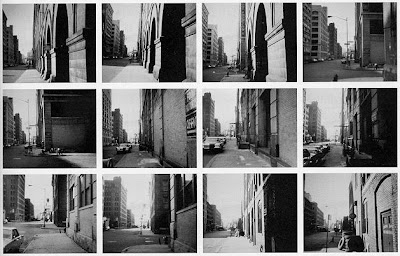
In Acconci’s photo works of the period, it is as if photography in tandem with language acts as a kind of prothesis or extra organ for cellular memory as cellular memory virtualizes movement in space. The artist photographs himself spinning around until he falls to the grass; he walks the streets under the Manhattan Bridge Overpass in Brooklyn taking photos at each street corner; he takes a picture every time he blinks. During the same period, Acconci enacted a series of works whereby his own body became a kind of measuring device or index for the space around him—on city streets, at the beach, in the woods, between art galleries and his home. Is the artist’s body measuring the world—to encompass or territorialize it? Or is the world measuring him—as if to prove the existence of his own body, to ground this body in actual spatial relations and dimensions: “the way a person might talk to himself in the dark”?

What these works record obsessively is negative experience: losses of perception as they echolocate a subject formed by sensory-motor dislocation (now you see it, because you once didn’t). After the fact of Vietnam—the actual bodies abused and mutilated by war on any side; the harrowing journalism as it made legible and accessible images of cultural violence the products of American sovereignty—to “parse” (Acconci’s curious term for his activities of this period) seems to evidence a caesura of the person as a persistence of information about the body in space-time. Physical space and a space of images coconstitutive with one another; physical space, and the image-body, and a blank through which the body in space comes into being.

Other examples overlap from the period. LANGUAGE magazine coeditor, Charles Bernstein’s first chapbook publication is called, *Parsing*, and features a series of language games after the term from computer science and linguistics. There is Madeline Gins’s book, Helen Keller or Arakawa, in which Gins correlates the perceptive dilemmas of the blind and deaf Keller with those of her partner, Arakawa, fusing incidents and musings of the writer/philosopher/probable founder of disability studies and activism with descriptions and reflections on works by the Wittgensteinian painter/sculptor/installation artist/architect. Though the book was written in retrospection of Arawaka’s late 60s and early 70s work, it is interesting Gins’ uses of the term "cleave"—a near synonym of “parse”—to describe the primary act of perception involved in encountering this work as it resembles Keller’s own poetic descriptions of her extraordinary sensory-motor circumstance.

For Keller to act in the world and therefore be “world-forming” or “cleaving,” not unlike Arakawa’s participant-viewer before one of his synaesthetically challenging canvases, installations or architectural objects, is to become necessarily “aesthetic” or “poetic” (where poesis derives from the Greek for the term “craft” and refers to an “active making”). The works of Arakawa/Gins, force their viewer-participant to react by creating conditions which may be said to augment disabilities and impairments latent or virtual in the “abled” so-called. These works intend new capabilities—actions, perceptions, sense awarenesses, ideas, movements—by both disengaging habitual sensory-motor functioning, dramatizing situations of chiasmus (the simultaneous recognition of cognition (what is thought reflectively) and sensibility (what is felt or sensed as an immediate data of the body)), synaesthesia (“seeing out of one’s ears” as Arthur Russell has it), and negative synaesthesia (the “eyes not having heard” of Shakespeare’s Bottom).

[examples from Arakawa’s painting here]


The following is from Robert Kocik’s *Overcoming Fitness*:

Are there glorious states without fitness? Undeserving and elated? Gratuitous and undying? Aren’t vulnerability and hunger advantageous too (Athens became a philosophical power only after losing its navy)?

That’s precisely what blessedness does—it overcomes fitness. The beatitudes, pronounced by Christ in the Sermon on the Mount, brought invaluable symbolic liberation. The democratization of happiness. Woe to the rich for they have already got all they’re ever going to git.

But the beatitudes themselves have only begun to materialize rather recently—applying themselves not to an otherworld or kingdom come but to current socio-economic conditions. Since 1525 when Thomas Muntzer caught cannonballs with his bare hands while leading the Peasant Revolt we’ve been in a period of material beatification. The Last Judgment is for the living.

And this from Kocik’s Rhrurbarb, a prosodic “emergency response” to his mother death:

Because in turmoil, healthy.
Because overextended, healthy.
Because overwrought, unbegun.
* Disservice*: secret name of God.

The following is from an introduction I wrote for Kocik in May of 2007, and presented at Peace On A events series in Manhattan:

While Kocik’s work encourages obsolescence, mis- and dis- use, it also remains entirely useful and generative thru what it can do. Perhaps it is generative in ways similar to disability. For to disable is finally to show how something works by how it doesn’t—it is “knockout” as Kocik puts it; more so, however inadvertently or fortuitously, disability posits the subject at the indiscernible points, the blindspots, where a technology—that which works, or functions all-too-well—has failed to maintain its instrumentality in relation to a user for whom the existence of that technology would otherwise recede in use. A tragic failure to privilege disability I find echoed in Augustine’s lament, which Kocik quotes throughout Overcoming Fitness: "if only they had found a use for the world without using it." To become prosodic body, then, is to occupy those obscure locations, place holders, purchases and pivots where I is not any longer I because it won’t work—so is unmade, inoperative, disabled, and only thus substantiated.

To contrast Robert Kocik’s work here with that of Gins/Arakawa, I believe theirs to be a kind of foil for Robert’s own. Where Gins/Arakawa strategically disequilibrate the sensory-motor coordination and perceptive habits of the “capable” so-called in order to promote eternal ability as “not dying” (Gins/Arakawa’s term), Kocik is more interested in activating ability in the “disabled” so-called, as well as the inverse. He achieves this by means of an elaborate toolbox he has amassed via research in poetics, theology, philosophy, anthroposophy, official medicine, alternative medicine, architecture, dance, biology and design. His recent umbrella term for these tools is prosody. Through prosody Kocik provokes ability—movement, health, thinking, conatus, communication—from a position that presupposes disability as a universal condition of being human or, for that matter, living; that through this condition we can discover advantage and affirm difference. In this way Kocik is a late practical philosopher of overcoming, grace and lightness; like (a certain) Darwin before him, Henri Bergson, Nietzsche and Deleuze, Kocik would have us—apparently human, apparently mortal—capitalize on our “fallen” condition, indeed celebrate it. Recognizing potentia in disability, disability is critical for the achievement of this overcoming. In contrast to Robert’s design practice, thru which he builds structures to practically empower the “disabled” and “abled” alike, Gins/Arakawa’s architectural works appear funhouses of sorts—the manifest fantasies of a wildly generative, however largely metaphoric, conceptual-aesthetic apparatus (all the words, drawings, painting and sculptures which precede the construction of actual architectural structures at the enormous expense of the artists’ benefactors and commissioners).

The following is from Eleni Stecopoulos’ 6/3/08 post, “Response to Disability and Poetics” at the Nonsite Collective website:

“Aesthetics: the improvisation I make of my sensitivity syndrome.” (from _Idiopathic_.) Aesthetics can’t come but from the intelligence of our conditions. All our asymmetrical intelligent bodies. Disability founds aesthetics—-for all persons, not just those with disabilities. If we became conscious of that, perhaps we might start to see how all our conditions determine our forms, how architecture—-physical, social, legislative—-determines all our access. Robert Kocik enters in here: how can architecture, then, treat conditions of inaccess and facilitate aesthetics?

So disability, as Eleni Stecoupolos has put it, is a kind of first aesthetics, where the aesthetic—what is made, what is built or constructed—is the result of conditions of possibility which may derive from limitations, decisions, conditions and determinations indicated by the prefix *dis*. Following Kocik’s intuitions communicated in a private e-mail the other day, that language should now be sufficient to achieve what his architecture and design practices otherwise achieve, disability may also be first poesis—active making in opposition to docility as it manifests in fitness regimes, mechanism, ratiocination, and telic “ablity”—ability where ends justify means.

A problem of discussing or “theorizing” disability, foreseeably, as a lived circumstance linked to the practical realities of specific social struggles—struggles to change the way actual bodies navigate everyday life, for example, or are privileged as subjects and citizens—is that the term would be taken as an indication of lack or insufficiency—that is, as a negation rather than an affirmation of difference. What I realize, when I consider the term disability—both as a political identity and as an ontological formation—is to what extent this term should denote abundance rather than lack. What I believe is consequential in terms of a discourse about disability is the future of consequence itself—ways of proceeding in the world which affirm and activate conditions of possibility, and which make good on opportunities, promises, debts of overcoming.

It is interesting that two “tests” of avant garde poetics in the 70s are, coterminously, Hannah Weiner and Larry Eigner. Whereas Weiner’s abuse of LSD in the late 60s led her to hallucinate text on her own body and in her immediate environment, Eigner’s struggles to write with Cerebral Palsy left their mark in concatenated syntactical patterns, radical uses of line spacing, and of the typewriter as a site of composition. While one may initially be struck by the quotidian content of Eigner’s work, where what appears repeatedly are the words “trees,” “birds,” “windows,” and other common nouns, the real content of the work may be Eigner’s own struggles, physically and psychically, to write. In Eigner’s writing it has rarely been so clear that embodiment—having a body that affects consciousness—cannot be separated from composition, whether as a performance or intention. Likewise, in Weiner’s case, while Weiner’s “clairstyle” (that form of writing by which she gave form to her inner experience of textual hallucination) is obviously shaped by counter-cultural art and literary forms such as Happenings, Intermedia, and New York School poetry, it also clearly originates from bio-chemical transformations in Weiner’s person brought on by LSD use in tandem with her own idiosyncratic thought-experiments, literary performances, and lifestyle choices. As Patrick Durgin has pointed out in conversation with me, these decisions—the choice to become “clairvoyant” and a “silent teacher” (Weiner’s terms for her visionary practice)—introduced difficulties that Weiner lived with until her death in 1997, difficulties which resulted in extreme self-care regimes, as well as the intermittent search for care among her community and friends, if not official medical channels.

A discussion of Weiner, Eigner and other artists of “disability” so-called always risks fetishizing the conditions of their compositions in the interest of making a case or proposing a thesis, and thereby greasing the wheels of literary theory and scholarship. In discussing their work here, I realize I am complicit in this academic tendency. Yet I return to Eigner and Weiner’s writings more or less constantly because they teach me about myself, and principally about writing as it intends the world I live in, and occurs in relation to it. They teach me that what one does on the page or before their materials is never separate from a bodily or psychic circumstance; that, as Robert Creeley refrains in one of his poems, “the plan is the body”. What Eigner and Weiner prove, is the extent to which any one body is always already disabled when they compose; they augment this primal condition, and so I value them—their bodies, their minds affected by their bodies—as they reveal particularities of my own, and possible universals. So, perhaps, any writer or artist who has achieved anything with form, may be said to have worked within disability, or discovered disability as that condition of embodied consciousness which is not a priori, and so intends thinking, vision, understanding, and inquiry without telos.

After an unpublished work by Brenda Iijima, *Remembering Animals*, I have tried to think about Iijima’s use of certain punctuating and diacritical marks in terms of an allegorical dimension of the work. This allegorical dimension has everything to do with how formal choices perform meanings and reflect a reading practice that may be said to be embodied, or intend modes of embodiment through a reading practice. The following is excerpted from a piece on Iijima’s poetics forthcoming in the inaugural issue of the magazine ON, which I coedit. With these excerpts I conclude in the interest of conversation and discussion:

Beyond any procedure or form clearly operative in the work, Iijima’s work moves, and in its movement constitutes an intention beyond descriptive, narrative or propositional qualities of the poem per se. This movement can be discerned in the lines themselves, and line breaks and tabbing in particular, but also in the ways the work has been scored by punctuation and diacritical marks. Throughout Iijima’s work I am struck by her use of parentheses as they delay a reading consciousness, as well as her similar use of bullets in Animate, Inanimate Aims, where these bullets (in succession of twos) function somewhere between a hyphen, ellipses, and periods (because they resemble them). Iijima’s use of these marks remind me that the poem can be a forming space for perception and consciousness. Through them Iijima attends and dramatizes the fact that she and her reader have bodies, are embodied consciousnesses, and that syntax can determine this.

The problem of these punctuation/diacritical marks lead me back to some of the subtler shorter poems of Louis Zukofsky (“Proposition LXI,” for instance, from the series poem, “29 Songs”), as well as Stein’s sparse use of commas, and avoidance of question marks, semi-colons and colons altogether. However I think even more of the ways Leslie Scalapino uses parenthetical marks effectively to create a dialogical consciousness within the poem (reading consciousness delayed in its reading and reflection upon what is being read in different textual intervals and durations) as well as Hannah Weiner’s “interruptive” and “telepathic” texts. These marks are also cleaving as they intend active perception and reflection simultaneously as a singular event of consciousness. I am also reminded of Larry Eigner’s struggles to articulate his unique embodied consciousness through the use of his typewriter, and how the traces of this struggle, a struggle neither merely neural or physical, hinge on certain concatenations of grammar, as well as spacing and recursive dynamics between words, phrases, and sentences (when sentences should occur at all).

In this way Iijima may be said to disable herself, or better yet realize writing as a condition of dis-ability where the intention of the writer is to enable active perception through the page as well as the instrument of writing (in Iijima’s case the computer keyboard of a word processor as well as, I can only imagine, notebooks) mediating this process. While one could say that these marks merely score, I think they do more than score. What they do is site an embodied consciousness coming into being within the world (the page as an intention of the world)—what Madeline Gins calls in her book *Helen Keller or Arakawa* the “forming blank”. Beyond scoring, the marks are what make this conveyance possible between reader and writer, one embodied consciousness circuiting with another. As the consequences of such markings have been little explored in writing, Iijima is brave in her doing so. In this way, I feel like she is advancing little advanced ground for the ways we experience composition as a force potentializing thought’s body, its ever twisting and folding substance.

…[the following passage, from the same piece, concerns the photo-copy before you…]

Several sections from *Remembering Animals* [an unpublished MS by Iijima] are entitled “Cries,” and these “Cries” (the cries of animals? the cries of the poem presenting the cries of animals remembered? the cries of us—humans who are reading and thus mnemotechnical (i.e., remembering animals?)) engage one of the ultimate problems of Iijima’s poetics as it puts an embodied consciousness in relation to political, ethical, social and soul-searching ends. This problem is one of empathy.

When I attended a series of panels about Leslie Scalapino’s work at St. Mark’s Church in October of 2005, organized by Iijima, I remember Iijima discussing Scalapino’s work in terms of neurological research, and mirror neurons in particular. Mirror neurons constitute an activity within the brain activated when one feels empathy. Or, rather, they are what initiate empathic reactions when we recognize the embodied presence of another person: when we see or feel them through cognitive-imaginative contact. In some way, I think the idea of mirror neurons guides Iijima’s own formal practice as she would like her reader to feel something through her work—for others, for animals as an other related to human others, for an ecology felt through these others, for an ecology that is an other (the Other?), for all others to be felt through particular uses of language.

In terms of poetry, mirror neurons “fire” through description and narrative tension, but more so I believe them to take effect through the feeling for words where they intend meaning rather than merely communicate or describe reality. In evoking the struggles of animals in relation to human challenges, Iijima would like us to feel their cries, if not remember them in relation to human ones. The way these cries are felt are through linguistic elements that are under-utilized (and radicalized) by poetic discourse, and yet the stuff of poetry‘s essence: sound, rhythm, movement, prosody, graphology. Once again, the grammatical/diacritical/punctuating elements of Remembering Animals underscore this fact, as double bullets and parentheses … are replaced by multiple dashes (lines) between words, phrases, and other graphic features which shape new habits of reading and encountering language on the page. Like many of Iijima’s idiosyncratic uses of diacritical and punctuating marks these marks allegorize the struggle to reform embodied consciousness. For multiple dashes to cleave textual units between and within lines is to effectively activate a reader’s sense of their embodied consciousness, and thus their responsibility before the page as a site of composition where the stakes of composition are high—an ethical demand.

In the case of the animal body, such bodies are in need of literal reformation and remembrance as they are eviscerated by scientific experiment for causes both humane and inhumane, and historically reified by Western discourses. In the case of the human animal, formally radical writing since the 60s has proven that in the face of empire and the strengthened sovereignty of exchange value the development of new compositional modes and strategies has become central to ways reader and writer are reformed and rendered through composition. After these cultural exigencies, the more “polished” and mannered writing of my generation seems totally outmoded by Iijima’s own insofar as her work abandons received lyric qualities, syntaxes, grammars, prosodies and generic distinctions, eschewing manner and categorization for effectiveness, activity and creative affirmation (joy, blessedness).

Wednesday, August 06, 2008

Some Nonsite Poems

“For every pile there is a pit,
for every pit, there is a pile.

For every heap of architecture,
there is a terrestrial void.”

*

For Lee

A devil’s refusal of the Lord
Makes him mourn all the more

Torturing Job the handle
We have on the negative

Refusing us makes us weep
Gives us ‘new families’

Not the old ones back

Gives us new names
To cross ‘eternity’ with.


Every time we touch
No one should marry

Sweet Balkan blank
That is not despair

Parsing pretends to be
You where you cross-
dress in the dark

When the lights came on
You were a shallow
Link to causes.

*

Becomes a gravity or per force
Becomes a field our feelings do
And the way you pass through it
And the camera there where
We least expect it
‘nature’ has a gaze too ‘the animal’
Has a gaze all its own
And invisible and this is what
Is called ‘spirit’ and this what
Is immanent to the communism
You propose

The camera hovers and it is like
Us seeing how you feel me.

*

Seeing how the law grows
How it buckles under
The logic it imposes

To negate it the way
You have negated it
Is not to deny its powers

Since one stays in relation to it
Now it eclipses everyone
When before it only eclipsed some

The sun was not half as right
Then but now it is right—
Not shining in our names.

*

Using as not using
Singing as not singing
Seeing as not seeing…
--an ‘interruption’,

*

These hands weep for
What they were made for
These lungs and things
You recognize as things

But then there is the unusable
Light in the trees
What se call ‘our’ what we call ‘we’
But is not shared as love

The dredger-ship too
Close to the swimmers--
Enough to imagine disaster

There is the jetty that ends
Before the sun can reach it
The spiral indefinitely
Submerged not a metaphor

For things seen.

*

Fog here
Fog there

Lifting as
Appearance

Also has
A feel to it.

*

For Amber

Your body is the
question you put
to me a green of

‘the soul’ if there
is a soul and
souls have limbs

your body is the
question the
question of further

how we are
lacking organs
those simple things

those not so simple
things that
bodies are when

they broke down
what I thought was me
was born only to

discover through
you that ‘me’ was
a question

put to this world
different then all
the world since all

History begins in
disparity bodies
become the cause.

*

Sight hearing loss.


Loss hearing loss.