Peace On A presents
David Levi Strauss & Kyle Schlesinger
Friday, February 9th 2007 8PM
BYOB & recommended donation: $5
hosted by Thom Donovan at
166 Avenue A, Apartment #2 New York, NY 10009
about the readers:
Kyle Schlesinger is a book artist, poet, editor & founder of Cuneiform Press. Recent artists’ books include *A Book of Closings* and *Moonlighting*. His serial poem *Mantle* (with Thom Donovan) was published by Atticus Finch in 2005, and a forthcoming book of poems will be published by BlazeVox Books in 2007. He currently teaches poetry and typography at SUNY-Buffalo.
Meanwhile prolongs this observation.
Boarding trains this circular morn bet-
ween two points the sky – robin blue and
just for you. Declines night now. Waning
figures cast fishnet sentences. Lines dar-
ting here or there – sequence yourself.
~ from *Moonlighting*
David Levi Strauss is a writer and critic in New York, where his essays and reviews appear regularly in Artforum and Aperture. His collection of essays on photography and politics, *Between the Eyes*, with an introduction by John Berger, was published by Aperture in 2003, and has just been released in an Italian edition by Postmedia. *The Book of 101 Books: Seminal Photography Books of the Twentieth Century*, with catalogue essays by Strauss, was published by P.P.P. Editions and D.A.P. in 2001. *Between Dog & Wolf: Essays on Art & Politics* was published in 1999 by Autonomedia, and *Broken Wings: The Legacy of Landmines* (with photographer Bobby Neel Adams) came out in 1998. His essays have appeared in a number of recent books and monographs on artists such as Leon Golub and Nancy Spero, Martin Puryear, Miguel Rio Branco, Francesca Woodman, Carolee Schneemann, and Alfredo Jaar. He was the founding editor of *ACTS: A Journal of New Writing*(1982-1990), and author of a book of poetry, *Manoeuvres*, before moving from San Francisco to New York in 1993. He has been awarded a Logan grant, three Artspace grants, a Visiting Scholar Research Fellowship from the Center for Creative Photography, a Guggenheim fellowship in 2003-04, and the Infinity Award for writing from the International Center of Photography in 2006. Strauss taught at the Center for Curatorial Studies at Bard College from 2001-05, and is now on the faculties of both the Graduate School of the Arts and the undergraduate studio art program at Bard.
In his introduction to *Between the Eyes*, John Berger wrote, “Strauss, who is a poet and storyteller as well as being a renowned commentator on photography (I reject the designation critic) looks at images very hard . . . and comes face-to-face with the unexplained. Again and again. The unexplained that he encounters has only little to do with the mystery of art and everything to do with the mystery of countless lives being lived.” And Luc Sante wrote, “David Levi Strauss brings an eloquent and deep moral seriousness to his examination of photography. Again and again he makes the ringing point that trying to separate aesthetics and politics can only result in vacuity. He is photography’s troubled conscience.”
Half hope, half fear. Like when people who react against politically committed art say, on the one hand, that such art is pretentious, delusional, and dishonest, since art is powerless to cause real political change; and, on the other hand, that this kind of art is irresponsible and dangerous, since it inflames the passions of the already savage rabble. So which is it, dog or
wolf?
~ from *Between Dog & Wolf*
Peace On A is devoted to emergent work by writers, artists, performers and scholars. Past presenters at Peace on A include Alan Gilbert, E. Tracy Grinnell, Cathy Park Hong, Paolo Javier, Andrew Levy & Eléna Rivera. Scroll down Wild Horses of Fire weblog (whof.blogspot.com) for back advertisements, introductions and reading selections.
Measure a million million
Measure a million to margin
~ Susan Howe
*
Kyle Schlesinger : *Insofar As* a Metapolitics of Sense
*To eat and to be eaten—this is the operational model of bodies, the type of their mixture in depth, their action and passion, and the way in which they coexist with one another. To speak, though, is the movement of the surface, and of ideational attitudes or incorporeal events. What is more serious: to speak of food or to eat words?* (Deleuze 23)
*In which the big wig. In which a new broom sweeps streets. In which from wench I came. In which rain on rain. In which Lucy Lippard’s slippers. In which nouns, calendars. In which the garter belt & the Bible Belt. In which that fine central intelligence (agency). In which major & minor anus. In which height, semaphores. In which loose can-cans. In which Irving & Lydia. In which immiseration. In which union jack-o-lanterns. In which the swans of Okefenokee. In which deer surge. In which youth & consequences.* (Kuenstler 9)
I have known Kyle Schlesinger since 2000 when we both enlisted at Bflo Poetics. In the meantime Kyle has been an incredible friend, colleague, collaborator & confidant. He is also a poet, a valuable scholar and “critic,” and the publisher of many books that have been important to me thru his Cuneiform Press. Some of these books include Gregg Biglieri’s *Sleepy With Democracy*, Craig Dworkin’s *Dure*, and most recently Bill Berkson’s *History and Truth*. Cuneiform is incontestably one of the most necessary “small presses” working in the United States today in its commitment to the printed word, and intellectual facts.
Over the years I have witnessed Schlesinger’s development, his progress if you will, as a poet. This started when he gave me his *Idioics*—a chapbook he put out while still a student at Godard College. His next major publication as a poet—in the meantime he had clocked a review of Raymond Federman’s *Voice in the Closet*, a transcription of a lecture given by Charles Olson at Godard and numerous other scholarly offerings—was the “serial poem” we collaborated on and that was published as a book in 2005 with Michael Cross’ aesthetically heroic Atticus/Finch Press: *Mantle—for George Oppen*. The making of this work, along with an essay on Chris Marker, with Schlesinger brought me into my own as a writer. I am ever grateful for this initiation.
Schlesinger’s contributions to *Mantle* are telling of his commitments as a word-smith, a word “cabinet maker” in the tradition of Charles Reznikoff (who the term is taken after). There are few people I’ve met whose intelligence is so led by a transliterative ear, an ear that hears so many meanings struck together as they are being written or spoken—exposited as such. This comes across in the following lines from *Mantle*:
Speak it.
The libretto is unfit to print
or so we have heard
your hymn in the gallop.
March is the month
of curtains if this must be
If this must
be a comment on atrocity
Pure loss is not imminence
imminence is not patience
Cities come quickly
marooned at low tide
Sanding room only
futurity ensures one
interruption per event. (Donovan/Schlesinger section 20)
In the time since *Mantle*, Kyle has completed numerous works of poetry at a deliberate, if not plodding pace. These works include his “Parallax Letters” (published with Sarah Campbell’s P-Queue journal in 2004), a work where he has worked-over & condensed a series of letters from a correspondence he maintained while traveling in Europe and Eastern Europe. He has also self-published an artists' book called *Moonlighting* whose pages recall the poetics of the critically neglected New York City-based poet, film-artist and punster, Frank Kuenstler—a writer no doubt a kindred spirit to Schlesinger. In *Moonlighting*, and the work after, Schlesinger’s poetics seem fully formed, thus embodied.
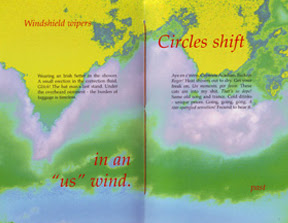
What occurs to me reading *Moonlighting* is the way the designed book coheres with the words—the text. Among the book’s pages are Photoshopped & Illustratored takes on cloud-scapes and other vistas in “psychedelic” color schemes. These colored-scapes form a background to the text as they also blend with it, throwing foreground and background out of whack, giving “depth of field” to depthlessness—no less “deep” surface. The psychedelic makes sense given Schlesinger’s ultimate problem as a poet, at least as I see it: to give experience in all of its details and difficulties over to a “logic of sense,” a problem the poet shares with any number of 60’s artists & counter-culturalists, but also more recently with poets Charles Bernstein, Gregg Biglieri, Louis Cabri, Craig Dworkin & Judith Goldman. Schlesinger’s logic of sense constitutes what I must term a “metapolitics” inasmuch as non-sense in relation to sense is what grounds language as an enterprise ever between the representational and presentative, both above “a politics” and before political realities.
If *Moonlighting* posits a metapolitics of sense, it is also a daybook of felt enjoyments, relations, percepts, thoughts, facts, emotions and other actualities engendered in linguistic grappling. These actualities are conveyed through a propositional syntax at the level of the sentence—telegraphic periods and caesuric dashes. In the end, Schlesinger’s *Moonlightning* may be most like earlier works by Ron Silliman, as Schlesinger would seem to renew the New Sentence for himself, recovering from it a lyric sensibility after LANGUAGE poetry’s unsentimental assaults on lyric poetry’s associations with literary romanticism and representationality.
Chum with a cheshire lining. Living
ink saunters through the couter-coun-
ter thickets in the trickle spot where
brambles never cease. Culture imp-
lied? Its engrained. The fact of your
feelings. To say nothing in as many
words as possible–you call that *poesis*? (from *Moonlighting*)
In the most recent (and unpublished) work, *Insofar as*, Schlesinger wears his metapolitics on his sleeve, taking up Frank Kuenstler’s punstering poetics towards the horrible events of our era: the second Iraq war; unprecedented American imperialisms—Gitmo, Abu-Ghraib; the reactionary from all sides. The words Schlesinger incants—“Insofar as”—as the initial words of each sentence of his poem, bear witness to language’s own complicity and simultaneous resistance to all forms of authoritative, invested address. As Schlesinger mentioned to me when he was starting to write the poem, he was searching Google and realized that politicians across party lines tended to use the phrase “insofar as” far more than almost anyone else on the internet. So to begin each of his own sentences with “Insofar as” is to indict language in its uses and abuses, and to infuse such deployments with a sincere sense of incoherence (non-sense or instability) utterly opposed to political deathtraps, blind alleys—diatribal tyranny & communicative stagnation. What anchors *Insofar as* at the level of language is the pun—what I consider to be Schlesinger’s greatest tool *towards* and *in* thinking. In punning is a logic of sense that evokes what Gilles Deleuze called “points of indiscernibility”—those linguistic, passional and existential thresholds most between what is *actual* and *virtual*, established as reality and potentialized towards new realities. The pun is that which sends a listener (for we of course do not only read language) and reader in as many linguistic directions as possible, that segments and cuts becoming as such like that archetypal cartoon animal torn at a crossroads—its figure literally elasticized. *Insofar as it*...
takes two to Google. Insofar as you're not going to de-
mocratically stop people from wanting. Insofar as “un”
is a salient prefix for the polis. Insofar as this claim is
warranted. Insofar as bipolar bears. Insofar as any psy-
chologically healthy person is able to ignore a
confluence of crossings (x-mas x-ing). Insofar as again
and again. Insofar as the old mannequin penguin pun.
Insofar as the required answer is denied. Insofar as what
we need now are more underproductive members. Inso-
far as they relate to Code Section 6213(a), eh? Insofar as
insofar as a form is necessary? Insofar as China is under-
stood fundamentally as the abstract Other. Insofar as it
elicits militant conviction. Insofar as sounds convincing,
perhaps even professorial, wouldn’t you agree? Insofar
as is caught up in a material transfer of invisible reifica-
tion. Insofar as visceral expectations of the next sentence
are circumscribed by the preposition erotica. Insofar as
the movement moves you. Insofar as my fidelity, twid-
dle-dee-dee. Insofar as I observe the same tensions in
Vertov. Insofar as is. Insofar as was. Insofar as can be. (*Insofar as* 3)
Schlesinger is of a singular intelligence as a writer in that he is someone who actually can not think before he thinks language’s indeterminacy, the infinite directions language takes the mind—that mind which may be made of language itself. Such an event is the beginning of proposition for him—transliteration, homophonics, neologism, paronomasia—as it parses our indiscernible points. What happens after this may be a matter for sense, but is never a matter for sense alone. It is what remains before sense as that which must become political and social, ethically committed, exterior as such in a world of common language experience—language’s being “the case” of anything whose existence could be told. So few people now are working diligently, arduously in fact, at the limit of such a linguistic-experiential mode in our world today with the pressures of “the day”. So few thinking in a language before what becomes expressed as “thought” or “meaning”. I find this tendency of Schlesinger’s mind, his person and will, both daunting, admirable and, most consequentially, generative. I hope this tendency will survive increasing cultural pressures for vulgar communicability, compromised efficacy, “direct-actions” so-called, and results as I value it more than almost any other.
works cited:
Deleuze, Gilles. *The Logic of Sense*.
Donovan, Thom & Schlesinger, Kyle. *Mantle—for George Oppen*. Buffalo: Atticus/Finch Press, 2005.
Kuenstler, Frank. *In Which*. NY: Cairn Editions, 1994.
Schlesinger, Kyle. *Insofar as*. [unpublished].
____*Moonlighting*. Berlin, Germany: Cuneiform Press, 2005.
*

David Levi Strauss : A Poetics of Fact
*In the poem this very lighted room is dark, and the dark alight with love’s intentions. *It* is striving to come into existence in these things, or, all striving to come into existence as It—in this realm of men’s languages a poetry of all poetries, *grand collage*, I name It, having only the immediate event of words to speak for It. In the room we, aware or unaware, are the event of ourselves in It. The Gnostics and magicians claim to know or would know Its real nature, which they believe to be miswritten or cryptically written in the text of the actual world. But Williams is right in his *no ideas but in things*; for It has only the actual universe in which to realize Itself. We ourselves in our actuality, as the poem in its actuality, its thingness, are facts, factors, in which It makes Itself real. Having only these actual words, these actual imaginations that come to us as we work.* (Duncan vii)
*I studied in the Poetics Program from 1980 to 1983, and I realize now that everything I’ve written in the ten years since then has come out of that instruction in poetics: the study of how things are made. Though we concentrated in the Poetics Program on the poem, our investigations (certainly Duncan’s investigations) were not limited to that. As Duncan said, “the seriousness of the study of Poetics we intend is the seriousness of the study of creative events.” I’ve had no trouble extending these principles into the study of photography, film, television, sculpture, paintings, performance, propaganda, ethnography, tattooing and body modification, pranks, drugs, war, and virtual reality.* (Schelling/Waldman 448-449)
The statement just cited, from David Levi Strauss’ essay addressing Robert Duncan’s pedagogy—“The Poetics of Instruction: Robert Duncan Teaching”—pretty well sums up how I understand Strauss’ work: where he is coming from & what he does. Whatever subject he chooses to write about—tho most often art, culture & politics—revolves around a single axis: the axis of Poetics, from the Greek *poesis *meaning “to make”. As a reader of Duncan myself, and student of Poetics, I feel closer to David Levi Strauss than almost anyone “out there” writing about said subjects. Like Stan Brakhage, Hollis Frampton, Susan Howe, Charles Olson, Robert Smithson & Susan Sontag before him Strauss’ concerns are equally those of the artist & ethicist as they are of the “critic” so-called. In fact, in the face of Strauss’ work I propose the critical clarity Strauss brings to his work—like a microscope zooming in so closely that it breaks the glass holding the specimen it would otherwise like to examine, and know—is poetry, and, for that matter, some of the best and most useful poetry currently being produced.
Last week I attended a memorial event for Susan Sontag at the 92nd St. Y where I currently work as an archivist. One of the common ideas running through all of the presenters’ works was that Sontag was ultimately an aphorist. As I consider Srauss to be one of the major figures filling the void that *is* the loss of Sontag—for both our moral consciousness and aesthetic conscience—this got me thinking about a crucial difference between Strauss and Sontag: Strauss does not seem the least bit invested in aphorism. Why is this? My guess is that aphorism—in the lineages of a Nietzcshe, Emily Dickinson or an Emerson—is an aristocratic discourse, an effort, as one of the Sontag presenters put it, to have the last word in a discourse. Strauss eschews the excesses and adventuring of the aphorist for something else: for an unaffected lyricism of fact, citation, proposition & hyper-clear description. Against an aristocratism of the aphorist-essayer Stauss presents a populist, common sense driven project in the most difficult and least vulgar senses of these terms: a gathering around an object, an image, percept or event that in its fidelity to addressing these facts lead a reader outward to common concerns and struggles—the exigencies of social, ethical, political, & moral relation.
Perhaps Strauss is part of a new movement of criticism, a critical poetics that is finally overtaking theory (the need to see, grasp, com-*prehend*, reflect inactively) as well as the tendency in the academy to wax bibliographical (the bread & butter of academic conferences) and the tendency in popular journalism and other culture industries to merely make fashionable— and often turn a buck. I look for this movement in a lot of the “poet-scholars” that have come out of Buffalo Poetics—that latter Poetics program; I also look to it in the scholarship of an Ammiel Alcalay, Craig Dworkin, Alphonso Lingis, Martha Rosler & Jalal Toufic among others. Poets & artists consistently need to take back thinking both from theory, academic frivolities and complacent commerce, and this is exactly what Strauss is doing. What this amounts to is both an ethics and an ecstasis of the factual (and actual) worlds as they are felt, perceived, and inquired after.
works cited:
Duncan, Robert. *Bending the Bow*. New York: New Directions, 1968.
ed. Schelling, Andrew & Waldman, Anne. *Disembodied Poetics: annals of the Jack Kerouac school*. Albuquerque: University of New Mexico Press, 1994.
~
Reading Selections
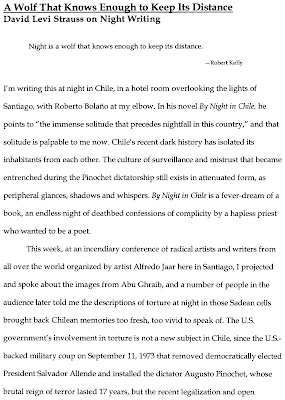
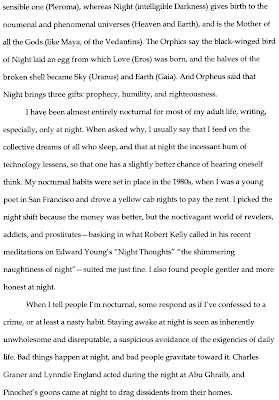
David Levi Strauss:


Kyle Schlesinger: