Monday, October 23, 2006

WJ on Mysticism (Quote)

a la Betsy Bonner...

"But with the memories, concepts, and conational [sic] states, the case is different. Nobody knows exactly how far we are 'marginally' conscious of these at ordinary times, or how far beyond the 'margin' of our present thought trans-marginal consciousness of them may exist. There is at any rate no definite bound set between what is central and what is marginal in consciousness, and the margin itself has no definite bound *a parte foris*. It is like the field of vision, which the slightest movement of the eye will extend, revealing objects that always stood there to be known. My hypothesis is that a movement of the threshhold downwards will similarly bring a mass of subconscious memories, conceptions, emotional feelings, and perception of relation, etc. into view all at once; and that if this enlargement of the nimbus that surrounds the sensational present is vast enough, while no one of the items it contains attracts our attention singly, we shall have the conditions fulfilled for a kind of consciousness in all essential respects like that termed mystical....

In each of the three cases, the experience broke in abruptly upon a perfectly commonplace situation and lasted perhaps less than two minutes. In one instance I was engaged in conversation, but I doubt whether the interlocuter noticed my abstraction. What happened each time was that I seemed all at once to be reminded of a past experience; and this reminiscence, ere I could conceive or name it distinctly, developed into something further that belonged with it, this in turn into something further still, and so on, until the process faded out, leaving me amazed at the sudden vision of increasing ranges of distant fact of which I could give no articulate account. The mode of consciousness was perceptual, not conceptual--the field expanding so fast that there seemed no time for conception or identification to get in its work. There was a strongly exciting sense that my knowledge of past (or present?) reality was enlarging pulse by pulse, but so rapidly that my intellectual process could not keep up the pace. The *content* was thus entirely lost to retrospection--it sank into the limbo into which dreams vanish as we gradually awake. The feeling--I won't call it belief--that I had had a sudden *opening*, had seen through a window, as it were, distant realities that incomprehensibly belonged with my own life, was so acute that I can not shake it off to-day."

from William James' "A Suggestion About Mysticism"

Sunday, October 22, 2006

True Crop


for Ed Ruscha,
literally hallucinating

The point was
this floating
lacustrine feeling
surrounded by
the sea

meaning what you say
letters stray
these letters how much
information would
you like

how much would it take
to cover the world
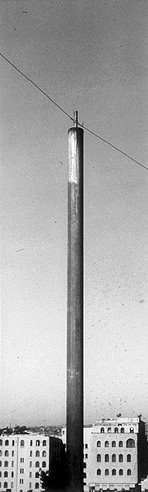
a simple lamp hangs
a very simple lamp
we mistake

this lamp for another
floating object
this is a copy of the world
minus a few aspects
which no longer count.

*

TOTAL
WAR

Excelsior
DIVISION

PURE SPIRITS
COVER THE
WORLD

from the air

*

With all percepts

Who gets to be an artist what gets to be art

In the sun perchance

All the stations

A flight from stations intent on record

Containing everything

But the sun covering the sun in evidence.

*

"like a speech delivered on no matter"


"with all kinds of delays"

*

Here's a photo
Of a car and here's
A photo of a photo

Of a car and here's
A drawing of that photo
Of the car now where's

The car?

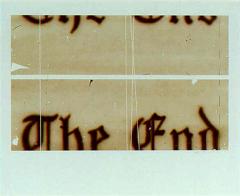
THE END

Saturday, October 21, 2006

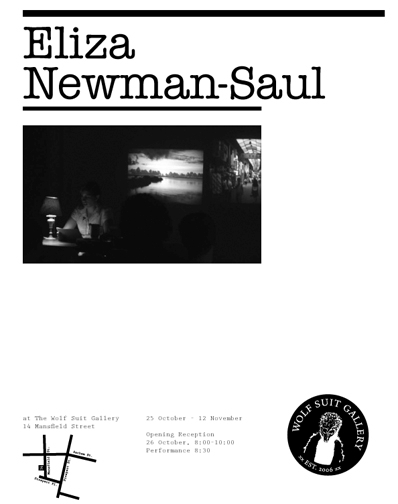
October 25th at Wolf Suit Gallery, New Haven (Yale)

3 Revisions


Next Breath Best Breath
--for Arthur Russell

Your dreams come near to you
For the child distinguishes
Between inside outside clouds

Arguments like music we are here
Things can't help happening where
There was something was something

Proceeding to parse your brow
Your bow given to Bach the lyric
Must return nearer than thought.

*

To Edvard Munch

Scratch out all but her literal whisper
The kerchief blood to paint blood paint
To erase all face her hands all details

What life corrupts to erase the literal paint
Scratch out or cover the details evoke the literal
Death her then then process reverses.

*

Eruv I.

"Make peace not love."
--Amos Oz

The spirit of this converted private is not an inside abstract
It is the key of keys for mutual dwelling a mobility of ritual to discover
In potentia is to discover again ourselves lifting what must be
Transportable as string a version of commons shifting the signs
Grew out of graffiti heart to bright beams making a bubble
An effect of needing an inside outside outside to be a call to floating
Contracts towards mobile peace the place of this converted public.

Friday, October 20, 2006

Non-Site

The word defined “to see around” design
a premise control
people with few people
the ubiquity in all
self control containment isn’t this a technology it is
Easy Pass porn cookies GPS PS
what is moral
what is a moral compass

split sovereign my enemy my self my friend
space (vanishing
points) space (chaos) coercion (dungeon)
consent (imaginary)
“A real subjection is born from a ficticious relation”
interlocucter egged on
thinking in the dark thicket Prefect can’t see rivalry

continue to pass the ball paradigm unalarmed
hypnosis what is power power is given
by stupid smart knowledge
advantage of relation
a crit
can you think ways this image can be given to a politics what are some
images the revelation
of one’s making strikes art dumb

auratic character an atmosphere
art is an abstract cave viewed negatively in the distance
magic lends itself
to analysis positive because it expands sacred uniqueness
innovation a mixed
sense of loyalty in magic
out of books intimacy loss of intimacy

you can never cross the same reproduction twice
the politics
of chant every image
arrives
surrounded by print
Control Room craving blood reinforce exclusion
contexts clash Time Inc. Toyota || Iwo Jima
after the Towers fell
the media let half the call get thru.

Lyrical Template (Non-Site)

"O where ha you been, Lord Randal, my son?
And where ha you been, my handsome young man?"
"I ha been at the greenwood; mother, mak my bed soon,
For I'm wearied wi hunting, and fain wad lie down."
"An wha met ye there, Lord Randal, my son?
And wha met ye there, my handsome young man?"
"O I met wi my true-love; mother, mak my bed soon,
For I'm wearied wi huntin, and fain wad lie down."
"And what did she give you, Lord Randal, My son?
And wha did she give you, my handsome young man?"
"Eels fried in a pan; mother, mak my bed soon,
For I'm wearied wi huntin, and fein wad lie down."
"And what gat your leavins, Lord Randal my son?
And wha gat your leavins, my handsome young man?"
"My hawks and my hounds; mother, mak my bed soon,
For I'm wearied wi huntin, and fein wad lie down."
"And what becam of them, Lord Randal, my son?
And what becam of them, my handsome young man?"
"They stretched their legs out and died; mother mak my bed soon,
For I'm wearied wi huntin, and fain wad lie down."
"O I fear you are poisoned, Lord Randal, my son!
I fear you are poisoned, my handsome young man!"
"O yes, I am poisoned; mother, mak my bed soon,
For I'm sick at the heart, and fain wad lie down."
"What d'ye leave to your mother, Lord Randal, my son?
What d'ye leave to your mother, my handsome young man?"
"Four and twenty milk kye; mother, mak my bed soon,
For I'm sick at the heart, and I fain wad lie down."
"What d'ye leave to your sister, Lord Randal, my son?
What d'ye leave to your sister, my handsome young man?"
"My gold and my silver; mother mak my bed soon,
For I'm sick at the heart, an I fain wad lie down."
"What d'ye leave to your brother, Lord Randal, my son?
What d'ye leave to your brother, my handsome young man?"
"My houses and my lands; mother, mak my bed soon,
For I'm sick at the heart, and I fain wad lie down."
"What d'ye leave to your true-love, Lord Randal, my son?
What d'ye leave to your true-love, my handsome young man?"
"I leave her hell and fire; mother mak my bed soon,
For I'm sick at the heart, and I fain wad lie down."

Tuesday, October 17, 2006

David Gatten at The Poetry Project


Last night David Gatten joined a cast of readers at St. Mark's Church to give a group reading of Fernando Pessoa's poem, "Maritime Ode". He also showed his recently completed films *What the Water Said* and *Shrimp Boat Log*.

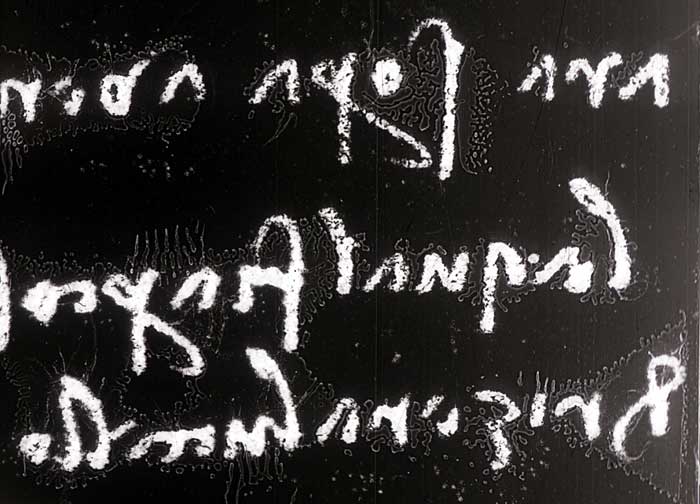
*What the Water Said No.'s 4 & 5* presents a log (of sorts) of film stock as "treated" (i.e. battered, crumpled, and punctured) by the Atlantic Ocean, off the coast of the Carolinas. While others have made similar treatments before, Gatten's seems unique in its inclusion of soundtrack--which snaps, crackles, pops and even bangs--as well as his dating of the film as if the film were the Ocean's log-book or diary itself--what the water said being conveyed by the marks left on the soundtrack of the projected film stock.

If *What the Water Said* is a clever literalizing play off one of T.S. Eliot's sub-titles to "The Wasteland," *Shrimp Boat Log* is intriguing for its signalling or blinking form, the intermittances of various footage including shrimp boats crossing the center of the screen and leaving wakes, and brief glances at a log book. Like a less spastic version of Brakhage's lapsing-blinking camera, Gatten's camera and editing technique in *Shrimp Boat Log* give visual rhythm and form to coastal life--a native feeling for signals both perceptive and cultural, organic and technological. As in his nine-part *Secret History of the Dividing Line*, I also find Gatten's *Shrimp Boat Log* compelling in the way it gives particular shape to a viewer's reading experience--where often the viewer has mere seconds, if that, to read from a log, and so reads a few words at each viewing interval.