Sunday, October 08, 2006

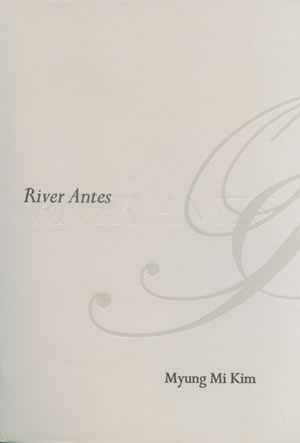
Myung Mi Kim's *River Antes* (Review)


I have long wanted to address the work of Myung Mi Kim, whom I have been reading with delight and devoted interest for over a decade now. Her most recent work with Michael Cross' B-flo based Atticus / Finch Press provides me with an opportunity, albeit brief....

When a section from *River Antes* appeared in Cross Cultural Poetics a couple years ago, what struck me immediately about Kim's new work was not a syntactical or lyrical innovation-- a significant change in the language or content of the work per se-- but the unprecedented and abundant use of two punctuating marks: the double slash ("//"), as well as a mark I'm not sure the proper name of, but which appears as a kind of partition or staff: "|".

As early as Kim's book, *Under Flag*, and throughout her more recent books, *Dura* and *Commons*, the poet has struggled to express language as a time-inhering and shaping material. The ways she has successfully achieved this are quite various, if not innumerable. For starters, Kim expresses durational meaning through a singular use of the space of the page where the reader finds ample tabs and spacings between words: the poet also does so through grammars which stress the palpability of word tenses, and deictical words (words indicative of time, place, and subject); by using inchoate words, phonemes and morphemes, and illegibility to enact states of language both of acquisition (learning to speak a language) and the post-semantic; and in her extensive use of notebooks, where Kim continualy accretes materials for her composition process.

Although Kim has employed punctuating marks before in unconventional and often diacritical ways, I am interested in how significantly punctuation marks seem to factor in *River Antes* and shape the book's meaning. While I am sure that the "|" and double "|" marks delay a reading process-- that is, delay the eye as it reads and processes--I wonder if there is not a deeper import at stake in the use of the marks. Do they mark, for instance, an ontological rupture--difference, trauma? Are they marks of dis-*aster*--the disconstellating of stars, and thus fate and time? I take this to be a possible meaning of the mark in the following from *RA*:

[conjugate]

A dependent's call
A dependent cries out

A || marvel perceive

Two pages later, the mark sounds a very different sense to me as it seems to perform another kind of lapse: the time-lapse of a cinematic or photographic process as it reveals a social-biological one--the consumption of corn-on-the-cob:

corn | corncob

Kim's scoring is especially meaningful as corn is transformed suddenly into its waste product (corncob) through the phantom objectivity* of the jump-cutting mark. Elsewhere the marks "|" and "||" seem to act as partitions cleaving highly discrete, anti-grammatical word sequences. Are these partitioning marks in fact mirrors?


The mark acts here as a kind of visual and aural rest, if not also the transferential surface of an abandoned dialectics--"spar wanton drear dear forbid" obscuring "hold facing simple adore one"; and "rights tie wallow heaving cause" not having a reflection at all (thereby nothing to be (mis-)identified by unless by absentee itself?).

In *RA* I am also struck by how Kim's concern for duration *qua* articulation (articulation of economic, racial and gender-based oppressions; articulation of "natural" and cultural forces; articulation of the interpollated and language-bearing self undergoing world) is given possibly its most creative book form to date. Through the poet's collaboration with her publisher, Michael Cross, the two have arrived at a form that not only treats Kim's hard-earned words elegantly (as all of her books to date have done), but that may possibly further the poet's project in book form.

Such an innovation becomes most clear in the pages of *RA* that fold out to three separate pages. In these fold-out "triptychs" there is a terrific sense of simultaneity as one scans all three "panels" at once, taking in the diversity of Kim's exquisite word scores and shapes. Among these pages are a variety of forms: on four of the pages the type is centered; on four others discrete words with spaces between them are divided by the mark "||" [as in the above]. On a page I find particularly stunning, Kim has arranged words that have been made partially illegible through photo-copy. In the center panel of my favorite of the five fold-outs the mark "|" and slash marks cascade down the page interrupted by periods and limited spacing, as if the punctuation marks from the book had conspired to form a Concrete poem. In this condensation of markings Kim provides a playful reminder of her ongoing preoccupation as a poet: to relate language itself as a time-based, and thus socially informed, process.

*"phantom objectivity" is a term used by Georg Lukacs to indicate a circumstance in which producer and produced are no longer related in a process, that are, therefore, abstract in their reification.

Wars I have not seen (Piece)

On my screen of kills
I can't remember

The precision bombs of September
Or was it January

1991 when
Global hegemonic strategy

Swept reality
Bricks turned to glimmering coins

While mushrooms metonymically
Displaced the body count

Repressing a distant present
Of slaughter

To Themiscyra

"Penthesilea: Son of the Neriad!
You will not follow me to Themiscyra?
You will not follow me to that fair temple
That rises tall among the oaks?
Come here, I haven't told you everything..."*

What marble
Eyes cry
True tears
For stone

Heart's mind
Whips legions
From lips
Their tears

For you
Unsubstitutable
Will we meet
At my temple

Or yours
Penthesilea
Resurrected
In bed

Your hand
Was my thigh
Heart's eye
Evens the score.

Come here
You haven't
Told me
Everything come

Here to
Themiscyra you
Haven't told
Me everything

My precious
Friend I
Haven't told
You everything

To Themiscyra
We go
My precious
Friend I

Haven't told
You everything
I haven't
Told you

Everything for
My temple
For my
Temple for

The sake
Of all
Homelands
I haven't

Told you
Of our
Legions slaying
Identity

My precious
Friend another
Temple rises
Even taller.

*from Kleist's *Penthesilea*, trans. Joel Agee.

Monday, October 02, 2006

Peace On A presents E. Tracy Grinnell & Andrew Levy


Peace On A

presents

E. Tracy Grinnell & Andrew Levy

Saturday, September 30th 2006 8PM sharp

hosted by Thom Donovan at:

166 Avenue A, Apartment #2
New York, NY 10009

about the readers:

E. Tracy Grinnell is the author of the chapbook Harmonics (Melodeon Poetry Systems, 2000), Music or Forgetting (O Books 2001), Of the Frame (Duration Press ebook, 2004), Some Clear Souvenir (O Books, 2006), and Quadriga, a collaborative work with Paul Foster Johnson (g o n g chapbooks, 2006). She lives in New York and edits Litmus Press and the journal Aufgabe.

Andrew Levy teaches in the English Department at QCC-CUNY, serving as Faculty Advisor for the student newspaper, Communiqué. He is the author of ten books of poetry, including Ashoka (Zasterle Books), Paper Head Last Lyrics (Roof Books), Curve 2 (Potes & Poets Press), Values Chauffeur You (O Books), and Democracy Assemblages (Innerer Klang). New titles are forthcoming from Factory School, and Innerer Klang. His newest manuscript is Don't Forget to Breathe. He is editor, with Roberto Harrison, of the poetry journal Crayon.

about the series:

Peace On A is an events series devoted to emergent work by writers, artists, and performers.

“Make peace not love.”--Amos Oz

*

Intros:

“how real or imagined it was real”: E. Tracy Grinnell

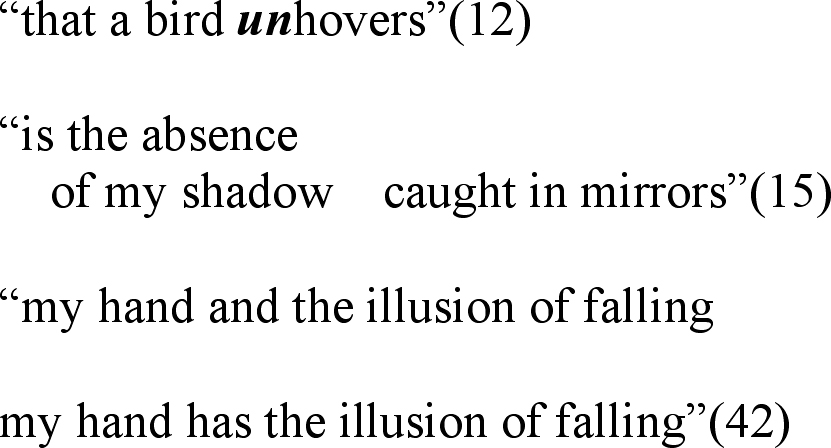
In its persistent movement between “clip” and “example,” E. Tracy Grinnell's *Some Clear Souvenir* enacts actuality as it is composed doubly by memory and perception in discrete historical self-experience. Language is a cinematic rack focus whereby the poem alternates between objects in the foreground and the back, memory and immediate data of consciousness, percept and essence. A forming blank* resides between two focal points: perceiving one’s self in the mirror (as one holds up a camera to take a snapshot?) and recognizing the reproduced photogram in the mirror’s frame—the news clipping which wrests a particular instance in space-time. Present perception struggles to cognize concomitantly the photogram affixed in the mirror (and thus also the mirror as exterior frame for perception) and a self involved in a consciousness of its perceptions. The poet/reader inhabits less a pre-subjective “mirror stage” than the point where virtuality and actuality haunt one another in clairvoyance (i.e., clear seeing):

“of four hands or disembodied

motivation that is external

to motion so that one haunts

or is haunted by the actual world”(10)

In Grinnell’s work the quest of a poetics is ultimately the question of actuality’s forms. I am reminded of George Oppen’s late-work—that poet of the “small words”—where space opens both in the poem’s horizon (at the level of line, and between words and phrases within individual lines) and the poem’s vertical axis (between lines and pages) to present thinking as it occurs in language. I am also reminded of poets as diverse as Larry Eigner, Madeline Gins, Robert Grenier, Jessica Grim, Lyn Hejinian, Leslie Scalapino, and Hannah Weiner—who have managed to push poetic technique to the point of a practical and lived phenomenology. A marriage of quotidian revealing and ontological rigor.

To get to the chiasmus of world and self through the shared third-party Experience, sensation turns not inside-out but upon the indiscernible points where one touches the world and both feels themself touching and being touched, acting and knowing itself in action:

Poetry approaches the limits of interiority where subject and object, interior and exterior, here and there are constituted in the intense lapses of prepositions, conjunctions, articles and other relating words towards the abstract injunctions of grammatical becoming: “newsprint grey / of everything / changes everything”(47). Thought-sensation is formed where the writer touches and is touched, where words risk tautological coevalness. By the play of more and less formal elemental intentions appearing to unfold and unfolding to disappear, Grinnell maintains the mobility of perceptions, sensations, ideas, and memory shards where one might otherwise “see” prehensively, foreclosing the open. Beyond theory *per se* and literary mannerism are lived words the located remnants of actualities, desires, potentia. Where experience touches experience “these locations are history”(65). When words evidence lived duration “rupture is / rapture”(8).

*”forming blank” is a term invented by Madeline Gins and Arakawa.

*

“No ideas but in effects”*: Andrew Levy

“Out of all the stream of human life
And action

Implicated
Scattered
Intensified
Sovereign”(51)

If Andrew Levy’s newest manuscript, *Don’t Forget to Breathe*, seems a clear continuation of the poet’s work—which for the last 15 years has yielded some of the most rigorous poems of “language effects” and tactical (dis)informing—the manuscript also seems a crisis point for Levy’s poetics. I have no doubt that this crisis stems from 6 years of the Bush administration, which has—as Donald Rumsfeld’s infamously mystifying addresses have gone to show—developed an effective poetics of rhetorical abstraction towards the end of Noble Lying: the rule of the hep (if not wise) through calculated dissimulation, disinformation, and distraction.

Reading Eliot Weinberger’s 2005 *What Happened Here*—a must-read chronicle of the W years—one encounters one of the most baldly stated and chilling statements of the Bush doctrine of Noble Lying: "An unnamed ‘senior advisor’ to Bush recently told the journalist Ron Suskind that people like Suskind were members of ‘what we call the reality-based community’: those who ‘believe that solutions emerge from [the] judicious study of discernible reality.’ However, he explained, ‘That’s not the way the world really works anymore. We’re an empire now, and when we act, we create our own reality… we’ll act again, creating other new realities, which you can study too, and that’s how things will sort out. We’re history’s actors, and you, all of you, will be left to just study what we do.’”

Against the actors of “history” so-called and of empire for real, Levy accretes remixes of subject position, address, information, affect, and fact to effect thought and action among his community: reality-based readers, writers, artists, students, family and friends who would work to alter the course of history by halting the current political, social and economic travesties of the United States. To do the voices, in Levy’s case, means butting a multiplicity of voices truthful and false, imagined and real, reasonable and justifiably hysterical against one another in order to reopen the question of how the real is arranged and inscribed. As apocalypse is of the hour in a global cultural imagination, and hope a scarce commodity, I can think of no more responsible way to be conducting one’s self as an artist at this point in history. To intend a new ordering for reflection; to attend a language as much of tactical abjection (proto-Flarf) as felt necessity is not to further suspend reality—to give in to the fantastic, sentimental and anti-intellectual as too much recent writing and art has done—so much as to hoist by their own petards those who would abuse it to gain and maintain power.

*quoted from *Paper Head Last Lyrics*

*

Don’t Forget to Breathe

There is always the danger
The facts will fall and part


Repeat what cannot be altered
Infinite and misunderstood


If I were the pronunciation of my name
The miseries of human life, tension of nothing
The softening of its existence, of yours
Arrested through mute consonants
Omniscient flood distributing a cultivated
Fragrance able to be fairly complementary
Or vernacular or made less arbitrary
In this undefinable sweetness

It says to me – it is you who incorporate
Domestications committed atrocities
Doctrines of isolation, the perfect boring
Controls of irresistible onslaught and slaughter
Betray continuity and visions of speckled fish
Calm and judicious views that housed
All of nature qua cultural whims given and
Completed – it is you who’s dead

The perfect boring salutary onslaught
Tension of consonants uncultured but cluttered
Complementary arbitration


Continuity housed it is you
The miseries softened flood it is you
Who misunderstood it is you
In this indefinable mumbo jumbo
This yodeling humor

This tasty loyalty?
This secret and secreted polis?


This innocent yet compelling
Permanence

--Andrew Levy