Monday, May 15, 2006


Fictions of Surveillance

For Harun Farocki
I.
If a tree falls
and the only witness
is the image
of the tree…
If the image
itself is rootless
where fantasy doubles
and emerges…
II.
Disaster mark
The lip of mouths unseen
Shed not light but shed
Light ideally
In idols the trains of doing
And the trains of fate, the trains of not
Doing, that the little oar blade
Is there, and there in the
Big wake
Of time that is us, we are the question
What the mouth discovers and
The eyes cover, what the veils eye
This distance our blade knife
Blade night
What occasional claims in idols
Occident and gas shed
Not light but shed
Visions a glass to stimulate
Flight simulator of proven movements
War exercises are practical truths
Perspective doesn’t complain
Of camouflage and the false
Cross red
Illusions of truer
Trees house gods men
See from space nightmarish
Project measuring man
To man.
III.
If a tree falls or night
Falls on eyes shades
Dark shades a wake falls awake
If a tree falls like the
Solipsist’s body a common
Sense that each picture pictures
If we sing ourselves we must
Sing of other men this too
Must be a picture
What light breaking into song...
IV.
Not on
my life
the cross
is born
of night
and night
not dark
separated
by a whim
of creation
an image
after
ascension
descending
V.
For the eyes too are products of light
Made of beams if you will
And human beings a research into
The sound of waves the wood pushing
A lapping furthermore and whereof
One image arrives without explanation
And another its shadow, and sanest
Words the shadowless discovering
Of veils and veils for veils sans eyes
A cropped mouth identifying the police
VI.
This too the world’s invention
This inversion, this Roman pack
This peace without peace.
Images outnumbering the soldiers
Bodies outnumbering measure
Photographs outnumbering the real.
VII.
Burnt as eyes withdraw from eyes
Sense grace withdrawing
Eyes from eyes graves burnt
As eyes withdraw from eyes
Sense grace withdrawing
Eyes from eyes graves

Sunday, May 14, 2006
Abby Walton's "Cook Book" (Blurb)*
This little book, a book without a title and comprised “merely” of 30 digital reproductions of Polaroid photographs taken of table settings, embodies much of what I find beautiful and important about Abby Walton’s art: an art of true grace, of daily devotions and meditations, and of an insistent practice of what, for lack of better term, I must call an “art of living.” Insofar as each Polaroid is wrest from the context of a familiar dinner gathering or elaborate party, together they are a document of a total care for the daily and a reminder of the ever-kindled hearth. That a commons should be beautiful, attended, loved. And in this last sense especially, the Polaroids and the book containing them are essential. Not a fashion-shoot for food, but indicative of a life that may be worth living.
*The "Cook Book" can be purchased at Printed Matter, NYC: http://printedmatter.org/catalogue.
Peace on A presents: Alan Gilbert & Cathy Park Hong (Events Series)*
“A divergence without combat, or a peace with neither conquered or conquerors.”
--Emmanuel Levinas
*Peace On A* series
presents
Alan Gilbert & Cathy Park Hong
Friday May 12th, 8PM
hosted by Thom Donovan at
166 Avenue A, Apartment #2
New York, NY 10009
Alan Gilbert’s poems have appeared in various magazines and journals including The Baffler, Chicago Review, and First Intensity; in the anthology *Free Radicals: American Poets Before Their First Books*; and online at The Poetry Project website. His writings on poetry, art, culture, and politics have appeared in publications such as Artforum, Bomb, The Village Voice, Time Out New York, and the website Jacket. A collection of critical writings entitled *Another Future: Poetry and Art in a Postmodern Twilight* was recently published by Wesleyan University Press. He has a Ph.D. in English literature from the University at Buffalo, and has worked as an art editor for the New York Foundation for the Arts and the College Art Association. He lives in Greenpoint, Brooklyn.
Cathy Hong’s *Translating Mo'um* was published in 2002. Her second book, *Dance Dance Revolution*, has been chosen for the Barnard New Women's Poetry Series and will be published by WW Norton in 2007. She is the recipient of NEA and NYFA grants, and spent last year in South Korea on a Fulbright Grant. Her poems have appeared in Volt, Denver Quarterly, Chain, American Letters, Commentary, and other journals. Currently, she lives in New York City, splitting time teaching at Eugene Lang college and working as a freelance journalist.
Peace On A intends an events series for work by emergent writers, artists, performers and scholars.
for inquiries and feedback please write:
thom_donovan@yahoo.com
Introductions
Alan Gilbert:
*Form is never more than an extension of culture*. So goes Alan Gilbert’s telling play on Robert Creeley and Charles Olson’s famous proclamation: *Form is never more than an extension of content*. Reading Gilbert’s *Another Future: poetry and art in a postmodern twilight* the past few weeks has made me more hopeful about the future of poetry and art criticism in general, and proved to me that this future is far from foreclosed or prescribed. Perhaps the most sizeable aporia Gilbert has found his way out of with grace and reasonability through his collection of essays, addresses, and scholarly meditations is that after Language Writing -- what may remain the single most important literary generation prceding Gilbert’s and my own. If Language has made a thorough, if not effective, assault on linguistic representation what is left having faced this central dillemma? Beyond polysemy, transcendentalist "active reader" theories, beyond an ecstasy of (non-)communication Gilbert returns us to various sense-makings of context, history, agency, discourse, cultural and economic analysis too often lost in the projects of many writers associated with Language -- projects Gilbert has sited as self-assured in their "assured sense[s] of not making sense." If not making sense alone will not suffice for another future what will? For Gilbert we have acts of witness and a recuperation of the subject, however abject, in Benjamin Friedlander’s verse; we have micro-historical emergencies in the post-Olsonian work of G.S. Giscombe, Susan Howe, and Mark Nowak; we have an original way of writing history through a poetics of archivalism by way of Ed Sanders’ verse experiments. The list of important names, works of art, and ideas Gilbert has redirected our attention goes on… I look forward to listening to him read tonight to hear how his critical work translates into that other praxis: poetry.
Cathy Park Hong:
Part ethnography, part philological science fiction, largely a tour de force of witz… Cathy Park Hong’s forthcoming *Dance Dance Revolution*, from which I hope she will read tonight, imagines a future or ”alternative universe” through the soliloquies of a tour guide whose *lingua franca* encompasses Korean, German, West Indian, “Spanglish,” “Black English” and the English of Geoffrey Chaucer – the problems of whose work perhaps most resemble Park Hong’s own, however across the centuries. To read the work aloud, which I have had the pleasure of doing the past few months, is to sound what I believe Robert Duncan called “muthos” (of course punning on myth and mouth), and Nathaniel Mackey after Duncan language’s “discrepant engagement". In such engagements, it is language itself -- language as a multiplicitous expression of cultural desire -- which is ultimate master over the speaker/author. The singular voice we hear in *Dance Dance Revolution*, beyond Park Hong’s capacious imagination, is a voice of present necessity as cultural confluences and conflict become articulate in an uncanny glossolalia ventriloquizing us –- the reader! -- to make us mouthpieces for histories micro and macro, disastrous and joyful, wondrous and all-too-familiar. If the language of *Dance Dance Revolution* also risks hyper-codification or an elaborate language game it does so in a spirit of experiment and inquiry which can only benefit its eventual readers and critics, not to mention a larger poetic discourse addressing cultural forces at large.
--Thom Donovan
DIGITAL CAUSEWAY
Every window contains
the memory of a body
seen through it,
along with a shadow that momentarily
erases its reflection,
because there are no
universal symbols,
such as sun and moon,
or loving the landlubbers,
and it’s hard not to take pleasure
in witnessing authority disgraced,
even if we internalize punishment
long before doing
anything wrong,
or are fearful of loss
and lacquer everything
with an opaque coat,
then tie it all down
as if it were a portable shelter
that might blow
from its rocky ledge
in the middle of the night,
which is why “sometimes”
is as close as it gets to “absolute.”
And so I’m not nostalgic
for Jimmy Carter;
I’m not nostalgic
for TV dinners
while watching allegories
unravel over a lifetime
in a staggered parabola,
asking: “Where’s mama?”
“Where’s papa?”
since there’s not just one
language to contest,
and the word “poetry”
is the lightest of beach balls
and the heaviest of boulders;
it’s running a standing start mile
with hurdles, high jump,
and a whole floor routine thrown in.
Therefore, I don’t mind
if you go ahead and shrug
your shoulders and smile
in that endearing way;
for a while I was addicted
to no longer being lonely;
in other words, I knew then
what I don’t know now:
Wings separate from the bodies
of most creatures,
and I’m burnt at the root
picking one small blueberry
staining the teeth scraping
the inside of a bowl,
similar to filling empty boxes
with more empty boxes
—all ones and zeroes—
and then pretending
it got lost in the mail.
--Alan Gilbert
1. Services
See radish turrets stuck wit tumor lights around de hotel
like glassblown Russki kestle wit’out Pinko plight,
only Epsolute voodka fountains. Gaggle for drink?
Twenty rooboolas, kesh only . Step up y molest
Hammer y chicklets studded in ruby y seppire almost
bling badda bling. Question? No question! Prick ear.
Coroner diagnose hotel as king of hotels ‘cos
luxury es eberyting. Hear da sound speaker sing ‘I get laid in
me Escalade/but I first sip gless of Crystal/den I whip out me pistol.’
No worry. No pistol in hotel, only best surgeon feesh y beluga
bedtime special. Deelicious. But before you tuck in king o’
water bed, befo you watch papa-view,
Be peripatetic y see snow bears merry on a ball or go
Be roused by molten sauna where Babushkas bap your tush
wit boar bristle switch. No childs allowed here. Mo mo?
De blood rust hes been Windexed to amber shine,
de insurrecta's marauding soul wetted into papa-machetes,
de looted radio back in de propa municipal hands.
Here be city of ebening calm, da fire-rilers gone.
If you want true heestory, go watch tailor
maki magic. He more revolutionary den artist.
If you dream only for Paris, dat is right outside de
atrium, beyond de sand dunes, which form y disappear
like mekkinations of human digestion. Sand swirl
to otherworld land where blankets da weight of human
bodies tatter y pill. No tatting, no pilling here. Da sand will
be in your eye, only sometime.
--Cathy Park Hong
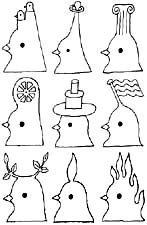
* The above image is a detail from Anton Van Dalen's *81 Birds*.
Friday, May 12, 2006
Poesis (Splitting)*
Restore form for the undead hover craft
Light is a fullness of exposure
Photography ensures a future for these words names
Remain in light drift to icy lines distant
Crystallize for all time a demolished name Niagra
Fight art with art unseen time is this other
This other of unfolding experience relation the fullness of exposure
Split the house and lift this unworked town craft like water falling unfailingly light
This is a magic of interruption
The crystal incompossibilty of all structure
A politics powers factor
The fullness of exposure
*composed Spring '05. Forthcoming in P-Queue.
Light is a fullness of exposure
Photography ensures a future for these words names
Remain in light drift to icy lines distant
Crystallize for all time a demolished name Niagra
Fight art with art unseen time is this other
This other of unfolding experience relation the fullness of exposure
Split the house and lift this unworked town craft like water falling unfailingly light
This is a magic of interruption
The crystal incompossibilty of all structure
A politics powers factor
The fullness of exposure
*composed Spring '05. Forthcoming in P-Queue.
Towards Exterior (Splitting)*

to Gordon Hadfield
TO H OVER
F OUR CORNERS CAP
A PAST OF HOUSING
SPL AY SP Y THE D I FFERENCE
DWELLING I N
W IN DOWS EYEBEAMS
EACH TO ITS D I VERGENCE
THIS GL I MPSE SUDDENLY
FULL OF US
TO HOVER SPL I T
F ILL US WITH THE WORLD
AGAIN TO MATTER
AGAIN ON THE MAKE
TO RAT TLE SPACE
A RESTING PLACE
IN THE DRAGS OF DAY TIME
THE ACCOM PAN I MENTS
OF A SAW
TO HOVER S PL IT
F I L L
US WITH THE WORLD
PON DERABLE
TO D I S COVER
THE PRE SENT
PRIVATE TO OPEN
THIS PUBLIC UP
AND FOR THAT MATTER
U TT ERLY ABEYANT
TO FI LL SP LIT H OVER
IMPON DERABLE
MY COVER
U P U TT ERLY ABEYEN T
N OO N N OO N FI LL S
THIS M ID NIGHT TO
AN ALCHEM Y A C OO L
WATCH OF SAW S
SEE W IS TFUL GRAF ITTI
WHAT CH ARMS WOULD
GRA TI FY S Y NCH
S TREET AN ALTER NATIVE O PEN
GRAFFI TI O F AN A
GRAFF IT I OF A N O
D ON’T RETREAT REC OIL FROM
A C O LD O F LAN GUAGE
DEM O LITION EV O LVES
BY SP O RES OF FIRST
INTERR UP TING STR UC TURE
LIKE THAT HI CC UP S Y STEM
WHICH SM O THERS S OO N
DI F FUSE F-ST OPS
DURATION DILATE SPECTACLE
AN ARC HE A N A RK
WE M A KE THE BEST IND EX
F IN GER T IM E’S FULLNESS
FIG UR ING A SL I VER
ST OR M OF NOON-TIDE DIAPHRAM V I B E
F O L D S I N T I M E
SEPT E MBER 11TH CHIL E
FOR VI CIO US HIS TORY
EX CAV ATION
I MAG I NES THE SK Y
A DIS ASTER WITH OUT TH E GRAV ITY
GRAFFITI RUNS ON TIME
PRO PHE SY ING A NO IS Y E YE
THE SEE ING EAR EVER IN P LIGHT
SHADE FLIGHT SPECTRAL
M O NEY M OO N ACR O SS O LD
SEE W O RTHY VE SS LES
P O WER IN A N EW F OR M
D O Y O U RE MEMBER
WHAT THE C O L D WAS LIKE
CR O SS ING SYN C O PES OF
AN EN LARG ING S LIVE R
SU F F E R ING
WHAT D O ES TIME KN O W
THAT SPACE CAN’T DO
CAN YOU REMEMBER A WAY ABOVE
SAVE THE DATE PARADISE
INDEED SPIRAL WITH Y OUR DEAD
KNOTS O N THE WAY T O HEAVEN
O THERS D ATES AN D TIME S
D O Y O U R EMEMBE R
BEATING WITH AN OTHER’S BLOOD
ABANDONED TO AN A BAND ONED BUILD ING
*composed Spring '05. Forthcoming in P-Queue.
Tuesday, May 09, 2006
Towards Exterior (Essay)*

Towards Exterior: on a photo-document of Gordon Matta-Clark’s *Splitting*
In the late 60’s and early 70’s, Chilean-American visual artist, Gordon Matta-Clark, was already exploring what would become his signature form: subtractive architectural “interventions” whereby the artist would cut up and extract parts from condemned and abandoned buildings, and document his process through photographs, films, letters and notes. To produce his 1974 work, *Splitting*, Matta-Clark enlisted the assistance of his benefactors, Holly and Horace Solomon, who owned properties in suburban New Jersey:
The property was a suburban one, but not an instance of the comfortable affluence that the word normally conveys. New York, like many major cities, abuts a ring of decaying, lower-density jurisdictions, whose residents once served more prosperous commuters or worked in light industries fleeing congested urban confines. The forlorn dwelling at 322 Humphrey Street in Englewood, which the Solomons planned to demolish later, lay squarely within such a precinct. When the weather warmed up in 1974, Matta-Clark, with Manfred Hecht and some others, set to work transforming the narrow, two-story house into the sculpture he called *Splitting* (Diserens 74).
As Corinne Diserens goes on to note in her essay, “More Songs About Buildings and Food,” the property offered to Matta-Clark by the Solomons for his projected work was one whose former tenants had been a poor African-American family. Later that same year, Matta-Clark would make another work, *Bingo*, under similar circumstances in a downtrodden Niagara Falls, NY. That two of Matta-Clark’s most important works were made after similar circumstances of suburban blight, circumstances that the artist must have been all-too-sensitive to if one takes into consideration the activist bent of his career as well as his well established political commitments (time and again Matta-Clark would make work at a nexus-point of social conflicts) and background (the artist’s father, Matta, was closely aligned with European Surrealist circles and an ardent champion of Leftist political efforts), is an observation I will return to in the last paragraphs of this essay.
*
*Splitting* is the result of five discrete acts of incision upon a condemned, suburban house – one along the center of the house lengthwise, the other four upon the house’s four corners. “First, the appliances and other debris left behind by its last, African-American tenants were relegated to the basement. Then, using a Sawzall (a large power version of a keyhole saw capable of piercing nail-embedded wood, cast iron, plaster, brick, and cement), the band of artists began by slicing a one-inch-wide vertical line marking the exact middle of the house’s longer axis. The cut extended from foundation to roof through the entire body of the house, where it neatly and implacably divided everything in its path: floors, stairs, railings, and landing”(Diserens 74).
In the photo-documentation of *Splitting* compiled in the 1974 monograph by the same name, one can discern from the interior and exterior of the structure a house basically intact except for a wedge beginning above the foundation and widening to a space no more than about a foot along the roof. Of all of the photographs of the work from the monograph, the one that is perhaps most striking and which has, at least, held my attention the most is a photograph taken from the house’s interior where the viewer can see the incision rising from the floor to a staircase banister and finally ascending upon the opposite wall fanning to a wedge-like shape. Through the wedge, sunlight glows less than it does glare at the viewer; the room is practically bare except for a power chord that runs along the landing and floor at the foot of the stairwell; the banister cleaves itself in such a way that it first looks as though the photograph had been itself cut, and the apparent "optical-illusion" of the cloven banister is indeed an effect Matta-Clark plays with as he cuts up and arranges *Splitting*’s photo-documents to produce collages offering views of the house’s interior otherwise unpresentable.
I would like to read the highly aestheticized photo-documents of *Splitting* (photographs that by their exquisitely detailing gray scale and sepia tones, and by their dramatic plays on light and shade stand as art works in their own right) alongside the ‘actual’ sculpture (a work no longer accessible to us except through Matta-Clark’s writings about the work and descriptions by the few who experienced the work first hand) in terms of the work’s historical context. I believe *Splitting*’s photo-documents lead us from a vertical dimension (what one might call, after the philosopher Emmanuel Levinas, *exteriority*) towards the historical and social problematic of the work’s production. In its "other-worldliness," its "strangeness" and literal exteriority, the splendidly glowing (if not also vaguely ominous) light opposing the photograph’s viewer (a light becoming-invasive too spiritual and sublime to be historical alone), would appear to me what should actually remain without graven image: that which Levinas has also termed *trace*, the *an-archic*, and *the face of the Other*.
I read *Splitting* specifically after Levinas’ books *Totality and Infinity* (1961) and *Otherwise Than Being* (1974), works considered to be the key works of Levinas’ ethical philosophy. In both texts, Levinas describes the primary encounter between a self or selves and *the Other* (*alterity* or *exteriority*) as a super-sensible instance interrupting sensible time and place whereby the Other calls a self out from its dwelling, an interiorization Levinas refers to as *chez-soi* (the dwelling of the self ‘at home’). For Levinas, such an encounter is one beyond the social, dialogic, political and interpersonal which yet presupposes these spheres of being, grounding them in what is otherwise. The primary location of this encounter, if it can be said to be a location at all, is in the Other’s face, a surface which by the quality of its infinitude expresses that it should be grasped neither by conceptualization nor epistemological or interpersonal understanding. From Levinas’ *Totality and Infinity* to his *Otherwise Than Being*, the imagined encounter between self and Other becomes all the more severe and urgent as the Other is imagined as a force that not only interrupts the self in its being-at-home, but terrorizes the self, in fact, taking it hostage.
We may also supplement Matta-Clark’s photograph with Jean-François Lyotard’s 1985 text after the America painter Barnett Newman, “Newman: The Instant”. In this work, Lyotard imagines a similar scene of terror and suffering before the Other. Only, in Lyotard’s text, what Newman and his viewer encounter and suffer before is not the otherness of another being’s expressive face, nor thought’s infinity per se, but the temporality of Newman’s compositions which instance a paradoxical time of creation – the occurrence of non-being’s passage to being:
The titles of many of [Newman’s] paintings suggest that they should be interpreted in terms of a (paradoxical) idea of beginning. Like a flash of lightning in the darkness or a line on an empty surface, the Word separates, divides, institutes a difference, minimal though it may be, and therefore inaugurates, [sic] a sensible world. This beginning is an antinomy. It takes place in the world as its initial difference, at the beginning of its history. It does not belong to this world because it begets it, it falls from a prehistory, or from a-history. The paradox is that of performance, or occurrence (*The Inhuman* 82).
Significantly, Lyotard reads Newman’s "zips" (the vertical lines cutting through Newman’s paintings) after the painter’s engagements with Jewish mysticism, and particularly the Kabbalistic concept of *Tsim Tsum* -- the sudden and immemorial event of divine creation. Insofar as the zips of Newman’s canvases appear as light sources breaking through or into the darker hues that surround them, and seem inexplicably to cleave surrounding color-fields, the zips may provide an aural-visual presentation of the violent instantaneity and immediacy of the *Tsim Tsum*.
According to Lyotard, the experience of Newman’s paintings is not that of a message being sent and received in one-to-one correspondence between messengers and receivers, but what transcends messages, messengers and receivers alike through the ‘thereness’ of its immediate and self-pointing address. In this sense, the experience of Newman’s paintings is less spatial than temporal, and (perhaps more complexly) less visual than aural-acoustic. It is an event by which, as Lyotard puts it, a viewer is *obligated* to heed the painting’s address and by heeding this address undergo the sublime temporality of the painting’s instance. *Obligation* would seem an off-putting term, yet this term should not be taken in any sense of there being an established moral order which must be dutifully followed (obligation should not be confused with Kantian *moral imperative*, however Lyotard’s concept may bear a likeness to Kant’s); rather, obligation indicates an ontological movement the viewer must undergo in order to experience or, more appropriately, bear witness to the painting in the sudden thereness of its presentation. And this may be the crucial difference between ethical and moral obligation for both Lyotard and Levinas: that moral imperatve is of the social, and ethical obligation of a time that both interrupts the social and presupposes it by situating existents exterior to the sensible and relational.
In Lyotard’s perhaps most important philosophical offering, *The Differend* (1983), the philosopher devotes an entire chapter to thinking speech acts of obligation after Levinas’ work. For Lyotard, the founding moment of obligation in the Judeo-Christian tradition is Abraham’s response “Here I am” to God’s call for him to sacrifice his son, Isaac (an event that I have little doubt Newman bases his own painting *Abraham* [1949] upon). The Abraham of Lyotard’s reading, as Lyotard cleverly indicates, is not a paranoid-psychotic commanded by a hallucinated voice, nor a merely sadistic father, but a self put in obligation to a command that, if it can be understood at all (and Lyotard’s reader eventually learns it can not), may only be understood in a duration constitutive of a non-totalizing and anti-telic eternity. This is a time of conflicting and contradictory judgments which God’s angels nor even God itself can foresee entirely or understand:
The angels themselves are prey to this blindness. ‘Driven out of Abraham’s house,’ Levinas writes, “Hagar and Ishmael wandered in the desert. When their water supply was spent, God opened Hagar’s eyes and she saw a well and gave drink to her dying son” [...]. So far, nothing abnormal, and we wouldn’t expect anything less from a God who is The Good. Still, this generosity aroused some reproach from the divine counselors (or bad aeons) that are the angels: they see farther than the ends of their noses and are acquainted with the ruses of history: “The angels protested: Wilt Thou bring up a well for one who will one day make Israel suffer?” God undoes the Hegelian trap: “What does the end of history matter, says the eternal. I judge each for what he is now and not for what he will become.” Even God does not and should not know the totality of events. It would be unjust were He to take into consideration what he is now and not for what he will become (*The Differend* 109).
For Lyotard’s Levinas, obligation is that which puts one in a relationship to the Other where one must hear and yet not understand a message, and through this refusal of understanding bear witness to expression itself as it founds the relationship between selves and the Divine and turns selves towards moral obligations and responsibilities among other beings. As Lyotard’s and Levinas’ texts bear out, this sublime temporality of witness is a terrifying one. Additionally, I have read somewhere (and since I have not been able to locate where I wonder if I didn’t imagine it) that it took Newman an unusually long time to finish painting the zip of *Abraham*. Was the completion of his painting deferred for fear of his subject matter? Whether I have remembered this fact correctly or imagined it, Newman’s painting may embody the event of Abraham suspended in the immemorial ‘not-yet’ of his sacrifice, and attest the inhuman willingness to heed the address of the Other his sacrifice entails. When Lyotard writes that “obligation is a modality of time rather than of space and its organ is the ear rather than the eye” (*The Inhuman* 81), the object of his critique are artworks that would represent pictorially rather than provide an aural witnessing-experience of the relationship of obligation, experiences by which one opens to an instant which holds its actors in sufferance by the fact that it is occurring in a duration paradoxically arrived and not-yet. Through an attunement to such calls, to *the* Call that repeats itself in the non-repetitive interruption of a time beyond and yet breaking into time, one is offered to a mode of reception and address ethical insofar as it is beyond the understanding of either the speaker or the listener.
Lyotard’s post-Levinasian instant of ethical obligation is a moment that interrupts the moral-social that it may return one to the social potentialized towards renewed moral responsiveness and action. And these wanderings through Lyotard’s and Levinas’ texts and Newman’s painting, I hope may return us to Matta-Clark’s photograph in its relation to his work as a whole – work that consistently places its viewer-witnesses among the most urgent social problems of the artist’s era.
The specific problem *Splitting*’s context holds is one of (sub)urban planning in its relation to economic and racial inequality. The house of *Splitting*, however it may have been received aesthetically by the artist’s closest circle (who were the only people other than his collaborators to see the work before it was demolished), and however sublimely it may exist for the viewer in surviving photo-documents, was a quite actual, if not historical, place to the African-American family who were the house’s last occupants.
I can not help but read Matta-Clark’s zip-like photograph of what must have been the interior of the living-room of the house as a photographic instance that attunes its viewer towards the inhospitableness of a society that would not provide better for its citizens by offering more equitable dwellings for all. As Jacques Derrida recognizes in his eulogy for Levinas, *Adieu*, such an inhospitableness attests to the persistent injustices of all societies that would continually turn-away (and turn away from) those within and without its boundaries bereft of homeland, domicile, identity and dwelling; concomitantly, such inhospitality attests to a society’s inability to make of itself an other, a self that would not welcome its own othernesses constitutive of movement, becoming and mobile identity – the ability to continually translate boundaries, to turn inside-out and outside-in, to be fluidly exterior and interior, beginning (archic) and beginningless (an-archic). Such an anarchism may also be recognized in the mobile interiors of Matta-Clark’s architectual subtractions wherein one moves constantly within spaces made porous to themselves and to what would otherwise remain outside them – those Matta-Clark himself, in a series of 1973 letters to friends, referred to playfully as part of a larger project towards *anarchitecture*.
Matta-Clark draws attention to the inequalities of dwelling throughout his subsequent work, but especially through the dramatic actions accompanying his photo-installation, *Made in American* (1976), which features photographs of shattered windows from housing projects in New York City. Matta-Clark installed the photographs of *Made in American* at a show entitled “Idea as Model” held at the Institute for Architecture and Urban Resources in lower Manhattan. As Corinne Diserens recalls: “Among the participants [of the show] were high-profile architects from the so-called New York Five: Richard Meier, Michael Graves, and Peter Eisenman (who also served as director of the Institute), for whom highly refined drawings were then the most prominent vehicles for their works and reputations”(103). In a crowning gesture to his installation, Matta-Clark returned to the show with an air-rifle, buzzed after a “late party” at the Solomons, to shoot out all of the windows within which his photographs were installed. As Diserens poignantly reads Matta-Clark’s action, and the outraged responses to that action, in terms of this essay’s conjunction of ethical and aesthetic responsibility:
The fellows of the Institute were, predictably, outraged when they arrived some hours later (Eisenmen being intemperate enough to liken Matta-Clark’s action to the Nazi storm troopers on *Kristallnacht*); the glaziers were called in and the piece eradicated by the end of the day. His action (retrospectively entitled *Window Blow-Out*) was patently reckless with the safety of bystanders at the moment of its execution. And it could not escape a certain urban picturesque, in that the shooting mimicked the despairing delinquency behind the endemic vandalism in the city. But the eradication of the piece, which amounted to an instantaneous summoning of the ‘urban resources’ required to repair the damage, actually completed it – and lifted it out of these particular dead ends. The critical point was neatly made, with greater power than any polemic, because the subject of the piece – the Institute itself – was maneuvered into acting out its message: If this deterioration was intolerable to Eisenman and his colleagues for even a moment, why was it tolerable day in and day out in the South Bronx or Lower East Side? (103)
In its spiritual richness as well as in its historical fact, the photograph of Matta-Clark’s *Splitting* I have chosen to write after is one that I believe may offer a haunting index to his life’s work as that work puts the ontologically otherwise in relation to the social and historical. What is especially haunting for me is not only the uncanny beauty of that photograph (a photo which I have had on my wall now and have been studying for months) but as well what I take to be its accusing and obligating address. The exigent address of the *Splitting* photo as well as many other artifacts of Matta-Clark’s all but physically vanished works (that is, with the exception of extractions he made of structures like the *Splitting* house that exhibit frequently and create another interesting degree of mediation between his original interventions and their subsequent presentation and documentation) turn us to the ontologically otherwise in order that we may turn better towards an actual world in which artworks, as many of Matta-Clark’s works instance, are so much a matter of radically pragmatic and tactical actions taken within a world at large.
Works Cited:
Corinne Diserens ed. *Gordon Matta-Clark*. London: Phaidon Press Limited, 2003.
Jean-Francois Lyotard. *The Differend: Phrases in Dispute*. Minneapolis: University of Minnesota Press, 1988.
______. *The Inhuman*. Stanford: Stanford University Press, 1991.
*composed summer 05'-present. Forthcoming in Sarah Campbell's P-Queue.
Subscribe to:
Posts (Atom)