Connect a line from "A" to a line from "B"
A.
What you see
What you hear
What you touch
What you feel
What you smell
What you taste
What you think
What you know
What you sense
What you understand
What you grasp
What you recognize
What you perceive
What you imagine
What you believe
What you fantasize
What you hallucinate
B.
Put your fingers in here
This is not the sky
Your ass is not a hat
For thinking (a thinking cap)
Fucking (what you fuck)
A feeling for unearthing
To end "oppression"
The oppression in both living and dying
I want to know we are here
I want to know we are not only here, that the face is not only
Nor the legs of logic
This long walk through the woods to a clearing in space, a pyre upon which are images/models we call thinking
We will call the burning thinking, the ash what is thought
We will not hear them calling our names through the woods
We will hear them calling our true names
This glass, this floor, this leg, this breast
Eroticizing the unknown, the invisible, the cinched
His narrative comes from nowhere
For that's the point
To hear sound beyond sound
The sounds of walking, errancy, appearance
So fire forgives
Whereof meat
Whereof the mind
The mind is meat, frozen for years
The years also frozen
The face eaters/the face eaten
Whereof bread
Is hunger or meat
Reclaimed for the Open
The open spaces, three paces, an open sound, the wood of appearing dogs
The crumbs reclaimed
Wicked and joyous women
Beloved of ice and meat
Do not imagine sound as seeing one's breath
Imagine hearing as holding one's breath for as long as one can
The flocking of these bodies, the inherent doubleness of things
Which conclude in a name (every name)
Beheaded we enjoy the body
Beheaded we forgive time itself
The body awakened to no thought before it
His narrative comes from nowhere, but is not nowhere
It is the sole position of our alibi
Tell us of our first guilt
Sound design pokes me in the eye
Contact extracts contact from contact, blue from blue on our common palette (parlances)
Like gesturing to a sky writer unseen
Waking in the wings of the withdrawn (the photography which is not of us)
For time there would be an image both of ourselves and not of ourselves
Which could sing us to sleep
A narrative which would wake us from drink
This body sinking to earth, regardless of surface
This gaze sinking, drunk on gestures
Blurred by the rule of their crossing
Walking down this city block close your eyes as if you were not a camera for the world
Spin as though the world were not revolving
As if the world should not be revised
Act as if you were not an actor
Falling and falling to sing these boundaries
Not of them
Flocking (as in this dance)
There is erring and there is error
There are guns and there are guns
Yet a gun is always a gun, errancy not always error
There is repeatability and substitution in a hell of images
There is the ghost of forgiveness's promise
The body becomes parsed, the mind severed
There are recordings of this
Their privilege is to move about in disguise
The truth is a disguise
That is the meaning of these doubles (a whole cultural literature of doubling)
To tell stories, to endlessly talk
That these exigencies repeat (are repeatable)
Forming a series of living events
A feeling for the fire of our future.
Monday, April 24, 2006


The Imagination of Hell ("into the fire of our future")
Body stratum spill
Guts spill wine mud pigs tits
Head will feed on hell
The acephalic the void
The fire will be fed
Endlessly on this blurred earth
Camera turning earth
Amuck alcoholic
Transcendence aether of the
Head
Wings down not up
Descending to acsend
The endless body of sex
Thongs breasts skin
Drink the dogs in
For they are the friend
Of horror hell
Of men not on earth
But in heaven
Walking in hell
They will yet succeed us
And laugh the hearty
Breasts the drink
Of men the women who cry
Fire
Who chewing
Will be chewed by men
Bread transcendence
Make a face
At the camera
Of the camera turned
To the earth no more
Burned than hell
No more turned
The imagination no more
Drink dogs in
For they are gods
Plows in an errand.
Friday, April 21, 2006
"Do you despair?"
I write this very decidedly out of despair over my body and over a future with a body. When despair shows itself so definitely, it is so tied to its object, so pent up, as in a soldier who covers a retreat and thus lets himself be torn to pieces, then it is not true despair. True despair overreaches its goal immediately and always, (at this comma it became clear that only the first sentence was correct).
Do you despair?
Yes? You despair?
You run away? You want to hide?
- Franz Kafka, Diaries 1910
Do you despair?
Yes? You despair?
You run away? You want to hide?
- Franz Kafka, Diaries 1910
Thursday, April 20, 2006
Cross n' Mix: Michael Cross among his Bachelors (Intro)*
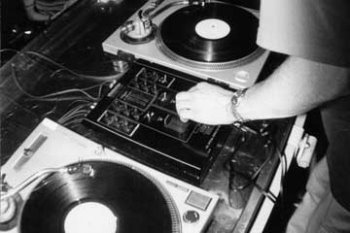
It is circa 1974-76. Birth of Hip-Hop in South Bronx, NY. Young Blacks, Whites and Latinos are taking their parents’ Soul & Disco records and mixing them together to create what we might now call “sound collages” -- mixes, *bricolage*. The DJ and MC are still one function: bachelor machines opening and closing among their records, turntables, mixers, microphones, wires (those valves of communal sound systems). They will not split into separate functions for a few years. These origins two or so years before mine or Cross’s.
Primordial Hip-Hop and its continuous innovations into our present rely on shock effect. Torque or the tactics of surprising. We may say something similar of the three art forms that constitute Hip-Hop as an aesthetic - rapping, breakdancing, and aerosol art; that their effectiveness is in a perceptive lag-time. Recognitions come astonishingly, enjoyably, to those made to wait. In “Wild Style” graffiti, arrows lead the viewer’s eyes along tropes from legible tags. As in the three-card-monty, invisibilities -- visual losses which can lead to economic ones –- return us to presences: the nut under the shell, leitmotif cards. Likewise, in popping & locking, bodily expressions point away from events that may or may not occur; time flows in multiple directions. Favorite rap songs are ones that leave us in aural-syntactical gaps. Syntax presents and absents semantic values.
While much has been written about the connection between Jazz & Modern/New American Poetry, little has been said relating "innovative" poetry since the 70’s and Hip-Hop aesthetics (nor those of Post-Punk or Techno). With this acknowledged I would admit into the record that before Cross read, wrote, edited & printed poetry, he was of course well on his way to becoming a rapper – an MC not just in initials. This turn to poetry, so he has told me, was made so as to improve his rapping.
In his introduction to *Involuntary Vision*, a collection of poems written by various poets after Akira Kurosawa’s film, *Dreams*, Cross writes: “To a certain extent, these poems are examples of our most popular contemporary art form – the remix; they rework and distill Kurosawa’s originals so that certain elements are amplified, while others distort.” Like rap music and DJ culture, Cross’s *New Brutalism* may find tuition in radical remixings of language imagined and found. New Brutalists are for Cross similar geniuses of torqued reappropriation.
As I have approached it in our [unpublished] Rust Talk (epc.buffalo.edu/ezines/rust), perhaps Michael’s affinities with re-mix artists accounts for the title of his short collection of poems after Kurosawa’s film, *gamut – for l.z.*. The “gamut” Cross’ title alludes to is of course that last poem L(ouis)Z(ukofsky) wrote for publication after his book of poems, *80 Flowers*, and that was to be first in his never completed (however projected0 collection, *90 Trees*. The title “Gamut” may be crucial as it would seem to reflect on the form of *80 Flowers*, and LZ’s late-poetics in general. As scholar Michelle Legott writes of the word gamut in the conclusion of her book, *Reading Louis Zukofsky’s 80 Flowers*:
A marriage of partners produces – a zygote; which, says the Century, is the same as a zygospore, from zygon (yoke) and spora (seed). Z-yoked gametes, in Zukofsky parlance? Did he see also the definition of a zygospore: “in botany, a spore formed in the process of reproduction in some algae and fungae by the union or conjugation of two similar gamates.” “Gamut,” encompassing the musical gamma-ut and the gamut of years which will take it into the twenty first century and the seventh millenium, may conceivably make the first step of that trajectory by alluding to gametes that find each other (they “meet” for a “gam” – endless talk?) in order then to “marry” and make of themselves a “z” yoke, a zygote, a zygosphere; the seed of things to come. Perhaps even a book of trees.
*80 Flowers*, along with *“A – 22”* and *“A – 23”* (the last two movements of *“A”* completed by Zukofsky), is considered by many to be the poet’s attainment of a linguistic-textual limit insofar as there inheres in the poems a maximum of sounded intellectual-torque between individual words and textual units. Where to go if a limit has been reached? Questions of limits lead me into the ways Cross may be interpreting the late Zukofsky thru his own *gamut*. Aren’t he and Zuk both acting as textual geneticists? In both poets, words and phrases are spliced not towards presupposed organic actualities, but for an eschatology revealing transcendent "natural" forms in cultural products. The 70’s Zuk. & Cross may both be Duchampian bachelor machines of language. Cyborgs of detritus and language shipwrecked by empire, decussated or molded to their ecstatic standstills. [Cross's debts to the "molds" of Matthew Barney, Peter Eisenman, and Rachael Whiteread should be the object of another essay].
I am to be innocent food
where there cant
like glacier
runs to the things
The Desolation Ruins
a kind of weepy brush
and so lurking
some embarrassed by
the martial life
stupid mankind-like-iceberg
I’m sorry for the nuclear
made night hurts
of a single horn.
--from "gamut -- for l.z."
During Barrett Watten’s talk on “Negativity” this past Fall, Michael was sitting beside me in the audience and at one point I glanced at his notebook. On the open page he had written: “Oakland – Detroit – Bflo: a connection?" Indeed a connection between these Second World American urban scapes, these places of ruined conveyance. And after a connection, what? A break, an arrow, a splice, a suture, a cut. An event.
*Given as an introduction to Cross's Spring 2004 reading, Another Reading series, Buffalo (curated by Barbara Cole, Gordon Hadfield, and Sasha Steensen).

Subscribe to:
Posts (Atom)