Monday, February 13, 2006

Mazing Vids (Review)


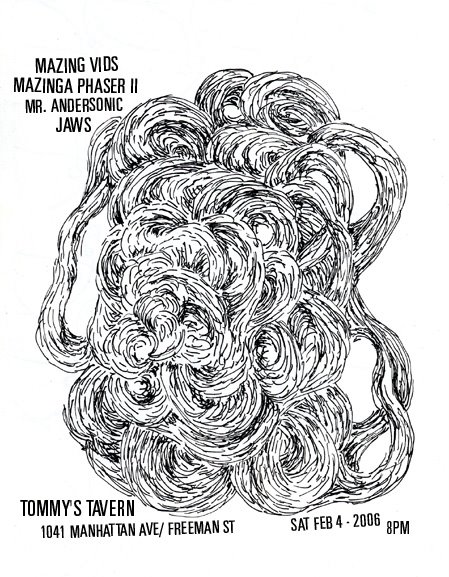
The Saturday before last, February 4th, I had the pleasure of seeing one of NYC's most over-looked and under-published bands in action at Tommy's Tavern in Greenpoint. Mazing Vids are two members, Ryan Byzantine (of Tallboys and Soft on Cuba fame) and Ryan Sovereign (AKA "Redux," of the esteemed Lasereye Stingray and also of the defunkt Soft on Cuba). Their typical configuration has the duo trading off instruments (Yamaha synth. and Fender Jazzmaster) while an 808 drums on. Both players lyricize and (dare I say it!) sing however it is Byzantine who really holds forth, talking psychotically and/or hysterically chanting in a style redolent of any number of post-punk ranters, and particularly channeling (thru years of practiced transmutation) Mark E. Smith (that original of literary histrionics).

Despite their generic company among emergent and established "noise" afficianados, Vids have a particular pop knack, the knack of bands as disparate as Cabaret Voltaire (the early drum-machine based stuff especially), The Clean (and Flying Nun Recs. in general), Desperate Bicycles, Theoretical Girls and others of stripped-down/total-intensity post-punk/electro expertise. What accounts for this knack (among other things) is the entrancing insistence of Sovereign's guitar "lines" whereby the guitarist repeats one riff (or note) thruout an entire song against the grain of the 808 and Chowdhury's lyric weavings. Of the later, the genius of Byzantine's lyrics lie in the artist's singular ability to elaborate within songs as short as two (or so) minutes a veritable set of formal and expressive clarity. As if to break the spell of his (self-induced) siren's song, Byzantine will often take random swipes at the Yamaha or Fender before concluding a song. And it would seem it takes such a gesture for him to return from the mental distances, the distances of psychotic attention, his lyrical performances clearly demand.

Given the duration, intensity and pedigree of the Vids who have played-out with some of the most formidable "art-rock" musicians of their generation (Black Dice, Yeah Yeah Yeahs, and Gang Gang Dance to name but three) I can't help but wonder why they haven't had an EP yet, let alone a full-length. But this is something for the labels (if not historians of NYC "rock") to sort out.

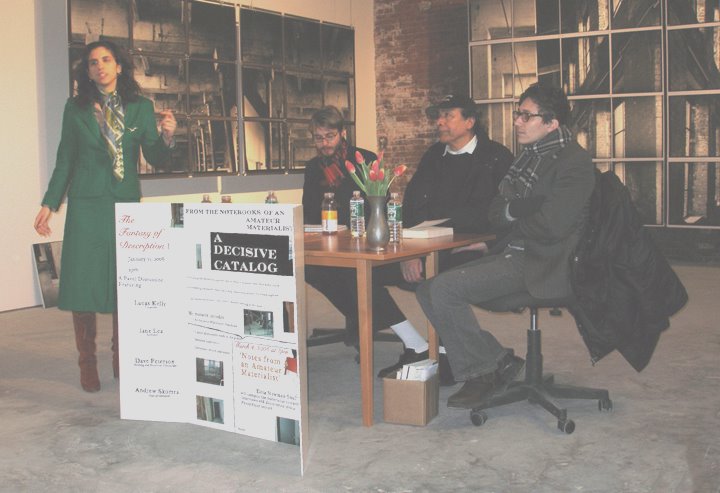
A Fantasy of Description* (Paper)


Propositions and discursus towards an Amateur Angelology

“To come into this world, as we said a moment ago, can have no significance other than to convert its metaphoric reality … into its true Reality …. Our author makes it clear that there can be beings who, although they have in appearance come into this world, since they are there, have in fact never come into it. Inversely – and here the analysis becomes most striking – there are men whom we can visibly discern to have left this world. They are dead, they are no longer there. We say: “They have departed.” No, actually they have never left this world and they will never leave it. For to leave this world it does not suffice to die. One can die and remain in it forever. One must be living to leave it. Or rather, to be living is just this. Can we distinguish in the winter, as Nasir-e Khosraw says, between a living tree and a dead tree? Both, it is true, are materially there. But in one the sap flows secretly. In the other the sap does not flow, because its roots are dead. When the spring comes – that is, the Imam of Resurrection—only the first will be covered with flowers and savorous fruits at his call. It is no indulgence in a mere literary reminiscence if the image of the Iranian philosopher suggests the thought of Balzac: “Resurrection is accomplished by the wind of heaven that sweeps the worlds. The Angel carried by the wind does not say: Arise ye dead! He says: Let the living arise!”(58)”
—from Henry Corbin’s *Ismaili Gnosis and Cyclical Time* (1964)

I. Five Propositions Towards an Angelological View of Materialism Written During a Period of Decisive Withdrawal

Prop. 1. That the world appears materially, but is ungrounded in its apprehended “materialism”.

Prop 2. That there is likely no “material” or “immaterial,” only the hidden (which is to say, occulted) and apparent (or revealed).

Prop 3. That the individual itself (both turned towards and beyond “the each” and “the all,” and being “alone with the alone”) makes the hidden appear as truth.

Prop 4. That in this making the hidden appear the individual achieves exteriority through a radical form of inwardness, what we may call a radical interiority.

Prop 5. That this process is ever fleeting, however utterly dis-continuous and e-ruptive.

II. Discontinuous Creation or A Platonism Without Guarantee

What would a site of discontinuous creation be?

How does such a site complicate “site-specificity” as a term indicating a literalized and anti-metaphorical materialism?

Is the recent turn away from “site-specificity” (if such a turn has in fact taken place) the turn away from an Incarnationalist discourse towards a Docetic view – where the Incarnationist-dogamatist cynically believes that God could be destroyed as matter in the form of the incarnated Christ, and the Docetic-heretic that the incarnation was only the appearance of one, that is, a phantasmic materialization, becoming ghost, or virtual corpse -- the “insight” specificity of each whose eyes beheld the prophet. This “insight” specificity, the assertion of a radical individuation of revelatory and ecstatic vision the gifts of which are bestowed by a Theosophical-Pentecostal Holy Spirit and an Oriental-Islamic Angel Gabriel, hinges primarily upon the verse from the Koran (4 : 156): “They slew him not nor crucified, but it appeared so unto them, and lo! those who disagree concerning it are in doubt thereof; they have no knowledge thereof save pursuit of a conjecture. They slew him not for certain”; yet also on the verse from the apocryphal Acts of Peter: “I saw him in such a form as I was able to take him in.”

Following the opposition Incarnationist / Docetic, is the turn from a “site-specificity” to an “insight” specificity a cultural shift towards understanding “site” as virtual, labyrinthine, non-continuous, apparent, and constitutive of multiple universes, worlds, aeons or degrees (the archaic gnostic divisions of the universe)?

How can the museum / gallery or, for that matter, post-Smithsonian dialectic of “site” / “non-site” become a site of non-relation after this cultural shift? How a site of radical inwardness? Of the responsibilities, if not the imperatives, the necessities, of the super-sensible, the subtle-invisible, and the eternal battle for an imaginal realm? What French Orientalist and scholar of Islamic Theosophy, Henry Corbin, calls, “the battle for the angel”. That is, the battle for the form of one’s possible soul, the soul *in potentia*: an angelic form the event of which is metamorphosis and resurrection of the self, and the world as it extends into invisiblity.

Where, in other words, does “site” become “insight”? And how can works of art and the spaces which ostensibly circumscribe them, turn us from sense to non-sense in productive encounter? Where and when does “site” turn inward to become outward again? The inside inside… The outside inside inside… Being "alone with the alone" to encounter the world.

III. Anti-Historical Materialism and Post-Cinematic Insight

Proposition 6. Historicity is not creative alone, if it is creative at all…

Yet site specificity assumes the case of a series of facts related in sequential duration by cultural or natural forces. History, like evolution, is then continuously created.

But can the non-sense of an imaginal shift throw sense back upon the mind radically, the mind in turn back upon itself. Beyond psychosis per se, halluciogenetics, dream or trance states, hypnosis. Beyond empirical or psychological shifts. . . .

The view of creation I would like to oppose to the continuous one is one eruptive and re-creative, atomistic, occasional. It is one most recently intuited and demonstrated by post-cinematic media. Lebanese artist and writer Jalal Toufic, shows this view of creation as it is demonstrated by cinema in his article, “Middle Eastern Films *Before Thy Gaze Returns to Thee*—in Less than 1/24 of a Second”. His primary examples are taken from the cinema of Armenian-Georgian filmmaker, Sergei Paradjanov.

Thru the jump cuts of Paradjanov’s cinema, the cinematic gaze returns to the viewer before the viewer has had the perception that in an instance between percepts the entire world has been made anew, renewed in a void of non-being. Yet, as Toufic shows, it is entirely in these moments of non-perceptibility that one’s prayers for the world become necessary, a commemoration of the divine as it erupts in the discrete intervals of the world’s creation:

“Out of the clash of any two images, but even more clearly of any one image, do not arise, as in Eisenstein, many concepts (even if, as in Einsenstein, beneath them all be the concept of the dialectic itself or of class struggle), but a *dhikr* (invocation, remembrance) of the one necessary Being, who is beyond concepts; or the notion of the absolute dependence of the myriad entities. The jump cut, 'the sound of one hand [or image] clapping,' is a silent *dhikr*. Forgetfulness of God is a molar illusion, since creatures, not having their substance in themselves, are always returning to that which alone has subsistence, God. If one is enjoined not to forget God for an instant, it is that that is the maximum that one can possibly forget Him, since at the end of the instant one reverts to Him, thus remembering Him. From the standpoint of perpetual creation, we are not forgetful of God, but of our return to, of our non-forgetfulness of, God. As in Buddhism, where though we are in *Samsara*, occluded, we have Buddha nature and Buddha face; in Islam, we are, through this renewed resumption into/return to Being/*al-Haqq*, involved in a perpetual *dhikr*. The explicit *dhikr* in the form of the repetitive invocation and remembrance of the name of the one necessary Reality has an echo in an implicit *dhikr* in the form of the recurrent resolution back of the non-subsisting entity to Reality. The disciple must have meditated enough this atomism and the *dhikr* it implies that however much he reiterates the name of God during a *dhikr* ceremony, he does not go into trance, since trance would be a sign of an obliviousness to the former *dhikr*.”(*Forthcoming*, 2001)

Against Gertrude Stein’s admonition from her 1934 lecture in America, “Portraits and Repetition”: “the only thing God can not do is to make a two year old mule in a minute” – Stein, that writer of “continuous present” and “stanzas in meditation” – everything is possible in Paradjanov’s cinematic universe so long as it can be established by a cut (or, more recently, by CGI). So it is perhaps in inverse relation that Paradjanov/Toufic and Stein compose the world serially, Stein becoming ‘I not any longer when [she] sees’ (that is, non-identical in the act of writing as envisioning), Paradjanov/Toufic expressing God (or remembering not to forget Him as it were) where there is no longer an identical subject “I,” the subject becoming disidentified by the recurrent occasions of divine commemoration.

Following Toufic’s highly original body of work, insofar as post-cinematic media is non-linearally generated, serialist, and emanationist (created and creative of light) it may do us best to locate a phenomenology of insight specificity in a poetics of cinematic and post-cinematic metaphorization.

IV. The Preservation of the Imaginal or Non-Sensical Imaginary as an Approach to Being Opposed to a "Literal"-"Allegorical" Imagination (or How to Make a Radical Interiority)

The special view of “materialism” I have only begun to point to and articulate in this presentation is one derived from Gnostical trends since the 1st century (Common Era), and both subtlized and intensified by the confluent discourses of Sufism, Neo-Platonist Theophany, and Persian Gnosis between the 10th and 12th centuries, yet it is a view that may be useful, if not salvational, for our present. What now is at stake in angelological insight and how does it bear on aesthethic production and reception?

Perhaps a better question may be why does a mystical or Gnostical understanding of the material world still matter?

If gnosticisms (literally: special ways of seeking knowledge) and mysticisms have continually been persecuted since their beginnings in Hellenic-Alexandrian culture (5th century B.C.) it is probably because they present a radical relationship between the individual and the divine. This relationship, for lack of better terms, may be called immediate and Pneumatic insofar as the individual, beyond the authorities of a Church or dogmatic hermeneutics or law, discovers the divine for herself through visions, revelations and ecstatic intuitions, that is, through a special imaginative ability. The angel of Islamic, Ismailian gnosis, for one particular example, is not the angel of a multiplicity or a community of beings, but a singularity equivalent only to the soul of the individual who seeks to know that soul as a name, event or symbol within a cyclical and recurrent eternity: an eternity of not one resurrection but countless, of not one degree of being but many: an eternity that the contemporary French philosopher, Gilles Deleuze, after Nietzsche’s Persian influenced notion of Eternal Return may recognize as a “disjunctive [ontological] synthesis,” and his colleague, Alain Badiou, “the truth of the event”. The struggle for this singular angel within eternity becomes a collective struggle, a struggle of all beings for the resurrection of the world, through a going within – into the imagination, into the mind, into a dialogue with divinity – that turns each individual towards God and in so turning turns God toward itself, face-to-face with the reality of its creation. In being so turned, “alone with the alone” as the 11th century Theophanist Ibn Arabi calls it, one turns outward towards the entirety of beings which should not be said to be of an actual world, but an imagined one which determines the “apparent” or “material” one so-called. Surpassing any contemporary view of the individual as an ego cruelly isolated by her interiorization, capitivated by the reifications of late-Capitalist Postmodernity, such a notion of interiority may be said to be radical in the way its puts the singular and multiple into ethical relation. The movement of this ethics, an ethics that may be termed that of a radical interiority or an interiority surpassing interiority towards exterior, is one that begins in the imagination coeval with the nervous system (the heart) however irreducible to the senses per se, compelled, as it were, by a non-sense of subtler organs…

If I could finally put forward an equation for a gnostical materialism of the radically interior it may look something like this: from the heart the imaginal, from the imaginal the interior, from the interior to the interior’s limit, from this limit to dialogue of the divine, from the dialogue of the divine to one’s angel (soul-event or true name), from the angel to a community of beings, from the community of beings a return to the heart… Universal Love being preserved by this need to imagine, to turn towards, to be face-to-face, to defer a conclusive understanding of the mysteries one most needs to know.

V. For the Cycles

“It is their own Iblis [darkness, demon] that they must hurl into the abyss, and in doing so they wage battle for the Angel who is in them in potentia. To reflect in oneself the Temple of the eternal Imamate is to anticipate the consummation of the aeon; it is here "to become aeon," to produce in oneself the mutation of cyclical or measured Time, and for each adept this consists in assuming in his person an increasing exemplification of the Angel's being. This implies that what occurs in and by the person of each adept also affects the being of the Angel who is their archetype and who finds exemplification in them.”
--ibid, Corbin

Where space begins suddenly
In time and presupposes our love
For the worlds (the world) what image will you
Make
Will one make
So neutral to think
The voice
A delay shapes

Delayed shapes suddenly here
And not here
Not yet to shore
The body up
Not the erotic
Mind you occult
By drinking up ink
A scholastic problem

Of love delaying future shapes
Of a certain bow
Of an angel struggling
In potentia with
A certain bow
Circular to sing

The inside before his breath is done
Before light light falsely
Catches up

A retard
To light
Catches up
To words
An allegory of their fall

And not a fall
Serials
From light evening light

Night / Light
Not a fall

As light so literal
An angel in actuality
Kept by its words.

*"A Fantasy of Description" was delivered as a paper at Smack Mellon gallery (Brooklyn) Feb. 11th, 2006 as part of the second of two panels (Fantasy of Description I & II) organized by Eliza Newman-Saul for her project "From the Notebook of an Amateur Materialist" currently on exhibit at the gallery. Newman-Saul's talk, "From the Notebook of an Amateur Materialist" will take place March 4th at the close of the larger exhibition, Site 92. Other panelists have included Matvei Yankelevitch (Ugly Duckling Press), Professor Raphael Ortiz (Rutgers University Art Dept.), Jane Lea (Columbia University Graduate School of Architecture) and Andrew Skomra (The Center for Psychoanlaysis and Culture, SUNY-Buffalo).

Friday, February 10, 2006

Knowing Not Knowing (Alone With the Alone)*


to Eliza Newman-Saul

The ‘interlocuted Same’ is a voice of ‘inner discourse’ (consider Lacan on Judge Schreber) of which we all perhaps partake, a voice interlocuting, circulating or circuiting in Generality. …Or the voice of God talking to Itself (Toufic); the ‘middle’ or ‘neutral’ voice of literary ontology (Blanchot).

Re: your “caring” or “uncaring” in an event of exchange or “communication” between “people”… I’m not sure that what I wish to address through our project is communication per se – whether something is “boring” or “of interest,” “private” / “solipsistic” or “inclusive” / invitational / dialogic. I want to attain the moments everyone should / does care about because it concerns no one in particular – a deepest interior shared in exteriority, a non-numerical thirdness of all entities / “parties”.

It is a genuine withdrawal beyond “performance” -- not experienced because experienced by no one -- that is a call to listen or to silence rendering interest / boredom out-of-the-question (expression or silence as “pure” interest: interest that stays interest?).

So perhaps it shouldn’t matter whether our video has a soundtrack or not: soundtrack should be silent, should evoke a silence, and that silence should be expressive / interesting in this sense and not merely non-invasive (avoiding interference with image-track). It is this silence that is not contingent on “actual” sounds.

Yet all this seems something different from my original proposition and your response. The thing I want to return to is “knowing,” compensations for “knowing” and “not knowing” (should we not also have to compensate for knowing if we should have to for not?).

As a precedent for our collaboration, what comes most readily to mind are David Antin’s transitional works between ‘meditation’ and ‘talk’ in which he and his wife proceed by a series of tape recorded ‘exercises’ by which they defer a unity of narrative intention and conclusive interpretation through conversation (and all that conversation entails in terms of interruption, distraction and circular modes of attending).

Only we may start less determinately and without so much “ironic flair”. To experiment with the consequences of beginning somewhere (anywhere?) in a series of texts, and to relate these texts interpretively to produce knowledge (however elliptical or circular) about them. In compensation for not knowing them we may perhaps come to know something else. A know how of ourselves, of poetics, of thinking itself opening beyond both the drudgery of textual authorities and the interiorities of private fancies and fantasies not nearly interior enough (not so interior that they produce an exteriority in which the different becomes equatable, if not Univocal). An ethics of commons.

*composed Jan '06 to Eliza Newman-Saul towards a series of collaboratve video performances w/ the artist. "Knowing Not Knowing" is a follow up to the post on this blog, "Compensations for not Knowing".

Wednesday, February 08, 2006

Matter Ark (from Splitting)*


To matter ark split into a few skies lights of birds resourceful interior here

Every split in place the house a banister a stair wainscot a stair split a glare shaved into light light breaking split walls in camera

Document of what split what didn’t happen the light we are seeing it now seeing transfixed a light breaks splits upon the eye

The crescent eye cats eye a wedge of fruit light the crescent light cats eye a wedge of fruit it may be greatest when it breaks

Greatest interior greatest exterior greatest in greatest exterior greatest when any break upon break open or split greatest fruit

A test of relation perspective sudden exterior light breaking breaking upon homes breaking open do you feel at home any longer within this enclosure

Within this line sing it seeks it seeks the end of time the beginning of this line a wedge broken upon determination determination at home in its small frame made of blood


Blood the body can’t hold the body a frame can’t hold the light entirely from outside as it breaks open it breaks open aspect and position

Position position once position once of of this foot this foot on the stairs position once once of this eye on the second story of space jigsawed

Jigsawed the frame frame of the body blood now flows outside now the stairs can be seen from an eternity of no position on the stairs no ascension or descending

The light also zips it jigsaws tsim tsum some songs it also sips it zips jigsaws a racing stripe straight up and straight down tsim tsum breaking the little frame of this world the biggest little song an aneconomic line tsim tsum sing the blood blow light from outside

The house blood flows blood fills outside plentiful it flows it fills anything a light it meets outside its little frame how long did he saw to see how long how long did he carve to invite the biggest slice of light fullest wedge

No description is just but the photograph of the split wedge into eternity no description just a sliver an indefinite wedge splitting into infinity a wedge opening upon


Opening song tsim tsum opening song of the opening line a wedge a wedge a wedge widening expand the width of this line for most

Josephine the biggest little song piping what to do with a shaking frame emotion a motion of this still frame it is split now a song shaking in its tiny frame again

Piping position position on a stage an eternity of stairs eternity of this breaking it seems to take forever to split this photograph is simultaneous

A document piping shaking in its photograph to capture eternity capture no light during a moment it first broke was there ever any first

Breaking any first breaking of the waves creatures mouse folk their tiniest frames house its tiniest frame he breaks eternity up he cuts up the blood as wood and invites that light inside he makes it come

A host of sorts a kind of host a host taken hostage taken hostage by his own blood vertical in this rim tsim tsum


This wedge eternal vertical of this split this photograph is simultaneous only only to cut up space as time only to cut another view through time

Time to come to come to come time to come as if we saw through walls these walls are like mirrors for a time to come time to come in incidents nicks of time in events

This immeasurable distance suddenness of the next room the street below suddenness of the next walls floor below this immeasurable distance sudden perspective

If architecture could be off and on screen cut to off screen split build a house any place that can see through itself

A time to come

A time that wasn’t next the non-succession sentence of these walls windows a place no determinate position of everything seen through


Above or below or below or above or above or below or above or below this sudden succession this purchase of vision see through floors suspension

To a car on the street below a parked car in any succession of vision there is only suddenness a suddenness or perspective impossible movement inside an inside an outside produced by movement inside a vision

A vision of outside of these outsides inside blood flowing moving inside the outside of the frame a wildness of vision willed dissymetry of the seen in the saw jigsaw a seer

See and saw see and see

This will be occurring when a plan folds over the flight of the walls of the house the doors fly open because they no longer can disappear

Neither the mind or the eye can any longer appear neither position on the stairs not any this is an architecture anarche texture


Texture without beginning i.e. the there of a plan jigsaw a plan to begin again in this frame to produce an outside moving within

I’ll take this time to keep moving the mind the eyes forever without beginning or a way to see through to the street below

This occupation without beginning this moving among the rooms forever of a building which will be torn down again

Ephemeral perfectly ephemeral and necessary this matter ark this matter arcs within a movement of its own outside many positions splitting the house from without

From within house of those eyes house house of the mind the mind’s intention to follow floors and doors in habit

Splitting inside splitting splitting inside the houses of your best intention your best attention an attention to cutting who will see the outside moving inside cities beyond those interiors rushing blood inside inside

A house that can see through its builders intentions a house that can see through itself we have many times inside


Many times inside the light breaking in this is simply one line

Many times inside the eyes of that house breaking-up breaking-up a time inside a being at home no longer

No longer are there windows to simply see out of

Must being have an above or below

The house of being the street the sky I may see a car passing inside the holes of a house

Photograph to preserve the abandonment of that moving inside photograph preserve ephemeral necessity of decreating

No longer need we open doors to become a new interior to become a new interior to become exterior inside the house of being splitting publicly produce a private scene of being


Of being of no longer being in the house of being of being no longer split us into everything we can be as sudden movements surprise us

Photograph to mark what we are being what we are not being in the house what movement can be in the house what movement can be in the house no longer being being split photograph to mark such ephemeral necessity the condition of movement

To keep moving the mind without a home within a home that is not a home the eyes as windows not only to see out of to keep moving within them one must move within sudden space

The simultaneous planes the folds how many floors does being have not merely interior these windows is there an above or is there below

Are you in or are you out these floors floors of a saw seen mark where anything can be a place our feet can no longer cross over planes neither ascending or descending depth of field in an expanding errand

Errand an errand cut such vital lines ovular ocular of the blood flowing outside down to the street up to the sky above or below skies lights resourceful floors


Resourceful birds internal movement internal movements of exteriors an errand of seeing

An errand cut can be a place to be without position above or below abeyance without obedience without frames a sudden lightness of blood drift

Of blood too and blood one of blood of blood of blood too and blood one one blood one blood of too much sing of too much sing this light too much to see all at once this simultaneous blood circulating

In an errand of blood of blood tsim tsum Josephine mouse sing this tiny frame be abeyant house sing the sudden light photograph a voice too high

Not above or below but too high an ephemeral necessity of the errant why must we seem to move in space and not in time time of our simultaneous blood

Not above

Resonant


The skies light not above the sunlight daylight breaking in into the domestic a private life holds in abeyance one heart

Not below

The daylight we need the sunlight we need a jigsaw seen in this new light don’t merely hope for song

Structure shake a voice at dawn so long for so long sawing to see no plan fold every day

Daylight every daylight not above or below the plan of any seen moving in any scene soon

Simultaneously an errand for eyes simultaneous shake structure frames simultaneous outside inside a big little light breaks move within this public sky

Disappear to appear move within this private skies light inside this breaking light our ground splits

Ground ground of our being away our being away in other doors in other floors of being neither above or below skies light too high


Moving to see the simultaneous saw too much

Too high moving to see the simultaneous instrument of spirit an aperture an aperture in song too high to see simultaneous blood moving outside within

A way a plane a floor or a door to sing an aperture in song her shaking frame for mouse

Errant cut a way display a floor or a door for the entire house of being to be moving

For spirit to move errant cut a way wave of the saw motion once

Once out of its song its frame once out once inside the outside of light who is it for

What did he want to destroy what did he want to explain a way in the flood what did he in fact preserve


For time once out of this frame

For simultaneously only

Planes to outfit light

Blood swell cut planes to outfit light depths of field he preserves a simultaneity of movement time elapse space

Time once for time once out of this frame presupposing any form cutting to fold template

To fold plans what he wanted to reveal what he wanted to destroy forms of interiority interiority as preformed

Move many times move many times move many times move the eyes in a strange errand

Errand a precise cut into space to time this flight inside the eyes move over whole beams holes in preformed frames

This is a proposition for public space also call me anytime I am anywhere but here

This is a proposition to fold plans to destroy only preserve the breaking the splitting of that light

Open a window there are no longer any determinate windows this is a proposition for a form of production from which the eyes can stray

The mind wanders to cut a tunnel a door or a floor in uncertain focus time elapse in ovals each time split eclipse

This is a proposition for no position neither above or below a form

*composed Winter '05. An offline version of "Matter Ark" and an accompanying essay on Gordon Matta-Clark will appear in the forthcoming issue of Sarah Campbell's journal, P-Que.

Tuesday, February 07, 2006

"Superficial Engagement" (Cont'd)


3.
Or the particular / the particularization / of conflicts / in their generality / specificity or uniqueness / of bodies lost or mutilated / defaced beyond recognition / or twisted / disappeared (in total appearance) / dehumanized by a Western / specificity to lose specificity / in violent diffusions (a “mass / media” imaginary) / lacking what we always have of course / this violence / and the ambivalent / an all-important ambivalence / of artworks may be the only / means to show the mess we are in / clearly / the noise that should yet effect clarity.

This violence / the occupation of Iraq / and of “the world” by the United States / or last gasps of empire / the general “human war” / engagements like contracts / are often violent / “en-“ a prefix of war? / to engage or put into relation / albeit violent / it turns the stomach / (it twists) / the face turns / (it untwists) / to hear / to turn to God in the human / animal / one must listen to see / accretion / the conflicted / messages of someone / existing in it (our “mass media” / imaginary) / if to see is to have at a distance.

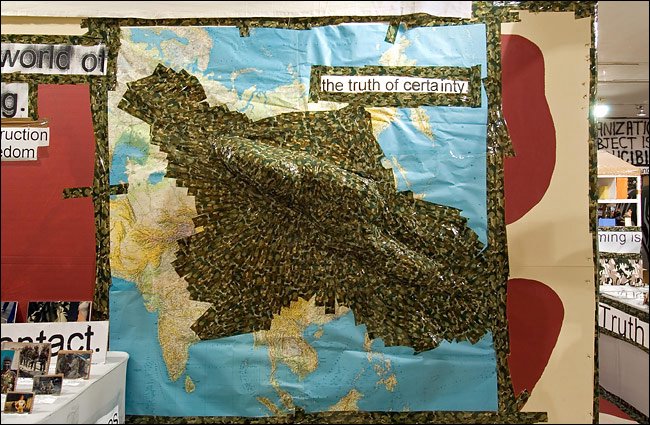
If I use / the prose / or conflicted forms / of / a constructivist / it is because / I am the unassimilating yet / in-formed mirror / of Thomas Hirschhorn / whose newest “public monument” / or "installation" / at Barbara Gladstone / gallery in Chelsea / presents a new challenge / to an ever growing / resurgence of "meditational"-"fantastic"-"psychadelic"-"imaginative"-"hallucinagetic" works currently fashionable.

For a few years now / I have imagined making / a longer / poem / using Paul / Sharits’s film / *Piece Mandala End War* / as a formal analogy / this longish poem / as I have conceived of it so far / would have / for its number of words (and/or lines) / the same number / of frames / from Sharits’s film / (something like 1,275) / only instead of individual colored frames / the poem would employ / words for their tonal values / certain words / replacing / the pictorial content of the couple / from the film / engaged in sexual intercourse.

These later words / I had always imagined / as having a “violent” / “shocking” / or sublimating effect / interdispersed / among the tonal words / an effect / that would cut / utterly against / the meditational inwardness / of the tonal words in pseudo-numerical arrangement / and / however simplistic / I have long-thought of this / unfinished project / as one possible solution / to the problem of effectively conveying / radical social-political contents / through forms which may be said / to be ethical / insofar as they instance / divine verticality / and spiritual inwardness.

It would be / I have always hoped / an ambivalent negotiation / of spiritual necessity and socio-political exigency / agit. prop. didacticism / and ecstatic mystical practice.

What reminded me of this / abandoned (or hopefully deferred) / project this past weekend / were Hirschhorn’s juxtapositions of photo print-outs/ of mutilated corpses / (low res. however / graphic / to the point of being revolting / making this / viewer at least / turn away) / with a variety of geometric / color pencil drawings/ and kinetic paintings (also low res. photo print outs).

Hirshhorn’s juxtaposition / of drawings by / Swiss Theosophist / & artist Emma Kunz / and images from the synaesthetic instruments of / Richard Land with images / from the ongoing American- / Imperial “engagement” / in Iraq / and ubiquitous and stealthy / “war on terrorism” / dramatizes a central ambivalence about / artistic response to / geopolitical violence / where currently the “art / world” turns inwardly / towards a spiritualist imagination and an imagination of / popular media / counter to the materialist urgencies / of more direct critique / and intervention.

So perhaps / what we must value / in Hishchorn is / his ability to show this ambivalence / thru / the determined / messy-ness of his installations / where conflict / reigns over resolution / and where messages (headlines in / this case / like “immaterial witness”) contend for the viewer’s attention / among a host of other / cathective points / mannequins with / screws driven into them / CD’s with jewel case covers made by kid's “spiral art” kits / large pine coffins / covered by ironic messages / of mourning and / “cheesey” de-cals.

As if all of the current art trends / "art data" if you will / were swept / into Hirschhorn’s angelic storm of installation-work/ and put face-to-face / the very urgent / and yet incomprehensible or unpresentably / present data of war / an "engagement" the artist might like/ to particularize / to make "specific" / but which becomes obfuscated / by an unmitigating rhetoric of headlines / and the repetition of violent facts.

Walking Chelsea this past / weekend / among so much art / lacking both necessity / and rigor / I could think of no work more necessary / for our current moment / in its mode of presentation / a mode as indeterminate as it is urgent / as monumental / as it is ephemeral / as noisy as it is clarifying / in its ambivalences.

Hirschhorn’s “Superficial Engagement”

1.
If installation was environment
And environment public monument
And monument non-
monumental
And the non-monumental
the nearest
Approximation to the realities
of culture
Subsumed by superstructures and the horizontally
Striated the gallery
walls wouldn’t appear
To build themselves white and formed
eternally Out of air
we would tend to be heir to These histories
of malice
and violence incalculable.

As human nature is
to the animal, the Mind (human
mind
or immanently
creative force) within
nature
is to culture, culture
which can only eventually surpass
what it is to be human
animal and animal.

2.
Beauty – that is presentable – and Beauty un-presentable – a veil – like trauma – patina of pain - do us the pleasure (where pleasure is horrifying) – to not unshow these bodies - repulsive bodies Beauty – that is also un-presentable – and from which one must turn - away compelled taken aback or flung

By Beauty – or a legible – noise pervasive – written large again – on the coffin lids – of culture written – large again – on these makeshift walls – the constructivist mutilations - constructions always in reverse - of what can not be shown – and yet must

What must – be legible also to not unshow – the also presentable – patterns of our overwhelming numericity – number our overwhelmingly flung patterns of blood – weaving the repeated wounds screws - mutilations which are never not images only

Not fictions entirely not of flesh – the mannequin flesh and color music – unsubstitutable for soldiers – “civilian” victims – of the image bio-dynamic – energy to rest time to oscillate – with time mutilated – and time harmonious – rested a geometry
a – healing geometry – her Theosophy of rock – weave of Kunz’s forms

Or Land’s synths – in flickering – contrasts how can there be – rest how can there be – rest for the motion of Spinozan bodies – shapes all com-passionate pattern against - and yet partaking of this particular war – the human war in general – infinitely unjust

The shape of this war – this particular – war and these particular images – of corpses images – of the dead no one – can show them all – no one cover – the unique particulars – no one can show – the unmutilated – universal yet we must to rest – to act within this war – to partake of human nature as culture – inaesthethic presentables