Devotion I.
Reich (brief intial)
Slow the birds showing pulse flocks
Locus of power but reversed
The name we share a dispersion
to what effect.
The name we share
Slow the birds showing pulse flocks
Owe or words shower else
Lower aria poll flows
Over-head, low how pulse shook
Owe less stock
Owe ease shock
Vase sh
As
We risk address
We re-stack
Windows
Tow to endow
Slowed hold hold hold flocks of
flocks of slowed hold hold
hold hold slow birds of flocks
of
cathect
Registration drive this most simple
division
the motor of the heart of the motor
Devotion IV.
Duration that began her life-work.
To presence what is happening each book.
The not so voluptuous silence and the blank voluptuous – both imaginary.
Make evident the shape of interest formal appearing when there is an active famine or whether.
Ethics is sometimes thinkable place sometimes written.
Duration. That began
composed Fall and Winter '02, and Fall '04.
Sunday, February 05, 2006


Friday, February 03, 2006
Devotion II & III*
Devotion II.
To know
if you can know
the flat portraiture
rectangle necessary
irrevocable memoir
of when we were not separable
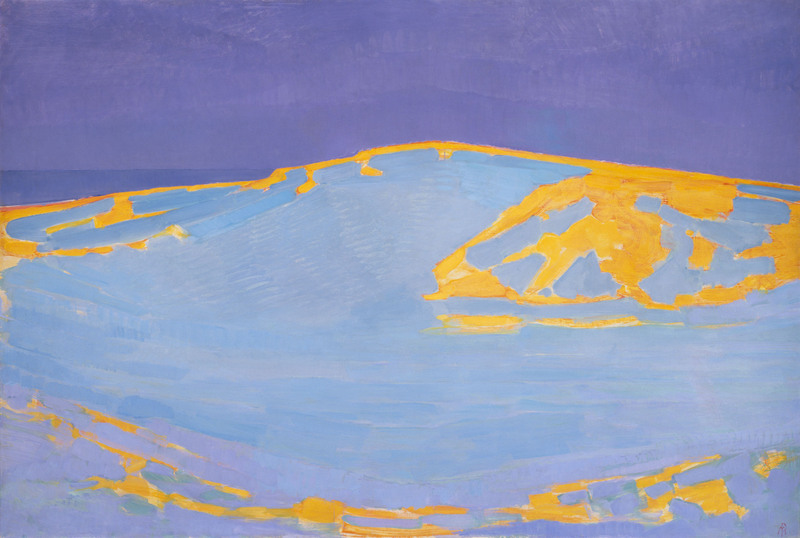
Windmills stalk flat flat flat flat
all wind blown at wind push weather
push all mill wind through color the wash
the reeds of a plain and
flat the wind pushed through them
Towering in its gesture
their simple relay
like machines do
The wind conveyed
by points that flutter
drawn by wash
Flat cross assymetric make aerial
make conveyance make
courses through winds graves
flat cross
the mark from an aerial
my sole blank bird
be flat vanished arrow
by cursor pushing which way
What more endemic but wind?
weeds
reeds weeds reeds
weeds reeds
weeds
blank of a cross
pure reed simple move
smooth cloth
smooth cloth
cloth smoothed
What the child looks at while it has vision
of having a flower before its mind
and the flower
the flower holding her
face and breast
mute the start.
The child gazing beyond
the colors of the flower
vibration and eyes deep
If we were young child and
the face young and honest
depersonalized upon
a fold of your hand
clasping
some object
the brushstrokes would show this
With flesh contact
canvas gaze at
a slight bend over which we call landscape
not flatness, not merely time
to the horizon
world
where it begins and ends
Slight bud and bend swell
and blood obsess
alabaster, spirits
equation for making weather
sound as weather does
expansion through it and without
to a cold stretch of green gray land
the cheek to show me my own soft watch
Devotion III.
Ghost Riding
Being beside
others days humans
separate the flesh mass
thunder being beside
suddenly this fence
Sand
an impossible
waterway line
instinct
move for
phenomenal tuft
indiscriminate
a point to
a distance ahead
a distance ahead
a way
On the backs points and
desert tongue
reel from sweet music
memory of orgy
artillery in a distance
without history
madness
without joyful test
Test of truth
league of wish
for infinity
site of flight
savagery
from the photograph of work
there the ink
the screen my thought of it
while it is spilling
would be dark
We cried in games
bad air pact
bird in sub-state (substrates)
places where none march straight
we beat the graves
and covered earth with sound
of the real like a dark stone
between two dark stones
Pray for me too...
from nothing but distance
is each night born
where a mile is not a mile
where a sun’s not a sun
capitalize this refusal
Not the kids
the wrap-around dead
pushed up by car
to ladder
to him
Pushed up put guns
down words
hostage to light
dear deer above
scrape the dust
(more often the place we return to)
... small machines
deer redeemed from context
caption:
to none aimed in fog
Near enough to nearly touch
their fingers, their lapels
women and men in black
sign and small world
preposition is our silence
The eye in the cat’s body
flashes
the face
an animal’s intention
if sickness were grace
Where vision is removed the human
Where vision is replaced our thoughts tend
*composed Fall / Winter '02
"fire is not clay thus not only each" (coda)
in grace the center that is
is grace the center of our soon-to-be
innocence in grace the center that is
in grace grace the center that is is grace
the center of our soon-to-be
fire is not clay thus not only each
grace is the center
center of infinity or zero not being
only one not only itself alone with the earth
the center that is
is grace the center of our soon-to-be
fire the movement that neither amounts
to one we are either zero or infinite
in a concave scene concave our being
concave our being in a concave scene
fire is not clay thus not only each
the center of our soon-to-be innocence
is grace the center of our soon-to-be
innocence in grace the center that is
in grace grace the center that is is grace
the center of our soon-to-be
fire is not clay thus not only each
grace is the center
center of infinity or zero not being
only one not only itself alone with the earth
the center that is
is grace the center of our soon-to-be
fire the movement that neither amounts
to one we are either zero or infinite
in a concave scene concave our being
concave our being in a concave scene
fire is not clay thus not only each
the center of our soon-to-be innocence
Wednesday, February 01, 2006
Ozu*

1.
It is her face lit by that light
Contemplative light
Contemplative mask
Of a face
Lit by that light
That beats like a drum
Dwindling in his heart
It is her
Face lit by that light
Capable of being
Covered
Being covered
By hands
Being covered by light
Covering conclusive tears
That beats like a drum
Dwindling
2.
Augment the mask, mask of
Her face
The lighting design
Augments time
The camera which stays
All trains
As they pass
Not quite upon these lines
Augment the white, of shirts
On a line
For all time, for all
Designs
Show time finally
The covered face of
Her tears
Smoke cuts away.
3.
Lit by that light
Bright light direct light
That beats like a drum
Dwindling in his heart
This is the time for this
Incense whisking
Frames away –
Fragile shades
This, the time for this
Who knows no time
When you leave,
Incense whisking
Little boats away
Down stream,
Attenuating
Rates per frame
That know no schedule -
Light which covers
The covered face
No heart can dwindle.
*composed Summer '05
Tuesday, January 31, 2006
"in a marionette or in a God"
“But, as the intersections of two lines, from the one side of a point, after passing through the infinite, returns suddenly to the other side; or, the image of a concave mirror after moving into the infinite appears suddenly again, near or before us; so, when Knowledge has gone, so to speak, through the infinite, Grace returns again, appearing at the same time, most purely, in the structure of a body which has either no knowledge, or an infinite knowledge, to wit: in a marionette or in a God.”
--Kleist
--Kleist
I Love Poets (review)
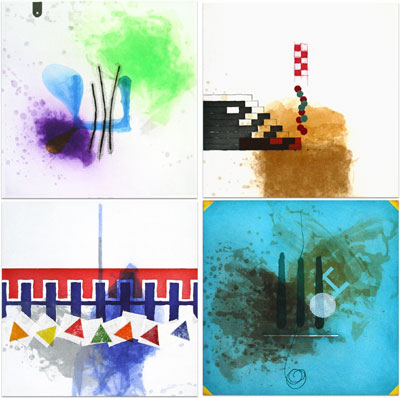
1. Richard Tuttle is an artist’s artist. 2. Richard Tuttle is a poet's artist. 3. Richard Tuttle is an artist's poet. 4. Richard Tuttle is a poet's poet.... There is a need for logical confusion of the terms of naming. Yet, beyond any confusion, the poets and artists who read for Tuttle this past Thursday, January 26th at The Whitney attest to the affinity and company the artist shares with poets. And mainly to the force of Tuttle’s most unforceful and gracious practice.
What struck me especially during the event, I Love Poets, was a certain trend in the reading selections. These selections may be said, whether they were written directly in collaboration with Tuttle (as in the case of works by Charles Bernstein, Barbara Guest and Mei-mei Berssenbrugge) or not, to be works enacting a vital ontology *after* and (perhaps more accurately) *with* Tuttle’s own works. Charles Bernstein probably highlighted this phenomena best as he (half-)joked that the works he was to read were not ekphrastic, not poems *to* or *for* paintings, so much as texts reciting what the work of art might say if it could only speak. The work then is what it says by showing. What it does or enacts *with* its viewer.
This “withness” of poetry, its adjacency to and participation with the being of the work of art, I felt particularly in the readings by Jonathan Skinner (reading for Anne-Marie Albiach Keith Waldrop’s elegant translation of a recent longer poem forthcoming from Post-Apollo Press), Leslie Scalapino, Larry Fagin, Berssenbrugge, Bernstein, and Tuttle himself reading from a collaboration with Guest. And such withness may be necessary in the face of Tuttle’s body of work, a body which consitstently em-bodies the subtleties of essentials made sensible, and makes apparent a grace of discrete and multiplicitous materials “hanging together,” suspended seemingly in a force-field by gracefulness alone. So it is likely in a Kleistian gracefulness where the artist, at a point zeroed or made infinitely light, finds mobile center.
However different their responses, each reader presented a means of expressing in poetic language the certain forces of Tuttle’s work as the responsive forces of grace. Skinner did so by way of his well-measured French which, despite his apology to the contrary, to my ears successfully sounded the immense silences and resonance of Albiach’s spacious pages, and Scalapino by her signature forays into the temporalities of meditational interiority. Fagin, especially through a pairing of poems he had composed for the occasion, "Loosey" and "Lacey," conveyed many of the revelatory qualities of Tuttle’s installed works by concise word-choice, and by pivotting radiantly upon prepositions, articles and pronouns. Bernstein’s poem in thirteen parts, “In Parts,” (from a collaboration with Tuttle called *Reading Red*) continued where Bernstein seems to leave off in his “thought opera” for Walter Benjamin, *Shadowtime*, activating the promise of the work of art to confuse the sensible and the emotional, and to extend emotions into thoughts in a present of aesthethic encounter -- what Bernstein may call in "In Parts" "the middle of the middle". In Bernstein's selection I could also not help but overhear the refrains of *Shadowtime*’s final libretto where the poet incants “now time” invoking thinking itself as an instantaneous and emergent making, the productions of attendence beyond comprehensibility or assimilation. Mei-mei Bersenbrugge’s text, *Hiddenness* (also in collaboration with Tuttle), presented a measured meditation seemingly about her daily contacts with the artist’s person and work, the notion of *hiddenness* taking on a “psychic” (if not also biological) air of the possibility of sharing interior and exterior "lives" - what William James in his late-philosophical works called the problem of two minds knowing the same thing. The notion of hiddenness also recalled to me my own encounters with Tuttle’s work wherein many of his objects appear on the brink of an occultation, with one foot in “this” world, in actualities, and one in another – in a world presupposing a need for perceptual exegesis. Finally, Tuttle’s own reading of his collaboration with Guest, *Durer in the Window*, proved himself a thoughtful and deliberate reader of poetry as he gave Guest’s words their well-deserved space and measure. Demonstrating unequivocally his *love* for poets.
2 after Alexander Sokurov*
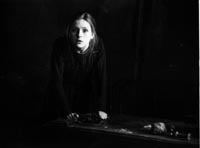
Whispering Pages / Spiritual Voices
The weightless will.
We laugh, we all
fall down.
Twisting
to rest
in senseless sleep.
*
The fallen faces.
I will pretend. They will fall
To water a reflection
Of water at least.
*
And that they could
fall
in reverse it is a matter
of how we find our way around
the pogramed city
convinced we
are still dreaming.
*
There is a sense
of magnitude in boots.
Boots made Infinite in
hovering.
The dead do not
intend anything,
do they?
*
While birds, seemingly matted, cross the screen, the screen, as though flip pages.
While birds, birds too heavy to be real birds, play at gravity.
A Russian novel per frame.
2.
Black cataracts
the sun
goes down in my eyes
*
Dear Afghanistan,
we see
with sepia the past
as though the same war
wasn’t always
being fought
under the same
desert sun.
Dear Russia,
a soldier sleeps
on sunless days
dreaming the milky
black of both pictures,
everything changes
because the eye persists.
*
The dust / in their eyes
profile / of a mountain / side
flat, incisive / sublime
arriving / in slow-motion
whatever “real / time” is.
*
Like icons these soldiers
the clouds which move
as they move
not above them
but as synchronous
surfaces,
angels twisted
in earthbound sleep.
*
The world,
the green
world is a tableaux
vivante or a Turner
where the clouds
break
the sun still won’t appear.
We hover above the cameras of this earth.
*composed October, '05.
Subscribe to:
Posts (Atom)