We can distinguish two kinds of interiorizing: the Devouring and the Convivial. The former is characteristic of the solitary ego regarding the world as alien and external. Its approach to the world is confrontational and defensive. This ego imagines that its imagination of what constitutes the literal is the one and only truth. It is monolithic in style because the Other is threatening and must be denied autonomy. The characteristic approach to the Other is objective Understanding – whether dogmatically nonrational (religion) or dogmatically rational (science). In either case the goal is to know, because what I know is no longer Other, it is part of Me. This drive to know, to dominate and deny the autonomy of the Other, to Devour the world, is insatiable. And this for two reasons: it is based on Fear and so can never rest; and, all this devouring gives no sustenance because there is no sympatheia, no connection to the source of nourishment, no possibility of feeding the soul from the soul of the world. The devouring ego drains everything it touches, and, closed in upon itself, it never empties, holding desperately onto its own waste, trying hopelessly to eat the universe. Its mode of growth is, of course, inflation.
But there is another kind of interiorizing, and it is this to which Corbin points. A turn to the imaginal need not be experienced as a retreat inward, into the interior, to what belongs to me. Psyche is not private. But neither is it “public” in the sense of impersonal, objective, soulless. Psyche is communal. But true community transcends any boundaries between the inner and the outer, the public and the private. Community only exists among persons, and persons can only be perceived, perhaps they can only exist when the walls dividing the inner from the outer begin to crumble. Only when we begin to hear the voices inside can we begin to listen to the voices outside. Then the boundary between what is mine and inside, and what is Other and outside grows ambiguous and unclear. We find ourselves immersed in the convivium, in community. We meet the Other as Other, in fear and respect. This experience is open, embodied, and mysterious…
--from Tom Cheetham's *Green Man, Earth Angel*
Sunday, January 22, 2006


Saturday, January 21, 2006
A Question Concerning Video Games
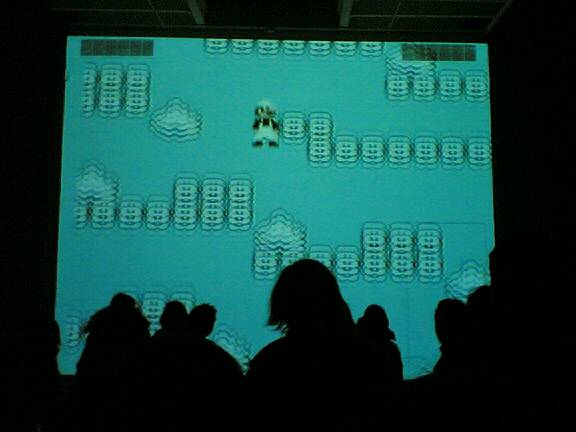
On the question posed
to me: what do
poetry and video games
share in common...
should I answer:
information? Words,
language forms, as first
informed, the rest,
as Zukofsky notes in his
"A - 12," risk:
"A poetics is informed
and informs -- / Just
informs perhaps --
the rest a risk." What is
the "rest" of "risk"
after informing?
Is it the "recklessness"
(a risk?) of the musician
Zukosfky also speaks of
in Bottom? The master
mastered by music
in virtuosic playing?
To "master"
form form masters you.
We are in-formed,
we are mastered. This is
where "the work,"
the value
of the work comes from.
The work's vitality,
perhaps, also.
To inform: for there
to be "basic" / simple
forms / "structures"
for creation; tendencies of
composition, generation.
"A - 12" is a poem
of generations in touch
or informed of
Stein's own "makings of":
"Or: remember,
G.S. begins / "Making of
Americans" / With
a quote / From Nicomachus'
father -- / With patient
father and Angry son -- /
That she said, 'How can
you know / More than
you do know / And we
are still in the shadow /
Of explanation.'"
From this form, this
in-forming, a lot can happen.
This informing as ultimately
rhythmic, a rhythm
of material, (in)formable
material. A kind of
"tendency" or
"culture" about the poem.
WITHOUT CODE. One
assumes after our
current parlance information
is a code. But what
informs is not
merely binary data; but
the data of what Bergson
may have called
"the intuitive":
the immanence of
composition itself, poetic
or otherwise. Information
makes a form
in which to dwell; it is
this form in which
to dwell and to
extend forms in time.
Being at home - being
"rest"-less - informing in
"rest"-lessness - "reckless-
ness" - "recklessness" re-turning
to basic information -
a kind of "home" or
more familiar (however
alter-able) dwelling:
the real question may then be
how and when
does risk occur?
Thinking Cures

The act of thinking became identical with suffering, and suffering with thinking. From this fact, Nietzsche posited the coincidence of thought with suffering, and asked what a thought would be that was deprived of suffering. Thinking suffering, reflecting on past suffering -- as *the impossibility of thinking* -- then came to be experienced by Nietzsche as the highest joy. But does thought really have the power to *actualize itself* without itself suffering, without reconstituting its own suffering? Does thought itself suffer from its own ability to actualize itself? What then is doing the suffering or enjoying? The brain? Can the cerbral organ enjoy the suffereing of the body of which it is a function? Can the body rejoice in the suffereing of its supreme organ?
-- Pierre Klossowski
Beuys --------------------- Nietzsche
Sickness ------------------ Health
Alchemy ----------------- Physics / Biology
Cross --------------------- Circle
Homepathy = contagion = swallowing a little poison goes a long way = migrain = talking cure = drawing cure = thinking cure = impulsive contagions = a semiotics = contagion as information
Or:
STOP FEELING TEACH
A DEAD HARE
TO STOP FEELING AND
PLAY DEAD
Dying to live / Gnostic Holographies
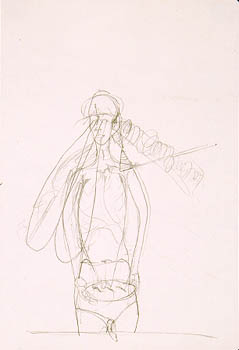
--To Matthew Ronay after Beuys's Codex
What we mean to write and what
We mean
To draw what
We mean by having
Insides and having
Other insides
(The inside
Of inside) is somehow
A matter of sex it is
Somehow
A matter of death.
Or Eros otherwise
A lag
Time of perception
A perceptive
Dark an occultation
Of the eyes
Of the hand
Drawing the eyes
As they don’t see
Fever balloons and
Madness blisters.
They trace
A therapy
A constant therapy
To heal
By writing words
As one might
Draw them
The pressure of this
A pressure
Not unlike
Death bearing
Down
Bearing
Down on an inside.
You will reconstruct
What organs you will
Reconstruct
By drawing
Organs without
Community bereft
Impermeable collective.
Bereft in slipping
The interminable
Slipping
Of affects
From body
To transmutable
Body
Your multiple
Bodies are
A distraction
Instances
Of time themselves
The floating
Organs of a draughtsman.
The sovereign holography
Feverish topology
Of pain and what is
Not quite pain
Not actually
Your organs
Your organs no longer
With outsides
For or
In themselves.
As one must always be
Alert to heal
As trauma
Has no end
Nor beginning
Except in
These occultations
Ex-orcisms /
In-orcisms
Dying in your codex
To live.
Subscribe to:
Posts (Atom)