Thursday, September 28, 2006


Wednesday, September 27, 2006
Piece
Is
Partisans, reality makers, History with a capital "Is"
In the eyes of song the present goes on
*
Struggling Models
An Equally Familiar
Disinhibitor Thing
*
Harm
What you lose what you gain what contacts you abstract what hems you in
What you gain what contacts abstract you what hems you lose
What contacts you hem in you lose what you gain
What abstracts you what hems
*
In
-SENSATE
-STATE
-NATE
*
My Piece
Kills sonorously relationally
Kills realistically nominally
Kills dialectically fundamentally
Transitively empirical
Just for the fun of it
*
Odyssey
The wager knows the bow of suitors
When become must suffer six strings
*
An innovation
An innocent autotelic protozone
*
Truth Effects
All the things overheard that will never be said
Ear whispering to ear of the beheaded
Dead presidents a mere curfuffle in the grand schematic
We all go down in trains we build against the sky
There is no sky here just say
*
Decide
The sun goes down
In your eyes the night
Rises in the throat
*
Arrive
My native piece
Blind to our
Plate-glass-nation
Floats by
A kind of lapse
Which one
Always moving
Segues home
Sudden-ing
*
Night Saving
There is your
Body like my eyes
Alive because they doubt
There is your distant crying
There is an oblivion
To speak of when we begin
Lobbed into the dark
Like a stone that never
Makes a sound
*
This Magic Moment
Two bodies lean
one against the other
one's plunder
the other's utterly
absconded from the enjoyment
of its earthly bounty.
One's surety the other's
harm
one's guarded
the other's a martyr
of global multiplicity
fair game for the shady.
Partisans, reality makers, History with a capital "Is"
In the eyes of song the present goes on
*
Struggling Models
An Equally Familiar
Disinhibitor Thing
*
Harm
What you lose what you gain what contacts you abstract what hems you in
What you gain what contacts abstract you what hems you lose
What contacts you hem in you lose what you gain
What abstracts you what hems
*
In
-SENSATE
-STATE
-NATE
*
My Piece
Kills sonorously relationally
Kills realistically nominally
Kills dialectically fundamentally
Transitively empirical
Just for the fun of it
*
Odyssey
The wager knows the bow of suitors
When become must suffer six strings
*
An innovation
An innocent autotelic protozone
*
Truth Effects
All the things overheard that will never be said
Ear whispering to ear of the beheaded
Dead presidents a mere curfuffle in the grand schematic
We all go down in trains we build against the sky
There is no sky here just say
*
Decide
The sun goes down
In your eyes the night
Rises in the throat
*
Arrive
My native piece
Blind to our
Plate-glass-nation
Floats by
A kind of lapse
Which one
Always moving
Segues home
Sudden-ing
*
Night Saving
There is your
Body like my eyes
Alive because they doubt
There is your distant crying
There is an oblivion
To speak of when we begin
Lobbed into the dark
Like a stone that never
Makes a sound
*
This Magic Moment
Two bodies lean
one against the other
one's plunder
the other's utterly
absconded from the enjoyment
of its earthly bounty.
One's surety the other's
harm
one's guarded
the other's a martyr
of global multiplicity
fair game for the shady.
Sunday, September 24, 2006
Last Word
Joshua Clover's last words are still ringing after his reading with Sarah Manguso earlier tonight:
"The poets were all reading Machiavelli when they should have been reading Clausewitz."
"The poets were all reading Machiavelli when they should have been reading Clausewitz."
False Generations (Revision)*
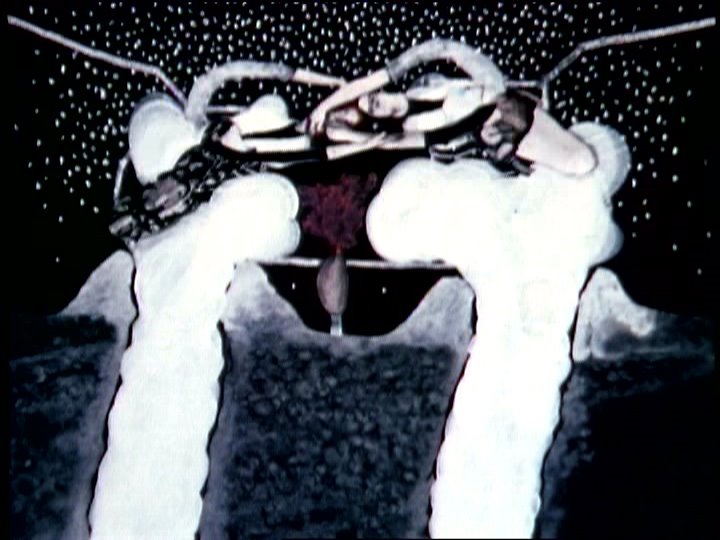
2. False Generations in David Lynch’s The Grandmother
In David Lynch’s third shorter film, *The Grandmother*, seeds give birth to human beings who behave as dogs in accelerated and non-linear generations. Is *The Grandmother*, then, not a film concerning rhizomatic deterritorialization? A nomadology of seedlings? “The wisdom of the plants: even when they have roots, there is always an outside where they form a rhizome with something else – with the wind, an animal, human beings.… Follow the plants: you start by delimiting a first line consisting of circles of convergence around successive singularities; then you see whether inside that line new circles of convergence establish themselves with new points located outside the limits and in other directions. (*A Thousand Plateaus*, 11)” Perhaps. But then the cinematic universe Lynch establishes in *The Grandmother* seems “archetypal,” preformalist or Occasionalist more than anything else. Lynch often says of his first film, *Six Men Getting Sick (Six Times)*, that he came to it in an attempt to make his paintings "move"; that is, to animate them. What is animation but a limit of cinema as false generation of movement (Bergson), or as an atomization of time per frame? False time, false movement, false generation.
*The Grandmother* is the second of two films that move from the painterly animation of Lynch’s first towards an original blend of diegetic “movement images” (Deleuze) with extra-diegetic and animation techniques. In the film, seed growth belies an inorganicism of the falsely generated, non-linear and preformalist. We can oppose the false generations of Lynch’s films to the non-organicism of Deleuze’s “crystal images,” where such images are generated by the bifurcating movements of actual images reflected in the uncanny opacities of their virtual counterparts: “This is unequal exchange, or the point of indiscernibility, the mutual image. The crystal always lives at the limit, it is itself the ‘vanishing limit between the immediate past which is already no longer and the immediate future which is not yet . . . mobile mirror which endlessly reflects perception in recollection’. What we see in the crystal is therefore a dividing in two that the crystal itself causes to turn on itself, that it prevents from reaching completion, because it is perpetual self-distinguishing, a distinction in the process of being produced; which always resumes the distinct terms in itself, in order to constantly relaunch them.”(*Cinema 2*, 81-82) These “powers of the false” of crystallic-virtualism—a virtualism which rests on Bergson’s crucial distinction between the dyadic terms real/possible and actual/virtual—we should distinguish from a preformalist organicism underlying that of Zoroastrian-Islamic aesthetics. Where crystallic-virtuality presupposes Bergson’s method of philosophical “intuition”—to locate form tendentially in irreducible temporal movements (or Durations)—preformalism assumes organicity as a consequence of the realization of preexisting potential forms (“templates” or clichés). Here, realized forms are the “copies” of possible forms as in Plato; however, per the magic of Surrealist exquisite corpse collage and primitive montage, ages and spaces (not to mention generations) may also meet in highly fortuitous assemblage. Counterposing the irony of Gertrude Stein’s statement from her lecture on “Portraits and Repetition”--“the only thing God can not do is to make a two year old mule in a minute”--such a view of creation assumes (following Jalal Toufic’s own Atomistic view of cinema in his essay, “Before thy Gaze Returns to Thee”) that Being is non-continuous, renewed during each “subsequent" instance: “Out of the clash of any two images, but even more clearly of any one image, do not arise, as in Eisenstein, many concepts (even if, as in Einsenstein, beneath them all be the concept of the dialectic itself or of class struggle), but a *dhikr* (invocation, remembrance) of the one necessary Being, who is beyond concepts; or the notion of the absolute dependence of the myriad entities. The jump cut, 'the sound of one hand [or image] clapping,' is a silent *dhikr*. Forgetfulness of God is a molar illusion, since creatures, not having their substance in themselves, are always returning to that which alone has subsistence, God. (*Forthcoming*, 121)”
In an early animation sequence from *The Grandmother*, the grandson ascends from his sprout-bed in order to abscond from his belligerent father. Analogously, throughout the film, the grandson negotiates what appear to be the three stories of a house: a bottom floor in which the grandson’s demonical, canine parents sit around a kitchen table and taunt him; a second floor where the grandson's bedroom is, and where he is periodically punished for wetting his bed; and a third in which he “grows” his grandmother, and he and the grandmother subsequently visit with one another. In ascending and descending the stairs of Lynch’s set, the grandson presents a typical movement from Angelosophy—the higher floors indicating subtler and thus more perfected degrees of Being, the lower the more demonical-animalistic. The shock of Lynch’s false generations is finally heightened by a passionate kiss shared by grandmother and grandson, as well as by a high-pitched whistling sound emitted from the grandmother’s throat, reminiscent of the sirens from *Six Men Getting Sick (Six Times*), and premonitory of Lynch’s first feature-length film, *Eraserhead*, in whose soundtrack many have claimed to hear super- and sub-audible pitches. Are the effects we know Lynch to have produced with fellow sound designer, Alan R. Splet, during the making of *Eraserhead* not evidence of a paradisical subtlety available through rigorous experiment in film soundtrack?
The problems of generation and temporality endemic to *The Grandmother* look forward to later Lynch films, and especially his most recent ones—*Lost Highway*, *Mulholland Drive*, and *Rabbits*—in which one encounters countless conundrums of narrative temporality. How, for instance, the protagonists of *Lost Highway* and *Mulholland Drive* are bifurcated by identities indicative of multiple temporal universes; likewise, how the characters of *Rabbits* occupy the same space/set however speak distantly, as though from different points in time, the lines of a mock situation comedy. That they are rabbits—those uncannily prolific creatures—who become the ostensible subject of one of Lynch’s most recent films, adds a comic dimension to his ongoing problem of generations ahistorical and “false”.
*a previous version of this text may be found among the March 2006 postings of this blog.
Saturday, September 23, 2006


Sunday, September 17, 2006
Praises Thunders Kills
Fire waits where fury was with looped ears and a mind full of lack
Motives come from positive position but guarded walls aren't fullproof
Until they could also move sensing a way towards our interpolations
Pressing on in cruel techniques memory complains about persisting mind
For every music never seen fire awaits every fact never sung we aligned
Falsely and do not see the brute exhibit for the lack of what is done
Where number does not bind hold me in this echo ironic as a scribe goes
During backward glances brave bright sand holds shape of attention most
Cameras that come and the sincerely undead beloved as they project
A reproaching flicker so hear your exterior heroics where eye's not I yet
Refugees escape harm to be harmed these corrupt words scattered to lyric
Forgetfulness regulated by a mutual blood of project of action and wrist
Onwards piecemeal go with the words as this is written and severed
By the eventual twist which is not innocence indeed no since nor sense
But justly ulterior suffered as the horizon of an awaited thought
What the aphorist makes instead not having forgotten to be dead
Like a magic lantern among the particulars of thought throwing out
Soundtracks of surrounding bifurcations the tears of shadows fell
Of project of action and rest forgetfulness regulated by an insular course
These words of corruption scatter lyrical refuge save it praises from it kills
So hear your outer heroics an approaching flicker where I’s not eye yet
As they come cameras and the sincerely undead as they project beloved
Brave bright sand holds shape of attention most during backward glances
In this echo iconic as a strobe goes where number does not bind merely show
We aligned falsely and do not see the brute exhibit for all evaluations worth
In this gas and despair we can thrive by dying for now our time to cry no
Being immortal organs for hearing noontide a way towards every fact never sung
Calling out the broad conditions of this leave from fronts I hear
That child whose image insists where they put the cut the will is power put
Promising no one some lines in your judgment book so we are time so far.
Saturday, September 16, 2006
Firstness*
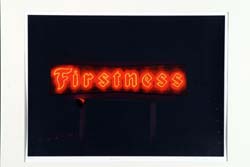
"The typical ideas of firstness are qualities of feeling, or mere appearances. The scarlet of your royal liveries, the quality itself, independently of its being perceived or remembered, is an example, by which I do not mean that you are to imagine that you do not perceive or remember it, but that you are to drop out of account that which may be attached to it in perceiving or in remembering, but which does not belong to the quality. For example, when you remember it, your idea is said to be dim and when it is before your eyes, it is vivid. But dimness or vividness do not belong to your idea of the quality. They might no doubt, if considered simply as a feeling; but when you think of vividness you do not consider it from that point of view. You think of it as a degree of disturbance of your consciousness. The quality of red is not thought of as belonging to you, or as attached to liveries. It is simply a peculiar positive possibility regardless of anything else. If you ask a mineralogist what hardness is, he will say that it is what one predicates of a body that one cannot scratch with a knife. But a simple person will think of hardness as a simple positive possibility the realization of which causes a body to be like a flint. That idea of hardness is an idea of Firstness. The unanalyzed total impression made by any manifold not thought of as actual fact, but simply as a quality, as simple positive possibility of appearance, is an idea of Firstness. Notice the naïveté of Firstness. [---] The idea of the present instant, which, whether it exists or not, is naturally thought as a point of time in which no thought can take place or any detail be separated, is an idea of Firstness." (A Letter to Lady Welby, CP 8.329, 1904)
*from Commens' Dictionary of Peirce's terms: http://www.helsinki.fi/science/commens/dictionary.html
Sunday, September 10, 2006
Words hinge
Words hinge
we are those
hinges
this is a grammar
of continuity
no.
Help yourself
to the spaces
between things
the breathing
between each breath
being for you.
we are those
hinges
this is a grammar
of continuity
no.
Help yourself
to the spaces
between things
the breathing
between each breath
being for you.
These Firstnesses
Which lushness is a correspondence an analogy of flowering
Your fingers positioned so in my memory of fingers
Or of these firstnesses before relation I remain hushed
Your body analogous bowing to our seconds flitting verities
Content to commence distance in blood so sequential
Because to be is to cause to cause shall see
This kiss with a difference our thighs lie
Uncovered towards a nearer blood
The city rises above us again twilight blue
In the sprinkle because to be is to cause
To cause shall see our delightful springing
Content to commence distance in blood so sequential
Your body analogous bowing to our seconds flitting verities
Of these firstnesses before relation I remain hushed or
Your fingers positioned so in my memory of fingers
Which lushness is a correspondence an analogy of flowering
Your fingers positioned so in my memory of fingers
Or of these firstnesses before relation I remain hushed
Your body analogous bowing to our seconds flitting verities
Content to commence distance in blood so sequential
Because to be is to cause to cause shall see
This kiss with a difference our thighs lie
Uncovered towards a nearer blood
The city rises above us again twilight blue
In the sprinkle because to be is to cause
To cause shall see our delightful springing
Content to commence distance in blood so sequential
Your body analogous bowing to our seconds flitting verities
Of these firstnesses before relation I remain hushed or
Your fingers positioned so in my memory of fingers
Which lushness is a correspondence an analogy of flowering
Eigenstates*
Summer pervades the lantern all quiet
Sirens around feet as I walk range
In grounds company effect & distance
Circumference of light long ago
Bigger than this difference of hearing I'm given to
How we are parts of speech to account for it
The yard its grammar disappearing here
In aspects different patch of way
*composed summer 2004 after the Larry Eigner Picnic, Blfo. Photo credit, Peter Manson: http://www.petermanson.com/eigner.htm.
Friday, September 08, 2006
What Happened Here

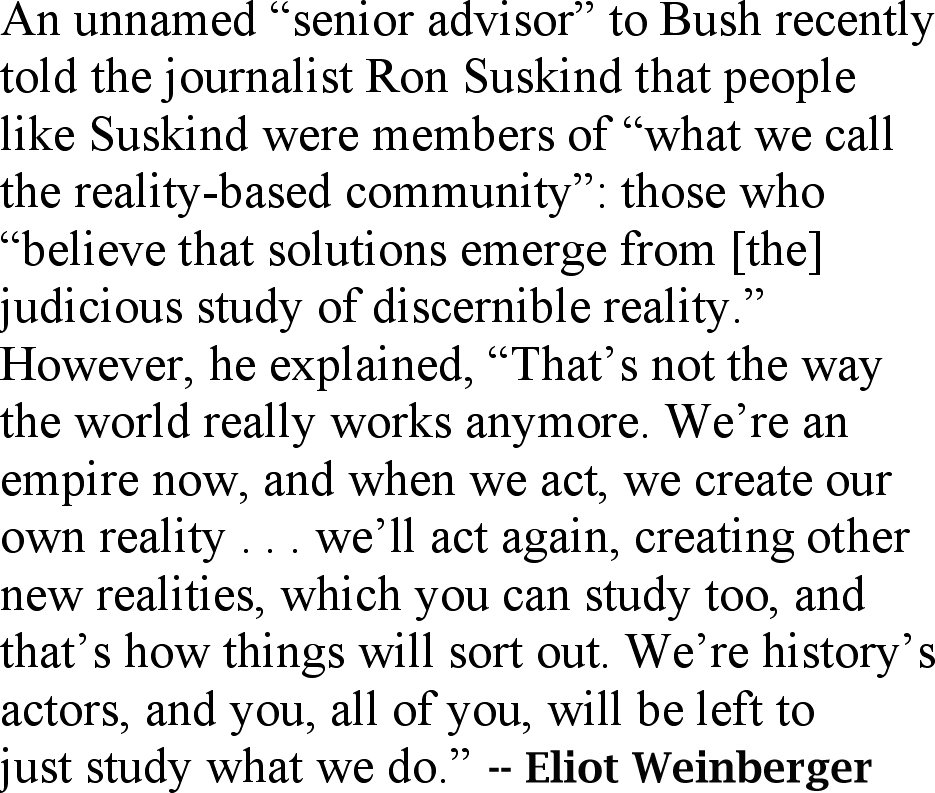
"Republicans do not like children. A little girl asked Richard Riordan, Secretary of Education for the State of California, if he knew that her name, Isis, meant 'Egyptian goddess.' 'It means stupid, dirty girl,' Riordan replies."
The above is taken from Eliot Weinberger's 2005 book *What Happened Here*, an essential chronicle of the W years. It is one striking example among many of the disturbing facts collected and arranged in the book. In *WHH* Weinberger sounds a political-ethical script after Charles Reznikoff's *Testimony* volumes and *Holocaust*, where hearsay and primary document reflect the antinomies of a hyperbolic (post-"Postmodern") political babble. If the hysterical pastiche of Flarf (or other individuals and groups currently taking up the problems of New York School and LANGUAGE communities) risks collusion with its contents--speech acts and cultural propositions riddled with hegemonic strategy--in an ostensible quest to call them into question, it may be interesting to counterpose the ironical effectiveness of a Rezi or Weinberger with those of a (Michael) Magee or (Kasey) Mohammad. The contradictions in the Bush admin are so rife, as Weinberger's "poem" proves, that one need only quote the administration's statements back, and arrange them with a kind of maximum torque of contradiction and rhetorical violence, to capitilize upon the cracks in the embedded U.S. political real (a terrifyingly banal surrealism surpassing Google's all-too-entertaining Boolean one). In Weinberger's book I sense the limit of what a poem can do during ever darkening times, if not a formal prescription to those who would write poetry to change the present face(s) of American politics: NOT APPROPRIATION, BUT FACTUAL ARRANGEMENT. *What Happened Here* is a necessary call to the direct action of collecting and collating Totalitarian facts and presenting them as poetic ones as the U.S. passes from a semblance of democracy to the blatent simulacra of Noble Lying.
Thursday, September 07, 2006

Wednesday, September 06, 2006
The Sacrifice
The flicker on their lips the bones
On their lips the bones which look
Look out from the face a portal of
Mortal harm the flicker in miniature
Pretending this isn't the end of the world
In miniature mortal harm the flicker
Out from the face a portal of look
The bones which look on their lips
The bones the flicker on their lips
On their lips the bones which look
Look out from the face a portal of
Mortal harm the flicker in miniature
Pretending this isn't the end of the world
In miniature mortal harm the flicker
Out from the face a portal of look
The bones which look on their lips
The bones the flicker on their lips
Monday, September 04, 2006


Friday, September 01, 2006
from "what wings raised: for Paradisical Beauty"

4. Do Angels See Anamorphically?
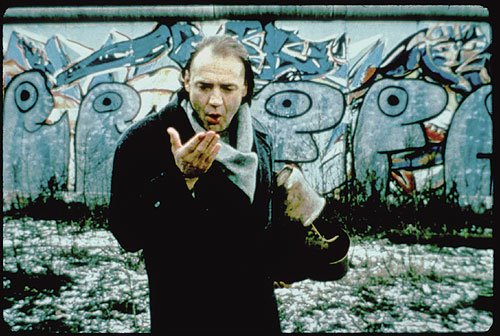
In Wim Wenders *Wings of Desire* angels do not see in black and white or color, but in sepia. Likewise, while Wender’s angels are telepathic (capable of reading the thoughts of others), and can teleport (be at any place instantly), they cannot experience the five senses of mortal beings, nor can they know death (Bruno Ganz is perplexed when he discovers his head to be bleeding) or sexual relations (Ganz, of course, eventually trades-in his wings to be with a human lover).
 In Adrian Lyne’s *Jacob’s Ladder* we do not see from the point of view of Danny Aiello’s Louis, however (as a Sufi Angel) we may imagine him to see like the Persian Sufi Sa’id when the poet writes:
 If the sword of your anger puts me to death,
My soul will find comfort in it.
If you impose the cup of poison upon me,
My spirit will drink the cup.
When on the day of resurrection
I rise from the dust of my tomb,
The perfume of your love
Will still impregnate the garment of my soul.
For even though you refused me your love,
You have given me a vision of You
Which has been the confidant of my hidden secret.[6]
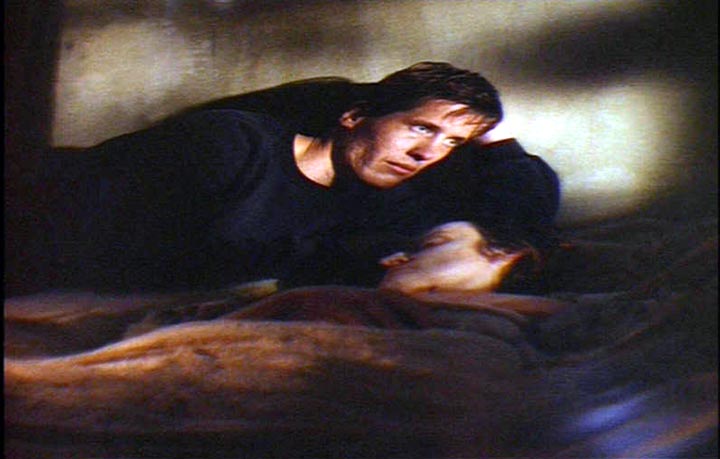
Jacob Singer (Tim Robbins) encounters any number of angels and demons as his soul transmigrates after a bloodbath among his troop in Vietnam, the terror of his Bardo given cinematic fact not only by the appearance of the demons who confront him--those without faces, eyes, and often limbs--and the predictions of a fortuneteller who tells him his palm is without a “life line,” and that he is therefore already dead; but also by the film’s swish pans which indicate “the fear of death-as-undeath that frightens one to death”[7].
 In Chris Marker’s documentary for Andrei Tarkovsky, *A Day in the Life of Andrei Arsenevich*, the French filmmaker points out how Tarkovsky’s characteristic camera angle differs from that of the typical American Western: where the camera of the Western points at an angle to the sky, Tarkovsky’s tends to angle towards the earth. This difference in camera angle indicates an important difference between American and Russian spirituality, as the American is regenerated by the transcendental promise of “big sky,” and the Russian by laying down in the earth, as many of Tarkovksy’s characters often do throughout his films.
One may often have the sense in Tarkovsky’s films that the point-of-view is that of an angel, or God itself. The concluding scene from *Andrei Rublev* provides one example of this, an aerial shot of the bell hoisted by an elaborate series of ropes; in the concluding scene of *Solaris*, the camera tracks revealing Kris’s home on earth to actually be located on an island of the oceanic planet.
In the opening shots of Alexander Sokurov’s *Whispering Pages* the camera, affixed to a boat which bobs in the water of a canal, tracks a building across the water while the shot is obscured by plumes of vapor. Birds that would seem doubly exposed fly in front of the screen and then land on the water; so ghostly are the birds that it comes as a surprise when they disturb the water. In a later scene, men and women jump from a landing to a place below, off-screen. While they jump the viewer hears a soundtrack, affected by reverb, of men and women talking loudly, cackling and laughing. These reverberating voices are non-diegetic, not matching realistically with the scene of the men and women jumping. In *Mother and Son*, the camera slowly descends as it cranes the couple sitting on a bench, looking at a photo album together. As the camera also twists while it descends, its motion mirrors the twisting trunks and branches of a tree beneath which the couple sit. In *Russian Ark*, Sokurov’s use of steady cam provides a constant sense that the camera is disembodied as it tours the St. Petersburg Hermitage. During the film, the camera often makes a focal adjustment that produces a feeling of vertigo in the viewer. The vertiginous effect of this adjustment—as if the lens were zooming-out while the camera tracked forward—is heightened by a *glissando* in the soundtrack. In Alfred Hitchcock’s *Vertigo* the viewer encounters a similar effect as Johnny-O (Jimmy Stewart) struggles to ascend the staircase at the Mission. Is this vertiginous effect of the camera in fact an effect of time travel? Both films travel “back in time”: *Vertigo* by reincarnation, *Russia Ark* by reenacting historical scenes from the Hermitage, and the nostalgic reminiscences of the film’s guide.
 While angels may see by steady cam and by slow tracking shots accompanied by a non-diegetic soundtrack, I wonder if they do not also see anamorphically? Along with the American filmmakers Sidney Petersen and Stan Brakhage (to whom Petersen gave his anamorphic camera lens as a gift), Alexander Sokurov is one of the great filmmakers to extensively employ anamorphic lenses—an optical technology originally imported from the Middle-East to Europe in the 16th Century[8]. In anamorphic illustration one finds an “accelerated” or “decelerated” (Baltrusaitis) state of optical abstraction, whereby one must look “awry,”[9] at an extreme angle to the plane of the picture, in order to see images in their correct proportions. In film, anamorphosis tends to elongate figures and give a swirling effect to their motions. By Sokurov’s use of anamorphic camera lenses, the filmmaker draws the viewer’s attention to a world deformed, and thanatological in this deformation. The anamorphic effects of *Mother and Son* are particularly telling of the optical phenomenon’s relation to death, as it gives due form to the mother’s *rigor mortis* at the conclusion of the film, and throughout the film all of nature--the trees, for instance, upon which the son leans and cries--seem themselves to mourn the mother’s death by the fact of their blurry elongations and wet, saturated colors. Likewise, anamorphoses provides a disorienting sense of space in *Mother and Son* and the film’s sequel, *Father and Son*, as the son of the former film (played by Aleksei Ananishnov) walks along a dirt path disappearing behind what appears a far away brush only to emerge directly in front of the camera, posing in *ruckenfigur*. Sokurov’s viewer may feel a similar sense of spatial disorientation as the two boys of *Father and Son* ride a trolley together, and eventually stand on an escarpment overlooking the city.
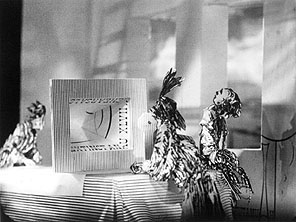
In the Quay Brothers only live-action film, *Institute Benjamenta* (1995), Jakob enrolls in the institute of the film’s title to be trained as a butler. In being trained, he first sees his lessons as repetitive and pointless, however gradually discovers in them an occult order. The exercises of these lessons, given by the master of the school, Frau Benjamenta--making a perfect circle of a cascaded set of spoons, folding napkins, reciting phrases one might say to the master of a house, swaying and intoning in unison with the other students--indicate a Grace not unlike that Heinrich von Kleist observes in marionette theater: “But, as the intersections of two lines, from the one side of a point, after passing through the infinite, returns suddenly to the other side; or, the image of a concave mirror after moving into the infinite appears suddenly again, near or before us; so, when Knowledge has gone, so to speak, through the infinite, Grace returns again, appearing at the same time, most purely, in the structure of a body which has either no knowledge, or an infinite knowledge, to wit: in a marionette or in a God.” In the total obedience of the Quay Brothers’ butler, the butler becomes like a marionette, and thus also like a God, involved with a universe of infinite mechanistic forces. It should come as no surprise that *Institute Benjamenta* was produced by a pair of filmmaker’s best known for their exquisite animation, insofar as contemporary film animation takes up, cinematically, problems similar to those of marionette theater and dance. Like the Nietzschean dancer in whom Alain Badiou recognizes the innocence of “a body before the body”[9], the butlers and animation figures of the Quay Brothers’ films overcome impulses to be mastered *by* (and therefore gain mastery *of*) invisible forces, perhaps giving answer to Simone Weil’s enigmatic question: “What wings raised to the second power can make things come down without weight?”.
Is the anamorphic distortion of a wall-painting in *Institute Benjamenta* a kind of key to the film’s own search for Grace, where such images are not only typically corrected by “looking awry,” but as well through the use of concave mirrors? As Jakob walks the labyrinthine corridors of the institute by night, he encounters a series of curiosities, including a clock whose second hand inexplicably disturbs a pile of dust as it traces its path, as well as jars containing the dried reliquary objects of deer. When Jakob leaves the hallway where the viewer sees an anamorphic wall-painting, he closes a door behind him and looks through a hole in the door to see, at the correct angle of the painting, a depiction of two deer engaged in coitus. Is the order of angels, like that of the institute’s labyrinthine architecture or the graceful pedagogy of Frau Benjamenta’s lesson plans, an anamorphic one insofar as it requires an optical correction to discover it? In such corrections may reside the necessary beauty of angelic intuitions.
Subscribe to:
Posts (Atom)