Friday, November 18, 2005

Meshes of the Afternoon (Quotes, Meditation)


"From the moment the first drop of blood is spilled, the martry does not feel the pains of his injury and is absolved of all his bad deeds; he sees his seat in Paradise; he is saved from the torture of the grave; he is saved from the fear of the Day of Judgment; he marries seventy-two beautiful black-eyed women; he is an advocate for seventy of his relatives to reach Paradise; he earns the Crown of Glory, whose precious stone is better than all this world and everything in
it."
--Sheik 'Abd-Salam Abu Shukheudem quoted in Barbara Victor's *Army of Roses*

“On February 25, 2002, Dr. al-Rantisi stated in an article in the Al-Ayat newspaper, published in London and Beirut, “Suicide depends on volition. If the martyr, whether a man or a woman, intends to kill him or herself because he or she is tired of life, it is suicide. However, if he or she wants to sacrifice his or her soul in order to strike the enemy and to be rewarded by Allah, they are equally considered martyrs. We have no doubt that those carrying out these operations are martyrs.”
-- Ibid.

“Thus at the same time as reaction to traces becomes perceptible, reaction ceases to be acted. The consequences of this are immense: no longer being able to act a reaction, active forces are deprived of the material condition of their functioning, they no longer have the opportunity to do their job, they are separated from what they can do.”
-- from Gilles Deleuze’s *Nietzsche & Philosophy*

This locution may be one of the major investments of the Lebanese war. It can only issue from someone who not only is unaware that he or she is already dead even as he or she lives, but also wants to extend his or her life even into death. Thus the testimony of Bilal Fahs, who drove a car filled with 150kg of explosives into an Israeli convoy on 6/16/1985 at Zahrani, Sayda, begins with the following Qur’anic aya: “And call not those who are slain in the way of Allah ‘dead.’ Nay, they are living, only ye perceive not” (Qur’an 3:169), and Sana’ Muhaydli says in her testimony: “I am not dead, but alive amidst you…” Notwithstanding over a hundred thousand dead in the years of war and civil war, the Lebanese seem not to have learned to die. Therefore, one of the great tasks of art and writing in Lebanon for the foreseeable future is to teach this people famed for being ‘life-loving’ to die, that is that they are already dead.
-- from Jalal Toufic’s *(Vampires): an uneasy essay on the undead*

“So the camera is moving as an eater of space, or a representation of space, and it is leaping in time. And the effect is that this is an amalgam of many walks, many men.”
-- Stan Brakhage on Maya Deren in *Film at Wit’s End*

Vengeance, the indefinite par excellence, here becomes a circle, therefore contained; with the consequences that guilt is as it were done away with, since we are dealing with a series of reactions with no initial action. Yet guilt is not really addressed and mitigated through recourse to either this perfect circularity where the constitutive injustice in the realm of the dead – due to the blindness of the vengeance of the shards of the minds of the dead – is occulted; or to ignorance, which is the result of self-interest (one is guilty of one’s ignorance). Indeed, what most often occurs as a result of the attempt at expunging any trace of guilt through a perfect circularity is the eruption of an unoriginated guilt (“I was guilty, abominably, intolerably guilty, without cause and without motive:”), the constitution of a vicious circle of a guilt that “demanded punishment… [which] consisted, fittingly enough, of being guilty.” One can be truly innocent only after confronting the aforementioned two guilts and even if one cannot extricate oneself from them.
-- from Jalal Toufic’s *Forthcoming*

*

The Lazarus Girls Dance

In that hell that is now – in the now
that is hell –
the now that is / now
and then and after / given as such
to space and time – your patience, our urgencies / your urgencies

She didn’t see – the body she – when she walked in – arrived / and on time yet – for the wind keys

She didn’t see - she yet the / body - as a tunnel - for dreaming - accretes

Undying -
the appearance of love

A fatal grip – of flowers - flowers / have not half-heartedly - fell / to shadow

To shimmey
this key
to Paradise
a key to dreams

This key to shadow - not yet a seizure
of the person - woman, women – not yet and / often

Having not grasped – her death / (yet) a woman – lifting the fatal / needle to not

Hear (the needle) / there is - no / soundtrack / no marks / of
falling
but the fatal / Raga gravel
on this endless path of appear

And mirror
the face
is a mirror – having / (not yet)
grasped - the face
(is) a mirror – suicided
inside

(inside) by her self / in fatal time – to leap - a breaded knife – but not yet / hurt – to repeat and combine

In fatal time - time repeat

And combine
time now – is itself – a / woman
(space) – holding
the key
on / her tongue
suicided – not yet
(by) her beloved / bereft
even – on the lips – of / consequence
her children –
call her the breaded one

A breaded – knife will / not help – your double (time) to kill –
the / key to shattering – and left alone / by these unwilled devices – what / device
left – alone will / accrete – not yet – or not any longer – multiple

Multiply a number of doubles / a number of devils

To accrete - holding the key

In clear shadow – clear shade / of mesh

What veil accomplice – of mesh what / mirror face felt – mirror this - is a song / for all – for no one – (women) suicided / by themselves – and others – binding – dynamite
turns inwardly for time itself

Reacted - and not at all - for time

To accrete

What veil accomplice – what
menace – (not) across / time – any longer
to bear
the longing - and / tears she
is –
compelled / sonambulist – rising by effort
of his limbs
why don’t you just hang / up – evidence – we are not
here – to be born across time

Not substituted – not a
mirror / face – a shattered
mirror – she / is walking
so – to swallow
to surface – what she can not / get – the key
to wind
the key – to wind is death

To Kingdom come / what don’t you get – not
your / death – born witness (martry)
across
unremembered time – the impossible
effort – agility
to climb – stairs and wake
a sonambulist

Waking to
your own death

as it – is not Paradise / delivered upon not arriving / having passed the chance trouble of
your doubles
the shattered mirror / of time – still waiting

Knowing less well – self-reflexive / the double – and her double – astral
or a virtual
corpse – you are not yet / Clear Light
Clear - Light
obscured
light of tunnel – back-tracking
camera
tracking back

Tunnel knowing not well – not / recognizing (the knife) yet – not the / dynamite or key – of plastic / to Paradise – us all

No one

Not the wind - no / one yet divine – not / the staircase (yet) you will / ascend / to descend (the fatal) – Ladder – re-creation / of the whole - world unwoken / world broken

Let us be for the having missed / do for the just missed - justice
the missing
to be just - and the blink

She – can only / catch – a camera

by missing

another – universe

a camera of accretions / substitution –
of the false

face for / another – false face shatter the / mirror in transit trance

Dream entrance a state in this (trance) is he and not / you dead (dream) this (he) dream / this he again

Dream this trance he (is not) yet / dead you - are dead until the end / there must be - another
created picture / picture dynamite stacks – or (the will) we pretend / to sublime melancholy –the figure / not

(in trance) again

Again affirmed / not in trance again

Chants / chance

Affirm

This is not
his will this / is not
your will not yet

To be suicided to be

Or accreted

Multiple -
this condition – our state
of health / leading you
back to you (as you) / (and you)
as him

Now ended
but not there / complete in / shattered accretion

For Maya Deren, for Eva Hesse, Wafa Idris -- 'suicided'?

Schlesinger's "To" / Conative Verse

Receiving Kyle Schlesinger’s poem “To” by e-mail, a work the poet composed after watching Scorsese’s Dylan documentary on television (Kyle BTW has long been a Dylan fan), I am reminded of the possibilities for conative, affecting verse through the use of recurrent syntactical patterns and serialist word combination on-the-fly. Here is the poem:

To*

Mind to tend
Mind to mind
Mind to mend
Mind to mine

Tend to mind
Tend to tend
Tend to mend
Tend to mine

Mend to mine
Mend to mend
Mend to tend
Mend to mind

Mine to tend
Mine to mine
Mine to mend
Mine to mind

To tend mind
To tend tend
To tend mend
To tend mine

Mind to time
Tend to time
Mend to time
Mine to time

To to time
To to mind
To to tend
To to mine

Time to mine
Time to mind
Time to tend
Time to mend

Time to time
Time to tone
Tone to time
Time to tone

To tone mind
To mind tone
To tend mine
To mind tone

Tone to hurt
Tone to mind
Tone to tone
Tone to mine

Hurt to hold
Hold to hurt
To hurt tone
To hold hurt

Such a work puts Schlesinger in the company of some of my favorite and most valued recent and contemporary poets, reminding one, perhaps, of many of Louis Zukofsky’s experiments in verse, and his insistence in *Bottom* and elsewhere on “recurrent” words and word-patterns as bearing evidence to the major tendencies, ideas, if not obsessions of a writer’s “lifework”; I am also reminded of that poet very much after Zukofsky, and particularly the rigorous serialisms of “Come shadow come and take this shadow up” and “Songs of Degrees”, John Taggart; as well as Charles Bernstein, in whose recent *Shadowtime* we find the harrowing and pulsating homage to Celan, “Dew and die”. To quote the first few lines:

“can dew and die can and die can tie his sin tap and
the war dew hoe and die has him and her and tar the
pry and […]”**

Truncating Bernstein’s poem as I have just done seems an inappropriate thing, the poem compelling the reader beyond itself to keep chanting the rhythms of the poem, if not the particular words themselves, taken up into a kind of perpetual motion machine of lyric. Not a small (or large) machine made of words, but a simple machine achieving maximum effect (and affect) by monosyllabic and conjunctive insisting.

One constantly asks (and should of course continue to ask) what a poem can do? That is, what words can effect, how they can move, inspire, enlarge or intensify experience, how can they produce consciousness, and how they can exist as practical objects -- not so much functionally (in what sense could a poem be a function?) or instrumentally, as being pragmatically towards actions taken in the world: towards actual bodies, interactions, things. Such a question is a practical one, but it is also one of what Spinoza called “conatus” -- the co-striving of beings for continued existence. Literalizing Spinoza’s term (and allegorizing "our" letters) I wonder if words don’t also exist conatively?

Spinoza’s term conatus is grounding of his Ethics, insofar as ethics can no longer be founded on ‘truth’ but, to paraphrase Deleuze, upon ‘what bodies can do’ – an evaluating akin Nietzsche. And not only what bodies can do, but what they do by the fact of what they are necessarily -- by their ontological tendencies. Therefore what is ‘evil’ is only that which will not cooperate with a given body by its chemical, biological or (problematically, as the heads of social Darwinism rear) cultural composition. The problems of human good and evil, an ethics of human animals, is a problem of to what extent bodies affect one another in ways given to cultural production, and cooperation within social interaction and affiliation.

A means for this costriving as an ethics of cultural production is, I would argue, the poem itself. The poem, as much as it is an intellectual thing, a thing of consciousness raised and made complex, is also a site where mind and body engage each other, and, perhaps more importantly, ARE for and of each other. Perhaps what we feel before we think, what we feel as we think the words we are reading (just as we might also hear them reverberate by voices in the air), are both emotions the stirrings of ideas and ideas the stirrings of emotions -- simultaneously, and inextricably. Or says Blake (and notably Bernstein quoting him in his essay “Words and Pictures” and his address to Bernadette Mayer, “The Only Utopia is Now”): “The tear is an intellectual thing.”

Or as Schlesinger writes to me, giving me permission to publish his poem "virtually" and comment on it:
"If you’re inclined to stomp on the chorus pedal, by all means, reverberate with vertebrae."

*

Notes reading “To”

In affectivity mind and body are bound mutually to the nervous system – and centrally, the discs of the vertebrae as those portals of mind / body, sense / non-sense. To move is to weave mind and body intensely, by sense in duration. To rest to act and act to rest. To find “perfect rest” - in Zukofsky’s Spinozan parlance – as a means to action.

To be ‘to’… the poem is an address, a speech act with an indefinite addressee; ‘to’ also intends an action virtual not yet or no longer made actual. A preposition = virtual action. Pre-position. One doesn’t “do” but one is ‘to’: about ‘to’, doing “this” ‘to’ do “that”. Equi-vocating?

Equivocalizing as affecting.

The first 4 stanzas establish a cross-bred equation / equivocalizing of the words 'mind' 'tend' and 'mend' and of the phonemes “m” “t” “i” “e” “n” “d”.

The spell / accumulated effect of these textual units becomes broken at the 5th stanza where the insistent pattern “x” 'to' “x” / “do this” 'to' “do that” turns to what I read as declarations of virtual action: 'To tend mind', etc. However we must shift our attention between two ways of reading the statements, to 'tend mind' inviting a reading of 'mind' as a verb and a noun, and this flickering between verb and noun slowing and speeding the reading of the poem -- noun delaying, verb accelerating.

Stanza 6 is a jumbling coda of the first 4 stanzas.

Stanza 7 I immediately read after the early “Phase” pieces of Steve Reich, 'to' first doubled in my reading attention – an echo of attention. But then I realize the 1st 'to' is not so much a stutter double-timing, but an activating word (for lack of a better term). A word highlighted in what it enacts and therefore is. ‘To to time’ as in “Use the word / the preposition 'to' to time” or “'To' is to / for time / timing”. By using the preposition 'to' (as I’m using it) I position myself to / towards time, I act within it while being acted upon, affected. The time of the poem / poem as time as inter-action. The attending of my being affected in a duration the partaking with the words comprising the poem.

“To” to affect being always duration. A matter of how the words are read in their ambivalent arrangement.

Reading throughout the poem, but especially in the final stanzas as words are recombined quicker, more intensely, the ambivalence of the words, not to mention their "abstraction", wear the attention down – attenuate consciousness. Like prayer? Chanting, meditation, incantation. Sense or meaning giving way to "pure" sense of sound – the sonority of words woven, recurrent, held (and 'hurt') in my reading attention. The poem stares /sounds back at us, echoes, reflecting as it enacts, enacting as it attends, as we attend it and it us – 'to'. Positioned 'to' and we 'to' us...

Finding rest (not "perpetual peace") to perhaps 'hold hurt' (index), to 'tone' down (chill out), to 'mend' 'time' (heal), to 'mind' what is 'mine' and what is Mind (shared).

Since I can’t remember an appropriate Dylan line right now, Steve Reich will have to do:
“While performing and listening to gradual musical processes, one can participate in a particular liberating and impersonal kind of ritual. Focusing in on the musical process makes possible the shift of attention away from *he* and *she* and *you* and *me* outward toward *it*.”***

*"To" as received by Schlesinger in e-mail attachment is centered on the page, in Helvetica 12 pt.
**There should be regular tabs between all the discrete words of this excerpt from "Dew and die", however I have yet to learn how to re-code the Blog format. Please forgive!
I emphasize the absence of the tabs because they are crucial to the reading of the poem in its propelling and plosive energy. An energy where the breath picks up the energy it leaves behind wherever it left off. What occurs to me reading the poem to myself and aloud is how the absence of grammar (other than of course tabs) doesn't matter, so long as you keep articulating the words, keep pace and tendential rhythms.
***From Reich's "Music as a Gradual Process"

Tuesday, November 15, 2005

"Karbala on Their Lips"

IRAN 1979 (The Necessary)*

The ‘human wave
attacks’

represented

the most
disturbing

and gruesome
parade

of mass self-
sacrifice

in

living

memory comparable

only to
battles

at Flanders during

the First World War
in which

tens of thousands

of men were hounded

from
their trenches

into

the firing range of the newly

developed machine guns in

the seventy
years since

no officers

or army leaders had been
willing to pay

such an
inconceivable
price

for such tiny territorial
gains

the most striking
thing about

the Iranian
‘human
wave attacks’

however
was the degree

of readiness to die
it caused

Iraqi machine

gunners to flee

not only because
they ran out
of

ammunition

but also because they were driven

almost mad because

they could no longer bear

to shoot children
the same

age as their own

until the 1979
revolution

these children

grew up just
like
children

anywhere
else poor

perhaps not
entirely happy but

all the same

with a profound
sense that it was better

to be alive
then

dead now

they
were

rushing to

their deaths as if
the world

had been

turned upside

down

and it was always
the same
word Karbala

Karbala

on their lips

Karbala

on their flags.


*all words from Christopher Reuter's *My Life is a Weapon* (2004)

Monday, November 14, 2005

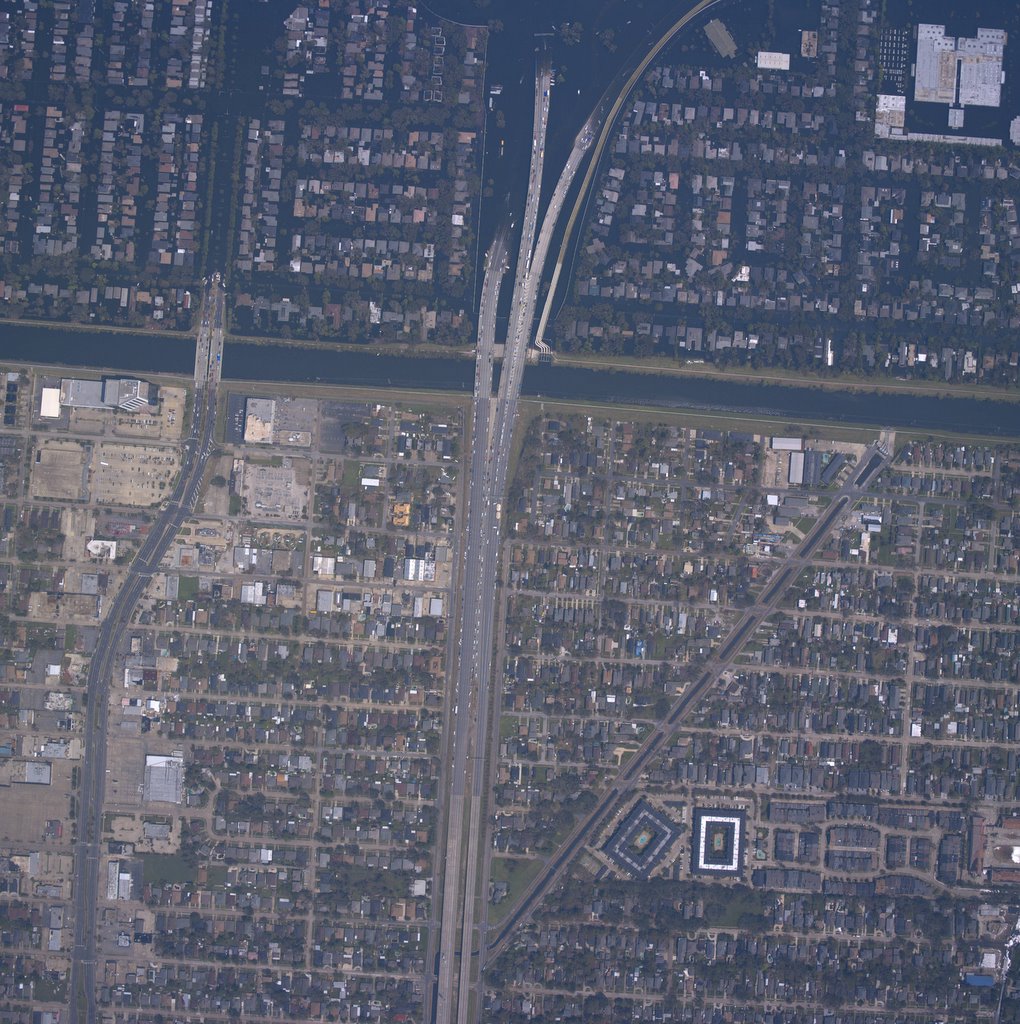
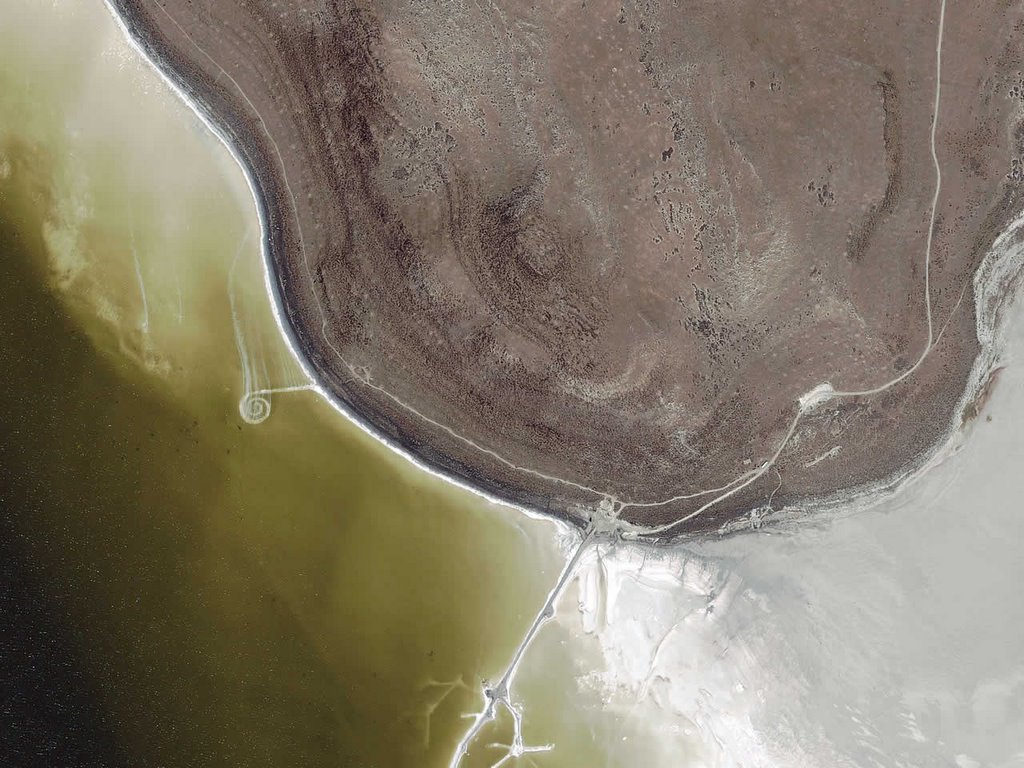
Smithson’s Katrina (Notes)


Library-late-concerns

‘Non-site’ as ‘mediation’ (Adorno) enfolding the ‘real’ / ‘site’.

Katrina photos – as ‘dialectics at a standstill’ (Benjamin) where ‘site’ / ‘non-site’ produces a lightning of reason and imaginative blindness at a nexus of the culturally antagonistic.

Attending the Whitney’s Smithson retro. with Jane Lea and Brandon Stosuy and looking at New York Times photos of New Orleans afterwards, Brandon comments how the photos remind him of Smithson’s non-sites.

“Before / After” from space (aerial photo) = the mark of ‘occurrence’, ‘there is’, ‘now time’.

‘Natural’ – as neutral terror.

Problem: to aestheticize natural disaster. But what if aestheticized (graphed) natural disaster leads back to our ‘anthropocentrism’ / ‘Humanisms’. A floodgate of the particular, of the lived-intuited.

From outer space ‘we’ is the ultimate abstraction, like money or art. Apropos Stein’s writing on ‘human mind’ in *Geographical History*, money, masterpieces, etc. But abstract must lead us back to ‘real’ in its eruptions.

Imagine: a Smithson non-site not w/ rocks and typical geological contents, but with the objects of the dead and survived – articles of clothing, water bottles, objects describing race / class conflict. A recuperation of Smithson as political, the play ‘abstract’ / 'particular' as unavoidably political.

Or could water simply evoke such contents now?

The artist must be mediator between industrialist / environmentalist (Smithson’s late dicta).

The artist must be mediator between
FEMA / people ‘on the ground’,
State / Inhabitant-Citizen,
Environmental / State–designed terror (the conditions which make for terror)?

The tears of this grid become the tears of real people. The tears of this grid broken, the tears of force.

Reduced to the animal, the ideal / abstract presents itself in its fragility, its lack of support.

The tears of our abstractions, our plans, our projects.
The tears of non-sense.

A fragile word: “tears”

Conveyed in pictures (reproducible) more than the eye. Words vs. pictures. Non-sense and sense.

Our plans, our projects.

Which is more particular?

Fragile newsprint, and collage of newsprint that will both decay.

Despite reversing our steps in the sandbox, playing the film backwards.

Benjamin’s storm made literal. Geo-graph-crit-ical.


Composed c. 9/26/05

Nevelson, Again


Colorless guilt
This self-fashioned
Light

Of the shipyards
Shore grey
Beardless

Presence of an after
Math after
An aftermath

Wood assumes
Number to not forget
This distance

Beyond the pale
Of settlement
Into

The arms of this shadow now
An uncolored
World we sing

Pogram’s program
A more
Immediate Kiev

They destroy destroy
Again
For the 29th

Time to ruin
Ruins affix stack
This not world

Variations
On seen things
Seen

Words and wood
What definition
Variation

Of the present
To measure slivers
Through the city scraping

The eye
Fresh it seemed
Pure conscious, pure

Sense pirch
On rocks for thousands
Of years we stand

In this night-
Mare,
Counting

Shadows
As they fall
From earth


Composed 9/12/05
after extended time w/ Louise Nevelson’s
catalogues, JPEG's of *Black Garden Wall III* courtesy
Anne Grady, & Nevelson's biography, *A Passionate Life*

Thursday, November 10, 2005

"Every Name in History is Hannah" (Paper)


Here is a paper I presented at The CUNY on Contemporary Poetry Conference this past weekend. I will be revising it for footnotes and citation this coming week, so please forgive these details. Forgive also transcription from Weiner's *Spoke*. I have yet to figure out an appropriate and efficient way to transcribe Weiner's unconventional type-settings.

Any feedback would be appreciated.

An idea after the conference...: can some of us working with Charles Bernstein (Weiner's literary executor) attempt to compile an extensive oral biography of Hannah based on reminiscences of friends, aquaintances and peers? This seems a good idea where very little writing exists about Weiner's life beyond scattered small magazine stuff (however essential this always is) and the books / MS's themselves in their radical diaristic / journalistic forms. Perhaps some of us could do this before the tenth anniversary of Hannah's death in 2007??? Any idea, also, how she may be celebrated on this important anniversary?

Here goes the paper:


Every Name in History is Hannah: on lyrical necessity in Hannah Weiner’s *Spoke*

The temptation of temptation is thus the temptation of knowledge. The repetition once begun no longer comes to a stop. It is infinite. The temptation of temptation is also the temptation of temptation of temptation, etc. The temptation of temptation is philosophy, in contrast to a wisdom which knows everything without experiencing it. Its starting point is an ego which, in the midst of engagement, assures itself a continual disengagement. The ego is perhaps nothing but this. An ego simply and purely engaged is naïve. It is a temporary situation, an illusory ideal. But the ego and its separation from its engaged self so that it can return to its noncompromised self may not constitute the ultimate condition of man. Overcoming the temptation of temptation would then mean going within oneself further than one’s self. Cannot the pages upon which we are about to comment show us the way?
--Emmanuel Levinas

1. Some facts in the case of Leonard

-- During the February, 1973 occupation of a Sioux reservation in South Dakota by participants in the American Indian Movement, or Wounded Knee II, the US government undertook illegal, if not blatantly terrorist, intelligence actions in order to infiltrate the AIM organization. These tactics were carried out in collaboration with tribal vigilates under the leadership of the local tribal chairperson, Dick Wilson, and his organization, Guardians of the Oglala Nation (or GOON for short).

-- As a result of these tactics, 64 local Indians were murdered and 300 reported harassed and beaten. These acts of violence have never been adequately investigated by the US Fed. Gov.

-- In the wake of Wounded Knee II, a Federal trial was held in which testimony was given by a Mr. Moves Camp against AIM leaders Russell Means and Dennis Banks. This testimony was proven fabricated and a mistrial declared by the presiding judge. The jurors requested that the case not be appealed.

-- In May and June of 1975, SWAT teams were assigned to the reservation and the rate of violence and death soared.

-- On June 26th, 1975, two federal agents, Jack Coler and Ron Williams, were killed in a gun battle on the Jumping Bull Ranch in South Dakota, where AIM supporters gathered at the invitation of reservation elders. To this day, both the gunmen and the red truck in which they rode remain unidentified.

-- A victim of evidence and testimony long since proven fabricated, AIM leader Leonard Peltier remains in prison to this day for his alleged involvement in the death of the Federal officers. His current date of parole is pushed back to 2008 – 20 years later then the date specified by the parole laws of the US gov.

-- In April 4th 1984, the year of copyright for New York-based poet Hannah Weiner’s book *Spoke*, the 8th Circuit Court ordered an evidentiary hearing regarding newly discovered evidence in the case of Leonard Peltier, including FBI perjury and the manufacture of the alleged murder weapon. In Oct. 1 thru 3rd of the same year, the judge presiding over Peltier’s case, Judge Benson, denied Peltier’s appeal for a new trial despite the FBI’s admission of perjury.

The case of Leonard Peltier and AIM inform the background of Hannah Weiner’s *Spoke* in a crucial way, the manuscript in which, to quote poet and scholar Judith Goldman, Weiner’s “extreme identification” with Native Americans may be said to come to a head, if not to reach a point of crisis intensified by other events in the poet’s life: the apparently failing health of her elderly aunt and mother, whom the poet visited frequently in their native Providence; as well as the poet’s increasing desire to be published and recognized for her output as a writer, to achieve literary notoriety if not fame.

Such a crisis arguably becomes a kind of test for “clair style” -- a form of writing practiced by the writer since a series of MS.'s in the early 70’s when she began to envision text in her immediate environment, and on her manuscript pages while composing. Says Weiner at the outset of the 1974 *Clairvoyant Journal*, the MS. culminating her formative experiences of “clair style”: “I SEE words on my forehead IN THE AIR / on other people on the typewriter on the / page These appear in the text in CAPITALS or italics.”

Something particularly unique about *Spoke*, and why it may be said to bring Weiner’s “clair style” to a head, that is to raise the stakes of the writing, is the extent to which the book foregrounds the practice of naming as well as that of pronouns, especially the pronoun “I”. This foregrounding is not unique to Weiner’s *Spoke* nor her writing in general, as it is also foregrounded by many in her closest peer group: writers and artists living in New York and associated, however loosely, with LANGUAGE, St. Mark’s Church, and a continuum of other avant garde venues and individuals who in the 70’s and 80’s explored forms of writing variously questioning and demonstrating the antinomies of lyrical personalization and textual authority. In this presentation, I will try to negotiate the importance of Weiner’s shared concerns for issues of compositional intentionality and textual authority with the uniquenesses of her compositional practice and her condition as someone diagnosed (however accurately and problematically) with schizophrenia.


2. Sirnaming

On one of the first pages of *Spoke*, a page unmarked by any number (but presumably 1 since the next is 2) and identified rather by the date, “June 13th,” a problem of naming and names is immediately present if not accounted for: naming here may be associated with childhood (and adult) writing exercises, “schoolwork,” or learning to write one’s name properly; it may be associated with cycling on a domesticating and interiorizing exercise bike opposed a roadster – the spokes upon which the book's title obviously plays. This ambivalent scene quickly takes a turn to “my right Hannah” and the names Bruce Andrews and “the language group, ” a group Weiner clearly identifies with explaining “ it is always / ok to use the name bruce andrews” however she may also expect being “scolded for it”.

Sir (s I r) name / some name / no name / my name / the name / who name / myself name:
these are some of the (non) names Weiner provides instead of proper names.
To defer their inscription? To defer naming as an act of identifying, of mnemo-technique as disciplinary?:

“NAME WAITS don’t write it in Mary slightly suspicious it name”

Foremost, “sirname” is an obvious pun on “surname” as an instrument of patriarchy, the name handed down by parents, and by culture determined to interpolate, therefore adjudicate. “Some name” / “my name” is a deferral by making general, the de- or in- differentiation of name as index or wound (Symbolic Economy 101 (read: binary)). To both defer and indicate naming – “who name,” “my self name” -- is to perform and effect oppositionality.

But there are stakes to deferment / denominalization Weiner seems all too well to recognize. To defer or refuse naming is to forego inscription in a commemorative order of authors, erased from literary economy, however faint and marginal that economy may be. To place her name among “the language boys” – where “girls obey orders of course” – Weiner realizes is to reproduce the authorial function stealthily under the guise of “avant garde” written forms that manifest contradictions of authorship, enunciation and literary economy. However to finally write the name “Hannah” within her manuscript (which Weiner does significantly in handwritten signature at an edge of typewritten standardization and photo-mechanical reproduction) is to become or make one’s self “silent”. Such an erasure is qualitatively different than “speaking silent” if to speak silent is both to transmit bio-cultural know-how (knowledge) under the pressure of persecution / genocide – the situation of course of Amerindians – or to very literally do so where writing displaces speech as heard presence / non-silent speaking. To speak silent, as ‘sposed to Spoke-ing, as Judith Goldman also argues, may adequately instance the major contradiction at the heart of Weiner’s practice and possibly language itself. That to not be silent is to more often than not become complicit; but to not become complicit is more often than not to become erased.


3. A FEELING for / or Every Name in History is I?

On pg. 32 of *Spoke*, Weiner apostrophizes in uppercase A FEELing for THE WORKERS of a postal strike:

“sis its just a small sacrifice to write postal
strike LEARN WHAT THE WORKERS about it
FEEL”

Can one “learn what the workers feel” because “the mind thinks faster then we speak” --
or write for that matter?

A feeling of the embodied mind writing in non-intent.

Beyond / before the revision of palimpsestual MS.’s I’ve yet to see but I may imagine or FEEL already, I may undergo a mindful-affective act of composition in the act of reading Weiner’s published books carefully and recklessly. Flying fugally to next expression “fugue” also may refer to psychotic episode. Such fugal flight – compositional action that binds writing to emotions where the will burns its wick at both ends proves identification – a declaring “I am” / “we are” -- not merely rhetorically effective, but perhaps the objective phenomena of going through the affective dilemmas of unique others, other instances in “space-time”. I is not I, then, any longer when we FEEL (where SEE and FEEL are interchangeably visionary)? Or “every name in history is I”?

“I was warning signals instantly on the red cross”
“ I was Hannah”
“I’m 68 before I DIARY become”
“I was weaken”
“I will read it until I die above.”

I am wondering if these are mere speech acts / another performance theory enacted out of pragmatic exigencies? Or born of another different necessity?


AUG 17

mattress I was open openly I didn’t think I was acid
problem I was quilt I was waiting for the entire I
was waiting for an hour to pass by I was curtain conscious I
was spelling it correctly I was conscious I was
important I was also leader I was blue pen conscious BIG
FOOL I was writing in it with it I was instructions
I was paper conscious I was a problem to my
inmates I was jail sentence I was liquidated just
once I was overweight too I was conscious problem I was a pillow
case I was in the closet I was an iron put the public
in the living room couch and don’t mind with the buttons on
and don’t spend any mothers money publicly I was hysterical
just once in a while
I was secretary I was Indian I was too conscious

Around pg. 59 of *Spoke* the pronoun “I” initializaes a sort of incantation, an incantatory repetition by which the reader may feel themselves transformed by insistent energetic pattern but also the specific over-determination of compelled declarative writing. The insistence of an “I” declaring its identification w/ people, places and things punctuated by non-regular tabs and other non-signifying expressive “spaces” begs a shared problem of Weiner’s most sympathetic contemporaries. Yet where identification, say, in Bruce Andrews’s *I Don’t Have Any Paper” explodes ventriloqual quilting points, and any number of texts by Charles Bernstein effect bathetic gems of Brechtian mannerism, Weiner’s identificatory statements (however also performative, ironic and self-reflexive) seem to erupt and inter-rupt uncompromised by a tragic will to power. It is in the sense of this constellating, or triangulating, that Weiner may in fact truly be the “test” or even the dream for and of Language Writing, insofar as her necessity embodies the productive, if not utopian, intent of a group of individuals to bear out the contradictions of late-Capitalist lyrical selfhood by becoming schizophrenic text beyond any rigid Marxist Structuralism.

Does not Deleuze / Guattari, and Pierre Klossowki before them, speak of such a necessity when they refer to Nietzsche’s so-called “psychotic” letter writing to Swiss historian Jacob Burchhardt:

This is what Klossowski has admirably demonstrated in his commentary on Nietzsche: the presence of the Stimmung as a material emotion, constitutive of the most lofty thought and the most acute perception. “The centrifugal forces do not flee the center forever, but approach it once again, only to retreat from it yet again: such is the nature of violent oscillations that overwhelm an individual so long as he seeks only his center and is incapable of seeing the circle of which he himself is part; for if these oscillations overwhelm him, it is because each one of them corresponds to an individual other than the one he believes himself to be, from the point of view of the unlocatable center. As a result, an identity is essentially fortuitous, and a series of individualities must be undergone by each of these oscillations, so that as a consequence the fortuitousness of this particular individuality will render all of them necessary.” The forces of attraction and repulsion, of soaring ascents and plunging falls, produce a series of intensive states based on intensity = O that designates the body without organs (“but what is most unusual is that here again a new afflux is necessary, merely to signify this absence”). There is no Nietzsche the-self, professor of philology, who suddenly loses his mind and supposedly identifies with all sorts of strange people; rather there is the Nietzschean subject who passes through a series of states, and who identifies these states with the names of history: every name in history is I…. (*Anti-Oedipus*, 21)

The non-subject of the speech act “every name in history is I” passes thru history / undergoes universal history / cosmic duration not as chronological or synchronic but the passage thru singular affective states in eternity. Can another person, a household object, an American president (Ron. Reagan), a Uranium contaminated landscape, and a civilization under erasure constitute an affective state to embody? Is the one who declares “every name in history is I” under pressure of necessity, for lack of a wiser term, “ontologically prioritized” or “privileged” – where one’s privilege is aristocratically to assert difference in non-reciprocal generality.

There is a long and on-going history of the subaltern – and women and minorities especially in 19th century --speaking as mediums to become authorized by ventriloquy. Mediumship is a language pragmatics Weiner is all to well aware of, references and even pokes fun of throughout her texts. Not to mention her wonderful plays on Orphic sublation – “going down” being literalized by words subscripted: “ I was openly tested with an Indian movement / as a leader humble in origin an antichrist special under the line special which is the underworld as I CAN SEE IT as / I am trouble in overcoat don’t mention names”

It is this reading practice and involvement with Hannah Weiner – one of our most important writers – I would like to recuperate: to play between Weiner’s very successful navigations of a symbolic order, an order determined by inscription as interpolating, and a sense simultaneously Weiner is excepted from “the law”: not as a moral citizen or a subject of want but as one experiencing and journalizing, to use the phrase of Jalal Toufic, “death before dying”: a bardo which, like that of a Kafka, a Schreber or Artaud, often made the poet both fearful and supernaturally joyful.

If Weiner’s rewriting / copying of the 1868 Fort Laramie treaty into the final pages of *Spoke* fails deliberately as a well-intended act of representation, to represent the case of the other under erasure in a legal economy in which to speak is to be complicit with the discourse of the party “I” would otherwise attempt to prosecute, forgiveness may only be possible where the I over-identifies in innocent feeling to “the united states on the other side of the page.”

Avenue A
New York
Thom Donovan

Monday, October 31, 2005

Bouncing (With Creeley)

"the most abstract fucking fact"
"bouncing"
"to be in my life"

*

Creeley / Cruelty

*

Not to look
That hard at things
To pick the wrong
Word
That would lack
Emotion actually
Locate
Here as wherever
Is
In fact speech

*

I say
To her appropos
The man drunk in our party
Acting
Like a shit
I want to become
Reckless through rigor there
Is an ear
Keeps over-hearing
All of what
We play
As we are always playing
Now

*

An ethics (if an ethics
there ever can be):
our radiant
attention attention
(and even distraction
will always trump
intention, like touch
does
the eye, and the eye
our theories always when
we really look
I mean really

*

I'd like to know
their inner-monologues
the audiences' when Nicholson smashes
his palm against
red chewing gum he'd stuck in
white plaster wall,

there were things of course
we saw on film
never cld have seen on dinky tv
things on the outskirts of 35mm. projection
a glass
bottle containing
transparent liquid for instance
water perhaps
meant to be
vodka

Friday, October 28, 2005

What Wings Raised


"To come down by a movement in which gravity plays no part. {...} Gravity makes things come down, wings make them rise: what wings raised to the second power can make things come down without weight?" -- Simone Weil