Friday, August 12, 2011

CJ Martin's Cosmetic Practice (Q&A)


This past month I corresponded with San Marcos, TX-based poet, CJ Martin, whose book, Two Books, just came out as the first imprint on Michael Cross' new Compline press. What has always impressed me about Martin's work is its rare attention to words as built worlds, as well as its choreopoetic virtuosity (the fact that the poems never stop moving, that the mind (perception, mindfulness, cognition) dances constantly within his lines). In Martin's work one feels as though they are reading a totally new prosody, poetry in its firstness. Wanting to understand his process better, which relies heavily on note-taking and the sculpting of others' texts, I asked him to go into some detail about how the poems of Two Books were composed (posted below). To order his book, which I highly recommend, go to Compline's website.

Thom Donovan: Your description of procedures makes me want to press you to describe in more detail. I mean, is it like Google collage or more like David Antin's Meditations (or something completely different?). One “take” or heavily produced? Sculptural or improvisatory? I find your description of taking up Norma Cole’s vocabulary or wanting to repulse Whitman intriguing, the word "repulse" reminding me of the cardiac in Zukofsky and Duncan, how the line is ever this physical thing determined by encounter.

CJ Martin: In a poem called "Face Essay" that I've been returning to after a couple of years, there are a couple of lines that might be useful here. Neither's mine. The first is Norma C's, actually: "interface / interfaith"----& the other's from a church billboard somewhere near Bryan, TX: "America needs a faith lift." In part, why the term cosmetic appeals to me is that its critical edge highlights the profanity, the complete trashiness, of getting visible---the fucking faith lift is brilliant (as pun) but just completely terrifying (as principle)---dear lord, suck out the fat of my faith, lift it up & stitch me back! Suck out the nation fat (deport it, suppress it), iron any wrinkles & make me look young again. The proximity b/w faith & face is kind of astounding in its obviousness, but as anything more than proximity, I'm not entirely convinced. That interface would necessarily be interfaith is kind of a given after a certain point, but as program it's so UN ('In your faith!', might be more like it, in terms of an encounter in the world).

So, the cosmetic as practice: all surface. Not contra depth, but as against the notion that surfaces have no depth, no gravity ("wall paper"). Against the notion that the work of a poem would be to arrive at unmediated depth, and against, in particular, the benchmarks of that effort (namely the sentence, the topic, the thought). Critical of a disdain for surfaces that gets aired, say, in places like Oppen's "The Mind's Own Place," given that the preferred program's a drag, too (we've known masculinity's a drag for awhile now, but too many poets seem still not to have recognized their participation as 'put on'). Cosmetics has abstraction (of language material, from meaning) as its plastic edge, attempts to recuperate abstraction as fundamentally political.

Cosmetic reading (which is cosmetic writing) is surface reading, reading as appendage, as drawn on (rather than as responsive, engaging). The procedure involves cloud-computing a vocabulary by

1. locating a surface (a page, a spread, an arrangement of multiple spreads of same number across multiple books, a digitized text, audio,
etc.) then

2. determining/arriving at a constraint. Early on, in the first of the Two Books, this was more annotative/straightforward collage—culling notes on reading, shaping & reshaping them, restrictive, but basically as organic as constraint could be for me at the time. Beginning w/the Worship poem (2nd book), a version of the mesostic was used to collect text: I'd write 'across' a surface by doing a line reading of a page & locating the first occurrence of each letter in a word/phrase I'd chosen, then collecting the first word containing the first letter in the first line, the first word containing the 2nd letter in the second line, etc. With one caveat: the first two sections of the Worship poem were largely written while listening to some kind of audio, & the procedure allowed for borrowing from the air as from the surface. Courted the blurred line, even, as dissonance. Sometimes the faux mesostic was abandoned in favor of a vertical reading (i.e.--a quick theft of the left-hand margin of a page, usually heavily sculpted) or, when digital, a control F constraint (like, say, control F "worship" in a digital copy of the HD Book & collect words on either side of that word). My reading of Whitman was repulsed by this function (ie turned away from itself), using passages from Ngai's Ugly Feelings. Whenever a reading splayed across & out from a constraint, it was permitted the turn. The 1978 poem was a slightly different constraint, too: (almost) all vocabulary had to be suggested by Cindy Sherman's film stills from '78, w/ a conscious effort not to 'write' the photos (fails sometimes miserably, but only if you really know the images or have them in front of you). So, that poem's kind of an anti-descriptive, treating the photos as lexical & trying to pry apart some of their material. In Wardrobe there are other procedures, like for ex the 2nd to last section in that poem, which is a back-masking of Wordsworth's "Prelude."

All of which I'm telling you b/c you asked! (Sorry to ramble on.) It may be that these notes would have been helpful if they accompanied the poems, but really it's not as important to me that the concept works itself out in the practice, successfully, or that the poems are understood in that context. More & more I feel like I'm settling into being a very poem-y poet---preoccupied w/prosody to such an extent that engaging the practice itself is sufficient to make me think I've written a poem--the positioning of material, not often towards elaborating sense. I'm writing a poem now called "Rhyme Eats the Words" (a quote from Meschonnic), which maybe says it all.

Thursday, August 11, 2011

After Matt Mullican

We put our fingers in death’s mouth, up death’s ass
To know we are objects, to remain objective
This represents “that person,” a kind of fellowship

With the dead, mysticism is our business
Though weary with wonder, always the link
Between death and the photograph, because that

Person or thing is no longer present, mark time
Through banality, specimens pinned as
Though once lived, giving life to shade that pinning

Seems the potential for something to move
Anything that means something, no association is free
We pay for it with our lives, in dailyness the whole

World’s draft, memento mori, this recognition
That we are living in someone’s place ancient
As our sense of bad faith, ancient as any symbolism.

Monday, August 08, 2011

Arthur Echo Echo (@ Jacket2)


The ever close listening Eric Baus has a nice write-up about poetry after Arthur Russell at Jacket2, featuring audio of me and CA Conrad reading our collaboration, Arthur Echo, and Kevin Killian reading his amazing poem for Russell, "Is It All Over My Face?".

Thursday, August 04, 2011

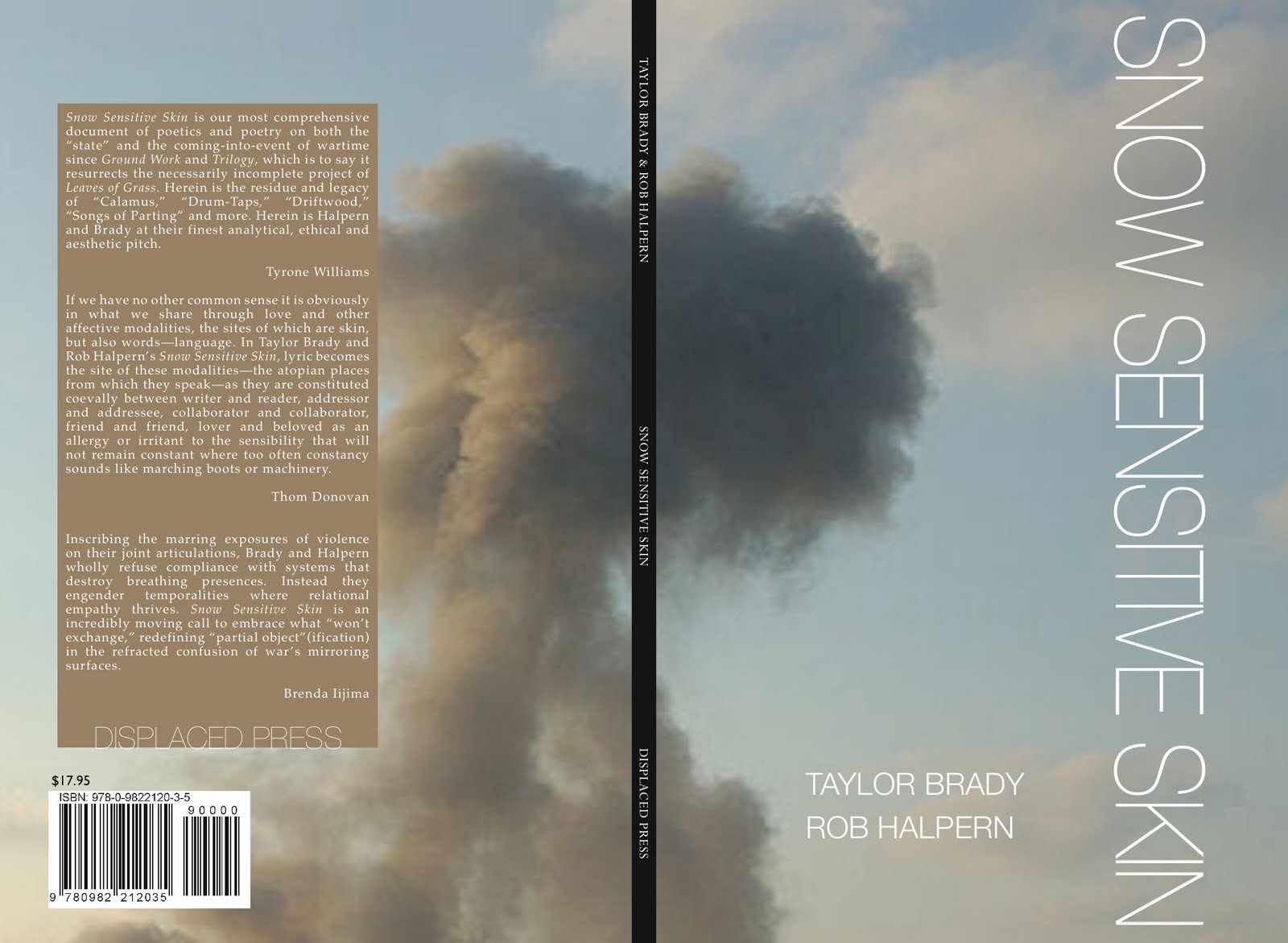
Brady's and Halpern's Snow Sensitive Skin Reissued


Taylor Brady and Rob Halpern's book length collaboration, originally published by Michael Cross's Atticus/Finch Press, has been reissued with Displaced Press. Below is a press release issued by Brian Whitner, the publisher of the press:

Dear Friends,

It is with great excitement that I write to announce the release of Taylor Brady and Rob Halpern’s Snow Sensitive Skin. This is an expanded edition of the original book published by Michael Cross’ Atticus/Finch and contains a new introduction by Michael, a selection of correspondence between Rob and Taylor during the writing of the project, and an extensive afterword by Taylor and Rob. The body in war-time; the time of war and of labor; “one vibration in both plane and flower”—Snow Sensitive Skin is one of the most moving and profound works ever produced out of a time of war and crisis, a must read.

…But don’t take our word for it:

“Snow Sensitive Skin is our most comprehensive document of poetics and poetry on both the 'state' and the coming-into-event of wartime since Ground Work and Trilogy, which is to say it resurrects the necessarily incomplete project of Leaves of Grass. Herein is the residue and legacy of Calamus, Drum-Taps, Driftwood, Songs of Parting and more. Herein is Halpern and Brady at their finest analytical, ethical and aesthetic pitch”—Tyrone Williams.

“If we have no other common sense it is obviously in what we share through love and other affective modalities, the sites of which are skin, but also words—language. In Taylor Brady and Rob Halpern’s Snow Sensitive Skin, lyric becomes the site of these modalities—the atopian places from which they speak—as they are constituted coevally between writer and reader, addressor and addressee, collaborator and collaborator, friend and friend, lover and beloved as an allergy or irritant to the sensibility that will not remain constant where too often constancy sounds like marching boots or machinery.”—Thom Donovan

“Inscribing the marring exposures of violence on their joint articulations, Brady and Halpern wholly refuse compliance with systems that destroy breathing presences. Instead they engender temporalities where relational empathy thrives. Snow Sensitive Skin is an incredibly moving call to embrace what “won’t exchange,” redefining “partial object”(ification) in the refracted confusion of war’s mirroring surfaces.”— Brenda Iijima

You can purchase Snow Sensitive Skin directly from SPD here: http://www.spdbooks.org/Producte/9780982212035/snow-sensitive-skin.aspx

As well, we would like to take this opportunity to extend a very special offer. For the very low price of $50USD (shipping included) Displaced will send you: Snow Sensitive Skin by Taylor Brady and Rob Halpern, Tout Va Bien by Suzanne Stein, hurdis addo by Samantha Giles, The Persians by Aeschylus by Brandon Brown, and The Hole by Thom Donovan. You can paypal us at iwaslike@hotmail.com. Your books will ship as one package (with some special surprises of course!) once all the titles are printed (mid-October-ish).

And as always, please feel free to join us on FB at
http://www.facebook.com/?ref=logo#!/pages/Displaced-Press/251206488224264

Please feel free to forward this message to your lists.

Very best,
Brian Whitener

Friday, July 22, 2011

Stacy Doris's The Cake Part (Video)

Thom Donovan and Lucy "Labchow" Lasky from Stacy Doris on Vimeo.


The Poetry Foundation has a useful write-up about Stacy Doris's book project with Publication Studio, The Cake Part, which will feature "fantastic" censored literature from the era of Marie Antionette. As Doris tells PF:

The Cake Part is a fantastic redeployment of banned pamphlets from the time of the French Revolution in the form of a book-length poem. Long kept hidden because of their transgressive content, these pamphlets were stored in a secret archive at the Bibilothèque nationale called the enfer (hell). Highly pornographic and formally promiscuous, The Cake Part is an eruption of all the repressed joy and terror of that 18th century revolution, back into our time, into the 21st century. Set in the typography of Web 2.0, the design of this book searches for the modern day equivalents of these banned pamphlets in the virtual networks which aid and abet current revolutionary movements.

The project includes videos of Doris's friend and colleagues reading and performing selections from the book, including a video I shot with my dog, Lucy.

Here is some of what Poetry Foundation has to say:

In a consideration of how best to launch the book, Doris and Matthew Stadler decided to use the revolutionary potential of the internet and ask varied and friendly poets to participate in an online book launch for The Cake Part (which will take place at the Morgan Library in NYC). Doris told us that she was interested in how “online presence is central to the structure of revolutions today, and how in a sense it was in the French Revolution as well, where zines and other networks were key for circulating information and propaganda.”

Thursday, July 21, 2011

5 Questions for Contemporary Practice with Sanford Biggers

This month's 5 Questions features artist Sanford Biggers:

Time is my recent fascination. By that I mean the effect that time has on history, how past truths are debunked over time through research and new understandings. For example, the New York Times recently reported that Memorial Day actually began on May 1, 1865, when Black workmen re-buried over 250 Union Army casualties and later, with other freedpeople, White missionaries and teachers, staged a 10,000 person parade and celebration.

I’ll provide a few examples from my own work. A few years ago I made a series of chrome plated lawn jockeys based on the story of Jocko Graves. Jocko was a stable boy who sought to fight alongside George Washington. Deemed too young, Jocko was ordered to maintain the stables and keep a lantern lit to guide troops home after battle. One evening, Washington and his troops returned finding Jocko frozen to death, still clenching the lantern. Touched, Washington erected a statue at Mount Vernon honoring Jocko. Later replicas evolved/devolved into the lawn jockeys we are more familiar with before being denounced as derogatory symbols after slavery. Ironically, some lawn jockeys were reportedly used as markers along the Underground Railroad. The three sculptures in the series Jocko, are frozen in a state of emergence and dissolution, symbolizing the conflicted history of Jocko and the lawn jockeys he inspired. Similarly, my recent repurposed quilt drawings entertain the contested history of whether or not quilts were used as “signposts” along the Underground Railroad.

Thursday, July 14, 2011

The Opposite of Apocalypse

--after Dana Ward's "Diamond"

The beginning of worlds the diamond is
The facet is saved by space
Made coherent by all it isn’t, messianic, an epic

Paper bag over the face
Of the whole world, world-covering
This is the covering of

The world not merely its end
What you affirm by saying it isn’t
Shines radiantly like rest

Or silence when the world recedes
It resembles an ear
When we were not hearing, just listening

This was the soundtrack
To my soul
I say these things because I want to get over

My voice, do the
Voices you do
Waiting for the tape

To cut-off, the lip synch to appear
The body wholly voice
The angle of incidence it comprises

A fire so many have died for
Prismatically a universal bling
Compressed to this singular dedication

The products of culture
Form no ground
To base this love on

Yet they are all we have
Love of what is missed
In the absence of what we never had

Or could possess, this song
We just made up—here it is
The applause sign blinking soundlessly

Before the studio
Audience of our souls
The kind of participation that affect is

Crying tears on the inside
Diamond-shaped
Before they ever shone.

Sunday, July 03, 2011

The Face

--after C.J. Martin

This disgust that begins with us
Flesh of the wind that is between
The wind and things we are singing

Abjectly, I think that’s how you said it
Belief like a labor like an effect
Paid back to the subject in naked force

When the faces we make fuck us up
When a dress is what you address
The faces we make like sunshine

Might harden, forget our fall into
Mass like a poetry I fight against
Call this resistance, charged into

Symbolic efficacy, forgetting I am
Just flesh, the procedures of the face
Cover it so corrosively the world begins.

Saturday, July 02, 2011

Rights of Participation (III)

--after Ryan Trecartin

1.
What path to hell are you seeking
Participation paves it with credit
Object-relations keep saying it
What you are not prepared for and

Dying for this preparation start
Breaking shit that is all we have
Dead labor’s the thing you
Keep spraying all these ghosts

Of Warhol’s 15 minutes the gender
Of Jack Smith’s creatures when
We are not dead labor sings
A blue screen to a jump cut sings

A thousand windows open while
A million others shut
To be the cell phone singularity
To be the corporate second

While the world elapses
While it does not matter this gender
That is no one because it is
Everyone anywhere does us all in

Transcends the body at work
Equals the soul imbibing
Energy drinks, spilling fake blood on
Your friends in this three-way.

2.
This is what they drink in hell
Energy drinks and Listerine
The world shrinks to surplus
Occluded by what we see
In cell phone time in lip synch time
In matted time the teeth
Blacked-out emphasize the poverty
Of zombies, seasons in hell move me
Catastrophes of techniques
Hell of a do-over acting when no
One is listening in this chatroom
A thousand angels and a thousand devils
On the head of a pin number
Like cell phones evoke their reason to exist
When money and affect are one
Long done with the message
Voices that leave messages.

Monday, June 27, 2011

Con/Crescent reading with Joseph Bradshaw and Dana Ward

On July 9th at 7PM, I look forward to reading with Joseph Bradshaw and Dana Ward as part of Jamie Townsend's and Nicholas DeBoer's Con/Crescent Reading Series. The location is Fergie's Pub at 1214 Samsom Street in Philadelphia.

Friday, June 24, 2011

With + Stand 5

Thanks to Dan Thomas-Glass for his work editing the latest issue of With + Stand.

Contributors:

Lara Durback
Sam Lohmann
Erica Lewis
Brian Ang
Kristin Palm
Caroline Knapp
Barry Schwabsky
Meg Day
Bhanu Kapil
Thom Donovan
David Brazil
Evan Calder Williams
Monica Peck
Suzanne Stein
Jacqueline Frost
Seth Forrest
Lars Palm
Jennifer Karmin/David Emmanuel
Donna Stonecipher
Carol Szymanski
Cassandra Smith
Erin Wilson
Matt Longabucco
Josef Kaplan
Steven Karl
Whit Griffin
Tyler Dorholt
Jamey Jones
Fred Moten
Andrew Rippeon
Thomas Mowe
Lauren Levin
Barbara Claire Freeman
Derek Pollard
Stephen Collis
James Yeary
Caleb Puckett
Rodrigo Toscano
David Abel
Jen Hofer

Thursday, June 23, 2011

Boston Poetry Marathon and BBQ

The Boston Poetry Marathon and BBQ schedule is up. Thanks to Jim Behrle and Michael Carr for their work putting this together for the second year in a row. Lots of great poetry to be heard!

Saturday, June 18, 2011

An Archive

--after Carlos Motta

There is an archive in the sky
Not unlike the one on this earth
Except that it doesn’t forget

Here we are forgetful
An archive, your archive, is specific not general
Because it is made of flesh and blood

And because some people can’t speak
Very loudly an archive attempts to speak
In words and pictures it is a kind of multitude

A swarm it takes to the streets and
Like events is not foreclosed
The composite of a few specific questions,

Of research, it tries to keep a promise
When the dead can’t
The person/people who organize it

Obviously matter very much
The archive being an extension of them
In its organization if not in its content

It bears the mark of their concern
Their burning regard not for a world that exists
But for what will have been

To make an archive like writing a poem
May make a living body of history transmissible
Making us bear witness—especially through what

It’s excluded or lost—to the collective struggle
To remember, the threat of disappearance
This struggle represents.

Friday, June 17, 2011

5 Questions for Contemporary Practice with Carlos Motta (@ Art21)

The latest 5 Questions for Contemporary Practice at Art21 blog features artist, activist, and radical archivist, Carlos Motta.

One of the biggest mistakes we often make is to believe in the monolithic category “ART IS,” which I believe is at the root of the debate (and skepticism) about the political efficacy of art. I don’t think art “IS” one thing in particular. It shouldn’t be thought in the singular, but rather embraced in the plural: Art(s), rather, are, whether objective and social, symbolic and didactic, pedagogical and entertaining, etc. I don’t mean to relativize or to dichotomize these categories, but to insist that a plural frame of mind produces a positive, inclusive, and liberatory rhetoric that resists the dominant and reductive forces of the art market and art history which have through the forces of authoritarianism, paternalism, and capitalism staked their claims over art.

Saturday, June 04, 2011

Review of Heather Kravas's The Green Surround (@ The Brooklyn Rail)


here

Throughout the performance we witness the dancers both consenting to these regimes and resisting their situation in the performance itself. As we take our seats they face us, standing in a line across one side wall, as in one of Vanessa Beecroft’s tableaux vivants. They are wearing white smocks, kerchiefs, black bobby socks, and mirrored, panoptical sunglasses, which shield their eyes. The bright white lights that fill the black box theater only make it more difficult to tell where the dancers are looking. Counting occurs throughout the evening, starting with the nine women standing together, ticking off on their fingers while they repeat the words “boot lick.” The submission theme continues, and it is often unclear whether the viewers are dominating or being dominated, the boot lickers or the ones having their boots licked. “Boot lick boot lick boot lick” glides into “lick boot lick boot lick boot” echoing the ambiguity of subject and object.

Saturday, May 21, 2011

Rights of Participation (II)

If this is called inclusion
Count me out

Love absorbs an order of the cops

Patrolling their reward
In paradise purportedly

Where a billion affects have failed
There is a feeling

Of freshness for you in me

Absorbed like a dream of losing you
Or being left behind

In the messaging of our waking dream
Affection absorbs a structure

Invisibly touched, patrolling its reward

If hell is friendship where a billion
“likes” have failed

What failed regard won’t make us lose?

Coerced purposively in a perceived
Paradise to the point that I could feel

Anything, this body, I could feel,
Me in you

Absorbed like a dream of losing you
Lost in a messaging I am senseless to

The sun, like a blind-spot in reflexivity
If this is exclusion count me in

Call me your remnant patrolling
Its little reward

Redemption of the world called us
With the words struck through.

Thursday, May 19, 2011

5 Questions with Not An Alternative (@ Art21)

Check out my latest feature at Art21 blog, on the Wllmsbrg-based art group Not An Alternative:

Capitalism is constructed to instrumentalize any form of engagement. How can we refuse this? Can we participate productively within a context where it’s either vote, engage, participate, or you’re apathetic. Can we vote no? We were inspired to create an organization that experimented with a form of engagement that was aimed at confronting the limits of liberal capitalism.
--Not An Alternative

Wednesday, May 18, 2011

Poetry Dinner (@ Four & Twenty Blackbirds)

It is a few weeks off, but the lovely people of Four & Twenty Blackbirds and Movement Research are putting together a dinner party/poetry reading for Sunday, June 5th.

Readers include Robert Kocik, Eva Yaa Asentawaa, Willa Carroll, and myself.

RSVP here

Tuesday, May 17, 2011

SPT's Reliquarium

This Saturday at Small Press Traffic you can bid on small bottles in which will be contained the remains of contemporary poets...

If the end of the world is coming…Celebrate it with Small Press Traffic
at
THE RELIQUARIUM
an apocalyptic fundraiser

Join us for the end of days (http://en.wikipedia.org/wiki/2011_end_times_prediction) at this end of season bash featuring:

+reenactments from scenes of the end of the world
+the co-generation of a literary time capsule
+an auction of poetic reliquaries
+an end times dance party
+drinks and MORE!

May 21, 2011 at 7:30pm
California College of the Arts Graduate Writing Studio
195 deHaro at 15th
San Francisco, California

entrance a mere $10!

with reliquaries by:
Steve Benson
Charles Bernstein
Rachel Blau duPlessis
Julian Brolaski
Enrique Chagoya
Thom Donovan
Elaine Equi
Coco and Rob Fitterman and Kim Rosenfield
Kathleen Fraser
Bob Gluck
Judith Goldman
Tracy Grinnell
Nina Katchadorian
Kevin Killian
Joanne Kyger
Nathanial Mackey
Harryette Mullen
Eileen Myles
Sina Queyras
Ariana Reines
Larry Rinder
Camille Roy
Fiona Templeton
Edwin Torres
Amy Trachtenberg
Kaia Sand
Tyrone Williams
and MORE!

Can’t make it to the event? You can still bid on poet reliquaries online! Send in your absentee bids to smallpresstraffic@gmail.com

Wednesday, May 11, 2011

SHIFTER 17 : RE___ING launch (at Printed Matter)


SHIFTER 17 : RE___ING

Book Launch at Printed Matter

Saturday May 14, 5-7pm

195 Tenth Avenue
New York, NY 10011

Editors:
Sreshta Rit Premnath & Matthew Metzger

Contributors:
Thom Donovan, Tamar Guimarães, Patricia Esquivias, Susan Jahoda, Eric Wenzel, Patrizio Di Massimo, Alicja Kwade, Adrian Williams, Mike Schuh, Lisa Zaher, Zachary Cahill, Arnold Kemp, Jean Marc Superville Sovak, Corinna Kirsch

Please join us this Saturday for the launch of Shifter Magazine's 17th issue, Re___ing at Printed Matter. We will also have back issues of Shifter on hand for purchase.

Re___ing, co-edited by Sreshta Rit Premnath and Matthew Metzger exists both within Rethinking Marxism's new issue (Vol. 23 No. 2)* as well as a new issue of Shifter. This folding of one identity into another, a re within a Re and the resultant destabilization of both frames of reference, is precisely the nature of Re___ing.

While re proliferates additives, doubles and fissures within the sphere of cultural production, it also implies multiple temporalities - to renew and to rewind. ing on the other hand, asserts the present continuous, it is always and already.

Paradoxically, re is also to reify. When you call me and I respond I am born. When I call you and there is no response I feel the threat of erasure. I therefore call with the strongest faith that you will respond and when you do we cement our relation. The abstract becomes concrete.

At what point does the attempt to exonerate representation from its intrusive counterpart, "the aura", become a concern around appearances rather than labor? As with Borges's Pierre Menard who rewrites Don Quixote word for word only to produce an anachronistic and inadequate adaptation, perhaps pure repetition is impossible. Therefore, although re attempts to proliferate multiples, the insistent ing, always in the present disturbs this veracity.

Here, contributors engage a variety of gestures tied to reproducing by deploying palimpsestic archives culled from historical documents, proposing morphological relations as historic fact and ultimately forcing procedures of mimicry, translation and interpretation to their limit. This limit or threshold in many instances is defined here through the body and its traces, actions, delusions and dreams which may often remain utterly irreproducible.

Re___ing is currently available for free download, online purchase as well as at Printed Matter, NYC and Motto, Berlin.