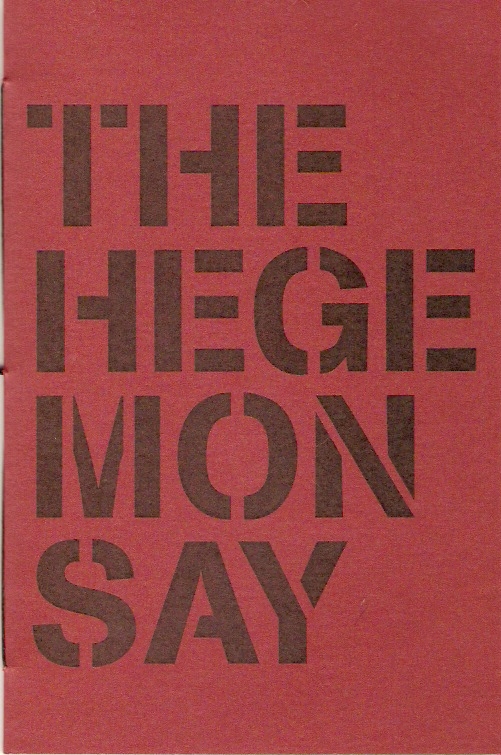
Birdtables... Lace Bedspreads...
Pottery Logs Sawn
To Order Pond
Liners Honey Goats'
Milk Pedlar Dolls
Rotted Mushroom Compost
Eggs Laid While
You Wait Toms
Glads and Cues
Replacement Windscreens
Dwarf Lop Rabbits
Maggots Sweet Corn
Terrier Meal Horse
Pellets Karate Lessons
Haircut Sir? Golden
Labrador Puppies Ready
Soon Clay Pigeons
Cream Teas Welding
& Resprays Baby
Bunnies Pullets' Eggs
By the Tray
Pork Sausages and
Shoe Repairs Concrete
Tubs for Sale.*
all text from J.M. Neeson's Commoners: common right, enclosure and social change in England, 1700-1820
Monday, August 10, 2009
Sunday, August 09, 2009
We Are This Pack
We are this pack with the fire
On our faces with our backs
To the wilderness we make
A new circle without center
Our elbows where we nearly
Touch each other are new centers
They are points in space denying
Diadem its high life so we are
So many errands licking up
The language in our wake
We survive so everyone survives
Making use of every waste.
On our faces with our backs
To the wilderness we make
A new circle without center
Our elbows where we nearly
Touch each other are new centers
They are points in space denying
Diadem its high life so we are
So many errands licking up
The language in our wake
We survive so everyone survives
Making use of every waste.
Advancing Feminist Poetics & Activism: A Gathering
This should be a pretty amazing symposium:
http://belladonnaconference.blogspot.com/
http://belladonnaconference.blogspot.com/
Friday, August 07, 2009
No One Starsong
That crowd not
Separated by death
Allegiance to little
No one starsong
Of possession again
This is the way
We tour the end
Like it were not
The end by an-
other beginning
We are before the
Threshold of
Another beginning
The world will shed
The world what
The world will shed…
Separated by death
Allegiance to little
No one starsong
Of possession again
This is the way
We tour the end
Like it were not
The end by an-
other beginning
We are before the
Threshold of
Another beginning
The world will shed
The world what
The world will shed…
Thursday, August 06, 2009
Are We Human, or Are We Dancer?
 This past winter I wrote a piece on Daria Fain's and Robert Kocik's performance "The Extent to Which," sponsored by Danspace. You can now read the piece in the current PAJ: a Journal of Performance and Art. Here's an excerpt...
"For Fain and Kocik, the right to determine genetic material should be left to poets, artists and other sensitive, creative people. As such, they are the unacknowledged geneticists of the world. In Germ, Fain/Kocik continued their attacks upon a genetic essentialism which not only discriminates among human beings (and therefore upholds various bad isms of our culture), but also human, animal and (in)organic life as they depend on one another. The germ becomes that which, via mutation, can leap over whole species in a single bound, therefore acting as a kind of wild card among the larger phylum. But the real germ of Fain’s/Kocik’s collaborative work of course is the aesthetic itself, as aesthetic phenomena may shape and alter genetic material. As Kocik pronounces in Overcoming Fitness, “May poetry determine phenotype!” By determining phenotype, poetry and art determine life itself; “nature” and “nurture” (pseudonyms for the real and the imaginary) are no longer mutually exclusive, but contingent upon one another."
Wednesday, August 05, 2009
Another Nail House
 --for Dale Smith
Another nail house and another rip
In the tale of us that house lifted
Into the air by balloons is the question
What will be left to critique when
Capital is through with us and what
Is ironic about those land grabs the
Poem must preserve a place to remain
In what is not real the poem must be
An active force in a universe that is
Heterogeneous however real.
Monday, August 03, 2009
I Have a Basement Apartment. Now What?
 I Have a Basement Apartment. Now What? debut presentation
From 1990 to 2005, more than a third of the new housing created in NYC outside of Manhattan were phantom apartments – illegal conversions of basements and cellars. These invaluable sources of affordable housing, often occupied by New York's newest immigrants, also happen to violate many of NYC's building and zoning codes and pose serious safety threats. What should happen to all these homes? Who decides?
This summer, CUP Teaching Artist Hatuey Ramos-Fermín and students from the College Now Program at Hostos Community College investigated these hidden homes. The group talked to tenants, landlords, the Department of Buildings, housing lawyers, and advocates to uncover the politics of living underground.
Join us on Friday, August 7 as we present the results of their investigation: "I Have a Basement Apartment. Now What?" – a comic book produced in partnership with Chhaya CDC and Make the Road New York. A dramatic reading and comic-making workshop will be followed by presentations from students and community organizations on mediation strategies and avenues for new legislation. All attendees get a comic.
Friday, August 7, 7 pm
I Have a Basement Apartment, Now What?
Make the Road New York
92-10 Roosevelt Avenue
Queens, NY
Take the 7 to 90th Street/Elmhurst
(718) 565-8500, ext. 409
Two Poems
What I does we refute by being
We and sometimes a dialogue
Or the beginning of an action in
Space names become consequent
To this that they were not each
Other’s mine and I can only express
What it knows through this event
There is the truth that with only
Knows—everything else just a
Sympathetic hole outsourcing us.
What sings us the beaks too big
Wing span too large for this cage
I am made of make and I am made
Of these things not me and to let
Them cry no singular thing are we
This shop-floor not exploitable that
Would kiss these lips instead these
Glass houses in which we won’t
See me and no one will accurately
Describe a feeling for what is right.
(June-August 2009)
We and sometimes a dialogue
Or the beginning of an action in
Space names become consequent
To this that they were not each
Other’s mine and I can only express
What it knows through this event
There is the truth that with only
Knows—everything else just a
Sympathetic hole outsourcing us.
What sings us the beaks too big
Wing span too large for this cage
I am made of make and I am made
Of these things not me and to let
Them cry no singular thing are we
This shop-floor not exploitable that
Would kiss these lips instead these
Glass houses in which we won’t
See me and no one will accurately
Describe a feeling for what is right.
(June-August 2009)
Friday, July 31, 2009
Big Bridge Oppen and Slow Poetry features
The new Big Bridge includes features on Slow Poetry (ed. Dale Smith) and George Oppen (ed. Eric Hoffman), the latter of which includes a review I wrote of Oppen's Selected Prose, Daybooks, and Papers in the winter/spring of 2008.
"Last summer when I began writing about Slow Poetry, I wondered if poetry that dramatized the dark and stupid could matter much longer. So I began framing raw questions that might help myself and others respond meaningfully to these dark and stupid times. I wondered how I could make sense of what's happening around us through poetry, through art? Perhaps Slow Poetry could be a way to help orient attention again in art to the world. I liked the term, too—Slow Poetry—because it associates with Slow Food and that now-global movement's linking of pleasure for food with a commitment to community and the environment. If we can enjoy poetry—itself an essential form of nourishment—why not also take into account the contexts of its making and reception?"
--Dale Smith
"...I asked contributors to provide essays approaching particular Oppen poems, focusing primarily upon Oppen's aesthetics and prosody, together with critical reactions to recent Oppen scholarship (in particular Cope (2007), Heller and Nicholls (both 2008)). This was only the most general of requests as I wanted as little restriction as possible discussion of the work. As Oppen himself wrote, he could not bring himself to write poetic "exercises," nor did not want my contributors to be forced to contribute critical ones. It was therefore with great pleasure when I received these essays, which I believe represent a significant move forward in Oppen scholarship, marking both the distance Oppen scholarship has come since the work of Cuddihy and Hatlen at the same time pointing the way forward for the Oppen scholarship to come."
--Eric Hoffman
"Last summer when I began writing about Slow Poetry, I wondered if poetry that dramatized the dark and stupid could matter much longer. So I began framing raw questions that might help myself and others respond meaningfully to these dark and stupid times. I wondered how I could make sense of what's happening around us through poetry, through art? Perhaps Slow Poetry could be a way to help orient attention again in art to the world. I liked the term, too—Slow Poetry—because it associates with Slow Food and that now-global movement's linking of pleasure for food with a commitment to community and the environment. If we can enjoy poetry—itself an essential form of nourishment—why not also take into account the contexts of its making and reception?"
--Dale Smith
"...I asked contributors to provide essays approaching particular Oppen poems, focusing primarily upon Oppen's aesthetics and prosody, together with critical reactions to recent Oppen scholarship (in particular Cope (2007), Heller and Nicholls (both 2008)). This was only the most general of requests as I wanted as little restriction as possible discussion of the work. As Oppen himself wrote, he could not bring himself to write poetic "exercises," nor did not want my contributors to be forced to contribute critical ones. It was therefore with great pleasure when I received these essays, which I believe represent a significant move forward in Oppen scholarship, marking both the distance Oppen scholarship has come since the work of Cuddihy and Hatlen at the same time pointing the way forward for the Oppen scholarship to come."
--Eric Hoffman
CAConrad on John Weiners at PhillySound
check it out! I love the poems Conrad has selected for a new Weiners EPC author page, like this timely one:
TRIMETERS
Your lips in a cloud
the spirit that visited
before I died
still assigned to the dead
the cyanide garments
that spirit vented
with tears in payment
from provincial rent
Without personal burden
only refuge denied
such taking allowed
as federal government
TRIMETERS
Your lips in a cloud
the spirit that visited
before I died
still assigned to the dead
the cyanide garments
that spirit vented
with tears in payment
from provincial rent
Without personal burden
only refuge denied
such taking allowed
as federal government
Wednesday, July 29, 2009
Climate Counts
I am extremely skeptical of the rise of "green" capitalism, yet this organization seems a necessity for responsible consumption given our current global economy:
http://www.climatecounts.org/about.php
Two related websites:
http://www.goodguide.com/
http://www.cosmeticsdatabase.com/index.php?nothanks=1
http://noimpactman.typepad.com/blog/2007/02/about_my_family.html
http://www.climatecounts.org/about.php
Two related websites:
http://www.goodguide.com/
http://www.cosmeticsdatabase.com/index.php?nothanks=1
http://noimpactman.typepad.com/blog/2007/02/about_my_family.html
Monday, July 27, 2009
"The limitation is us"
 Rereading Mike Kelley's book Foul Perfection, I came across this passage, which seems a wonderful parsing of two discrete definitions of the sublime and the sublime's relationship to objectivity. The passage is quoted from an interview Kelley conducted with Thomas McEvilley in December, 1992:
"Thomas McEvilley: Along with formlessness, the theme of the sublime in recent art involved a sense of the human individual possessing in a hidden way a potential for vast spiritual greatness. [Barnett] Newman is again the obvious example. But clearly you approach it differently.
Mike Kelley: Right. I have a big problem with that reading of the sublime. My reading is more Freudian, involved with notions of sublimation. I see the sublime coming from the natural limitation of our knowledge; when we are confronted with something that's beyond our limits of acceptability, or that threatens to reveal some repressed thing, then we have this feeling of the uncanny. So it's not about getting in touch with something greater than ourselves. It's about getting in touch with something we know but cannot accept--something outside the boundaries of what we're willing to accept about ourselves.
TM: You're not concerning yourself with what's on the other side of that limitation.
MK: The limitation is us. I'm not interested in what's not us. But to keep talking about it in relation to the threat of physical annihilation separates the project too much from aesthetic discourse. And I want that also to be a part of it. It's about one's interaction with an object, not just one's interaction with one's self. The focus is on the object."


Whose Objectivism?
Stephen Burt's eccentric genealogical construction of contemporary potery after Objectivism, "The New Thing," seems yet more evidence that the Objectivist nexus is not one, but many. And all the more reason poets themselves should take responsibility for making the work of their peers legible to each other, and help to reveal its place within larger historical continuums and trends (a work too often reserved for professional critics).
Having grown up among intense communities of poets and artists (as well as critics!), and having studied Objectivism as a graduate student, I am struck by how distant Burt seems from my own senses of an Objectivist continuum in present-day poetries (however much I enjoy reading many of the poets whom Burt mentions).
Citing Burt's statement, "For [C.D.] Wright, as for [Juliana] Spahr and [Mark] Nowak, poetic attention to facts and things—emulated, reclaimed, quoted, re-framed—speaks to the material conditions a left-wing politics works to change. For other makers of the New Thing though, the solidity they seek is not so much economic as phenomenological: the poem finds, and emulates, some permanence—it is, and describes, something with weight and “measure,” small enough to hold in the hand" I wonder: must the political-economic and the phenomenological be partitioned? Many of the most rigorous poets I know today work through political definitions of the phenomenological and vice versa.
The emergence of political subjects through the incommensurably singular presents a contemporary definition of Objectivism to which I am beholden. Looking back at Oppen and Zukofsky in particular, I believe much of their work allegorizes the emergence of the subject as it struggles to act as a political being via a phenomenology which foregrounds textuality as an extension of various forms of social mediation (the fact that writing has an objective existence and this existence mediates a reader's reality). Oppen's engagements with Heidegger's "arduous path of appearance" comes to mind most readily here; but so do the uncanny convergences of his poetics with Hannah Arendt's thought, for whom the political was also fraught with ambivalence and difficulty. "Left-wing" content, or any content for that matter considered properly subaltern, does not separate itself from matters of form (because it simply can't). Rather, through the subaltern--or that which is made illegible, invisible, or impossible by its situation within the social--form and content constitute an inseparable unity because they coappear within a single event.
For another, more vitriolic take on Burtian objectivism see Stan Apps' Free Will Applicator here.
Having grown up among intense communities of poets and artists (as well as critics!), and having studied Objectivism as a graduate student, I am struck by how distant Burt seems from my own senses of an Objectivist continuum in present-day poetries (however much I enjoy reading many of the poets whom Burt mentions).
Citing Burt's statement, "For [C.D.] Wright, as for [Juliana] Spahr and [Mark] Nowak, poetic attention to facts and things—emulated, reclaimed, quoted, re-framed—speaks to the material conditions a left-wing politics works to change. For other makers of the New Thing though, the solidity they seek is not so much economic as phenomenological: the poem finds, and emulates, some permanence—it is, and describes, something with weight and “measure,” small enough to hold in the hand" I wonder: must the political-economic and the phenomenological be partitioned? Many of the most rigorous poets I know today work through political definitions of the phenomenological and vice versa.
The emergence of political subjects through the incommensurably singular presents a contemporary definition of Objectivism to which I am beholden. Looking back at Oppen and Zukofsky in particular, I believe much of their work allegorizes the emergence of the subject as it struggles to act as a political being via a phenomenology which foregrounds textuality as an extension of various forms of social mediation (the fact that writing has an objective existence and this existence mediates a reader's reality). Oppen's engagements with Heidegger's "arduous path of appearance" comes to mind most readily here; but so do the uncanny convergences of his poetics with Hannah Arendt's thought, for whom the political was also fraught with ambivalence and difficulty. "Left-wing" content, or any content for that matter considered properly subaltern, does not separate itself from matters of form (because it simply can't). Rather, through the subaltern--or that which is made illegible, invisible, or impossible by its situation within the social--form and content constitute an inseparable unity because they coappear within a single event.
For another, more vitriolic take on Burtian objectivism see Stan Apps' Free Will Applicator here.
Facebook is confused...
"Which example applies to you?
Right now your profile may be confusing. Please choose how we should refer to you.
Please select either Male or Female
Thom edited her profile.
Thom edited his profile."
Right now your profile may be confusing. Please choose how we should refer to you.
Please select either Male or Female
Thom edited her profile.
Thom edited his profile."
ON1 press
Here's some welcome press for ON1, compliments of the University of Arizona Poetry Center's July newsletter .
"ON: Contemporary Practice is a forum for writers to exchange ideas about their contemporaries: writing that takes place now. In their preface to the inaugural issue, Cross, Donovan, and Schlesinger describe a collection that is “not edited, per se, but the accretion of response to the emergency of the present.” These are potent words, and the essays and conversations in ON do feel high-stakes, nervy, and engaged. Tenney Nathanson on Beverly Dahlen, Dale Smith on Hoa Nguyen, Jonathan Skinner on Julie Patton, Tim Peterson on kari edwards, and Jen Hofer and Sawako Nakayasu on each other are just a few of the pairings. Collaboration vibrates through the pages like electricity, and it takes the form of analyses and enactments. ON is great conversation and great theory, protean and visceral."
Copies of ON1 may be purchased at LULU.
ON2 is on the way with contributions by Corina Copp (on Rodrigo Toscano & Poet's Theater), Robert Dewhurst (on Dorothea Lasky), Robert Kocik (on Stacy Syzmaszek), C. J. Martin (on Rob Halpern), Evelyn Reilly (on Rosmarie Waldrop and contemporary women's writing), and Tyrone Williams (on Erica Hunt) among many others.
"ON: Contemporary Practice is a forum for writers to exchange ideas about their contemporaries: writing that takes place now. In their preface to the inaugural issue, Cross, Donovan, and Schlesinger describe a collection that is “not edited, per se, but the accretion of response to the emergency of the present.” These are potent words, and the essays and conversations in ON do feel high-stakes, nervy, and engaged. Tenney Nathanson on Beverly Dahlen, Dale Smith on Hoa Nguyen, Jonathan Skinner on Julie Patton, Tim Peterson on kari edwards, and Jen Hofer and Sawako Nakayasu on each other are just a few of the pairings. Collaboration vibrates through the pages like electricity, and it takes the form of analyses and enactments. ON is great conversation and great theory, protean and visceral."
Copies of ON1 may be purchased at LULU.
ON2 is on the way with contributions by Corina Copp (on Rodrigo Toscano & Poet's Theater), Robert Dewhurst (on Dorothea Lasky), Robert Kocik (on Stacy Syzmaszek), C. J. Martin (on Rob Halpern), Evelyn Reilly (on Rosmarie Waldrop and contemporary women's writing), and Tyrone Williams (on Erica Hunt) among many others.
Saturday, July 25, 2009
SHIFTER 15 call

SHIFTER is this great magazine (in a newspaper format!) edited by Sreshta Rit Premnath and coeditors. I am particularly keen on the ways Premnath is blending concept with wit, and bringing visual artists into conversation with scientists, philosophers, poets and others across various "disciplines." Submit if you will.
SHIFTER15 - Will
Editors: Sreshta Rit Premnath, Abhishek Hazra
Deadline: September 30, 2009
‘Indeed, the truth was not hit by him who shot at it with the word of the “will to existence”: that will does not exist… Only where there is life is there also will: not will to life – thus I teach you – but will to power.’
Friedrich Nietzche, “Thus Spake Zarathustra”
When Will shot Joan he did not mean to. He wanted to shoot the apple balanced on her head. The cactus wine may have put the gun in his hand. The spirit may have provided the reckless confidence. And in the spirit of its will he pointed his gun and squeezed the trigger. It may have been at the moment he squeezed the trigger, or perhaps a split second before, that the world had already begun to rip. Space and time had torn the future into an infinite set of possibilities. The set could be divided into two subsets: He would miss Joan / He would not. But the will of the spirit produced a second pair of possibilities that would not matter in the least - He would hit the apple / He would not.
If Will was not himself when he constituted this new reality, one without Joan, then who was responsible? Who’s will acted upon reality? His finger’s? The gun’s? The wine’s? Yet, we must not confuse will with intention - maybe this assumption of a causality itself is a mistake. What is known is that it happened.
If will is a potentiality - a vector that opens possibility and cleaves reality - does it precede choice? Are personal wills constituted by hegemonic ideologies (producing pre-inscribed realities), or rather is an individual’s will that space of agency which allows for an opening and aggregates with other individual wills to produce the transformation of the social?
There is a story about a revolutionary who was tortured to reveal the location of a comrade. He lied and gave his interrogators the wrong coordinates. But, when his interrogators arrived there, they found his friend.
Is reality willed into existence?
Details: Please scale image submissions for a 6″X9″ publication (6.25″X9.25″ with bleeds). Images should be at 300dpi. Rich Text, Word, Jpg, Photoshop, Illustrator and InDesign files are accepted. Send submissions to shiftermail [at] gmail [dot] com
Friday, July 24, 2009
Monopoly Bloomberg Edition

Thanks to Andrew Levy for sending me the Monopoly Bloomberg edition: http://angrynyer.com/wp-content/uploads/2009/06/bloomopoly1.jpg
Wednesday, July 22, 2009
Death of a Hippie

after Mike Kelley and John Waters
We are just this kind of junk
Left out to rot in another
Caricature the concept of nature
Or essence means the world to us
Perhaps the symbolic death
That was Reagan Paul Thek
Adumbrated by Pop and not Junk
Not this actual material eroding
Ideas of the 'good' and 'real'
Someone to tuck you in at night
Someone to fuck you like we
Were not all monsters whether
We like it or not some concept
Of culture takes our place
What did the hippie leave us with
Except some notion of the citizen
Public unassimilable criminalized
Even though white crushed
By the political machinery
Deengineering a tenuous democracy
Containing American decadence.
I mean these men and not
These women (men) these places
That were never place enough
(displaced) to blame us in
The eyes of all people (unpeopled)
The sea will rise and we are
This rising (so sited) the dirt
Will move it will be replaced
By money (rather instantly)
It will erode and we will
Have been this dirt (here)
The difference it will have
Caused (always over there)
This is our sense
Of humor in hell
The mask you wear
Of a pig’s face
Reminds me of this
The maggots in that
Naval which would
Otherwise give birth
To the world the
Eyes that seem to
Be everywhere
Desirous frenzied
Not meeting each
Other in their
Reflections sensing
That total sense
Of senselessness
We awake from
All-too-privately
If you or I would
Ever shit still
If we would ever
Partishipate this
Filth could affirm
Empire’s manner.
The Hole (II)
Like that Black Sea
Called back by empire
It is overwhelming
The whole process of
The world irreversible
Someone told me they
Would shoot it all into
Space the waste products
They said that others
Would like to drill a
Hole to the core of the
Earth stuff-it full of
Everything we’ve made
But can't account for.
Yet tonight is like the
First night of the world
To be with you again;
A freshness of subjects
Reenacting our origins
Which are called pain
Which are subsequently
Called art.
Called back by empire
It is overwhelming
The whole process of
The world irreversible
Someone told me they
Would shoot it all into
Space the waste products
They said that others
Would like to drill a
Hole to the core of the
Earth stuff-it full of
Everything we’ve made
But can't account for.
Yet tonight is like the
First night of the world
To be with you again;
A freshness of subjects
Reenacting our origins
Which are called pain
Which are subsequently
Called art.
Monday, July 13, 2009
The Withdrawal of Tradition Past a Surpassing Disaster

Jalal Toufic's virtual press, Forthcoming Books, has put out a collection of writings on what Toufic calls "surpassing disaster." This collection collates texts from Toufic's books Oversensitivity, Forthcoming, and Undeserving Lebanon. More than perhaps any other concept, I have found Toufic's concept of the "surpassing disaster" a useful and compelling way to think about cultural catastrophe. Here's a link where you can download the book in PDF: http://www.jalaltoufic.com/downloads.htm
Subscribe to:
Posts (Atom)