Thursday, January 06, 2011

Jane Sprague's Imaginary Syllabi


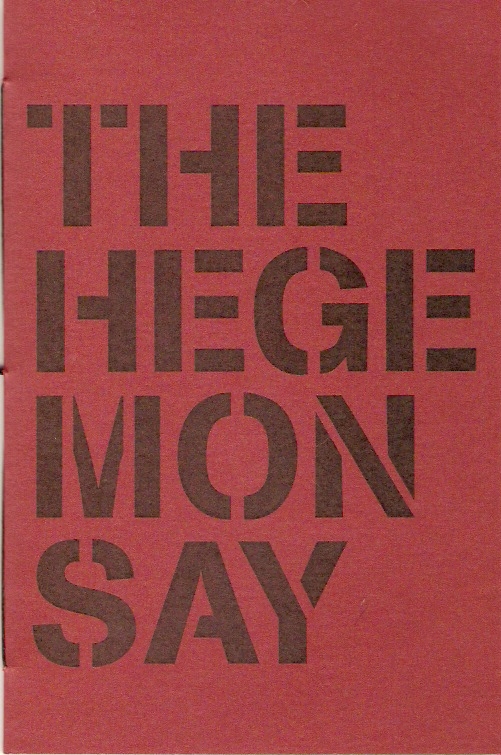
Imaginary Syllabi
Palm Press, 2011
Edited and published by Jane Sprague

Cover design and layout by Keren Cohen

A book-length project of contributions by multiple authors that aims to collect writings which investigate, uncover, examine, complicate, question, spoof, spark, incite, meditate, mediate, mix, sample, nettle, navigate, question, provoke, and otherwise (essentially) challenge pedagogical strategies pursuant to the work of teaching writing and other disciplines. This book includes writings which dream up, concoct and explore utopian, fabulist, fantasy syllabi for potential imagined or real classroom endeavors: Educational projects undertaken and employed (deployed) in and outside of official as well as mongrel “schools.” Official spaces might harbor (or cultivate) the mongrel & vice versa.

Material

• Sample syllabi that have been implemented or might/could be implemented AND the opposite of this condition: wholly fantastical stuff more suited to investigations in outer space and other sociocultural vacuums.

• Syllabi composed entirely of images or text or some combination of both. Syllabi may be scattered or comprehensive lists of pertinent, esoteric, weird or terribly useful URLs.

• Documents from classroom practices that were successful, compelling, disturbing etc. and which their authors wish to share, distribute, make known.

• Essays/Syllabi that mention other teachers and communities of teachers &/or documents, critiques, etc. &/or explore and extend the work of other teachers and communities of teachers, theorists, scholars, activists, revolutionaries, radicals, & intellectual insurgents.... There is no intended fixed, predetermined or official meaning attached in this CFW to the word “teacher”; “A thing which shows or points something out…”; teachers are sometimes not necessarily human organisms.

• Writings that disclose, assay, weigh the idea of the “syllabus” itself.

• Unimagined documents for unimagined learners among whom we could also group teachers / professors / instructors / mentors / advisors / and so on.

Questions?

The intent of this project is to spur and develop a sense of critical inquiry, partnership, collaboration, critique and rebellion that the final book object also aims to cultivate among and within its readers.

Contributors:

Danielle Adair
Piotr Adamczyk
Stan Apps
Cara Benson
CAConrad
Thom Donovan
Jim Duignan
Rob Halpern
Kevin Hamilton
Paul Hoover
Adam Katz
Dorothea Lasky
John Lennon
M. Simon Levin
Dana Teen Lomax
Kelly Marie Martin
Erin McNellis
Miranda Mellis
Rich Murphy
Laurie Long
Jennifer Nellis
Holly Painter
Erik Pedersen
Mirielle Perron
Kristin Prevallet
Elizabeth Robinson
Chris Stroffolino
Sam Truitt
Andrew Zawacki

Wednesday, January 05, 2011

"On Reviewing" (@ Lemon Hound)

Sina Queyras of Lemon Hound asked me to respond to her questionnaire about reviewing, which I gladly did:

LH: Is there a quality you are looking for in a review that you haven’t found?

TD: I think it is less that there is a quality in reviews that I haven’t found, and more a sense that the review, as a form of criticism, should whither. In fact, what I really want more of are forms of literature that enfold their critical reception, and especially their reception as it is inflected through community, friendship, and civic responsibility. What if the poetry book included the review (the blurb is an unsubtle device gesturing at this)? What if the book disappeared into its reception and distribution as, for instance, Tan Lin’s Seven Controlled Vocabularies seems to do in some ways. What if, in other words, the work itself started to constitute an act of meta-discourse that intends to present its role in exchange, community, correspondence, reception, distribution, and its complicity in all of these events. What if distributed authorship (or choral modes of criticism—a term I have been using recently to describe a recent trend within contemporary poetry) made the perceived object disappear, dissolved in a network of others, in becoming, in archive and collective performance and the desire for emergent modes and models of subjectivity? Perhaps, for many of us, that is what the poem already is. Though there is nothing announcing this formal quality through its context within a book, magazine, or wherever else the poem may be encountered. The problem I’m identifying involves a crisis of the media itself, which continues to ‘implode’ in relation to the US’s current oligarchic political system, but perhaps also points to the unsustainability of anything which does not acknowledge its connectivity through higher forms of organization, systematicity, and corporatization.

Tuesday, January 04, 2011

BOMB Interview with Adam Pendleton PDF

Here is a link to a PDF of the interview I conducted with Adam Pendleton for the recent winter issue of BOMB.

Saturday, January 01, 2011

Pod People—for Leslie Scalapino

Thinking, Leslie, of your favorite movie—Invasion of the Body Snatchers. I have often revisited this film, Philip Kaufman’s remake of Don Siegel’s original, wondering why it was your favorite movie. The film begins with these gauzy, cotton objects drifting in outer space (the pods!). They are making their way to planet Earth—San Francisco to be specific. There they will undertake their ‘invasion’ by releasing a substance into the atmosphere. A substance humans/citizens will take into their lungs while they sleep, mind-altering like a psychotropic drug redolent with late-60s utopian longing. This film, released in ’78, looks forward and backwards. Backwards at the socio-political struggles of the 70s, of which I consider you a part—and the environmental movement in particular (in the film the would-be protagonists, Donald Sutherland and Brook Adams, work for the EPA). Forwards to a particularly dystopian decade, the decade in which I grew-up replete with Reaganomics, late-Cold War imperialism, culture war, and the replacement of erstwhile public servants and citizens with ‘pod people’—people seemingly soulless; an exaggerated version of the people our public institutions and policies would often seem to want us to be. The backdrop to all of this, like in the Dirty Harry movies also set in San Francisco, are these residues of social progress and struggle, forces represented by the counter-cultural non-conformism of Jeff Goldblum’s character; the flakey pop-psychology of Leonard Nimoy; and the subtle, yet inevitable, romance of Sutherland and Adams. Like the pods of Invasion of the Body Snatchers something threatens our humanity essentially. Only this force, mediated by the film, is not from outer space, or even really from outside us. And it is this fact to which your own work bears witness, phenomenalizing it through a syntax which gives form to the primal rupture between ‘inside’ and ‘outside’—where ‘person’ begins and socius ends; where interiority becomes radicalized by an external pressure of events, if not an empathy which overwhelms any account of individuality without exteriority (the need for friends, compatriots, lovers, neighbors, countrymen; the encounter with those inexplicably and mundanely ‘other’). What I am saying—something I would like to say, rather—is that conspiracy infuses your work, rendering it potent. A conspiracy, on the one hand, which threatens the social frameworks and communities through which ‘we’ have no choice but to exist. And a conspiracy, on the other, of knowledge that any interior is hopelessly dependent on the irrevocable connection of all beings, a fact underlying your particular brand of Buddhism, and your commitment to Gertrude Stein’s experimentalism, and a landscape exceeding in its reality any visual or aural description one can make of it. The pods, and the pod people, and the network—the original ‘social network’ called city—partaking of ‘us’. Dear Leslie, who invented an uncompromising grammar—a daring language practice—to embody our ceaseless correlation and conflict.