--for Eliza Newman-Saul
Use your hearing to see.
Then should we say, “Do you tear that”?
*
Alter this color blue without touching it or seeing it.
Put it elsewhere.
If blue can not be put here, put it here.
*
Each thought is a vestment rolling upon another vestment, opening.
Fold your thoughts as many times as possible.
*
Through the other side of everything you see.
*
Zoom.
*
In
*
Your eyes are not flashlight beams or headlight beams or spotlights or X-rays or animated gifs or surveillance devices or GPS satellites or cell phone headsets or distant video monitors with the contrast all wrong or torn billboards or a dissolve to white.
Your eyes are ___________________________
*
Thicken your ears.
Like concrete.
Like cake.
Like come.
Like money.
Like resemblance.
*
Before you think – hear.
Before you hear – think.
Before – you think hear.
Before – you hear think.
*
Fail to be similar.
*
Fault every union for despair.
Doubt empathy totally.
Criticize continuity.
Hate hate.
Fuck fucking.
*
Feel a function of thinking.
Imagine such a function without thinking.
*
Your eyes are convoluted (tied).
Your eyes are pink.
Your eyes are tweezers.
Your eyes are little Gods.
Your eyes get fucked when they see.
*
You are the glass our lips both kiss.
I am the fog on that glass.
We are the glass shattering but not the fog clearing-up.
Our eyes, like dreams, are made of milky blackness.
*
Preliminarily believe.
*
See “dream-images” near to eyes (30 cm.) and everywhere else.
See smoke aswarm with fear, “the primitive gloom”.
*
You are the glass our lips both kiss.
Remove these lips but not the glass.
Do not stare into this glass.
*
Stage each degree of being…
each devil, each name, each moment of history.
“The primitive gloom” and a conative light.
*
Fail to be different.
*
Put it here.
Hear it put.
Put put.
Hear hear.
Here here.
*
Reach inside inside.
Reach outside inside inside.
*
See through the other side of everything.
*
Preliminarily disbelieve.
*
Believe in belief only.
Doubt to believe.
Believe to doubt.
*
Put it there.
There there.
*
Picture a vacuum. Vacuum a picture.
*
Think with your ears.
Thicken your eyes.
*
THHIIIICCCCCKKKEEN.
*
Hallucinate the literal.
Hallucinate the littoral.
Hallucinate the clitoral.
Hallucinate the pictorial.
*
Compose for an hour in a minute.
Compose for a year in a second.
*
This color has no name.
*
Pretend your body can occupy no space.
What would this look like?
Draw a picture and bury it.
Call this place of burial the place where nothing can be put in space.
Call your body a sudden resting place.
*
Think of a correspondence between a color and a place.
Name this correspondence differently then both the color and the place.
*
Ignite the space your body can’t occupy.
*
The sun is a giant cataract.
Catamarans seem to float in the sun.
There is nothing similar about the sun and a catapillar except when we can see the solar sea.
*
Die. Cry. Spy. My. Arrive. Pie.
*
Divulge the true name of this sentence.
Change this true name and don’t divulge it.
This too is an event of conscience.
*
Believe in the value of this sentence.
*
As if… night were not upon you.
As if… you were all of the same substance.
*
Real people are actually ghosts.
Actual ghosts are blurry shapes.
Blurry shapes are often letters.
Letters are ceaselessly meaningful.
The ceaselessly meaningful is only real.
*
Make these words disappear.
This word, in particular, has no sense.
Blind the rest of the world for one second.
Imagine nothing then and only then.
*
See and hear nothing.
Be nothing.
Nothing nothing.
Be near nothing.
Nothing near.
Never.
Nearer.
Hear the clear light.
Make the voice in your head heard aloud as constantly as possible.
*
This ringing.
*
Play alive.
*
Nearer Nearer Nearest.
*
Have no image of yourself that is not the image of everything else too.
*
Move in time to move time.
*
Move time without time.
Move time without space.
Move space without space.
Move space without time.
*
to move time.
*
Hear shadows, the flaying of the sea.
*
Pretend a sea never existed to be seen.
*
lay live
*
“Is only real” “people are ghosts”.
*
Nothing as something.
Something as nothing.
Something something.
*
Through the other side of everything you see.
Thursday, April 06, 2006


What Tomb (Some Questions for Matt Mullican's Bulletin Boards)
What pictures.
What pictures have in common.
What pictures death.
What fingers of dying.
What describes them.
What fingers of decomposition.
What poses made of light.
What is a pose and what is a picture.
What is the difference.
What has only transcendence.
What has no transcendence.
What is the lightness of dying.
What is a picture of death.
What is a picture of a corpse.
What is a picture.
What is only a picture.
What closes the eyes.
What eyes close.
What shudders.
What shudders when eyes are closed.
What distrusts eyes.
What eyes distrust.
What distrusts real eyes.
What makes death.
What makes dying death.
What makes eyes.
What desires.
What eyes desire.
What desires death.
What does death desire.
What is so like a tomb.
What is frozen.
What tomb.
What seems most like time unfreezing.
What seems most like time frozen.
What seems time freezing.
What is seeing.
What is seeing like.
What is seeing like when it is not like seeing.
What is seeing when it does not see.
What is to see.
What is a preparation to see.
What is having seen like.
What preparations do we make to see.
What preparations to have seen.
What do we do when we are not seeing.
What do you call one then.
What then does one call seeing.
What pictures have in common.
What pictures death.
What fingers of dying.
What describes them.
What fingers of decomposition.
What poses made of light.
What is a pose and what is a picture.
What is the difference.
What has only transcendence.
What has no transcendence.
What is the lightness of dying.
What is a picture of death.
What is a picture of a corpse.
What is a picture.
What is only a picture.
What closes the eyes.
What eyes close.
What shudders.
What shudders when eyes are closed.
What distrusts eyes.
What eyes distrust.
What distrusts real eyes.
What makes death.
What makes dying death.
What makes eyes.
What desires.
What eyes desire.
What desires death.
What does death desire.
What is so like a tomb.
What is frozen.
What tomb.
What seems most like time unfreezing.
What seems most like time frozen.
What seems time freezing.
What is seeing.
What is seeing like.
What is seeing like when it is not like seeing.
What is seeing when it does not see.
What is to see.
What is a preparation to see.
What is having seen like.
What preparations do we make to see.
What preparations to have seen.
What do we do when we are not seeing.
What do you call one then.
What then does one call seeing.
3 Disassociations

For Matt Mullican
1.
To pin
down the finger
in its own skin
would close
our eyes
if the eyes would
how we consent
to pin down
a mode of pins.
Bulletins.
Bullets.
Ken.
2.
Close the eyes
light dark
toned
brightened refract
in spoons reflect
on shield
for certain a move
of eyes
in the painted
nears an object
of photography
let’s pretend
tend to
sit, still, while,
the world ends—
O another re-
flection, and O an-
other,
close your
eyes
for this world.
3.
Nature morte,
more your grim,
ace moves, or
tower, pinned
down, caption,
swells tongue,
more like a
gum, the blotter,
gummy
guns, of these
eyes,
bleed, a,
patina,
frost webs, meets
its own,
swelling maker,
wholly, twisting
like that,
frieze, gum,
to twist guns,
to hidden consequences,
turns, insider
of light,
or dark tons,
the movements of,
tuning the of,
of no longer,
for,
the light
in these trees,
accreting, those,
synapse below,
rage node lower,
attention range
brown noise,
limbic note,
liminal,
limn, signs
syncope
pictures,
to attention,
you really,
pin me,
an image
if I can’t think of
an image,
nor for then,
you, it is you,
I think of,
then,
not a
place as imageless,
as sex,
less
with fingers,
a kind of death,
a kind, death
in your sexless,
mouth man,
a part, the prose
rotting away,
the intimate, narrowness,
of hidden all,
in reflection,
chills, reflect
almost,
whiter,
like having,
they are almost like,
having, the world,
morose, or it is done,
with remembering,
done for,
distraction,
by disassociation,
the fingered, guilt,
of a blotted,
guilt,
a,
cross, me,
my less,
in, description,
blots,
too content,
to consent,
light,
a privilege,
gums
a twist,
to tongues,
the, print,
and smudge,
it singly,
pin,
discolorment
not,
in history, whiter,
of the subject,
fuzz stillness,
to have,
history,
all of the,
space of these eyes,
psyche,
to die for,
in this tree gazing,
between, we keep
things for the,
sunny,
towers to not,
see,
to see not
Friday, March 31, 2006
Antonioni (a point of indiscernibility)
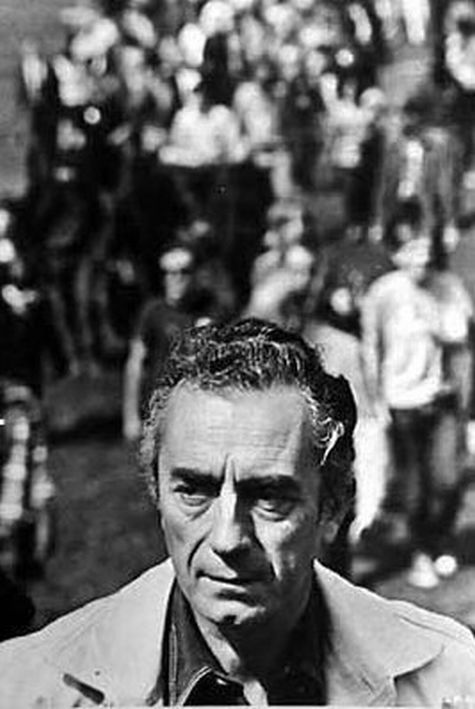
Across Antonioni’s filmmaking, there is a recurrent moment of perception that may allow us to reflect on an emergent imagination after cinematic images. I believe that Gilles Deleuze touches on the potential of these perceptive moments when he considers Antonioni’s filmmaking in terms of what he calls “any-space-whatever” and Op and Son images in his *Cinema 2*:
"As for the distinction between subjective and objective, it also tends to lose its importance, to the extent that the optical situation or visual description replaces the motor action. We run in fact into a principle of indeterminability, of indiscernibility: we no longer know what is imaginary or real, physical or mental, in the situation, not because they are confused, but because we do not have to know and there is no longer a place to ask. It is as if the real and the imaginary were running after each other, as if each were being reflected around the other, around a point of indiscernibility."
The scenes of “any-space-whatever” that most interest me in Antonioni’s films, and which I would like to appropriate for this project, are ones construed too easily as hysterical. Beyond a clinical or “common sense” diagnosis of hysteria, the bodies of many of Antonioni’s most significant characters may be telling of a condition of psychic-bodily dissociation related to our present post-cinematic condition. What is sense and where is it located in space when the image one has of bodies related in space is elsewhere: withdrawn, discoordinated, psychastheniac (Roger Caillois)?
Continually this is the question I ask myself watching Antonioni’s films until his post-’68 work, Zabriskie Point (1970). Curious as a film after American counter-culture and social movements in the late-60’s (and not so different than any numbers of films in this regard: Hal Ashby’s The Landlord, Peter Watkins’ Punishment Park, etc.), Zabriskie is of particular interest to me as it presents a clairvoyant and senseless imagination in the face of social despair and political-judicial distopia -- the “states of exception” of the late-60’s/early-70’s American polis and a “globalizing” polis now.
Like any number of Antonioni characters, the female protagonist of Zabriskie puts the viewer into an ambivalent situation of perception, a point of indiscernibility (Delueze), in the final scene of the film: is she a terrorist in actuality, or does she only imagine the detonation of a bomb at the hotel? How does this scene form a mirror for the perceptive lapse earlier in the film that forces the viewer to adjudicate whether the male protagonist has in fact shot a police officer or if he is merely a hapless innocent? Moving from a meditation on such images shall we consider particular tactics for revolutionary violence not in terms of sensory-motor coordination achieved in purposive movement, but in terms of an eidetic imagination imminently destructive in virtuality *and* reality inasmuch as the real is increasingly determined by the virtual? If this project risks creating a critical fiction it does so only to mobilize factuality towards a new situation of demonstration and thought we currently bear witness to in the wake of “Terror” and other geopolitical quilting points.
Annunciation (Arise to Descend)*
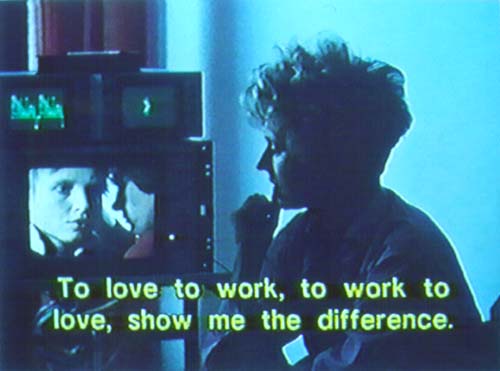
Or why are we still working in this factory?
to Sasha Steensen
To come down by a movement in which gravity plays no part. . . . Gravity makes things come down, wings make them rise: what wings raised to the second power can make things come down without weight?
– Simone Weil
A pleasure to work
The stutter
The very veil of gravity
Do not fail me
Now these
Second wings
Work is a pleasure
To lovely
Innocents
Work is a pleasure
Blue work
No separate
Love
Of video monitor
How we really
Talk beauty
To make money
To make movies
To make money
The way we move
Blue collar blue
Of virgin pleasure
Huppert with
Hair cropped
The other
Like Falconetti
When is the face free
Of this feeling
When of this
Pain second
Wings to stutter
Of Weil verily
Moon bluish-white
When will we
Descend from
Lofty denials
From ascetic skill
Monitors of
Bourgeois pleasure
Work is pleasure
Don’t distinguish
Work from pain or love
To make money
To circulate power
Of this desperate snow desperate winter
Of this monitor
Design alights
Promising Delacroix
Such wings
The working sing truly
Arise to descend
On second wings
The working
The unworking
Sing truly
Will beyond will
Blowing harmonicas
The beginnings of sing
Beginning sound
Track
Beginning sound
Track beginning
Traces
Of blue rewind rewind
Defer a moment on
This unshepherded snow
Shadowing pleasant tolls
Our pleasure to work
Beginning with
This poverty of love
The fullness of love
Pleasures of debt
Blue makes everything
Seen and soon
Heard in this whistling
Track this harmonic noon
Heard by this harmonic blue
Difference between boss
And worker
Difference between
Factory and tv
Matters of these second wings
Descend arise
Point to pleasures of sky
Sky blue with no one trail
Noon shaped by silhouette
And love why are we
Separate
And why don’t we turn
Why do we
Still work
In this factory
Do we still love
The sight
Of paint as it lights up?
*composed Spring '05.

Subscribe to:
Posts (Atom)