Monday, December 12, 2005

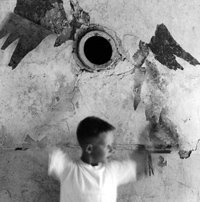
Meatyard, my neighbor*


23.
Nor will I sow joints.

Joints of flesh, joints of
wood
what wainscot cites.

Nor will I reap
enfeebled bones.


24.
A joy!

A joy to bake on the rock of Lazarus!

Living being a free-fall.


26.
There are holes
in the sky
almost like clouds.

The clouds of hell
I command
clandestine young thing
of flame and wing

we must be
subterranean,
our verses must
and unbind
many points in space.

These holes weren’t
punched by logic,
yet we can’t deny
they are there.

And we are here…
our arms make
penumbral the
presuppositions
of a time-based world.

There is
a difference between
a sky light
and a radiant hole.

Since one day
we will fly
flung by
our tearfulness.


27.
I sing thee two exposures, three masks of leaves.
For eternity, this motion waits on our poses (rounds of choice appear)

Tree of appearance, tree of barren knowledge
These free-falls know no expression.
A depth of field yields terminal views.


28 / 29.
Torsion a
pony

-tail whips rigor

mortis
of motion.


Torsion a ponytail

whips rigor mortis

of motion.


30.
Freeze frame of
the frozen retinal

“The mind”
breaks sound
barrier of these branches

Each one a false view of the thing.

No more do we hear
rational
in pastoral

than we touch
logos in ghosts

Seeing them for the trees

dark “beams” a mind
of black & white

breaks barrier of sight.


30.
The fly
a
buzz
in my iris.

A shaft
stuffed
in astral
ears.


34.
Only sometimes does death choose us.
Only sometimes breath


39.
A hazy absolute

a/k/a: the “all all”,
a/k/a : “the the”.

No such Elysian (But as the eyes have it)

The eye grows hazy
not wanting

once more to give up the world,

the “real world” again.


44.
Kiss me

I am young and
not young.

You are faceless.
Your total back

gives me the face.


49.
A little tear in the eye.

My thesis sticks to light.

It tells us nothing
of where we are looking
or where we are

(these dark
room ontologies, these bad
brains).

Tear the foreground first

then remember

a sliver of light motion misapprehends.


55.
Bardo is my business.

No kidding

Don’t be afraid of losing your invisible limbs (spectral analytic).

There are still solid things to guide you, material to purchase.

Where to start?

Not being a real boy.

New organs are new notions.


56.
This dream-state of erasing and erasing
(if it is a dream-state at all)
can no longer hurt you.

These leaves have grown up with us.

We take full responsibility for the bite-marks.


56.
Autopsy of an x-ray.


59.
What the fuck?

Why is the world so heavy,
and me so light.

My so called solid hands.


60.
This is
the moment
of lightness
I live for

(discontinuously dying to live).

Alighting –
the wings of
the world

gazing
through each instance,
each instance gazes
through you.

Dear view finder…
Who is an angel NOT of history?


62.
Would it be rude to peer into my tongueless mouth the absolute?


68.
Mutants, we are all pure forms of maternity.

Cathedrals and
camera

obscuras

her hair
aglow.

Not quite an apocalypse.


68.
This umbilical kiss.
The light no longer can conceal.
That unacknowledged world.
Hush now, Plato.


85.
Craving a plausible
shape for the dead and not
in fact a voice.

What were you expecting?

Night is quick to rise and
covers the obelisk

Secrecy being
the first form power takes.

Plotting your return to the living
what is it you see

more curious than frightening?


86.
These mannerist endgames

(we play anyway).

The game of pastoral, columns, perspective (

prospective surds
)

(Nor were these cities ruined in a day.)

Thin wires
(optical chiasm) chiasmus

strip sense of thing.


88.
A white wall may be the world's end.

For Melville.

Overwhelming pictures.


101.
Ill Cyclops, my filament?

How can you just float there

like that.

Always a light
source, never
a god.

There will be no words for what you dream

(random sound-image).

No worldly
eyes for the transmigratory.


114.
You dig.

I dig.

This blur.

*composed September-November '05. To Brandon Stosuy.

Does matter have eyes? (towards Smithson)

Does matter have eyes?

Is there a vision of matter, that belongs to matter its self?

Maurice Merleau-Ponty, in his late MS., *The Visible and the Invisible*, recognizes that all matter, organic and inorganic, sees, and that the "subject" so-called is located in relation to this inordinate, ongoing gazing.

The subject is only a subject as it gazes and is gazed at, and partakes of a common gaze that is the gaze of the created, Univocal or 'General Being'.

This mutual gaze of 'General Being', the gaze of all emergence, is neutral, true in and of itself, a universal form of power or power dispersed (& Foucault may recognize such an ideal economy of power in Benthem's project for a Panopticon)

What I am concerned with after Merleau-Ponty is a radical mutuality of the gaze extended to the sensorium in its relation to nervous system / mind, a mutality called 'General Being' and recognized in 'chiasmic' relation. Interpenetrating, intussuceptive -- however both terms seem inadequate, not radical enough. The best image of chiasmus may not be an image at all; but pre-cognized (ek-cognized?) by the one who, touching their self, loses the self at an edge where the self as thing and as reflective consciousness blend indefinitely. The result is a blindness. The blank of simulatenously cognizing the sensible and insensible in one other.

In this mutuality all beings emerge and exist, being for and in themselves. "Subject" / "Object" radicalized beyond cognition. Can we imagine this mutuality comprising a film; a total film, a view of all views, that can never be seen except in some never realized eternity? Which are yet, practically, for the purposes of memory and action, always present... Virtually present?

*composed September '05

Saturday, December 10, 2005

"Art is ethics by other means" (review)


This past Thursday, Dec. 8th I attended an event at PS1 celebrating the recent “visual issue” of The Believer. Here is a cross-section of a review I started writing:

Leading up to Matthew Ronay and Brandon Stosuy’s live “interview,” Eric Fischl extemporized on the “death of painting,” beginning with the observation: Vincent Van Gogh cut off his ear and made a self-portrait of himself afterwards and the painting was considered art; approximately a century later Chris Burden had an assistant shoot him in the arm with a rifle and this action, and not its “documents” and reliquaries, was instead considered the work of art. Throughout his presentation, Fischl proceeded largely by surveying particular sculptural and painted works and considering an evolution of painting and sculpture towards their dematerialization (or “death,” as he referred to it) and works after. Where I thought Fischl was connecting some interesting dots, he seemed careful or unwilling to draw conclusions during his talk, putting forward instead questions and conjectures that “interested” him.

Fischl concluded his presentation with some remarks about the current “state of art” (and NYC-based visual art in particular) post 9/11. His moralizing finale was both traumatic and pedestrian: artists failed to respond adequately to 9/11, to take “action” through their work, and this failure represents a "paradigmatic shift" in art’s claim to a moral and/or political efficacy. In response to Fischl’s conclusion the artist and self-proclaimed "amateur materialist” sitting beside me, Eliza Newman-Saul, conveyed a more radical conclusion, one that may go productively against the grain (and the refrains) of ongoing assessments of that “disaster”: that merely siting a “paradigmatic change” after 9/11 obviates the critical imperative to investigate the event’s historicity, and History itself as both a synchronous and diachronous procession. Or, in other words, that there is in fact no “paradigmatic change” nor necessarily an “event character” about 9/11 in its relation to “art,” but only, perhaps, what Barrett Watten calls "bad history": history traumatically cathected by the dialectical “blindspots" and "traumatic kernels" of a truth content neither arbitrarily unprecedented or absolutely discontinuous.

Where Fischl presented a moral response to art after 9/11, coincidentally Ronay / Stosuy presented what I took to be an ethical or ethological one. So much depends upon the distinction. Beginning with clips of football injuries in which one could see knees fully dislocated from their joints and legs hanging from their ligaments, Ronay proceeded mainly to address his own work after 9/11. His conclusion: artists tended to “internalize” the event and in turn responded by making work around problems of “death,” “sexuality,” and “the body”. As Ronay admitted, these are problems of “existential” concern; but they are also “ethological” ones insofar as they investigate “what a body can do” (Spinoza) and what one is capable of believing in (Deleuze’s Philosophy should give us something in which to believe qua Art should give us something to believe in). As Stosuy fed Ronay leading questions, the artist continued to ponder “love” and “hedonism” during a time of “empire”. Should not love have to account for, even provide for, “anal cupcake beads” -- the artist cunningly asked. Ronay’s work, a work I have only recently become familiar with, seems to present questions concerning the production of bodies in relation to a cultural “imagination” and a “real” both radically profaned and spiritualized. This chiasmus of the imaginary and the real may account for a work of Ronay’s in which one sees the plastic representation of a dog’s backside observing the dog’s genitals to be in the shape of a young girl’s. Ronay’s world thus seems a plastic one in which actuality has given way to the "virtual" in a material form.

If not for Fischl’s moral claims after 9/11, I could see the artist struggling to make a point similar to Ronay's in his presentation, where his constellation of 20th century works of art culminated with pics of Paul McCarthy’s own cartoonish sculptural monstrosities, and the haunting flockings of the Chapman Bros. sexualized and ambigendered children: that the flip-side of events like the torture of prisoners at Abu Gahib -- and ultimate degradation of the body torture always entails -- is an ongoing proliferation of hellish and disorganizied bodies in the "American"-Western imagination. If we can make a basic distinction between morality and ethics we might say that morality attends the “ideal” while ethics does the dyad “real” / "unreal" – the fluctuating conditions of bodies, of relations and fields of force.

The scene of Ronay / Stosuy unflinchingly encountering pornography, pedophilia and extreme bodily states presents the problem of the “real” where moral prescription a la “artists should have done something else after 9/11” will continue to fail. Never is there the moral imperative of “something else” (not even after the most despicable acts of humanity to which, I might add, 9/11 can hardly compare) but only historical consciousness always trying to keep pace with events in the world and tragically lagging behind (or retrospectively pressuposing them, as the case may also be). The final irony of Fischl’s talk may then be his devotion to the sensitivities of artists, which makes me think that it is not the individuated artist who fails, but the society of which she partakes. Art is ethics by other means insofar as the artist may present the problem of this failure and a culture may struggle to participate in this presentation and make conscious to itself what is being presented.

The final presentation of the evening was given by artist Cory Archangel. Archangel’s performance may serve as a kind of third party to Fischl and Ronay / Stosuy, where I have always found the artist to chase his timely critiques of art trends in relation to electronic culture with an endearing and effective showmanship.

My first glimpses of this crucial balancing act in Archangel’s work were taken when I knew him as a student at Oberlin College. In addition to presenting numerous videos and tape pieces with his collaborator, Paul Davis, during their junior recital in Oberlin’s music conservatory, Archangel concluded the recital with a simple yet radical lesson. Using an obsolete Apple software called Lisa, and addressing his audience thru a “real-time” video feed, Archangel revealed the software’s coding to the audience. He proceeded to explain how binary code works to encode information -- and specifically information pertaining to licensing and copying permission -- and, for his final trick, pointed to a particular moment in Lisa's code where one could turn the copy protection on or off.

The activism and didacticism lurking behind Archangel’s deceptively self-evident projects were pervasive during the period we overlapped at Oberlin (1996-1999), and especially among a group of students actively investigating questions of emerging media: Archangel, Jacob Ciocci (Paper Rad), Jen Liu, Laboratory Theater and Ray Sweeten to name just a few. I found the spirit of these investigations to be in full effect the other night as Archangel performed the not-so-simple (as we were all too learn) action of closing his Friendster account (and thus, in his words, committing online “suicide”).

What struck me again was how a relatively routine action could become an important object lesson in the pragmatics and metaphysics of electronic media in Archangel’s hands. If there is a trick to Archangel’s didactic performances it is likely the very opposite of the one used by con men in the three card monty, where the artist's conceit is not in making the card appear where it did not seem to be, but in revealing that which we imperiously keep track of but so often can not recognize in its value and significance. Artists often talk about their work as being “participatory” or “democratic”; Archangel’s art is genuinely participatory and popular where the majority of art that intends participation and democratic-populism fails. The evidence is not in the show of hands from his audience or a gratuitous Q&A, but in his audience’s frequent shouting out of instructions about how to use technologies constitutive of their common experience. It is in recognition, a recognition that goes back to an ancient "state of the art": that we use technology, but that technology also uses us; and this mutual using reflects real conditions of experience and appearance.

After countless interruptions, technical difficulties, digressions, shaggy-dog stories and witty banter the actual moment of deletion was once more prolonged by a survey requesting Archangel’s reason for deleting his account. To which he typed (not without typos and excessive exclamations marks): “the advancement of artistic performance”. Indeed!!!!!!!!!!!!!!!!!!!!!